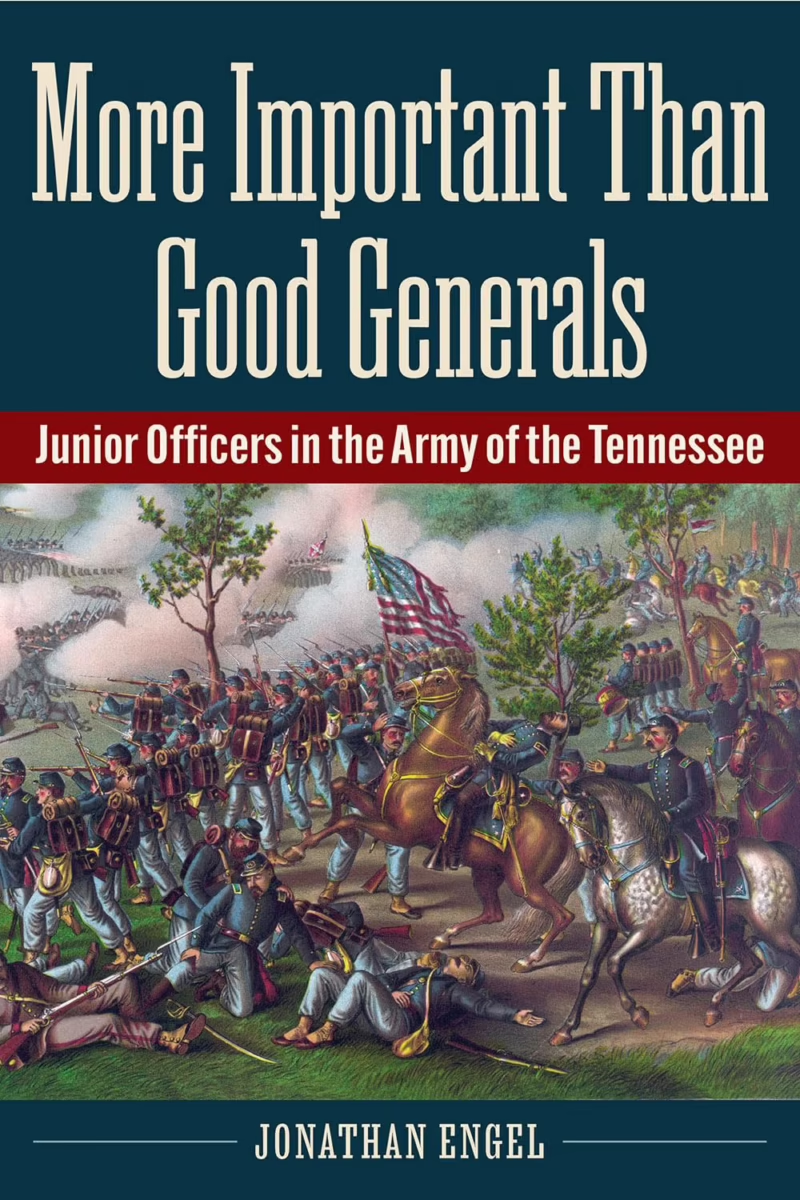
Sherman’s famous crack about good corporals and sergeants mattering more than good generals has always been a convenient line for anyone wanting to justify a study of the men below army command, and Jonathan Engel puts it to exactly that use here. His subject is the regimental officer corps of the Army of the Tennessee: that is, the rather narrow scope of captains, lieutenants, majors, and colonels who led companies and regiments in that army, rather than the planners of operations and campaigns.
Engel is right that this tier of leadership has been comparatively neglected next to the biography-heavy literature on generals and the now-substantial body of “common soldier” studies. However, several works have appeared in recent years on this very subject, and while new work on mid-level military leadership is always welcome, to call junior officers “under-studied” may not be entirely accurate (6). Moreover, the author addresses essentially the same rank and the same core questions (motivation, culture, the transition from civilian to soldier) that these other recent studies have already done to one degree or another, but with a highly focused approach. The result is a useful if uneven book.
The most basic issue with Engel’s study is the evidentiary sample itself. Engel admits up front that he abandoned an attempt at a truly scientific sample, and while that level of authorial candor is refreshing, the 481 officers he ends up with are, by his own account, simply whoever left behind enough letters and diaries to be usable. In fairness, all historical evidence is self-selecting to a degree, but a sample built on survivorship of paper—and not on a systematic effort to represent the junior officer corps as a whole—skews Engel’s findings from the start.
This creates problems. When Engels tells us, for instance, that officers “emerged from the conflict with their moral and political worldview intact,” the claim is only as strong as the evidence that can sustain it (223). Engel’s letter-writers self-selected for exactly that kind of narrative coherence; the officers here were precisely the kinds of literate, well-connected, politically engaged men who wrote long, reflective letters home. Officers like these are therefore overrepresented in Engel’s sample, even among the generally better-educated and more privileged literate body of Civil War junior officers as a whole.
Engel also leans on uncontextualized data more than once, as with the author’s observation that only three officers in his sample mentioned overseeing target practice. This is an anecdote treated as a finding, when it may only reflect that those three specific officers thought something like target practice was worth writing home about. Other statistical miscues are scattered through the book. The claim that one in five sampled officers died in service, with only 12 percent of those deaths arising from disease, is presented as a striking finding, but Engel offers no real comparative baseline for us to understand what this might really mean. There is no side-by-side figure for enlisted mortality in the same units; no comparison within or among regiments, brigades, divisions, or corps; no discussion of whether Army of the Tennessee junior officer casualty rates were unusual compared to other armies or across the Union army generally; and no acknowledgment that the officers in a study skewed toward the war’s later, harder campaigns would naturally show elevated combat mortality or attrition connected to contemporary circumstances.
The lack of comparative approach is a problem in the book. Engel, by his own admission, studied just one army, and it was an unusually successful one at that. Without a counterweight like the eastern Army of the Potomac, or even another successful western force like the Army of the Cumberland, there is little telling how much of what he describes is a trait of junior officers generally, how much is peculiar to the Army of the Tennessee, and how much is simply what a consistently victorious army’s leaders sounded like. There is almost no meaningful comparison to Confederate officers.
Structurally, the book’s organizational scheme poses challenges and tends to dilute its argument. Chapters move between administrative duties, ideology, race, discipline, and attitudes toward Grant and Sherman without much sense of a cumulative thesis or with a temporal or chronological scheme. Each section reads as a self-contained mini-essay rather than a building block in a larger argument about what made this officer corps distinctive or historically significant; it is difficult to get a sense of change over time.
Finally, one of the book’s most interesting nuggets, the total absence of formal officer examination boards in the Army of the Tennessee, gets a mere handful of pages. Given how directly this bears on the quality and professionalization (or lack of it) of Civil War volunteer officership, Engel’s study would have been well-served by a sustained investigation into why such boards never took hold in this particular army.
For these reasons, readers are encouraged to approach Engel’s conclusions as suggestive rather than dispositive, to be tested against different armies and different contexts. Devotees of the Army of the Tennessee may find this study of use in understanding that army’s field leadership. Readers interested in racial, ideological, and political attitudes among junior officers would be wise to read Engel in concert with Kristopher Teters’ Practical Liberators, Jospeh T. Glatthaar’s General Lee’s Army, Zachery A. Fry’s A Republic in the Ranks, or my own Citizen-Officers. None of these criticisms, however, should erase Engel’s real contribution—or the fact that the Civil War’s junior officers continue to merit serious scholarly attention.
Andrew S. Bledsoe, a professor of history at Lee University, is the author of Citizen-Officers: The Union and Confederate Junior Officer Corps During the Civil War.