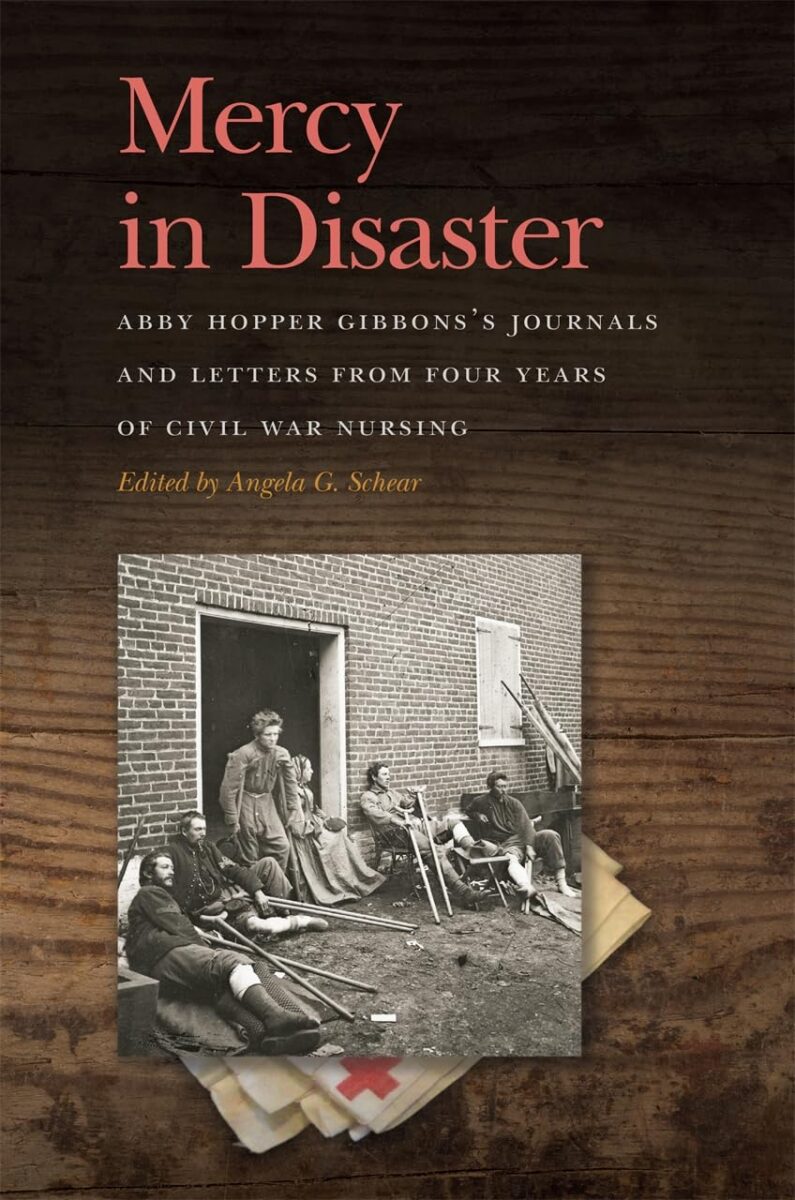
The U.S. Civil War cannot be adequately understood through its military history alone. In recent decades, scholars have worked to amplify the voices women and other historically marginalized groups in their accounts of the conflict. In Mercy in Disaster: Abby Hopper Gibbons’ Journals and Letters from Four Years of Civil War Nursing, editor Angela G. Schear presents the wartime writings of Abby Hopper Gibbons, a devout Quaker, staunch abolitionist, and volunteer nurse who devoted her life to social reform, activism, and humanitarianism. But this thoughtfully edited collection of writings is more than a compilation of journal entries and letters. The book illustrates the emerging role of women, the evolution of medical care, and the fight for freedom and civil rights for African Americans during a time of war and social upheaval.
The book begins with an introduction by historian John J. Hennessy, who provides a superb overview of Abby Gibbons’ life and achievements. Next, Schear details the editorial method she used to transcribe and annotate the original sources. Eleven chapters follow. Each begins with the editor supplying important historical context for Gibbons’ experiences.
One of the greatest strengths of this work is that Gibbons’ writings capture the harsh realities of wartime hospitals and the limitations of medical care during the conflict. In her writings, Gibbons details overcrowded hospitals and rampant disease, such as typhoid fever and consumption. Inadequate supplies were a major issue, and Gibbons writes to her husband, brother, and children several times throughout the war requesting urgently needed supplies. Gibbons also details the emotional toll of being a nurse and describes the grief and anguish of being surrounded by death. These vivid descriptions of the war remind scholars that the trauma of the war reached well beyond the battlefield and combat actions.
Another strength of this work is that Gibbons’ writings provide insight into the experiences of women during the war. The Civil War transformed the role of women in society, and Gibbons writings evidence this transformation. Although Gibbons was limited by her era’s Victorian ideals and gender ideologies, she was able to exercise significant authority and independence as a leader in the hospitals where she volunteered. Her letters and journal entries show that she organized and managed skillfully resources and activities in the hospital throughout her four-year service as a nurse. Gibbons interacted with male military officials and surgeons as a near-equal, and she often stood her ground when her decision-making or personal convictions were challenged—even if she violated military or social protocols in the process.
In one case, Gibbons defended an African American hospital cook when he was charged with selling meat to a soldier. After aiding the cook and successfully proving his innocence, Gibbons was summoned by the surgeon-in-charge, who promptly tried to dismiss her for advocating for the cook. Gibbons resisted the surgeon’s accusations of any wrongdoing and demanded that her dismissal be put in writing. Gibbons defiantly stated that, “I have the ear of Senators, and members of the House—of the Secretary of War, and the President—you shall feel this” (83). The next day, a doctor explained to Gibbons that she had “transgressed a military rule” (83). Schear acknowledges in a note that male surgeons commonly complained that female nurses were not familiar with military rules. The surgeon and Gibbons met again, and a resolution between the two parties was ultimately achieved.
Gibbons’ writings make clear that female nurses operated in an environment that was foreign and sometimes inhospitable to them. Women’s wartime service blurred the boundaries between women’s traditional roles in the domestic domain and their burgeoning roles in public and political spheres. Gibbons’ writings also show scholars that women were not a monolith, and that they often disagreed about what was “proper” for women in society. Gibbons’ disagreements with Dorothea Dix, another prominent female reformer and social advocate during the war, for example, are detailed throughout Gibbons’ letters and journals.
In sum, this book presents a valuable new collection of primary sources that will be useful to scholars of the Civil War—or anyone interested in the history of medicine, nursing, women, or social reform movements in the mid-nineteenth century United States.
Brittany Gregory is a graduate student in the Department of History at Sam Houston State University.