 John Banks
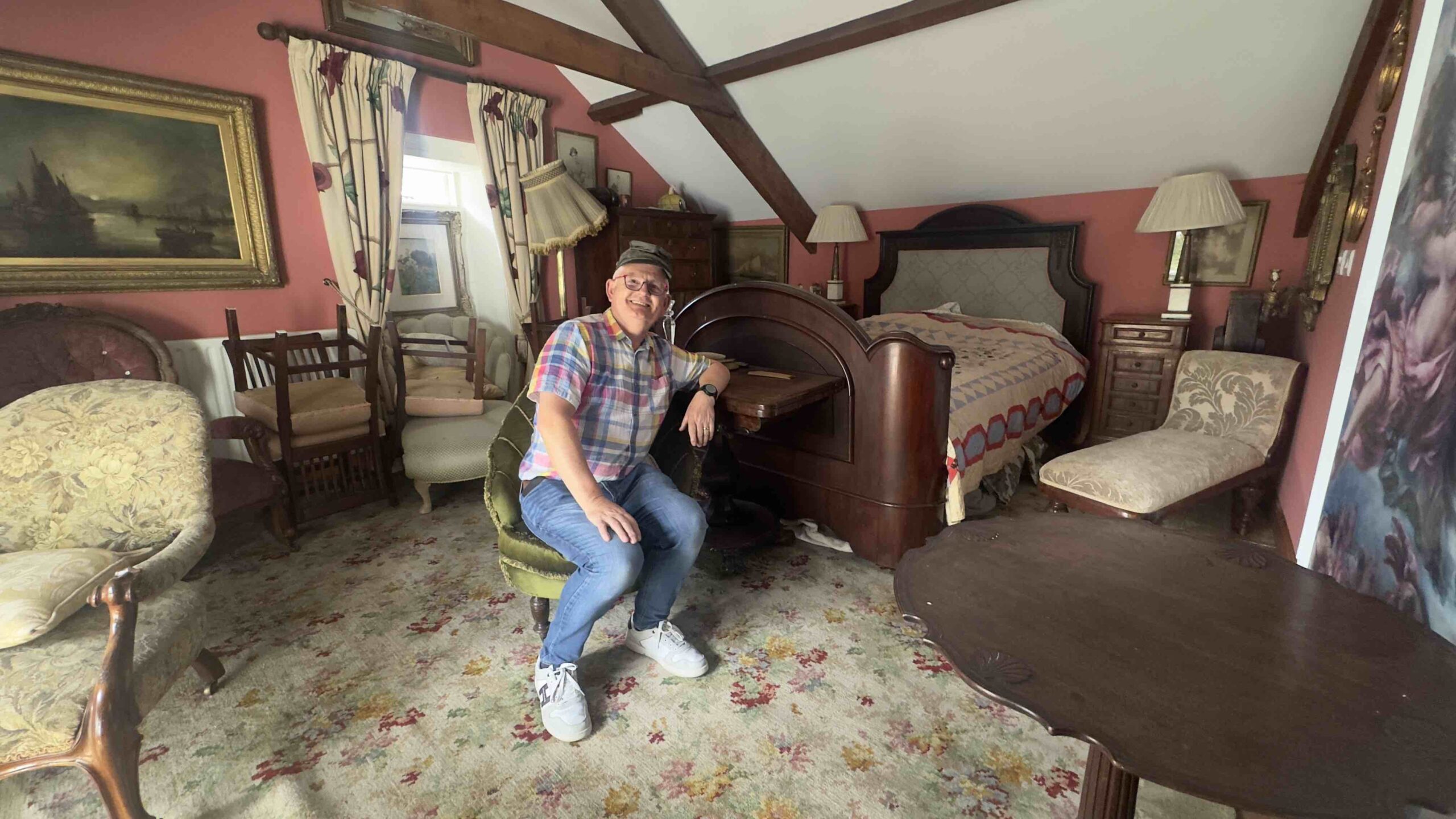
Cóilín Ó Coigligh in the room where Confederate general Patrick Cleburne was born in Ovens, County Cork.
Rain streaks the windshield as we traverse County Sligo, renowned for its wild beauty—and as Cóilín Ó Coigligh, my driver and travel companion, jokes, for its notorious lack of electric vehicle charging stations. It is here, amid rolling hills and stone walls flecked with moss, that my Irish pal guides me to one of Ireland’s many Civil War-related sites (our rebellion, not theirs). This one is more obscure than most. Beneath the sod of Old Cemetery in Sligo Town rest the grandparents of Edward Doherty, the Canadian-born Union army officer who in April 1865 hunted Abraham Lincoln’s assassin, John Wilkes Booth.
I stand before the grave and let the story begin in my mind: Doherty’s parents left County Sligo in the 1830s, bound for Canada. Edward was born in 1838, in the small Quebec town of Wickham. By 1860, he had drifted to New York, just as the nation edged toward war. Within weeks of Fort Sumter’s fall in April 1861, he enlisted in the 71st New York Volunteers. By July, he had experienced battle—and defeat—at Bull Run. Captured there, he made a daring escape back to Union lines, then mustered out when his regiment’s 90-day term ended.
But the war still called. Doherty joined the Corcoran Legion, rose to captain and later joined the 16th New York Cavalry. He earned a reputation as “a gallant officer, full of energy and pluck.”1 After Lincoln’s assassination, it was Doherty who led the detachment that cornered Booth in a Virginia barn. Sergeant Boston Corbett fired the shot that killed Booth, though some of Doherty’s descendants believe otherwise.
Now, more than 160 years later, I stand on Irish soil before his ironmonger grandparents’ gravestone, the words “The Brave Avenger of President Lincoln” chiseled across it—an inscription added after World War I. At its base lies the weathered remnant of an American flag, a small reminder of how Ireland and America are forever bound by, first, our civil war and later theirs.
As we drive around Ireland, Ó Coigligh’s replica Civil War kepi occasionally perched on his head, he rattles off numbers: Up to 180,000 Irish-born soldiers served in Union blue, 20,000 to 40,000 in Confederate gray, most of their stories untold. Ó Coigligh hopes to steer that narrative in a new direction when he launches his website, which will identify monuments, plaques, graves and other American Civil War ties in Ireland.
 John Banks
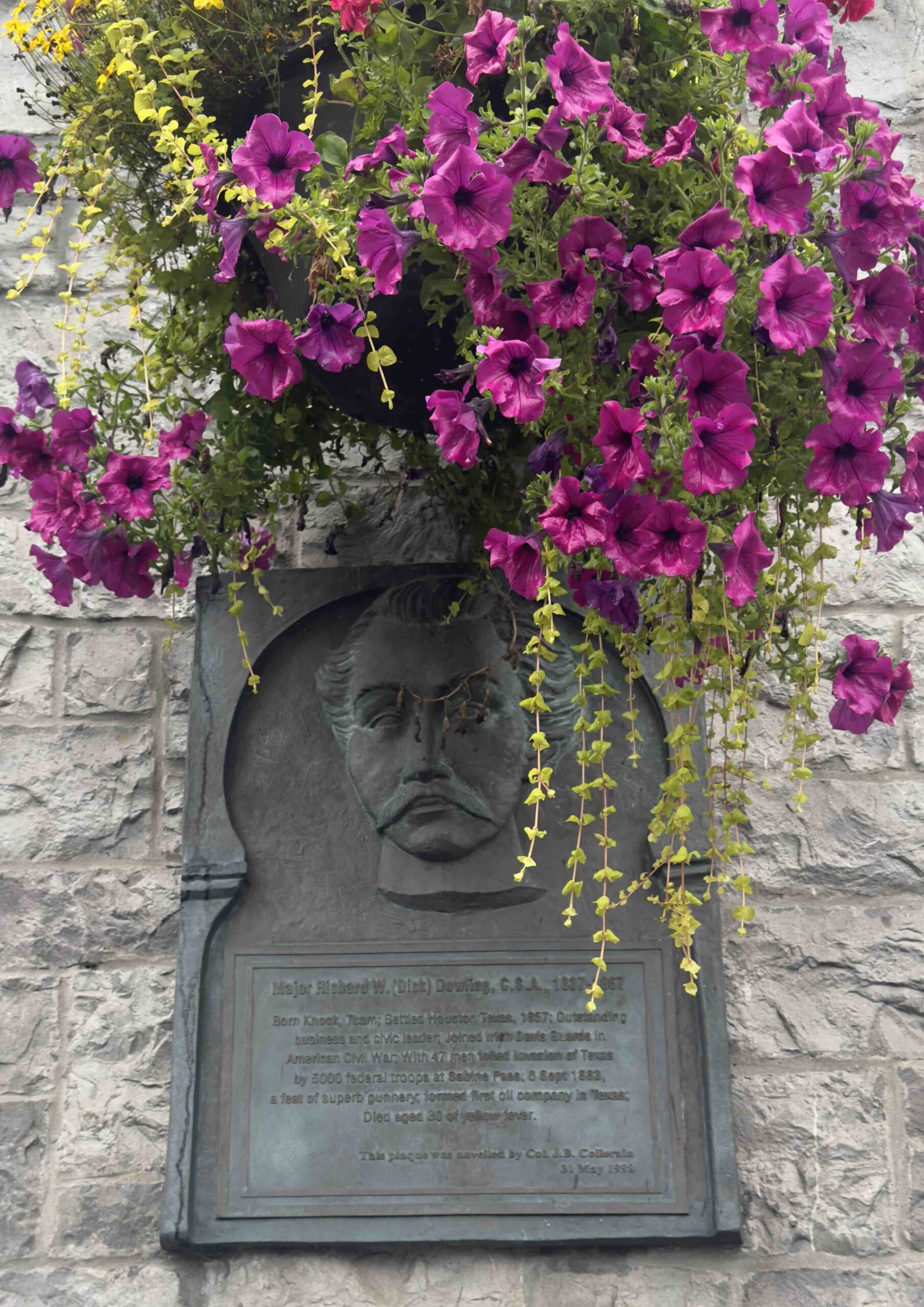
Plaque for Confederate commander Dick Dowling in Tuam, County Galway, Ireland.
Ninety minutes after Sligo Town, we arrive in Tuam, County Galway. Ó Coigligh maneuvers the car into town and leaves me to drive off in search of badly needed electricity. Across from a bookmaker and a pharmacy, I spot Pat O’Hara, a white-bearded local historian, leaning against the stone wall of the town hall. Soon Dick Burke, retired editor of the Tuam Herald, ambles up. Ó Coigligh seeks their expertise on Dick Dowling. In chilly rainy Tuam, I am the American in the group, wearing shorts and a sheepish grin.
Above us, partially hidden behind cascading petunias, the mustachioed mug of Dowling, a local Confederate hero, stares from a bronze plaque. At Sabine Pass, in Port Arthur, Texas, on September 8, 1863, Dowling and his garrison of 47 Irishmen repelled nearly 5,000 Union invaders and a flotilla of gunboats. They disabled two vessels, captured scores of prisoners, and helped preserve Texas for the Confederacy. In the South, Dowling was lionized; in the North, the defeat was branded a disaster.
While I chat with Burke and O’Hara, Ó Coigligh, a retired school principal, films O’Hara and Burke for his website. Then, eyes twinkling, Burke asks, “Would you like to see my artifacts from Sabine Pass?”
Of course we would. Minutes later we sit in his warm kitchen, steaming cups of tea before us. Burke proudly lays out his treasures, obtained on a visit to America: a battered minie ball, an iron shard of a Union gunboat’s boiler, and a replica of the Davis Guards Medal awarded to Dowling by the City of Houston weeks after the battle. We lean close, as if the objects might whisper their stories.
But the road calls. We drive through farmland framed by walls made from glacial stones and turn down a narrow lane, past the ruins of a Norman castle, before stopping in a park in rural Castlehackett. From a nearby car emerges Anna McHugh, cane in hand, a smile lighting her face. She has devoted years to honoring Patrick Kelly, a County Galway native who rose to lieutenant colonel of the 88th New York Infantry in the famed Irish Brigade. Yards from where we stand he attended primary school, she says. The walls of the ruined structure still stand.
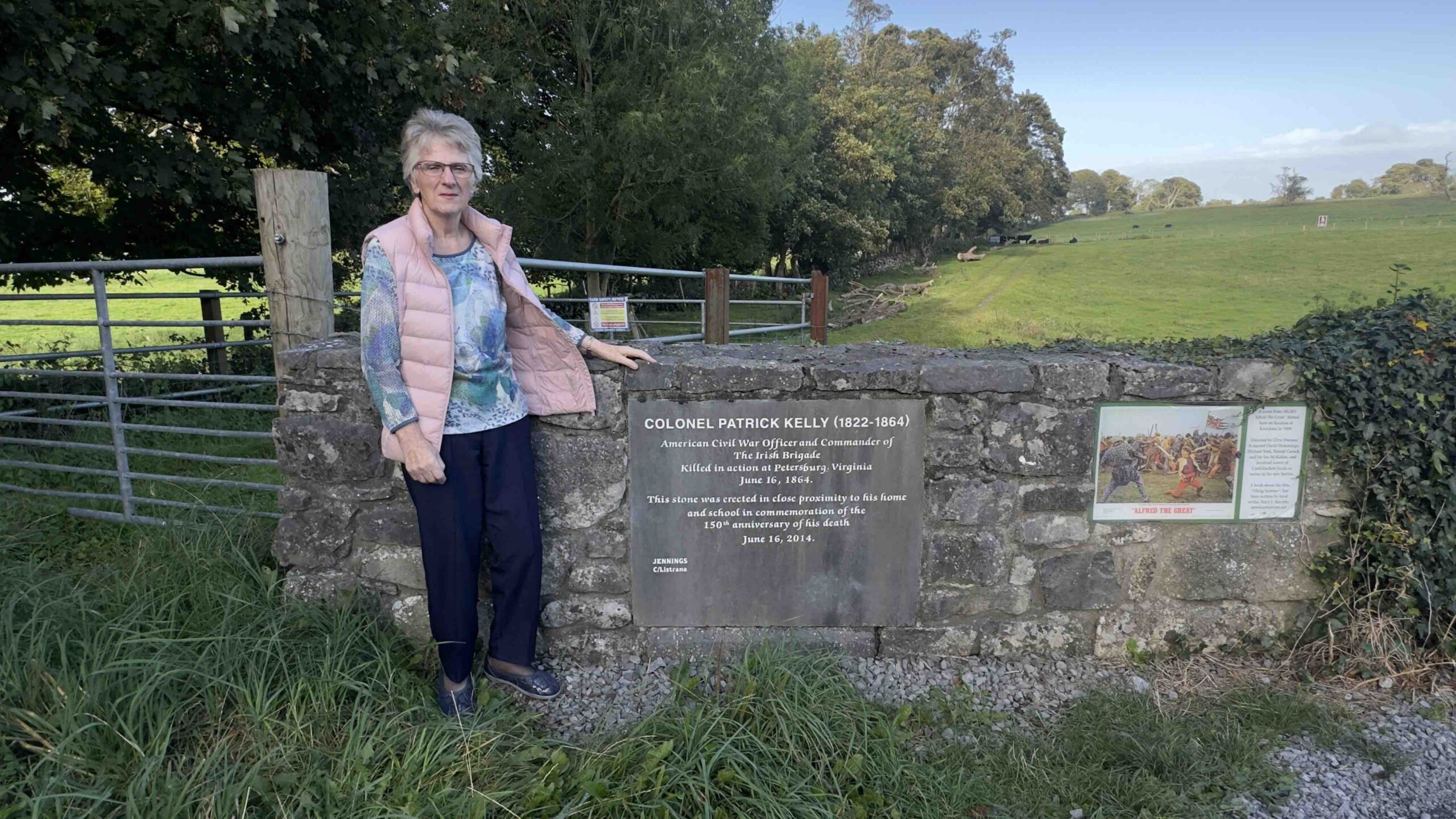
Invigorated by our good fortune, we follow McHugh to a stone that bears an inscription she commissioned for Kelly. She tells us how he led his men at Antietam and elsewhere before a bullet ended his life at Petersburg on June 16, 1864. McHugh researched his story, including by visiting the United States, and convinced a farmer to allow the stone’s placement.
 John Banks
Anna McHugh at the stone inscription she commissioned for Patrick Kelly of the Irish Brigade in Castlehackett.
“Do you think I’m mad?” she asks as we gaze into the distance at a farmer’s large shed nearby, once home to Kelly and his family.
Not at all, Anna. Not at all. Her devotion keeps Kelly’s spirit alive on the soil of his youth.
And then, at last, comes the stop that lingers longest in my memory. Through open gates we enter Bride Park Cottage in Ovens, County Cork, birthplace of Confederate general Patrick Cleburne. For a Civil War traveler, this is sacred ground.
“I can’t believe we’re here,” Ó Coigligh says, his voice hushed as we roll up the gravel drive. I feel it, too—a current of anticipation.
Genial owner DJ Murphy greets us near the front entrance while his dachshunds Cha and Mya—a sister and brother named for an Irish comedy duo—eye me warily. Entering the expansive house feels like stepping into a comfortable pair of well-worn Timberlands. Heavy wooden furniture from Cleburne’s era fills the rooms; oil portraits line the walls. Murphy, his brogue as thick as soda bread, offers us tea and a bit later places in my hands a polished key to Cleburne, Texas—a gift from the city across the ocean named for the general. It shines in the light, a link between past and present.
We climb the narrow stairs of Bride Park Cottage, the wooden boards creaking underfoot. In the small bedroom where Cleburne was born, I pause. The beams overhead are original, says guide Liam McAlister, a longtime friend of Murphy’s. I imagine the child who would one day become known as the “Stonewall of the West,” a man destined to fall at Franklin.
It is a strange intimacy, to stand in the room where Cleburne’s life began, when I have so often stood on the ground where it ended. At Franklin, I have walked the fields that were littered with broken bodies on November 30, 1864, when Cleburne led his men into a slaughter that claimed him, too, at 36. I have visited his two original gravesites in Tennessee cemeteries—in 1870, he was reinterred in Helena, Arkansas, his adopted state. Birth and death, separated by an ocean but connected by memory, come full circle for me.
Back downstairs, Murphy unveils another treasure: a large framed, colorized photograph of Cleburne as a general, a gift from an American. The Irishman stares from the image with calm intensity, mustache and beard neat, uniform apparently immaculate, eyes steady. I am struck by how a man from this quiet cottage became a legend in a foreign land’s bloodiest conflict.
In the garden outside, the remains of a monkey puzzle tree stretch skyward; perhaps it stood here during Cleburne’s time. As we prepare to leave, the afternoon sun struggles to burst through a gloomy-gray sky, casting light across the cottage walls, and I feel that strange mix of awe and melancholy that always comes when history feels close enough to touch.
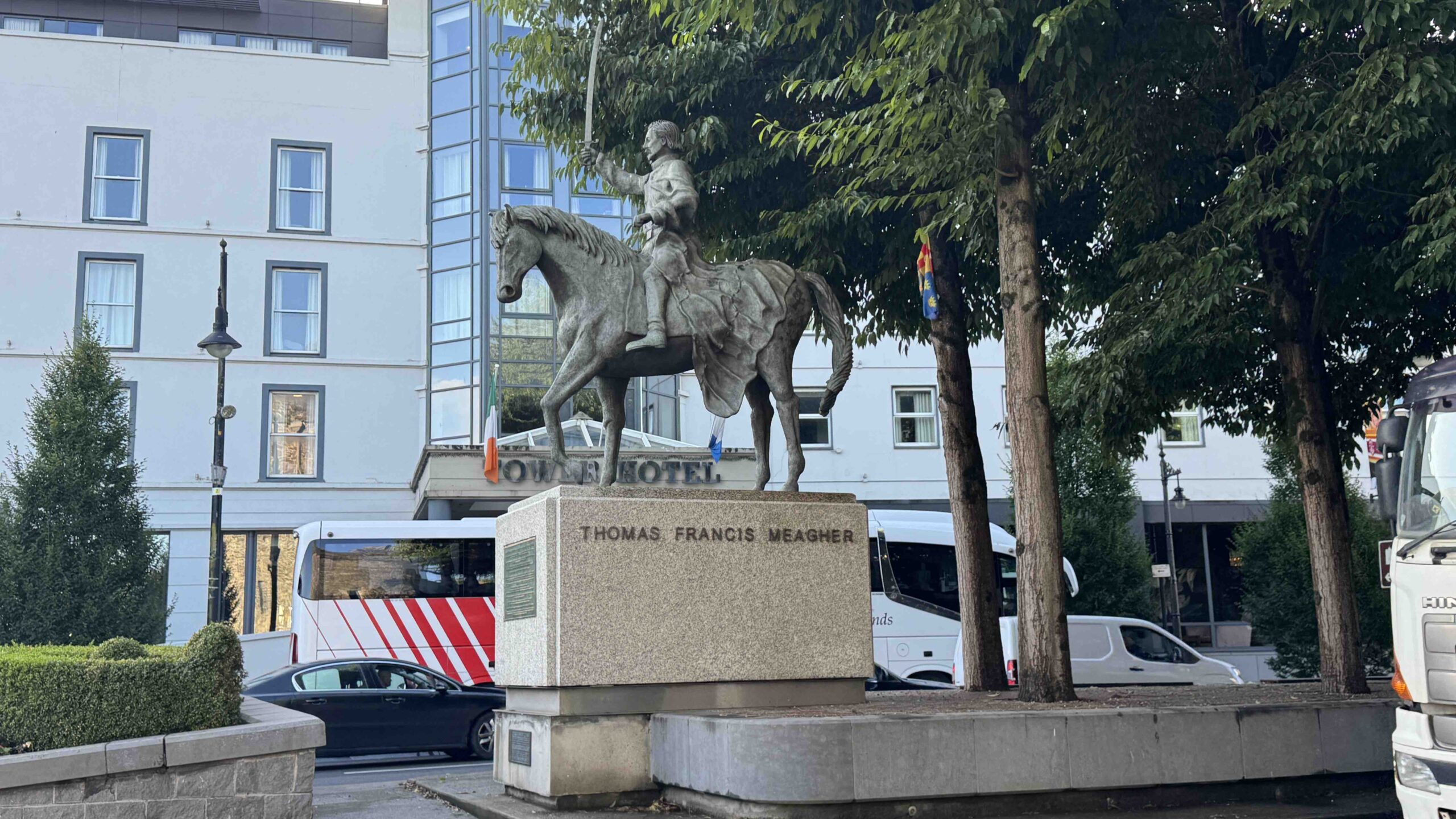
Our pilgrimage continues in Waterford, Ireland’s oldest city, where centuries of history press at every corner. After breakfast at the Granville Hotel—the birthplace in 1823 of Irish Brigade commander Thomas Francis Meagher—we walk toward ancient Reginald’s Tower and pause across the way before a statue of Meagher on horseback, his sword thrust skyward.
“Some say it doesn’t look like him at all,” Ó Coigligh says while traffic rumbles past.
 John Banks
The statue of Thomas Meagher in Waterford, Ireland.
Nearby, he points out the building where in 1848 Meagher unfurled the Irish tricolor for the first time. Its green, white, and orange would become Ireland’s national flag. In America, Meagher—Irish patriot, newspaper editor, Tasmania prison escapee and rebel—would lead the Irish Brigade into ferocious battles at Antietam, Fredericksburg and elsewhere.
Later, in the Bishop’s Palace Museum nearby, we find a small room crammed with Meagher relics: his swords, his sash, even a sprig of boxwood worn by one of his soldiers at Fredericksburg in December 1862. A curator rushes in, speaking quickly, telling us Meagher stories before vanishing. I linger before a massive painting of Meagher, his presence commanding, and wonder about the man whose life ended mysteriously in Montana Territory in 1867.
Afterward, we walk narrow lanes into Ballybricken parish, where the monument to Captain Patrick Clooney stands. He left Waterford in 1861, joined the 88th New York Infantry, and fell at Antietam the next year. His obelisk, dedicated by the locals in February 1863, rises from Ballybricken Church Graveyard, only yards from the church he attended as a boy. On the front, the long-ago stone carver misspelled Antietam. But it doesn’t matter. I stand before the monument and think of William Roulette’s farm on that hallowed battlefield—a place where I have tramped dozens of times. Perhaps I have even stepped on the very ground where Clooney fell. Now, here, I see where his life began.
Inside the church, parish official Teddy Hennessy shows us the font where Clooney was probably baptized. He has dug through baptismal records in search of the name, eager as we all are to preserve Clooney’s story.
Four days. Countless miles. A blur of rain, sunshine, one double rainbow, cottages, museums, ruins, and abandoned graveyards. From Sligo Town to Tuam, Cork to Waterford, we chase Civil War echoes across Ireland. Each site and each story ties this enchanting country to America. As our adventure winds down, I think of Doherty, Cleburne, Meagher, and Clooney—men born here, tested in America’s crucible, remembered on both sides of the Atlantic.
And I think of Anna McHugh, of Pat O’Hara and Dick Burke, of DJ Murphy, Teddy Hennessy, and that nameless museum curator—guardians of memory who help keep these stories alive. And, of course, I think of my friend and guide, Cóilín Ó Coigligh.
Without them, this Civil War history chapter might go unread. With them, it remains brightly bookmarked, vibrant even, and so human.
John Banks is author of A Civil War Road Trip of a Lifetime and two other Civil War books. A longtime journalist (The Dallas Morning News, ESPN, The History Channel), he is secretary-treasurer of The Center for Civil War Photography. He lives in Nashville with his wife, Carol.
Notes
1. Memphis Bulletin, April 30, 1865.