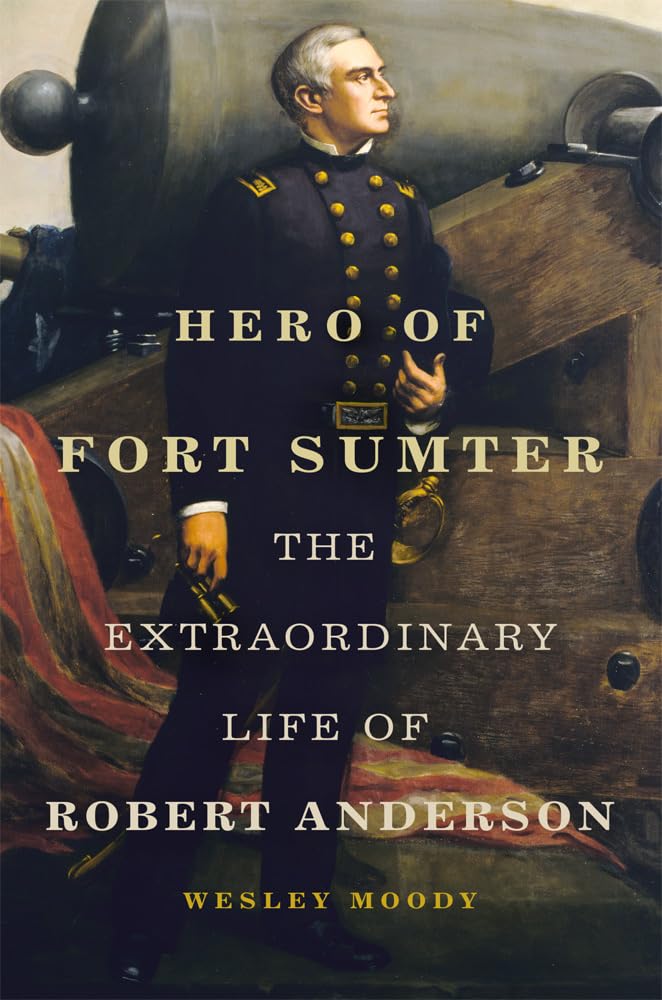
Anyone who knows anything about the U.S. Civil War knows something about Robert Anderson. In December 1860, Anderson, then a major in the U.S. Army, made the fateful decision to move his small garrison from Fort Moultrie to Fort Sumter in Charleston harbor. This decision electrified the North, especially when compared to President James Buchanan’s indecisiveness during the secession crisis. Anderson became a folk hero. When the rebels fired on Fort Sumter on April 12, 1861, Anderson led the garrison though the bombardment and surrender. In most accounts of the U.S. Civil War, Anderson then moves off stage, while other commanders emerge from the wings to lead the U.S. war effort.
The problem with this approach, Wesley Moody explains, is that people know Anderson only during one moment of his long military career. Anderson “served his nation for almost forty years from South America to Maine, through four wars, eventually reaching the rank of major general. Yet he always remains Major Anderson of Fort Sumter” (1). Moody, currently Professor of History at Florida State College, insists that people need to understand that Anderson’s life was far broader than several critical months in Charleston. Limiting analysis of Anderson to the period December 1860 – April 1861 “is a disservice to a patriotic public servant and our understanding of American history” (1).
Unlike some biographies of Civil War-era figures, which rush to get to the Civil War and spend most of their time on the period 1861 – 1865, Moody offers a cradle-to-grave account of Anderson’s life and career. He begins with Anderson’s father Richard Clough Anderson’s service during the Revolutionary War and the family’s move to Louisville, Kentucky. Moody scrutinizes Robert Anderson’s childhood and years at West Point. Anderson graduated fifteenth in his class of thirty-six and was commissioned a second lieutenant in the Third U.S. Artillery.
In 1823, President James Monroe appointed Anderson’s brother, Richard Clough Anderson, Jr., the U.S. Minister to Colombia. Several years later, President John Quincy Adams asked Richard Anderson to serve as one of the U.S. representatives to the Congress of Panama. Richard Anderson asked his recently-graduate brother Robert to join him. Robert’s experience was “short, difficult, and ultimately tragic” (37), and Richard died in Cartagena of yellow fever. However, Moody contends, Robert Anderson learned from his brother the importance of diplomacy, which was critical because, “the nineteenth-century military officer was as much a diplomat as a warrior. Many times in Anderson’s career, he would see his role as an army officer as preventing war, not waging it” (27).
After he returned to the United States, Anderson’s life in the army took him to many different places. At Fortress Monroe, he received “a clear idea of what the routine of his army life would be” (29). As an assistant inspector general during the Black Hawk War, Anderson swore many volunteers, including Abrahm Lincoln, into federal service. Anderson spent several years at West Point as an assistant artillery instructor. Because Anderson believed “that it was in the army’s best interests that officers did not spend too much time away from their regiments” (51), he went to Florida and fought in the Seminole Wars. Like some of his fellow officers, Anderson participated in Indian Removal, but his sympathies were with the Cherokee. Anderson went to the U.S.-Canadian border in 1841, where he saw Winfield Scott contain a potentially explosive border crisis. Anderson fought in the U.S. War with Mexico and returned to the U.S. as a brevet major after being wounded at the battle of Molino del Rey.
As noted above, Anderson’s time in Charleston has received the most attention from scholars. Moody offers a solid overview of Anderson’s stormy months in the Palmetto State, from his initial posting on November 20, 1860, to the garrison’s surrender on April 13, 1861. South Carolina, after Lincoln’s election, pushed ahead full bore on secession. Anderson understood that Fort Moultrie was not defensible. It would have been a simple matter for the South Carolinians to assault and capture the fort. Consequently, Anderson shifted his men to Fort Sumter. As the Secession Winter ground on, Anderson’s decision to hold the fort gave him a national reputation. Moody concludes by discussing Anderson’s military career during the U.S. Civil War and his final days in Paris. Anderson’s life, Moody remarks, is “the story of the antebellum army” (195). One might also make this comment about some of Anderson’s contemporaries, such as Winfield Scott and John E. Wool.
While Moody offers a solid cradle-to-grave treatment of Anderson, this book spends very little time discussing Anderson and memory. When Anderson met with Colonel James Pettigrew and Major Ellison Capers of the South Carolina militia after relocating to Fort Sumter, he said, “in this controversy between the North and the South, my sympathies are entirely with the South” (132). This statement, Moody comments “unfairly color[ed] his actions over the next four months and for later generations” (132). Although Anderson became a folk hero for doing something when many politicians preferred doing nothing, his statement nonetheless led some people to question his loyalty. Anderson’s wife Eliza and daughter Eliza spent a lot of time defending Anderson’s historical reputation and legacy. Despite their efforts “Anderson fell into obscurity. His loyalties became mischaracterized, and his contributions were forgotten” (2). His daughter Eliza used her husband’s “wealth and social connections to preserve and defend her father’s reputation. In the end, she was unsuccessful in what had been her mother’s mission as well. Anderson’s memory faded after her death” (201). One wishes that Moody had spent more time discussing these memory battles, which also involved debates about loyalty and sectional reconciliation.
Anderson, Moody concludes, “was more than a leaf caught in the wind. His inaction at times and bold action at others helped rally the people of the North to the Union cause and ultimate victory” (201). Readers will certainly enjoy learning a more about the man best known for his time at Fort Sumter during the Secession Winter.
Evan C. Rothera is Assistant Professor of History and a member of the Civil War Consortium at Sam Houston State University.