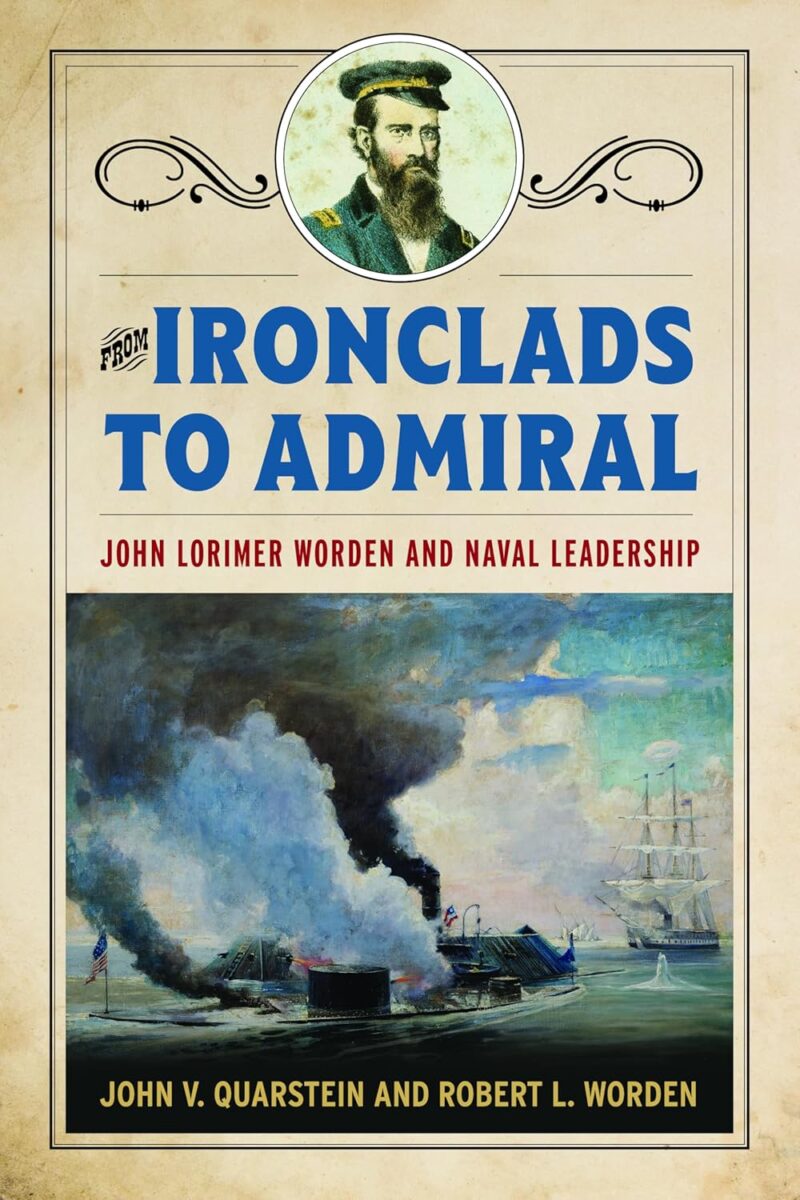
There is no shortage of biographies exploring the lives of Civil War era figures. Thousands of books have been printed about politicians, generals, admirals, and all manner of other participants. Until now, however, not a single volume covered the life of Rear Admiral John Lorimer Worden, one of the war’s most famed naval officers. Through in-depth research, expert analysis, and clear prose, John Quarstein and Robert Worden’s From Ironclads to Admiral: John Lorimer Worden and Naval Leadership finally give John L. Worden the biography that he deserves.
It is surprising that no one has attempted a complete biography of John L. Worden until now. As an antebellum naval officer, Worden conducted scientific experiments at the U.S. Naval Observatory and led sailors in the war against Mexico. During the Civil War, he was captured by Confederates in April 1861 and wounded while commanding USS Monitor in its famed duel with the ironclad Virginia. He commanded the turreted ironclad Montauk and assisted in the production of later-class Monitors. After the war, Worden superintended the U.S. Naval Academy, commanded the Mediterranean Squadron, and participated in founding the U.S. Naval Institute. Few nineteenth century naval officers did so much in one career.
John Quarstein and Robert Worden are perhaps the best qualified persons alive to biography John L. Worden’s life. Having spent many years operating the USS Monitor Center of The Mariner’s Museum and Park, Quarstein has more practical experience than anyone on how the navy’s turreted ironclads operated, how they impacted the Civil War, and who commanded them. As a retired archivist and collateral descendent of the book’s subject, Robert Worden’s skillset and family insight only adds to the work’s value. I could think of no one more qualified than the co-authors to write this book.
In many ways, this is a standard biography of a Civil War participant, and in many ways it is not. Just like most other biographies of wartime participants, it covers Worden’s entire lifespan, with a focus on how his command of USS Monitor during the Civil War became his most defining moment. Antebellum activity builds towards context for why Worden was chosen to command USS Monitor and how he ably fought ironclads in the conflict. Postwar exploration builds upon this, showing how Worden’s command of ironclads forged his national popularity and solidified status as a rising star that continued impacting the navy.
There is much that differentiates this book from many traditional books documenting Civil War participants. Unlike many biographies that devote only a single chapter to antebellum activity (and one more on postwar life), Worden’s biography spends significant time on his other career assignments. Of the book’s fourteen chapters, only six are about the Civil War, and of those six, only one focuses on Worden’s time commanding USS Monitor. Other chapters focus on Worden’s time assigned to the U.S. Naval Observatory in Washington, his activity in the U.S. War with Mexico, his efforts at superintending the U.S. Naval Academy, and his efforts in founding the U.S. Naval Institute. I personally found the chapters on Worden’s participation in the War with Mexico and his postwar command of the Mediterranean Squadron most insightful.
John L. Worden wrote no memoir and did not partake in the prolific article writing of other wartime veterans. Finding Worden’s voice could have proven difficult, but the co-authors push past this perceived limitation, making copious use of archival material related to Worden, his assignments in the navy, and the Navy Department overall. This ranges from personal correspondence to vessel logbooks, from navy reports and publications to official records. The authors certainly did their homework, finding virtually every piece of paper either written by or about Worden that still survives. The book utilizes detailed endnotes, though contains no comprehensive bibliography. Instead, the authors include a small essay summarizing primary archival sources used.
This book’s publication by the U.S. Naval Institute adds to that organization’s library, while also exploring its own origins. The authors bring a lifetime of familiarity with Worden to carry his career to the forefront. From Ironclads to Admiral is long overdue.
Neil P. Chatelain is an associate professor of history at Lone Star College North Harris, and the vice president and editorial board chair of Emerging Civil War.