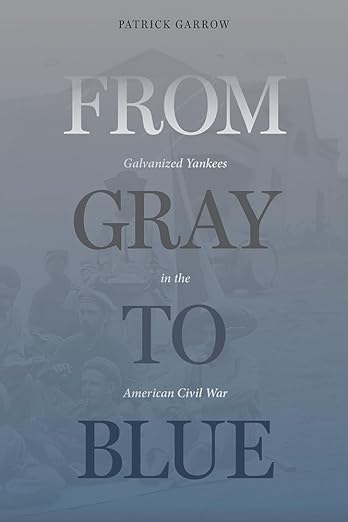
Galvanized Yankees are a group that have received disproportionate interest for a relatively small body of Civil War soldiers, having been the subject of scholarly analysis and popular films alike. After examining Union prisoners of war who became Confederate soldiers in his book Changing Sides, archaeologist Patrick Garrow now considers their opposites in From Gray to Blue. In doing so, Garrow widens the traditional definition of galvanized Yankees as Confederate prisoners who joined the Union ranks to include all former Confederates who enlisted in the Union forces after completing their terms of service or deserting.
From Gray to Blue is composed of a series of overviews of units with a significant number of galvanized Yankees, supplemented by brief contextual chapters on Northern prisons, Union recruiting in the South, and the Civil War on the Western frontier. Besides addressing how each unit was organized and recruited former Confederates, Garrow includes information on the units’ enlisted men, such as their birthplaces, civilian occupations, and health issues during the war. The unit histories conclude with an evaluation of whether the unit can be considered a success or a failure based on its combat performance and desertion rate.
The units profiled in From Gray to Blue fall into three general categories. The first comprises the six regiments of U.S. Volunteer Infantry traditionally associated with the galvanized Yankees, which were recruited out of Union prisons and sent west to guard frontier posts and escort settlers on the overland trails. The second group includes other units that incorporated Confederate prisoners, such as the 23rd Illinois Infantry Regiment, an Irish unit whose colonel disobeyed orders by recruiting prisoners, and the 1st Delaware Heavy Artillery, a company recruited from prisoners at Fort Delaware that served as guards at the fort.
The final category covers units recruited in the South that therefore included galvanized Yankees according to Garrow’s expanded definition of the term. These units feel like somewhat of an outlier compared to the other two categories, both because their recruits did not come from prisons and because they included Southern Unionists who were conscripted by the Confederacy and deserted to join the Union forces. In the latter case, while these individuals had technically served as Confederate soldiers, going over to the Union did not involve the changing allegiance associated with most galvanized Yankees. Nevertheless, the examination of these units is limited to a single chapter, and Garrow’s case studies of the 1st Florida Cavalry and the 2nd North Carolina Infantry present several parallels with other units of galvanized Yankees.
Desertion was a common concern with galvanized Yankees, given their inherently questionable loyalties, and Garrow therefore examines the factors affecting the desertion rate in each unit. Ethnic loyalties appear to have been significant in keeping galvanized Yankees in the ranks. Immigrants were often targeted for recruitment from the prisons on the assumption that they would not have been as dedicated to the Confederacy as native Southerners, and two of the most successful units, the 23rd Illinois and the 2nd U.S. Volunteer Infantry, had Irish commanders and enlisted a substantial number of galvanized Yankees from Ireland. Terms of service were similarly important, as Garrow demonstrates that USVI regiments serving one-year terms of service experienced desertions at a markedly lower rate than those enlisted for three years. In the case of the 6th USVI, which began a three-year term as the war was ending, losing manpower to desertions seems as if it would have been inevitable even if the unit had been composed of Northern volunteers.
While From Gray to Blue does not supplant Dee Brown’s 1963 work The Galvanized Yankees as the most engaging book on the topic, it will be necessary reading for those wanting to learn more about this group. Besides going beyond the six USVI regiments covered in The Galvanized Yankees to analyze other Union units that clearly qualify as having enlisted galvanized Yankees, Garrow corrects some minor errors in Brown’s work; for instance, Garrow identifies a handful of former Confederates who became officers in the USVI, whereas Brown had believed that there was only one such individual. Taken as a whole, From Gray to Blue presents an effective overview of the wartime experiences of the thousands of ex-Confederates who found themselves in the curious position of fighting for their former adversaries.
Jeremy Knoll is a doctoral student studying the U.S. Civil War in the Department of History at The Ohio State University.