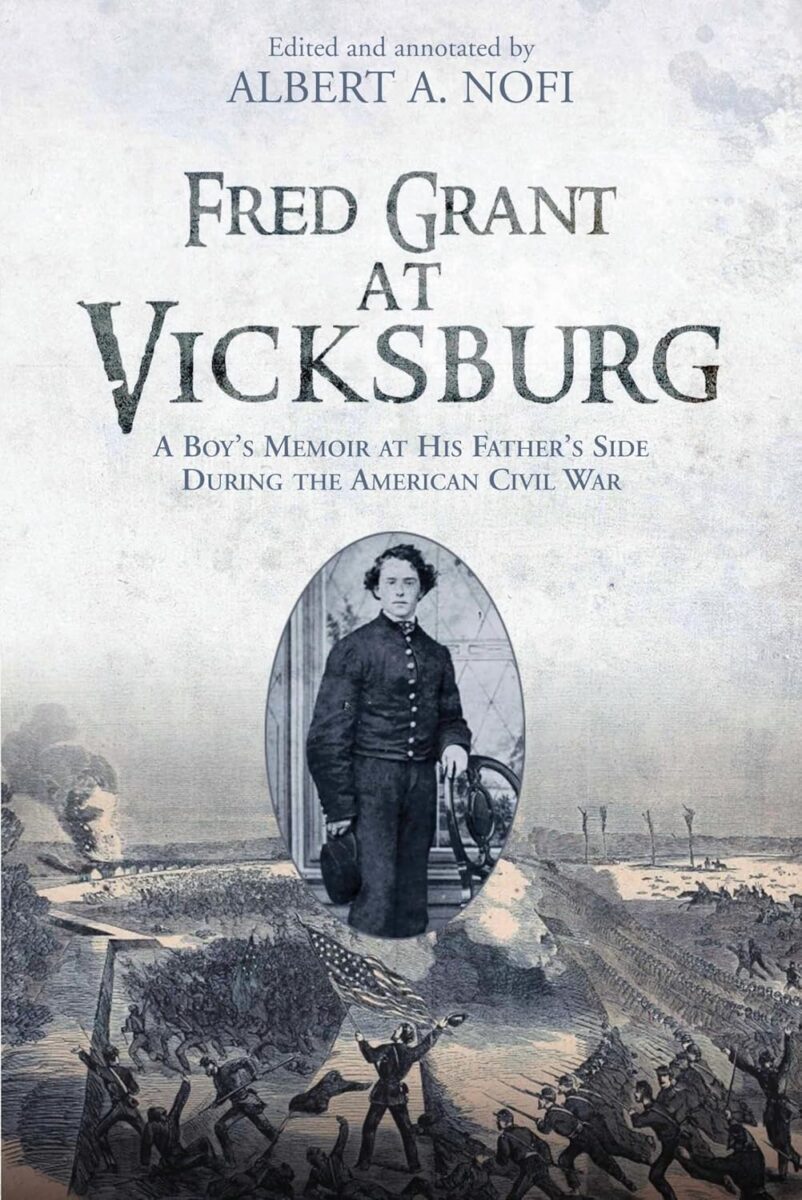
This primary source arrives at an opportune moment: just as historians like Earl J. Hess, Timothy B. Smith, Donald L. Miller, Lindsay Rae Smith Privette, and others have reinvigorated scholarly interest in the Vicksburg Campaign. Twelve years old during the Vicksburg Campaign, Fred Grant authored his reminiscences for the National Tribune in 1889. The resulting memoir is a grown man’s effort to recapture the perspectives and experiences of his childhood self.
Joining his father on March 29, 1863, Fred witnessed many of the campaign’s significant episodes and personalities. However, the true merits of the memoir lie less in the factual detail it supplies (which, as Nofi points out, can sometimes be inaccurate) than in the emotional experiences it conveys. Fred recounts the wonder he felt as he toured Admiral David Porter’s flagship, the thrill of watching the Union navy run the Confederacy’s blockade of the Mississippi River, the pride he experienced as his father’s soldiers and lieutenants doted on him and labelled him “pet,” and the nausea-inducing horror of witnessing soldier deaths, burials, and amputations.
One of the most prevalent sentiments is Fred’s clear love and awe for his father. Admiring Grant’s seemingly unflappable nature even during the campaign’s most uncertain stages, Fred recalled: “My father, who always pursued the even tenor of his way in war as well as in peace, fulfilled each of his duties with method and care. It was a surprise to me, even then, mere boy as I was, to see my father quiet and self-possessed when others seemed to be laboring under great excitement” (53).
In other passages, Fred comments on his father’s care for his men, equestrian skills, bravery under fire, humility in victory, and sympathy for the defeated rebels. The stern and cold “Unconditional Surrender” Grant is not to be found in these pages, much less the caricatured “Butcher.” The general, dead for about four years when these words were first written, could not have asked for a better eulogy.
Nofi provides readers with a treasure-trove of contextual and supplemental material. A brief overview of the campaign’s early stages, a short biography of Fred, a timeline, biographical sketches of significant personalities, an order of battle, and a glossary all enhance the book’s utility. Indeed, the memoir itself consumes fewer than half of the book’s one-hundred and thirty-six pages. The editor’s meticulous annotations further ensure that readers have all the information necessary to reap the fruits of this slender volume.
Scholars and researchers will value the memoir for the insight it provides into a child’s experience during the Civil War. All readers will appreciate the touching portrayal of a father through the eyes of his son.
Robert L. Glaze teaches history courses for Georgia Military College and Lincoln Memorial University. He is currently revising his manuscript, Experiencing Defeat, Remembering Victory: The Army of Tennessee in Civil War Memory.