 Marching to Victory (1888)
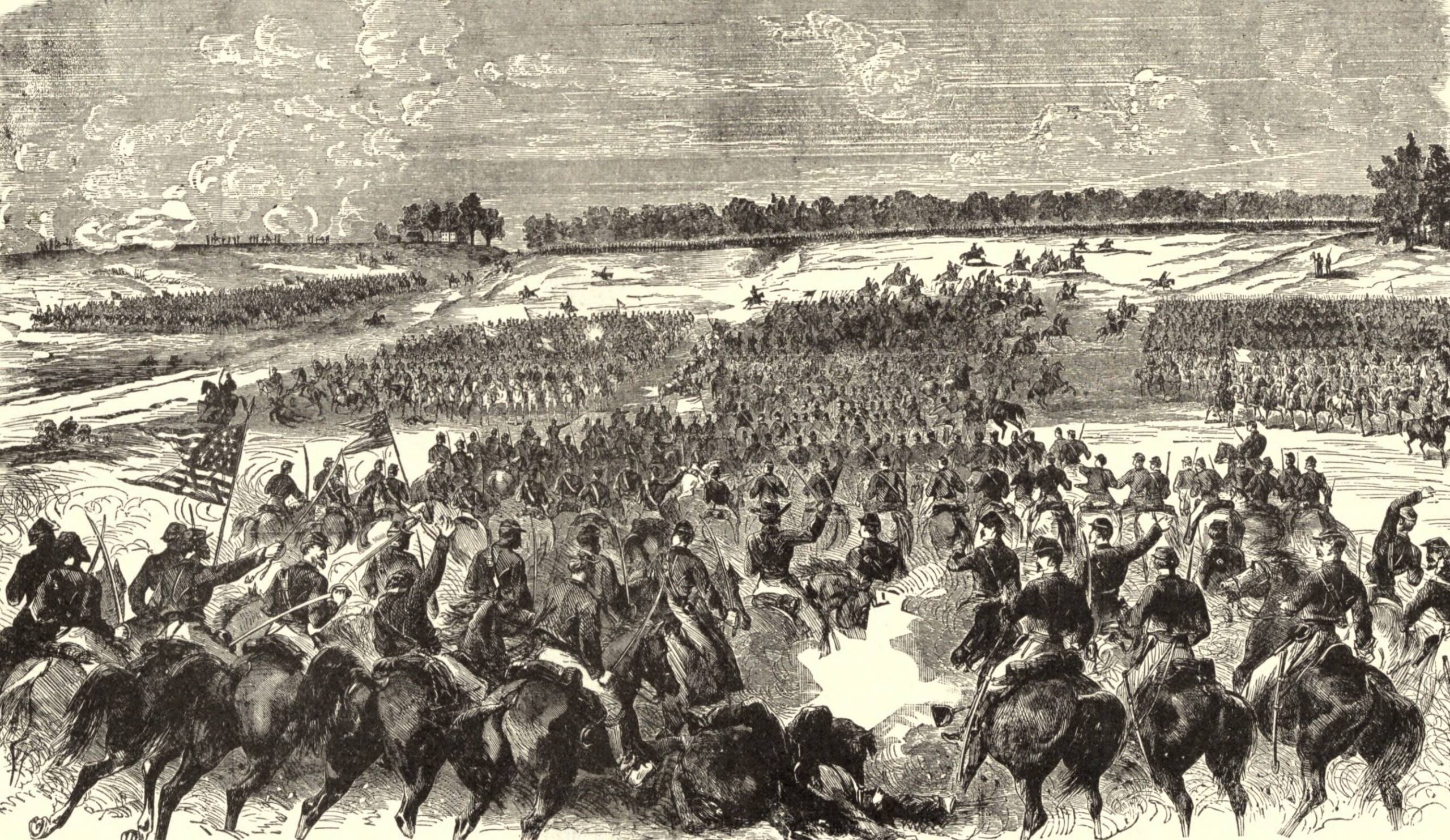
An artist’s depiction of the Battle of Brandy Station
On June 9, 1863, Union and Confederate forces clashed around Brandy Station, Virginia, in what became the largest cavalry battle ever fought in North America. Days earlier, Robert E. Lee had begun to move his Army of Northern Virginia in what would be an invasion of Pennsylvania; his plan called for J.E.B. Stuart’s cavalry to screen the infantry on its northward march. Stuart’s actions were observed by the Army of the Potomac, whose commander, Joseph Hooker, believed the Confederate horsemen might attempt a raid against Union supply lines and directed cavalry commander Alfred Pleansonton to engage and destroy Stuart’s force. In the early morning hours of the 9th, Pleasonton moved his 11,000 troopers across the Rappahannock River at Beverly and Kelly’s fords and launched a surprise attack on Stuart’s 9,500 horsemen. An all-day fight ensued, in which the advantage changed multiple times. Pleasonton’s men broke off the attack at day’s end, making Brandy Station a tactical Confederate victory. Even so, the Union cavalry had gained valuable confidence by acquitting itself well against Stuart’s skilled horsemen. Several days after the battle, one of the Confederates involved—a soldier in Cobb’s (Georgia) Legion—wrote a letter to the Augusta Weekly Chronicle & Sentinel newspaper in which he detailed his unit’s participation in the fight. His account is reproduced in part below:
June 12, 1863
As we are at present indulging in the monotony of camp life, although being under orders to move at a moments notice, having four days rations cooked, I propose to give the readers of your valuable and interesting journal, a brief detail of the transactions of our “Legion” in the fight of the 9th instant, having the honor to be a participant. On the morning of the 9th instant, about five o’clock, we were aroused from our slumbers by the rattle of small arms and the booming of heavy guns. The sound of the bugle was soon echoing through our camps, warning us to prepare for coming events. We were not long getting ready, being soon in the saddle, and drawn up in line. Five minutes had not elapsed, before the command “forward march,” was given. Proceeding in the direction of the Rappahannock river, we readily came in sight of the enemy’s position, he having selected a thickly timbered piece of land for his operations, which prevented us from discovering his numbers. Skirmishers were immediately sent forward … with instructions to dislodge the enemy if possible. Firing soon commenced between the opposing parties; our skirmishers succeeded in driving the enemy into the interior of the woods; when the Hessians were reinforced.
Their cavalry charged our brave little band of skirmishers; their number being much greater than ours compelled us to retire, which we did in perfect order, wheeling and firing upon the advancing foe. Our boys were discovered emerging from the woods, pursued by the Yanks. The “Jeff. Davis Legion,” being nearest the enemy, were ordered to charge him, which they did successfully, routing the enemy completely. Our boys were again ordered to reoccupy their former position, which was in an expansive field. The vandals then sent forward a large body of infantry skirmishers. Captain Young’s company was ordered to dismount, together with a detachment from the “Jeff. Davis Legion,” to encounter the advancing foe. It was not long, however, before the opposing parties became engaged in deadly conflict. While thus engaged, the enemy were reported in our rear.
 South Caroliniana Library, University of South Carolina
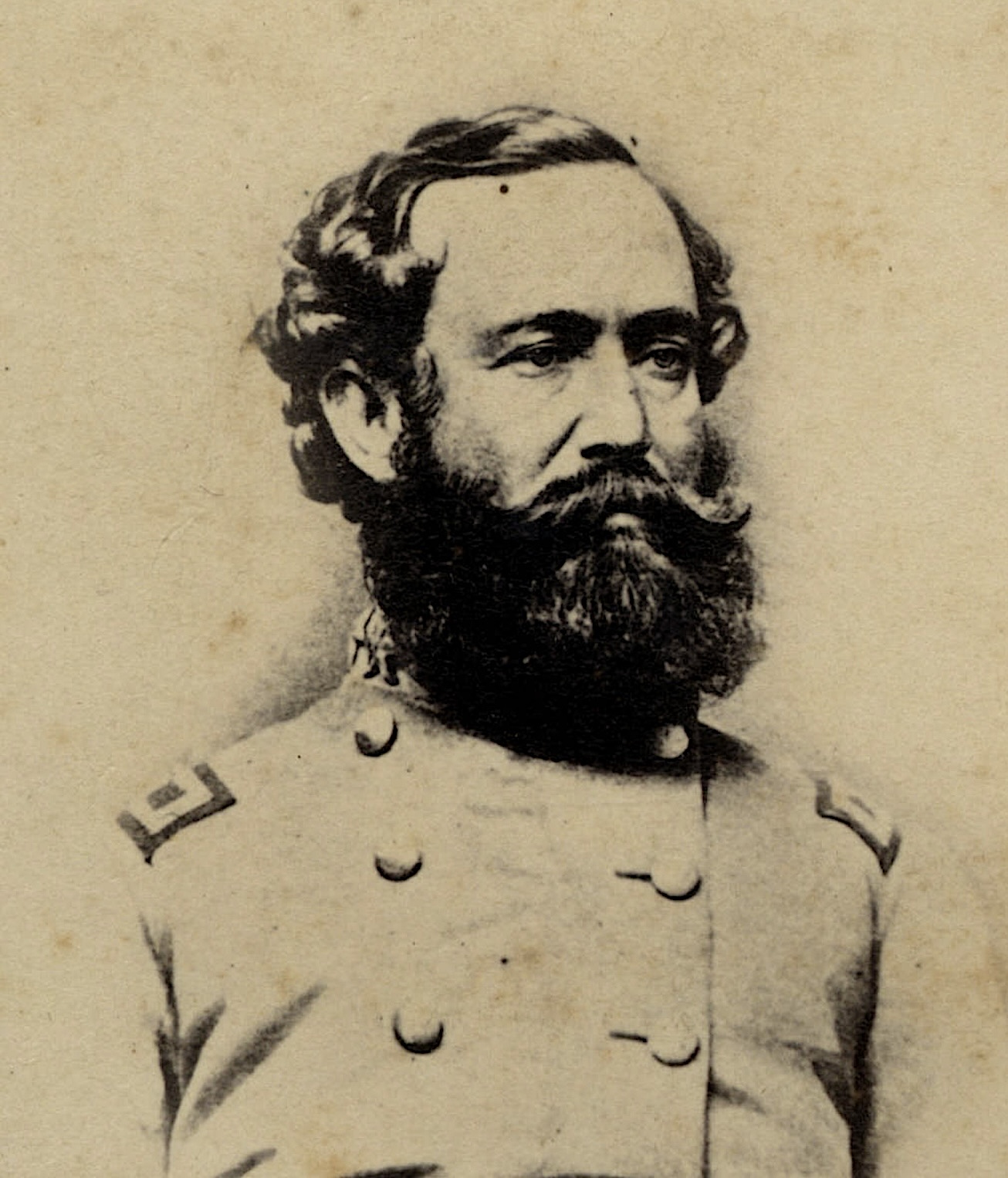
Wade Hampton
Leaving our skirmishers supported by one regiment to hold the Yanks in check, our “Legion” was ordered to left about to meet the advancing column of the enemy which was threatening our rear. The move on our part was immediately executed, then the command of “gallop, march,” was given with instructions from our brave and gallant general ([Wade] Hampton) to charge them regardless of numbers. Proceeding through bogs, over ditches and fences for two miles, we came in sight of the advancing column of the enemy. There being one company already detached from our “Legion,” besides a number wounded in skirmishing, reduced our command considerably, nevertheless, it did not weaken our determination or expectations. Onward our impetuous steeds dashed, until at length we came within pistol shot of the Hessians, who were pushing forward with alacrity in order to take possession of one of our batteries which was placed near Gen. [J.E.B.] Stuart’s headquarters, and pouring destruction into the enemy’s ranks. They had succeeded in getting within twenty paces of Gen. Stuart’s headquarters when Cobb’s Legion got into position. The command “charge” emanated from the lips of our gallant colonel … who was in front; every countenance flashed with “victory or death,” we dashed upon the infuriated Hessians with drawn sabres (while they used the pistol chiefly) with such impetuosity that led the Yanks to believe that the rebels intended to wound their feelings; there was weeping and wailing and cracking of Yankee skulls. After ten minutes desperate fighting, the enemy’s ranks became dismembered, then a general stampede followed. They left their dead and wounded in our hands (not very acceptable gifts, I assure you) to be cared for….
The repulse of the enemy at this critical junction changed the aspect of affairs wonderfully, having a tendency to turn the tide of battle; for which Cobb’s Legion has the honor and credit extended to them.
Had they gained the position which they were aiming for, many true Southern patriots would have fallen in retaking it. The position [Fleetwood Heights] commanded our entire right wing, and would, beyond doubt, have proven a fatal stroke to us; but thanks be to God our little band was inspired with the love of liberty, they rushed up in the execrable foe with such violence that would have required men of iron hearts to withstand….
I have only given your readers a detail of the fighting which came beneath my observation. Our line of battle must have been at least fifteen miles in length, Hampton’s brigade occupying the right.
The boys are in excellent spirits, and express themselves ready and eager for another encounter with the Goths of the North….
Source
William B. Styple, ed., Writing & Fighting from the Army of Northern Virginia: A Collection of Confederate Soldier Correspondence (2003)