 Anecdotes and Incidents of the War of the Rebellion (1866)
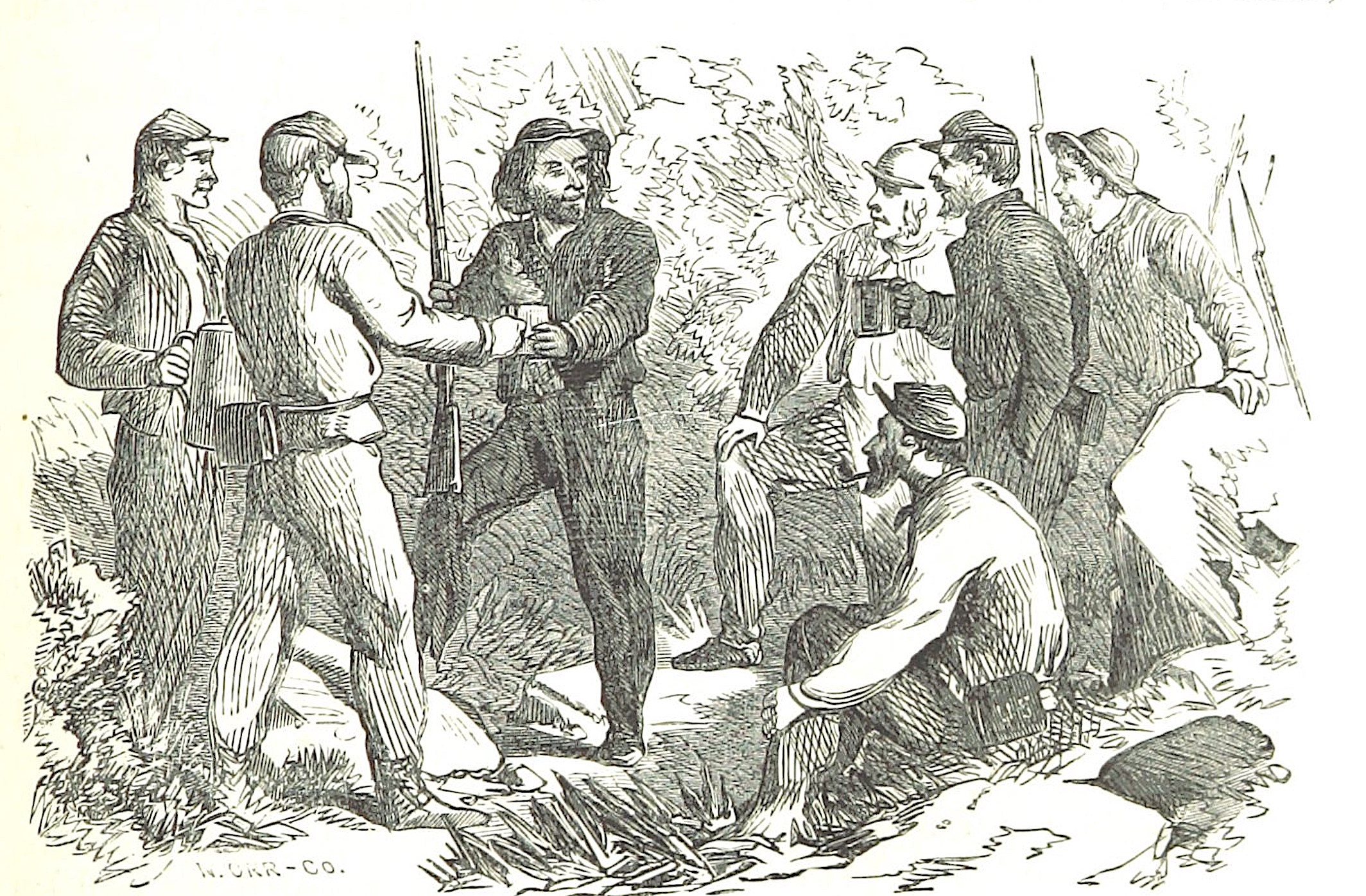
Union and Confederate soldiers chat and share coffee in a postwar illustration titled “Courtesies of Picket Life.”
In the Voices section of our Fall 2025 issue we highlighted quotes by Union and Confederate soldiers about the times they interacted with their opponents when not in active combat. Unfortunately, we didn’t have room to include all that we found. Below are those that just missed the cut.
“These men who take one another by the hand this minute, may the next send one another to the spirit-land. These who are now trading tobacco for coffee and sugar, may, ere another hour rolls round, be trading lead for lead.”
—An unidentified Union soldier, in a letter written “Before Petersburg” in 1864
“We made a bargain with them that we would not fire on them if they would not fire on us, and they were as good as their word. It seems too bad that we have to fight men that we like. Now these Southern soldiers seem just like our own boys…. They talk about … their mothers and fathers and their sweethearts just as we do…. Both sides did a lot of talking but there was no shooting until I came off duty in the morning.”
—Wisconsin soldier Chauncey Cooke, in a letter to his parents during the Atlanta Campaign in the summer of 1864
“[A]s soon as night would come, they would come in. Without a single exception, I have seen these men always kindly and hospitably received by our soldiers; it is always, ‘How are you, Johnny? we’re glad to see you; sit down and have some coffee, and tell us the news.’ The amicable feeling existing between the men of the two armies when not actually fighting is very curious, and between the best troops on each side the understanding seems the most perfect.”
—Lieutenant Colonel Charles Fessenden Morse, 2nd Massachusetts Infantry, on Union soldiers receiving Confederate deserters, in a letter written during the Atlanta Campaign, July 15, 1864
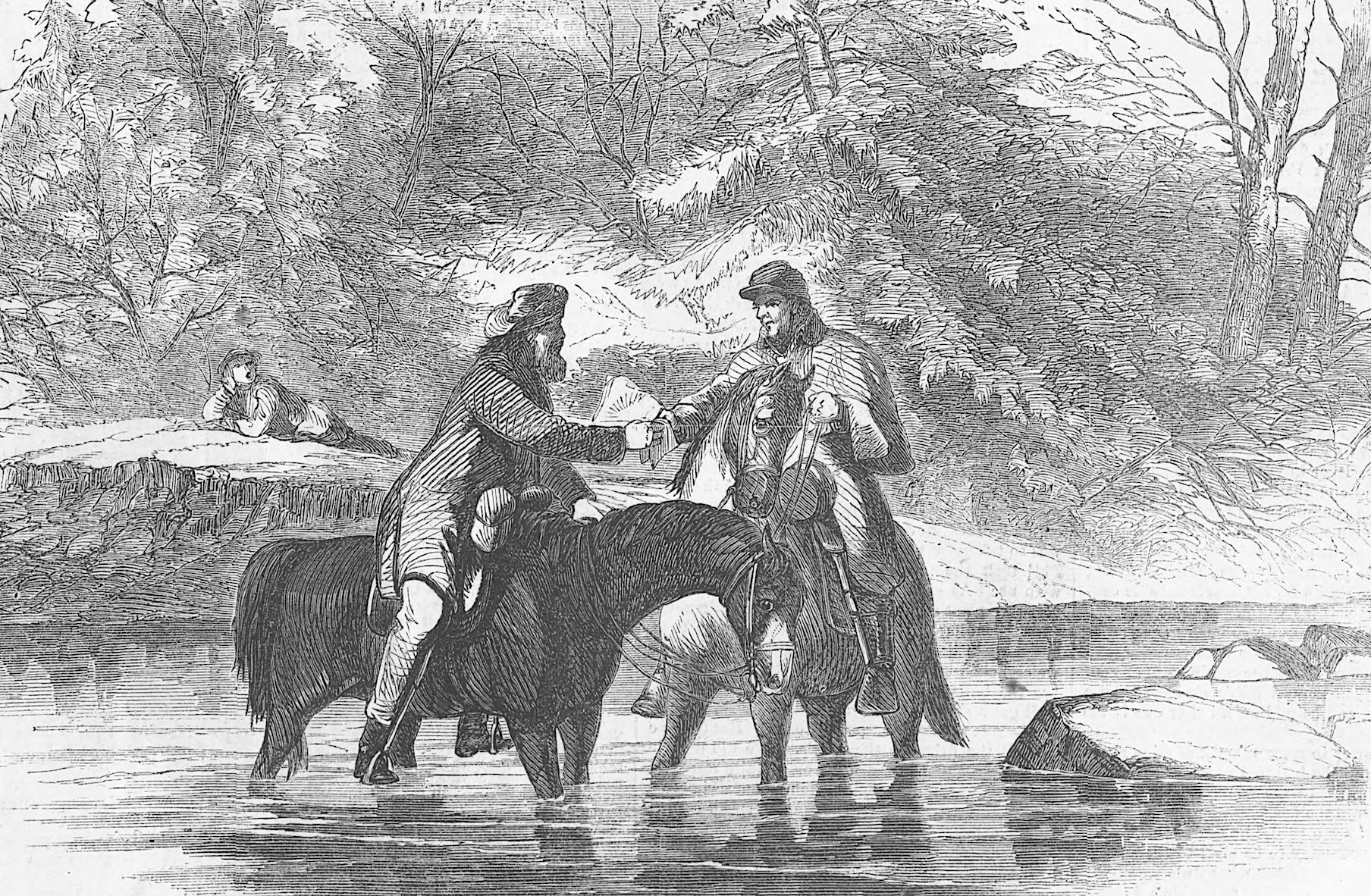
“We send you some tobacco by our Packet. Send us some coffee in return. Also a deck of cards if you have them, and we will send you more tobacco. Send us any late papers if you have them.”
—Mississippi soldier James Parker, in a note he sent “by miniature boat six inches long” to a group of New Jersey troops who were stationed across the Rappahannock River, in early 1863. Parker addressed his message to “Gents U.S. Army.”
“It was a singular sight, to see the pickets of two great hostile armies—walking unconcernedly within a few yards of each other, their bayonets sticking in the ground, bantering and joking together, exchanging the compliments of the day, and even saluting the officers of the opposing force, with as much decorum and respect as they would use toward their own.”
—Edwin B. Houghton, 17th Maine Infantry, on life during the Siege of Petersburg, in his diary, August 1864
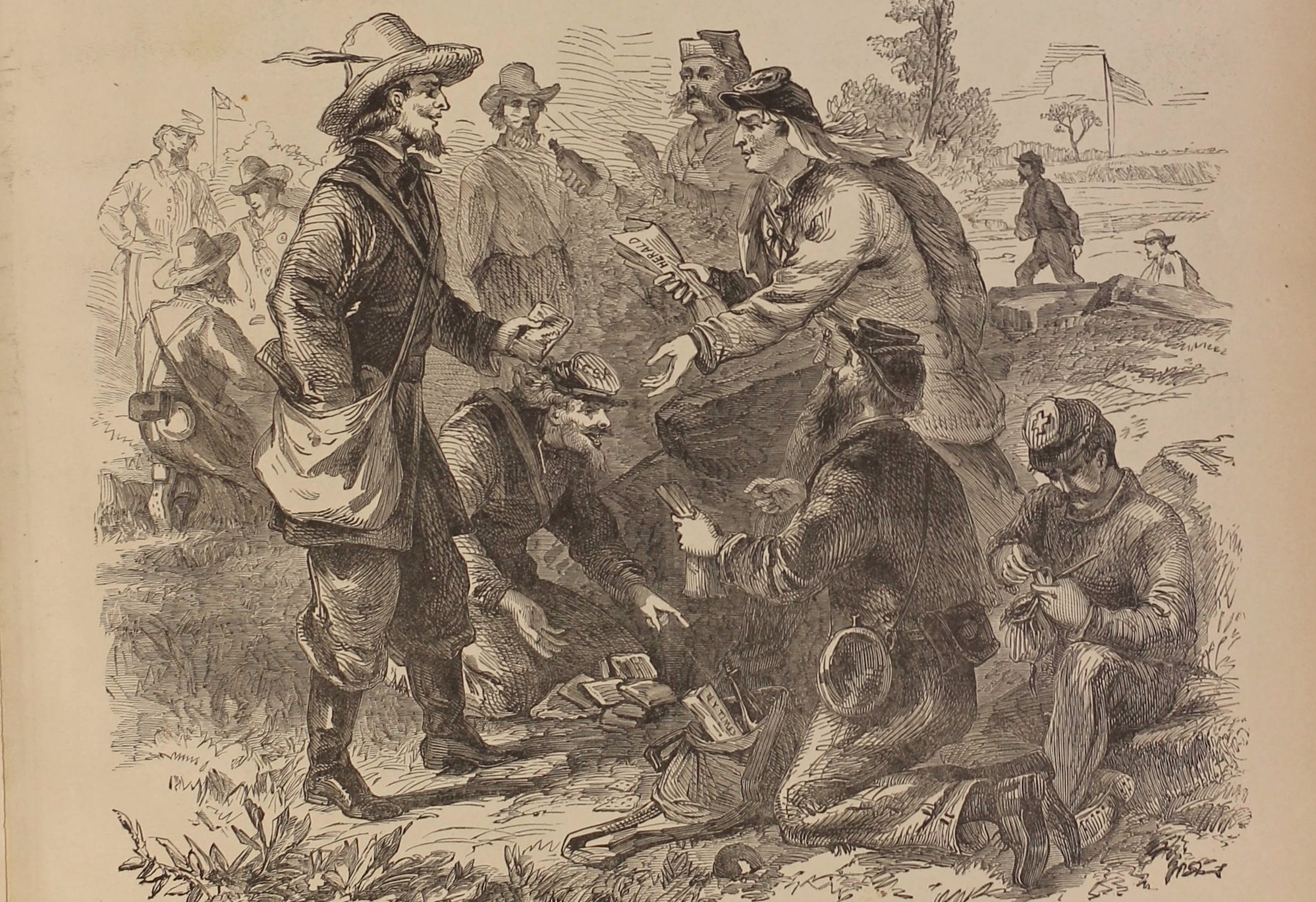
“Had a singular episode this morning. A Johnny raised a little white flag, and held up a paper. One of our boys started on the run with a ‘Herald.’ They met at the Rebel Abbitis, shook hands, and exchanged papers, and both ran back. This was followed by at least a hundred of paper for paper, and coffee for tobacco. The boys were all on the parapet. The scene lasted for about 15 minutes. Then the Rebs called out, ‘Yanks, hunt your holes, we are ordered to fire.’ Down went all heads, and bang, bang, went the guns.”
—Union chaplain Hallock Armstrong, on an incident during the Siege of Petersburg, in a letter to his wife, March 16, 1865
“One day, while on a short scout … I met a body of Federals, under a flag of truce, who were negotiating an exchange of prisoners, the details of which were soon arranged with a Confederate officer. Very soon the Yanks and Johnny Rebs were mingling as if they expected never to shoot at one another again. I had the unusual experience that day of dining with the Federal officers at the house of Judge Vance, a well-known citizen.”
—Confederate cavalryman John Milton Hubbard, on an incident in December 1864 at Hernando, Mississippi, in his memoirs
“A singular incident happened during the night. We struck up a conversation with the Rebels. One of our boys, after talking a long time, found he was talking with an old friend. Inquiries were made for mutual acquaintances, and they had a real social time. Finally they laid down their arms and came together.”
—Illinois soldier Seth James Wells, on an incident during the Siege of Vicksburg, in his diary, May 20, 1863
“Some extraordinary scenes occurred during the armistice. Round one grave, where ten men were laid, there was a great crowd of both sides. The Rebels were anxious to know who would be next President. ‘Wall,’ said one of our men, ‘I am in favor of Old Abe.’ ‘He’s a damned Abolitionist!’ promptly exclaimed a grey-back. Upon which our man hit his adversary between the eyes, and a general fisticuff ensued, only stopped by the officers rushing in.”
—Union officer Theodore Lyman, on fraternizing gone wrong during a pause in the fighting at Cold Harbor, in a letter to his wife, June 7, 1864
 The Soldier In Our Civil War
Union and Confederate soldiers are depicted exchanging items during a pause in the fighting at Petersburg in a wartime illustration.
“During the day a few prisoners were brought back, and among them was a smoke-begrimed captain with gray hair. I invited him into my tent and gave him something to eat. He had been in some of the hardest fighting of the war, and he said to me: ‘You see these white hairs. When I came into the army they were all coal black.’”
—Confederate surgeon Spencer Glasgow Welch, on his interaction with a Union prisoner during the Siege of Petersburg, in a letter to his wife, May 2, 1865
“That night, the cries of the wounded, during the storm which raged, was unpleasant in the extreme. I gave many of the rebel wounded water, and covered them up, for which they were grateful, and would urge me to take money. Our boys would mingle with them with the best of feelings—brave men after a desperate struggle respect each other.”
—Charles Maxwell, 3rd Maine Infantry, in a letter about his experiences after the Battle of Gettysburg, in a letter dated July 25, 1863
“We were so near the rebels that we could pelt them with clods of dirt, on the other side of the works. They threw over an empty whiskey bottle, to show us what they had to drink; and we threw back crackers, to let them know what we had to eat.”
—Stephen A. Rollins, 95th Illinois Infantry, on how his comrades and the Confederates defending Vicksburg interacted during a pause in the Union assault on the city on May 22, 1863, in a letter to his parents, July 20, 1863
“The wearing apparel of many of the guard who brought the prisoners from Leesburg to Manassas was in rather a seedy condition, and after their arrival at the latter place one of our troops approached a very finely dressed Federal officer, and smiling, asked him if he did not feel cheap to be brought there a prisoner by those ragged rebels. The officer replied, ‘you may laugh now, but our men will laugh next week.’ (Alluding to the approach of McClellan’s overwhelming forces.) The Confederate rejoined, ‘I shall laugh at you anyhow now, and take the chances of getting whipped next week.’”
—A soldier in the 6th Alabama Infantry, relating a story about an interaction between a comrade and a Union officer taken prisoner at the Battle of Ball’s Bluff, in a letter to the Georgia newspaper Columbus Sun, October 26, 1861
“I have seen and talked with many of the prisoners taken in the battle. They speak highly of the Southern soldiers, saying that such fighting was never seen before, as was done on the 21st.”
—Captain William H. Mitchell, 11th Georgia Infantry, in a letter about the Battle of Bull Run to the Atlanta Southern Confederacy newspaper, August 12, 1861
“Through the kindness of one of the surgeons (a prisoner, and classmate of mine while in New York), I was permitted to visit the prison and converse with the inmates…. I was … introduced to Col. Corcoran, of the 69th New York Regiment. He is doubtless a brave man and fought on the memorable 21st, for what he deemed principle and the respect he owed ‘the stars and stripes.’ Misguided being! It is a pity that his talent and courage had not been exerted in a better cause.”
—A soldier in the 15th Alabama Infantry, on his visit to Union prisoners held in Richmond after the Battle of Bull Run—including the prominent Irish-born officer Michael Corcoran—in a letter to the Georgia newspaper Columbus Sun, August 31, 1861
“A church in this place is now used for a hospital. At one door lies a man wounded in the left leg, as he says, by a cannon ball, in the battle of Manassas Plains. Yesterday, with some friends, I visited him. We asked what State he was from. He replied, ‘from the United States.’ In speaking of his condition, he only regretted that he was not killed instead of being wounded. We told him that he would soon be well and could get an opportunity of having his desires accomplished. He replied that between his wound and imprisonment he should never be released. With the exception of an embarrassed look of the eye, he had a very pleasant countenance, and conversed intelligently; but when the war was the subject, he displayed a good share of the non-committal policy peculiar to Yankees.”
—A soldier in the 15th Georgia Infantry, recounting a visit to a hospital treating Union POWs wounded at the Battle of Bull Run, in a letter to the Atlanta Southern Confederacy newspaper, September 24, 1861
“Some of the men were communicative, and tried to impress upon our minds that they were not Abolitionists; that they detested abolitionism as much as the Southern people possibly could; and that the abolition of slavery would injure the North as much as the South, and that a great revolution in northern public sentiment had taken place, in favor of slavery, and against abolitionism, since the war commenced. They said that, if the two sections could understand each other, the war would cease, and the Government be restored. The say they never suffer the idea of two governments to exist within the original bounds of the United States to find a lodgment in their minds, and that both must sink forever, or again be united. They thought they would be able to conquer us and establish peace by next spring.”
—A soldier in the 19th Georgia Infantry, on discussions between his comrades and Union soldiers taken prisoner at the Battle of Ball’s Bluff, in a letter to the Atlanta Southern Confederacy newspaper, October 27, 1861
“One poor wretch, shot through the loin, had lain there over twelve hours, in the most excruciating agony. I gave him some water from my canteen, for which he had suffered very greatly, and talked with him a little…. He … said he enlisted because it was most profitable to be in the army, where he was paid $20 per month. He also stated that the forces that assailed this point were paid extra to lead the attack.”
—A Georgia soldier, on aiding a wounded member of the 3rd Vermont Infantry, who had been wounded at the recent Battle of Dam No. 1 and lay exposed between the opposing armies’ trench lines, in a letter to the Savannah Republican, April 25, 1861
“The first day we got on the battleground, I had an opportunity of conversing with one of the wounded who had been left there. He said he was an Englishman and had no interest in the war at all, ‘but,’ he said, ‘work was dull, and they told me the best thing I could do was to enlist in the army; so accordingly they got me drunk and enlisted me.’ He asked for a drink of water which I gave him. The poor fellow died of his wounds a day or two afterwards.”
—J.D. Bethune, 2nd Georgia Infantry, on talking to a Union soldier wounded at the Battle of Dam No. 1, in a letter to the Georgia newspaper Columbus Sun, May 31, 1862
“Our regiment was on picket again yesterday. The Yankees are remarkably civil—as much so, indeed, that there has not been a gun fired on that part of the line for more than ten days. They walk about carelessly, in groups, and wave their caps, handkerchiefs or papers at us; and very frequently (not withstanding very positive orders against having any intercourse with them whatever) exchange New York papers for southern.”
—V.A.S. Parks, 17th Georgia Infantry, on picket life during the Peninsula Campaign, in a letter to the Savannah Republican, June 21, 1862. “Further to the left” of their line, Parks added, pickets “keep up a constant war against each other. A man shows his head at the peril of his life.”
 Harper's Weekly
Union and Confederate pickets meet in the middle of the Rappahannock River in a wartime illustration.
“On our Brigade line there is no firing now, between the pickets on the outposts, and the feds show great anxiety to hold friendly intercourse with our men. They occasionally exchange papers, coffee for tobacco, &c., but all this is contrary to strict orders.”
—A soldier in the 8th Georgia Infantry, in a letter written during the Peninsula Campaign, June 18, 1862
“They carried me … about three miles, now and then taking a prisoner, till they had 27 of us—mostly sick and bare-footed men…. [T]hey treated us very kindly. A great many of them asked me if I wanted some beef and crackers, and coffee water, &c. Had I accepted all their proffered rations, I might have stuffed my haversack, but I only accepted enough to meet my immediate necessities.”
—Confederate soldier R.A. Gaines, relating his experience of being taken prisoner during the Maryland Campaign, in a letter to his brother, October 11, 1862. Gaines, weakened by a “spinal infection,” had been unable to keep up with his comrades on the march.
“There are some very interesting occurrences along our lines—some of them tender and melancholy, others ludicrous and amusing. A short time ago a Federal band came down to the river and played Yankee Doodle; when it had concluded the Yankees cheered loudly; they then played Dixie which caused our boys to cheer as loud; they then played Home Sweet Home, when a universal shout went up from both sides. A pleasant episode in a soldier’s life, and perfectly natural.”
—Andrew J. McBride, 10th Georgia Infantry, in a letter to a friend, May 23, 1863
“Among the prisoners taken this morning I recognized a man who was very active, while I was a prisoner, in relieving the wants of soldiers. In one instance I had seen him divide his rations with a Confederate prisoner. I stated this to his guard, and in a few minutes the fellow was covered with donations. One man gave him a piece of fish, another bacon, and another bread. He thanked them, and said I thought you were all starved here. This is more than I have received in a week. One of our brave fellows asked him if he had a blanket. He replied in the negative, and as I turned off I saw the questioner throw a fine blanket to him.”
—A Confederate soldier, on an incident during the Battle of Cold Harbor, in a letter to the newspaper Atlanta Southern Confederacy, June 4, 1864
“During the short peace established by the flag of truce, the breast-works were crowded and much raillery was interchanged. The Yankee bands came up and discoursed beautiful music, to the delight of our boys. Dixie was given in fine style, and was received by our men with cheers that made the welkin ring. Then commenced the Yankee Doodle, but our boys could not imitate the politeness with which the Yanks had listened to Dixie, and deep groaning ran along our line, interjected with cries of ‘That’s played out,’ &c.”
—An unknown Confederate soldier, in a letter home about the Overland Campaign published in the July 1, 1864, issue of the Georgia newspaper Columbus Sun
“Among the tricks resorted to by the enemy to hold communication was this: They would write anything they desired to communicate upon a small piece of paper and roll it around a Minie or a grape shot and throw it across the line. One of these missles brought the following: ‘Johnny—Will you trade papers with us? … Meet me half way; you need not be afraid of our shooting you. We can have a friendly game of euchre, and wind up with whiskey.’”
—From a letter by a Confederate soldier stationed at Petersburg, Virginia, that appeared in the September 15, 1864, issue of the Alabama newspaper Mobile Advertiser & Register
“Several times the Rebels have called upon our boys to cease firing, and we did as they desired. The boys jumped up, shook their blankets, walked around—as well as talked across to the Rebels, who done the same thing. Each time a Rebel officer would come along and order his men to fire, they would yell to our boys to keep down, as they were ordered to fire again.”
—Union general Robert McAllister, in a letter home during the Petersburg Campaign, September 13, 1864
“Our men & the Rebels seem determined to be together all the time.”
—Michigan officer Charles Hayden, on the frequency of fraternizing among Union and Confederate troops, in his diary, December 23, 1862
“I hope I did not hit any person [even] if they are Rebels. We shook hands after the fight. I was hungry and they gave me some meat and bread that was good sure.”
—Illinois soldier Henry C. Bear, in a letter to his wife after the Confederate defeat at the Battle of Arkansas Post, January 1863
“The Boys have been to gather a number of times … traiding coffee for tobacco, but I do not love them so I could not take them by the hand as some of the Boys did.”
—Union sergeant Day Elmore, in a letter to his parents about his comrades’ interactions with enemy troops during the Atlanta Campaign, July 2, 1864
“I was glad to do a little something for them, even if it were only to turn them on their side, and give them a glass of water. Utterly as I detest a living active rebel, as soon as he becomes wounded and a prisoner I don’t perceive any difference in my feeling towards him and towards one of our own wounded heroes.”
—Union soldier William Wheeler, in a letter to his family about assisting Confederate wounded at the Battle of Gettysburg, July 26, 1863
“We gave them from our own rations some fat meat, crackers, coffee and so forth, in order to make them as happy as we could. We could see plainly that their officers watched our communications closely.”
—Osborn Oldroyd, 20th Ohio Infantry, on his and his comrades’ interactions with enemy soldiers under a flag of truce during the Siege of Vicksburg, Mississippi, in his diary, May 25, 1863
Sources
Soldiers’ Letters, from Camp, Battlefield and Prison (1865); Bell Irvin Wiley, The Life of Billy Yank (1952); Letters Written During the Civil War, 1861–1865 (1898); The Campaigns of the Seventeenth Maine (1866); Letters from a Pennsylvania Chaplain at the Siege of Petersburg, 1865 (1961); The Siege of Vicksburg, from the Diary of Seth J. Wells(1915); Meade’s Headquarters, 1863–1865 (1922); A Confederate Surgeon’s Letters to His Wife (1911); Soldiers’ Letters, from Camp, Battlefield and Prison (1865); Writing and Fighting from the Army of Northern Virginia ed. by William B. Styple (2003); The Civil War letters of General Robert McAllister (1965); Randall C. Jimerson, The Private Civil War(1988); Letters of William Wheeler of the Class of 1855 (1875); A Soldier’s Story of the Siege of Vicksburg (1882).