 Library of Congress
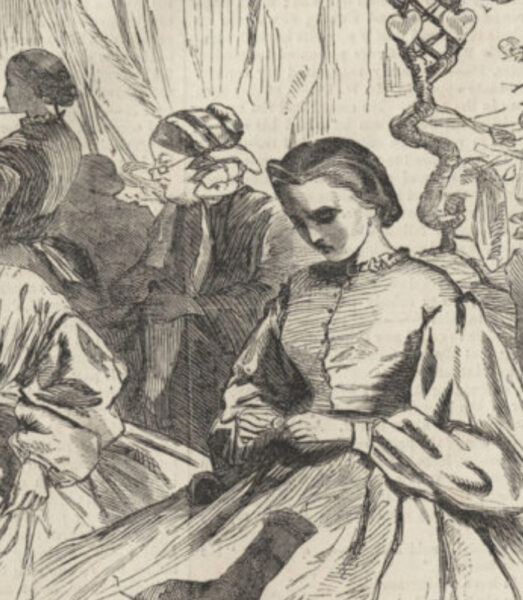
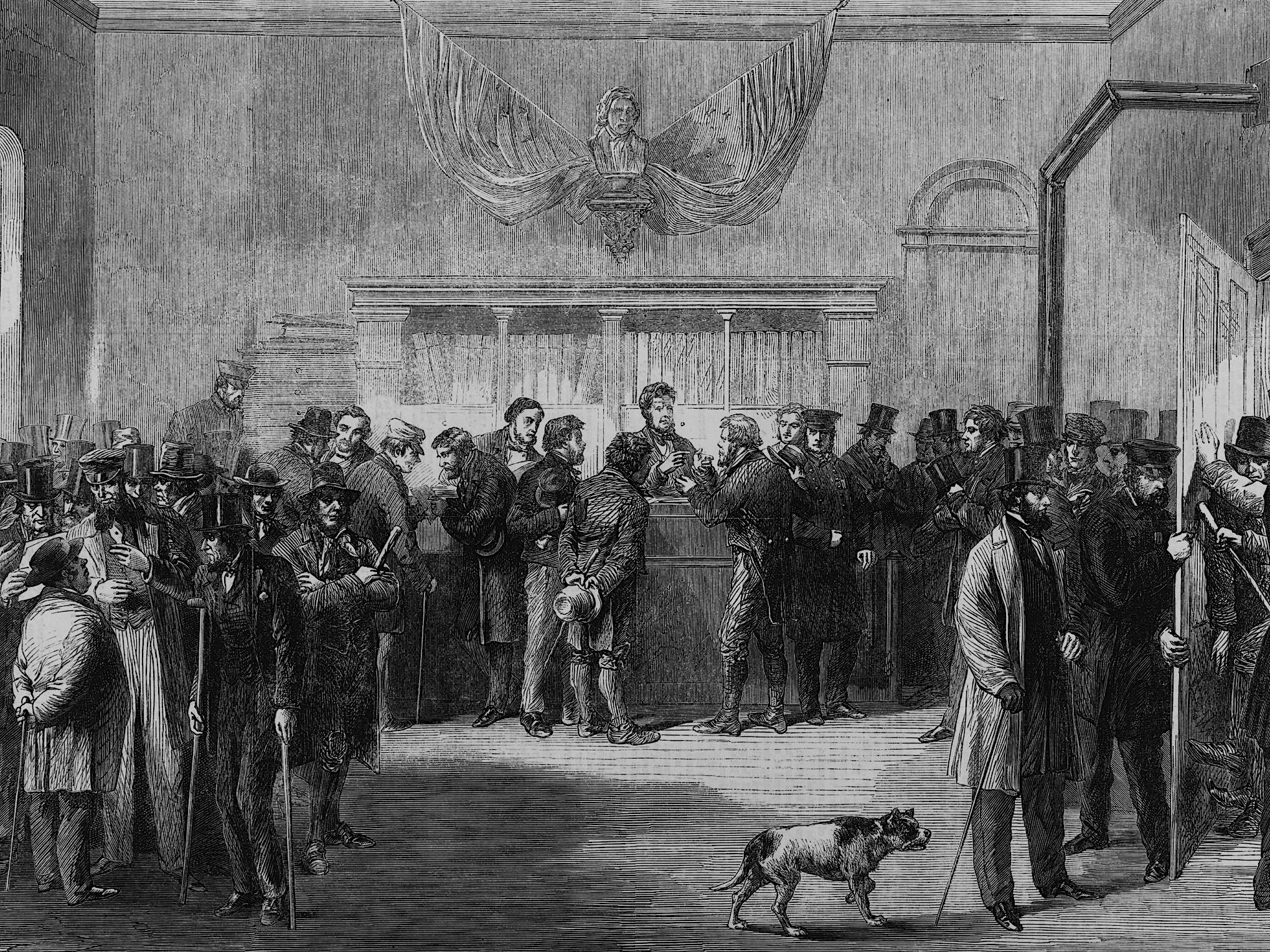
New Yorkers are depicted applying for exemptions from the military draft in an 1863 illustration from The Illustrated London News.
Less than two months after violent military draft protests gripped New York City in July 1863, the editors of The Scientific American reprinted an article from the Philadelphia-based newspaper The North American that highlighted a different—and “sometimes amusing”—kind of draft resistance occurring in that city, as witnessed by a reporter in a local provost-marshal’s office. It’s reprinted below in full:
Experience shows the fact that the two infirmities most common among men in cities are hemorrhoids (piles) and rupture in its various forms. On account of these two affections, fully three-fourths of the applicants for exemption receive their discharge. Rupture is an affection that is in its very nature incurable. Its effects may be palliated, but a ruptured man could not possibly perform a soldier’s duty. Very bad cases of hemorrhoids are equally disqualificatory for military service.
In examining substitutes the most rigid scrutiny is exercised. Many attempts at fraud are made. Men unfit for service sell themselves as substitutes, foolishly supposing themselves able to conceal their infirmities. They little know the ordeal through which they must pass. They entirely overlook the fact that a surgeon, in five minutes, can overhaul them as a watchmaker overhauls a watch. There are abundant attempts at fraud all round. Drafted men claim disqualification on the ground of disability, and men who want substitute money endeavor to conceal their ailments. Both call into practice the utmost skill of the surgeon making the examination.
The substitute, upon presenting himself for acceptance, is taken into a room, where he disrobes himself. The surgeon begins with his teeth, and examines his whole body down to his toes. The examination is even more searching than the examination of an applicant for a policy of insurance upon his life by a life insurance company’s surgeon. If the front teeth are gone, so that the man cannot bite off a cartridge paper, he cannot be accepted for infantry service. He may do for a trooper. Every limb is examined. If the lungs are unsound, the temperament apoplectic, or the system wasting, the Government does not want the man, either as a volunteer, a conscript or a substitute.
The applicant is made to throw himself into various attitudes. His toes and fingers must be practically perfect. He is made to pick up a grain of corn from the ground without bending his knees; to stand upon the points of his toes, and to show that he is perfect in his anatomy. If he stands this test he is accepted, and a release is given to the man who brings him. The substitute then receives his money, and is given into the custody of a guard. He is then a United States soldier for three years.
A little man claimed to be ruptured. The removal of his clothing disclosed a truss with pads about as big as tea saucers, large enough to cover a first-class rupture upon the Belgian giant. The doctor could find no sign of any rupture, but as a rupture sometimes descends or recedes, the man was told to sit down for a while. In half an hour, if it existed, it would be perceptible. The man sat down, in puris naturabilis, upon a chair, trembling like leaf. But the rupture didn’t show itself. The surgeon said that if he could bring a respectable medical certificate of rupture existing, it should have due weight. The man left, saying he would get it. He appeared honest.
Out of about thirty whom we thus saw examined, more than a dozen were badly ruptured: a fact which shows that dealers in trusses do a lively business. One fellow had voluntarily relinquished his front teeth to escape conscription. To his unutterable dismay he was accepted for cavalry service. When he found himself caught, his knees smote together, and his face paled to the whiteness of the paper on which the surgeon wrote his name and condition. He was in splendid health. The gums from which the sound teeth had been violently drawn had not yet receded into position. Very few colored men apply for release. When drawn, they go or else bring substitutes, and few of them do this.
Source:
The Scientific American, September 5, 1863