 Canadian War Museum
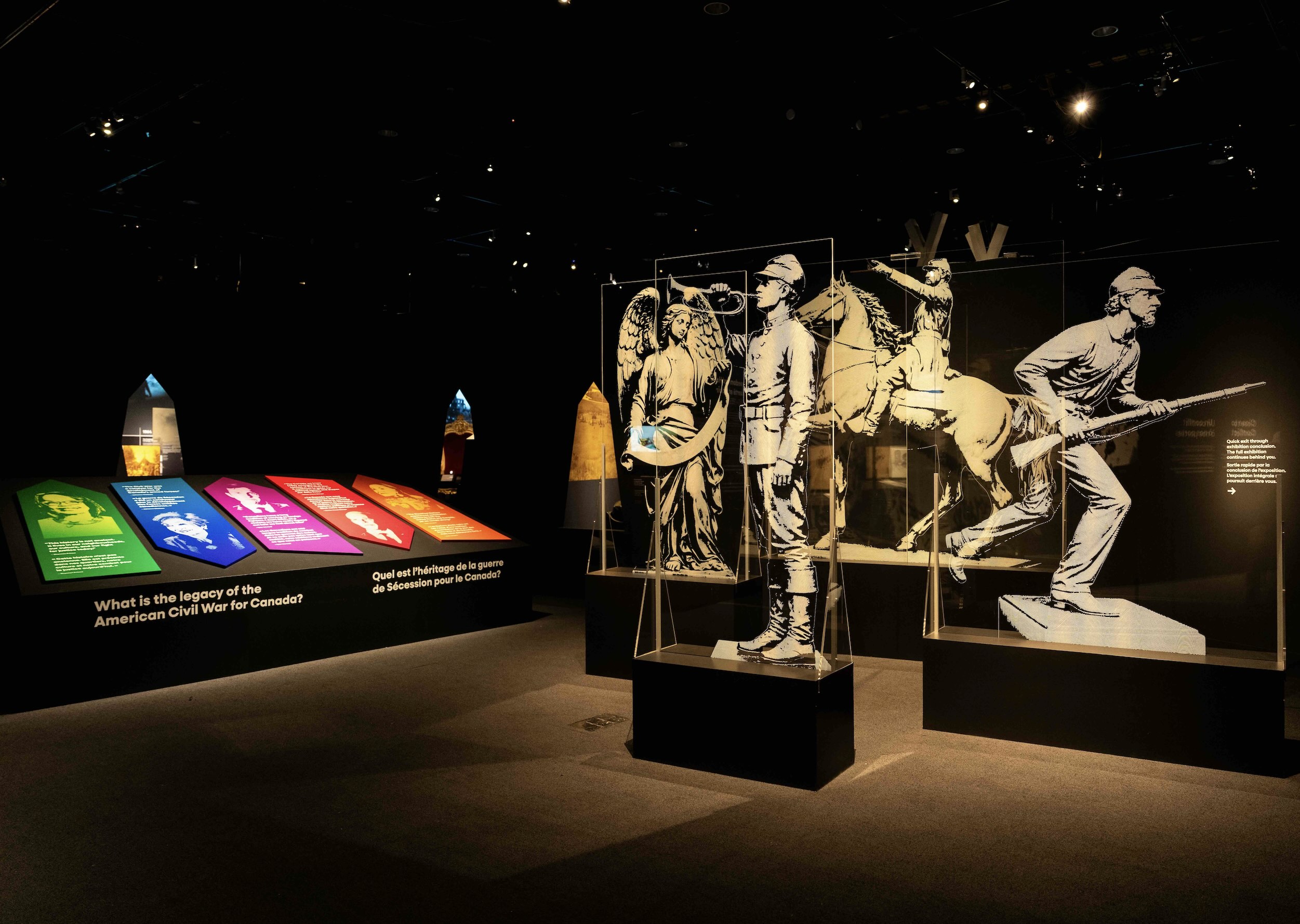
Entry of the Canadian War Museum’s new exhibit, Close to Conflict: Canada and the American Civil War.
I am in a museum in Canada’s capital city, Ottawa, standing in front of a 19th-century border marker, a modest obelisk pulled from the line between our neighboring nations. Already I sense that I don’t know the American Civil War from an international perspective as well as I thought I did. I have spent decades among the war’s battlefields and reenactors, myself among them, and I have always understood the conflict as an American story with American consequences. Close to Conflict: Canada and the American Civil War asks me to reconsider that from my first step inside the Canadian War Museum’s newest exhibit.
“We wanted visitors to experience the historical events through the lens of contemporary relevance,” Claire Champ, the museum’s creative development specialist, says as I stand before the marker, feeling it signal a new threshold in my effort to understand the war and how far its occurrence and consequences reached.
Champ and the exhibit’s curator, historian Tim Foran, accompany me on my walk-through. I will come back alone later, and it will feel different the second time—quieter, mine to misread if I want. But they are beside me now as I move toward a roofline hanging overhead, the shape of a one-room schoolhouse rebuilt here on a smaller scale, standing over a case of artifacts as if it is still beckoning children in from a field in Buxton, Canada West.
Beneath it is a table, four chairs, a screen at each place. I sit, and faces look back at me—descendants of the people this room remembers. Shannon Prince, who helped build it, has already told the curators what she wants a visitor to take away: “This is not just black history,” she said. “This is Canadian history.”
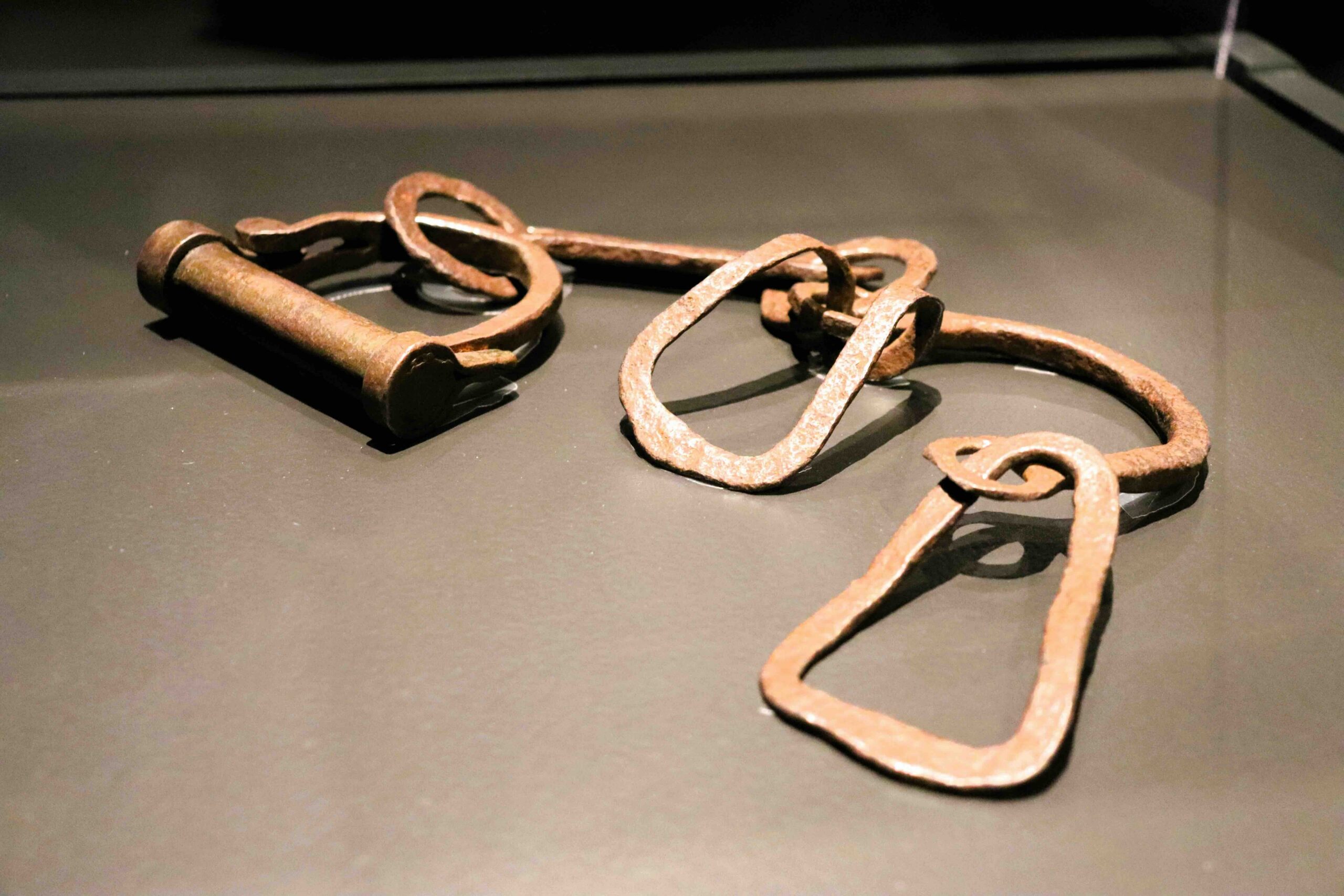
Then I see the shackles. Small enough that I understand what they were made to hold. Open, unlocked, left as if a child had only just stepped out of them—a curatorial choice, deliberate and unflinching, a nod to the enslaved black individuals and families who fled from America to Canada in their quest for freedom. These are the first child-sized shackles I have ever seen in person. What happened to the child who last wore these? Did they live to adulthood? Did they know freedom in their lifetime? The display does not answer me, nor do I think it is supposed to.
 John R. Heckman
Slave shakles are among the many items highlighted in the Close to Conflict exhibit.
Foran leads me into a room that feels smaller than I expected, and tells me why before I can ask: this was never meant to be another museum show about a battle or a campaign. This is an exhibit about consequences—about the deep and lasting impact the Civil War had on its northern neighbor, not what occurred between opposing armies on any one battlefield.
The soundscape hits me before I see artifacts. Somewhere above, a bugle sounds, pulled from a recording of a Civil War reenactment, and my body answers before my mind catches up. I have heard that call hundreds of times from inside my reenactor’s wool uniform, waiting for orders that were never really orders, only theater with real blisters on my feet. “They’re sounding the retreat,” I say to Foran, and he looks at me the way people do when they realize you are not merely visiting a story but have, in some lesser way, lived a parallel version.
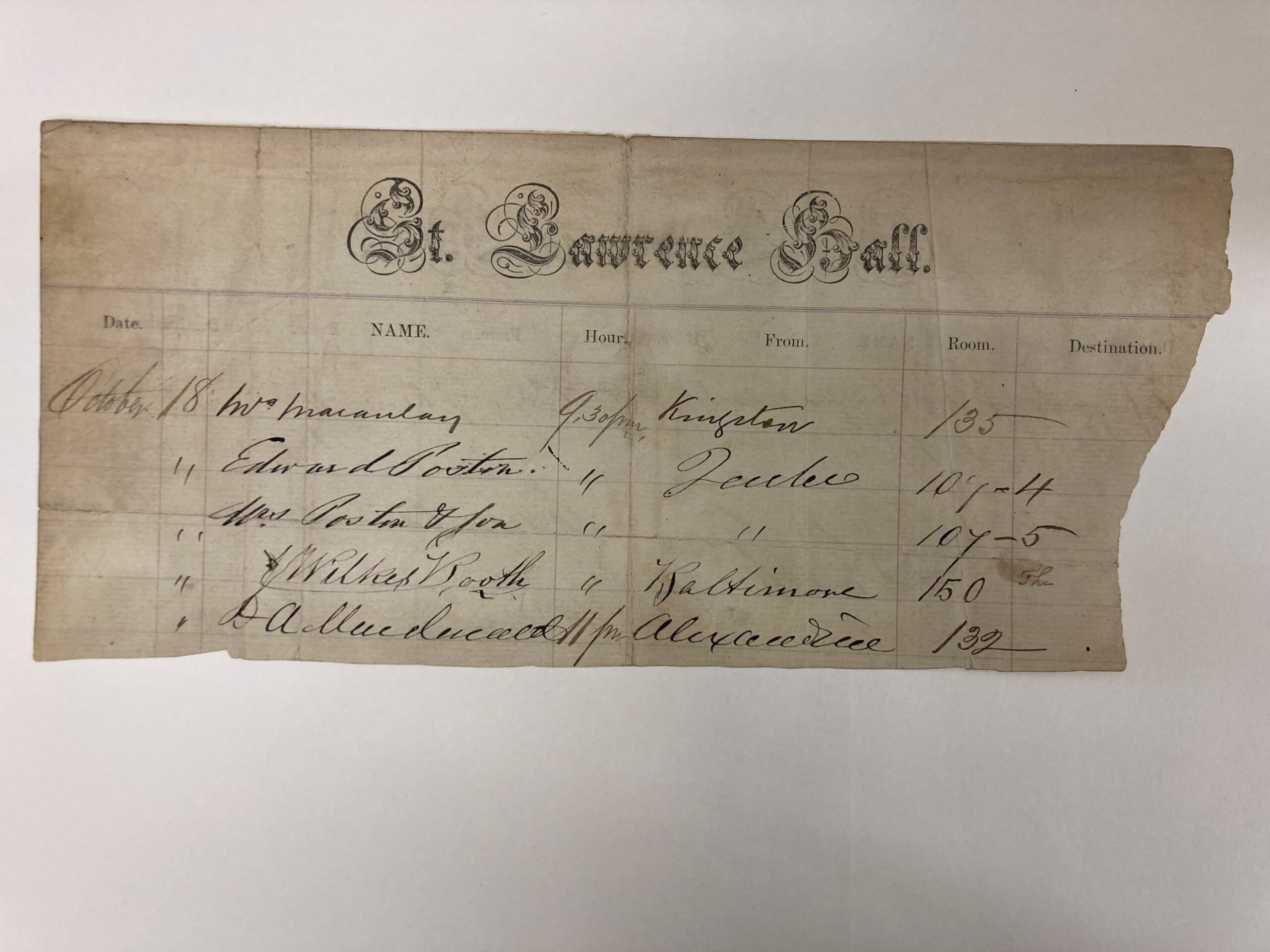
In a display case nearby is a hotel register from St. Lawrence Hall in Montreal, dated 1864. Near the bottom, a signature: John Wilkes Booth. The Confederacy’s Canadian headquarters ran through this building’s rooms, and Booth was one of many Rebel agents and supporters who passed through. I cannot help but connect the possibility that the same hand that signed this register fired the weapon that killed President Abraham Lincoln the following April in a Washington, D.C., theater.
 Canadian War Museum
 John Wilkes Booth’s signature in a register from St. Lawrence Hall in Montreal, dated 1864.
A few steps on I see the uniform of Captain John Lonergan, Company A, 13th Vermont Infantry. His Medal of Honor citation describes how he led his men toward the Confederate position along the Emmitsburg Road at Gettysburg, July 2, 1863, recapturing four Union guns and taking two more from the enemy, along with more than 80 prisoners near the Rogers House. Two years later, Lonergan was organizing armed incursions across the Canadian border, leading Fenian veterans of the Civil War into what was called British North America until 1867, in the cause of Irish independence. Here was a man decorated for valor at Gettysburg who, not long after, tried to invade America’s northern neighbor.
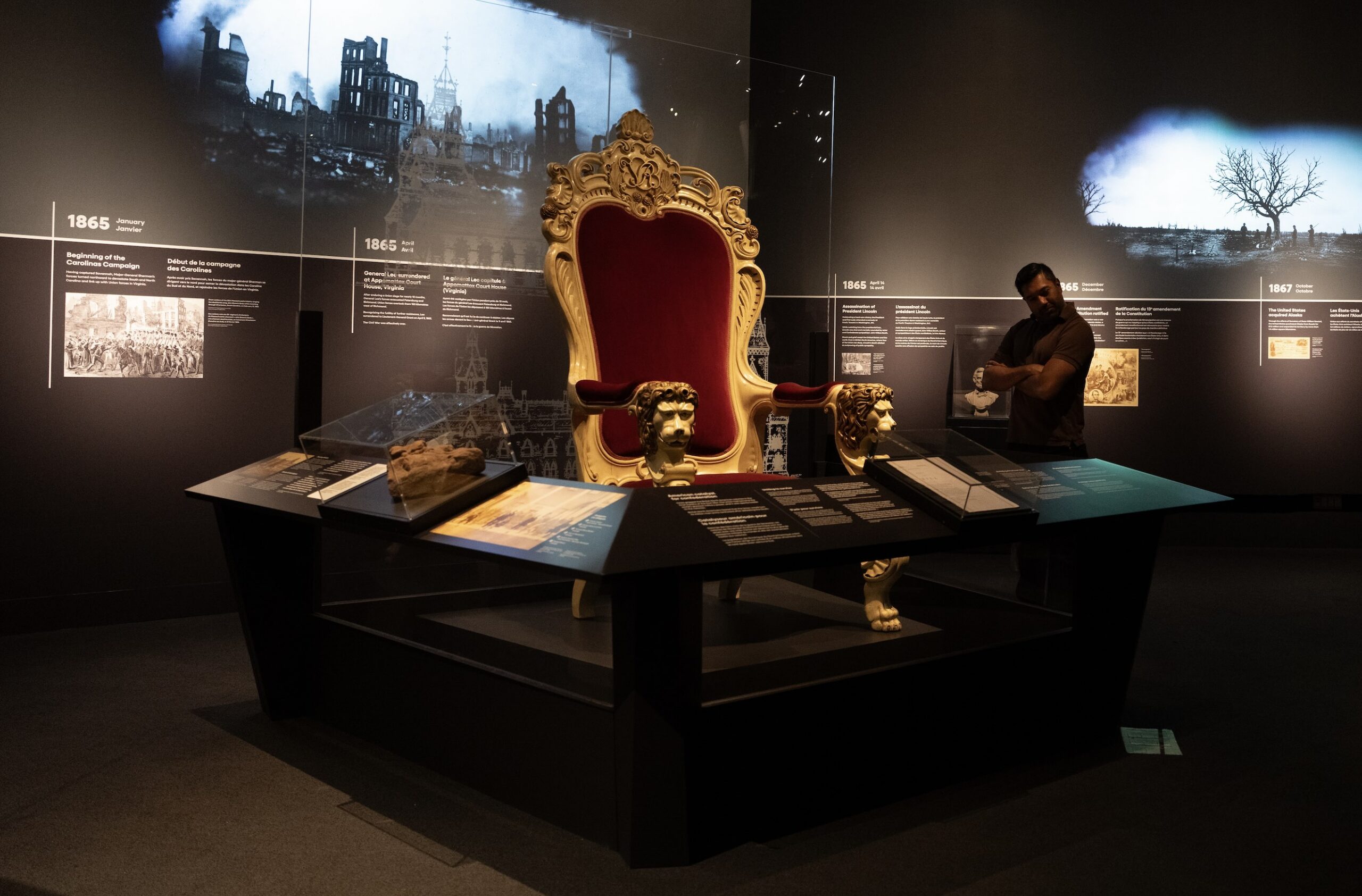
At the end of this timeline along the back wall of the exhibition waits a throne. Upholstered in a red gone dark with age, carved in pale wood, a monogram at its crest—VR for Victoria Regina. Whoever sat here did so as Queen Victoria’s stand-in, on her authority, in a country not yet fully its own. I get close enough to see the detail in the carving before I look up. Behind the throne, looming overhead, is a photograph of a ruined American city. It is Richmond, with its spires and chimneys against a wrecked skyline, the sort of image that needs no caption to read as “aftermath.” Foran does not let the moment pass. “Looming on the minds of those considering [Canadian] Confederation,” he says, “was the destruction south of the border.”
 Canadian War Museum
The throne that serves as the focal point for the exhibit’s back wall.
The throne only magnifies the real subject of this room: what a watchful colony does when it sees, at close range, what a continent can do to itself. Union, for British North America, was born out of more than simply ambition. It was an outgrowth of an American catalyst for Confederation—a need to unify in direct response to a perceived threat of invasion from the U.S. Lonergan’s uniform and this throne are, I realize, part of the same sentence: fear that crossed a border once with rifles crosses it again here as policy.
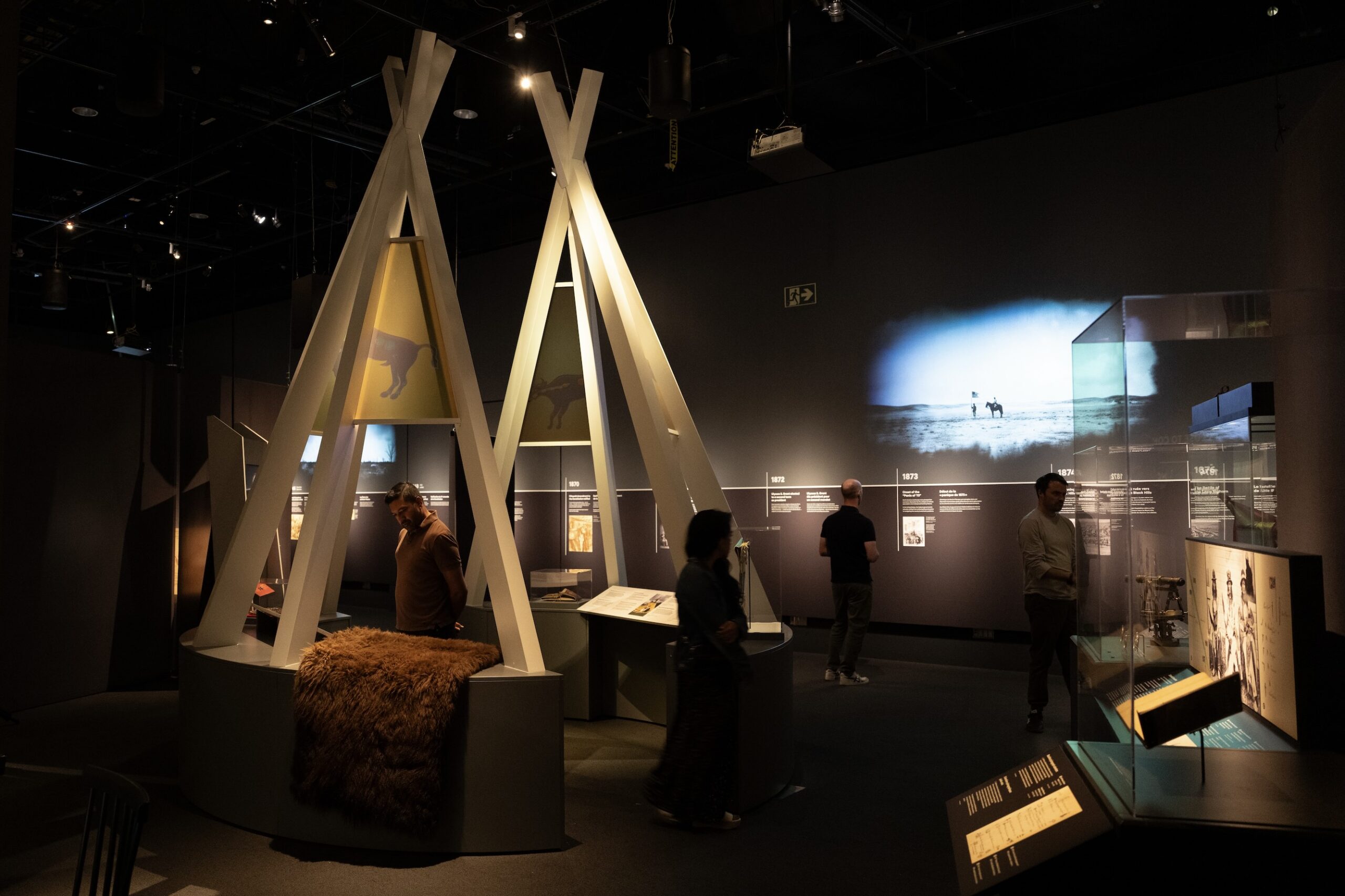
The next room speaks in the first person. A tepee stands at its center, painted, its lines older than anything British about the throne I have just seen. I grew up assuming the concept of Manifest Destiny stopped at our borders. Standing here, I understand it wasn’t contained at all. Canada’s own westward expansion followed hard on the American one, the destruction and casualties much the same. I am left to make that connection myself, and I am not entirely comfortable with how easily I do so.
The tepee’s design belongs to linda manyguns, a Siksiká Elder and Knowledge Keeper, who has left her own words beside it: “This painted lodge was affirmed by the painted lodge holders, then brought to life with songs and stories. It is treated as a child and must be kept in a quiet place and never left alone.”
 Canadian War Museum
A tepee stands at the center of one Close to Conflict‘s exhibit rooms.
Nearby, a buffalo hide is displayed to touch, and I do. Under my palm it is coarse, heavier than I expect. I try to imagine the animal it came from, the plains it once crossed, what it meant to a people whose entire world moved with the herd. It feels less like an artifact than a hand extended across time.
The last things I see are not weapons or portraits or a throne. They are powwow regalia, made for children, worn by children of the Blackfoot Confederacy in recent years. These two items have been chosen deliberately to be the final objects in the room. They do not offer resolution nor do I think they are meant to. Did Canadian Confederation’s push westward do to First Nations peoples what this exhibition has already shown me American expansion did to the enslaved and to the border towns of Vermont? What was the cost paid by people who did not choose the war that caused such things? I leave the room without a satisfactory answer. What I carry out instead is proof that despite everything I have just seen, the Blackfoot Confederacy is still here, still choosing what the next generation will wear, still telling its own story on its own terms. It is the last voice in the room, and rightly so.
I do come back alone and my second walk-through is quieter. For this exercise, I have no one beside me to describe the significance of what I am looking at, only the objects and what I already know of them. Standing again at the border marker on my way out, I find myself thinking not of 1863 but of Foran’s answer, when I asked him which contemporary debate felt most connected to this exhibition. He never named it and didn’t have to. I had already stood in front of a uniform belonging to a man who, two years after Gettysburg, led armed men across this same line, marking the continuation of Canadian anxiety over who might come north, and why, and what it would cost to be ready. That anxiety has a name today, even if the exhibition declines to give it one in bold letters: sovereignty, and the cost of defending it.
John R. Heckman is a doctoral student in Interdisciplinary Humanities at Brock University, studying how people engage with information and memory surrounding armed conflict, especially in digital spaces. A southcentral Pennsylvania native, he has collaborated with museums and archives across North America and Europe and led battlefield tours in the United States, Canada, and France. He hosts the Civil War Breakthroughs podcast and is widely known online as The Tattooed Historian, a legacy project devoted to bringing thoughtful, research‑driven historical scholarship to broad audiences.