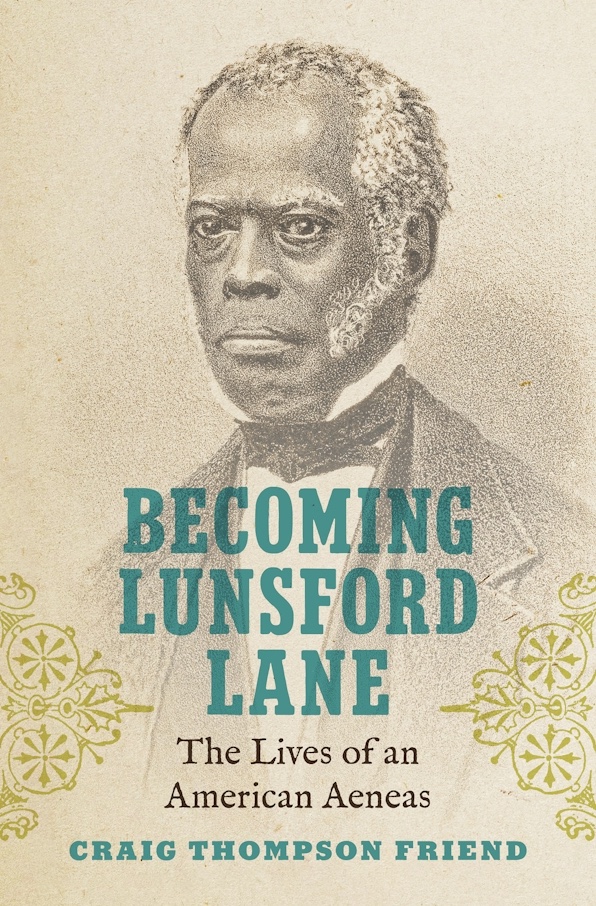
Lunsford Lane is not usually listed among the famous fugitive enslaved people of the nineteenth century United States; he has received just a tiny fraction of the attention scholars have paid to Frederick Douglass, one of his contemporaries. Although Lane is not well-known, his account of his escape from slavery, The Narrative of Lunsford Lane, “crafted a parable from the American myth of self-making, situating him to claim an empowering and rewarding individualism seldom associated with Black American, particularly those enslaved” (3). Craig Thompson Friend, currently professor of history at North Carolina State University, offers the first biography of Lane since William G. Hawkins’s Lunsford Lane was published in 1863. Friend strips away the distortions Hawkins inflicted on Lane’s life, having combed dozens of archives to find the elusive traces of a complex, fascinating, and enigmatic man.
Friend begins with Lane’s parents and their enslavers, the Haywood family of North Carolina. The Haywoods “carved out a notable family presence in Raleigh, overseeing large households comprised of White dependents and enslaved Black folks on cultivated town estates supported by nearby farms. Every Black body signified their enslavers’ aspirations and achievements” (34). Lunsford Lane was born in this milieu. In the 1820s, he met many different people in Raleigh, including the Marquis de Lafayette, from whom Lane “heard of rational liberty and its responsibility for others’ liberty as well” (62). Lane practiced different entrepreneurial activities, but he “was neither singular in his economic ingenuity nor particularly good at it” (69).
For Black North Carolinians, the 1830s were a “decade of turmoil and terror. Laws and judicial decisions asserted White superiority, forcing thousands of Black folks to adjust their lives to new realities” (92). Lunsford Lane enjoyed an “advantaged position” and a privileged reputation” (116), in contrast to many of his fellow enslaved people. With the help of powerful allies like Governor Edward Dudley, Lunsford Lane “pushed the law as far as he could in Raleigh” (118), but he ultimately left North Carolina to raise money to purchase his wife and children. William Lloyd Garrison embraced Lane and northerners eventually opened their wallets to help. When Lunsford Lane returned to Raleigh to reclaim his family, a mob seized him. Although threatened with death, he coolly outwitted the mob. “Abolitionists did not believe in buying slaves, but contended that their masters ought to free them without pay,” he explained, so how could the mob suppose he was working with the abolitionists? Lane survived the mob, though tarred and feathered. Lane reclaimed his family and left North Carolina for Massachusetts.
After he relocated to Massachusetts, Lunsford Lane’s story continued to fascinate northern audiences. He quickly became a celebrity and transformed himself into a popular speaker. In 1842, Friend observes, Lunsford Lane “was among the first of the new heroic age, and according to abolitionist audiences, for all the right reasons: family, manhood, and freedom” (154). Eventually, as audiences began to turn to new people and different stories, Lane “sought to translate his rational liberty into freedom for others” (177). As the United States drew closer and close to civil war, Lane drifted away from abolitionism. This was not surprising because “abolitionism had been moving away from him for some time” (215). Friend explores the tensions in Lane’s marriage (and its eventual dissolution), Lane’s travels from place to place, his haphazard attitude toward mortgages, and the many different things he did (with varying degrees of success) to make a living. At one point, Lane became a doctor, although this proved to be a short-lived career.
In 1863, William G. Hawkins published Lunsford Lane. Friend explores how the book “exposed a tension between Hawkins’s voice and Lane’s experiences, and it was the former that filled the book” (253). Lunsford Lane died in June 1879, alone in a tenement house. He has no obituary, no gravestone, and has largely disappeared from history. Friend ends with Lane’s children and grandchildren, whose histories demonstrate “no remembrances of the man who saved himself and his family” (303).
Lunsford Lane’s story, ably narrated by Friend, provides invaluable insight into slavery, abolition, and race in the nineteenth century United States. While it is true that Lane has largely been forgotten, the life of this American Aeneas will greatly interest both scholars and general audiences.
Evan C. Rothera is Director of Graduate Studies in History and Co-Director of the Civil War Consortium at Sam Houston State University.