HAPPY ANNIVERSARY!
Congratulations on the 10th anniversary of The Civil War Monitor. What an amazing publication with coverage from all aspects: historical data, illustrations, artwork, writing—and all the great stuff that makes it a valuable, delightful, and thought-provoking journal.
All the best.
Dennis McMahon
Burlington, Vermont
* * *
Happy 10th birthday to the Monitor! I’ve been reading the magazine for about 5 years and it’s one of my favorites, regardless of genre. I appreciate all of the work that must go into producing it—both on the part of your authors and your staff. It shows!
Timothy Harris
Via email
* * *
Thanks for the terrific 10th anniversary issue. I read it cover to cover. The feature articles were all good, though I especially enjoyed the books section this time. The suggestions for further reading on guerrillas [“The Five Best Books on Civil War Guerrillas”] and Army of Northern Virginia gunners [“Voices From the Army of Northern Virginia, Part 2: Artillerists”] prompted me to order several new books that I’m looking forward to reading.
Keep up the great work.
Daniel McManus
Via email
THE UNION FOREVER!
In Andrew F. Lang’s article “The Union Forever!” in the fall issue [Vol. 11, No. 3], the author presents a glaringly sanitized account of American governance when he writes that most people in the pre-Civil War era “shared a broad view of Union as a democratic republic ordered by law and constitutional procedure to organize a self-governing society based on natural rights and political equality.” He ignores the important detail that the Constitution of 1787 created a Union government based not only on the principle of liberty, but the principle of ownership of man as well.
The Constitution openly continued the international slave trade for 20 years, allowed slavery in those states that wished to permit it, recognized slaves as property, and fashioned a fugitive slave clause for the purpose of returning interstate runaway slaves by federal authority—all of which managed the ownership of man. The Constitution’s drafting of a three-fifths compromise and an electoral college system granted outright political power to institutional slavery. That power translated into such governmental actions as the Fugitive Slave Act of 1793, the Missouri Compromise of 1820, the Compromise of 1850, the Fugitive Slave Act of 1850, the Kansas-Nebraska Act of 1854, and the Dred Scott Decision of 1857. All were written in the name of the people of the United States as represented by their Union government, and they either helped to protect or expand slavery. Moreover, roughly one in five of us represented in that Union government were slaves in 1790. By 1860 millions of us were enslaved.
The Constitution produced two forms of government—constitutional republicanism and constitutional slavery—and blended them. There is a good argument that the Union government operating between the dawn of the Constitution and the time of the Civil War was destroyed instead of preserved.
Michael Smiddy
Plattsburgh, New York
* * *
Really enjoyed Andrew F. Lang’s piece in The Civil War Monitor on the concept of the Union. Big question is how to translate this concept to high school students. What sources best convey this phrase, identity, value?
Blake Busbin
Via Twitter
Ed. Blake, we forwarded your question to Andrew Lang. He responds: “Abraham Lincoln and Frederick Douglass offered dynamic and cogent definitions of the Union’s founding, purpose, potential, and, in their minds, antislavery basis in ways that today’s high school students can engage and grasp. I would recommend Douglass’ ‘What to the Slave is the Fourth of July?’ (1852), ‘The Dred Scott Decision’ (May 1857), and ‘The American Constitution and the Slave: An Address Delivered in Glasgow, Scotland, on March 26, 1860.’ From Lincoln, I would recommend his ‘Fragment on the Constitution and Union’ (January 1861), Address at Independence Hall (February 1861), First Inaugural Address (March 1861), Address to Congress in Special Session (July 4, 1861), and Gettysburg Address (November 1863). I would encourage students to think about Douglass’ and Lincoln’s logic, their conception of history, and the ways they positioned Union in the national political conversation.”
LEE RECONSIDERED
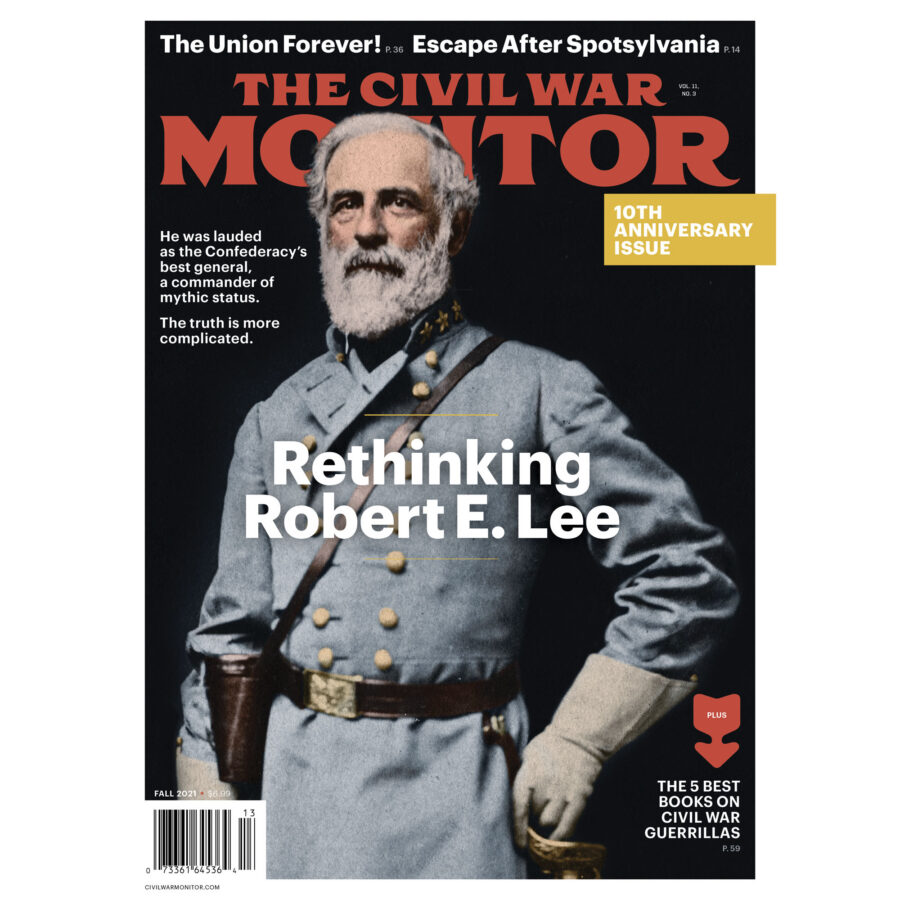
In Allen C. Guelzo’s informative and insightful article “Rethinking Robert E. Lee” [Vol. 11, No. 3], he writes of Lee, “no one seems to conform more plainly to the Constitutional definition of committing treason against the United States….” I must respectfully disagree with the author.
Virginia’s ratification of the Constitution on June 26, 1788, was conditional. That is, Virginia would ratify and remain in the Union so long as the people and their rights were protected from being perverted, injured, or oppressed.
In its April 17, 1861, Articles of Secession, the Virginia Legislature recited the identical reasons (i.e., the people and their rights are being perverted, injured, or oppressed) for withdrawing from the Union and resuming as an independent political entity as before, declaring “said Constitution of the United States of America is no longer binding on any of the Citizens of this State.”
On April 20, 1861, Lee resigned his commission in the United States Army and returned to the sovereign state of Virginia.
Everything here was strictly legal. It would be no different if Lee moved to England, we went to war with England, and Lee fought for the Crown.
Lee may have been guilty of many things, as we all are, but treason was not one of them.
Tom Braniff
Staten Island, New York
* * *
As a longtime admirer of Allen Guelzo’s work, I was surprised to see him fall back on the old chestnut of the Lost Orders as his explanation for Robert E. Lee’s defeat at Antietam in his article “Rethinking Robert E. Lee.” For one, the main change those orders made in George B. McClellan’s tactics—attempting to relieve Harpers Ferry via Crampton’s Gap—was a complete failure due to the incompetence of William Franklin. But more importantly, by the time Lee and McClellan faced off east of Sharpsburg, any advantage gained by the Lost Orders was itself lost as the Confederate army was all back together (with the exception of A.P. Hill’s division which, of course, worked out to Lee’s advantage). In fact, at Antietam Lee got exactly what he was after when he came into Maryland—a showdown with the Union army that had just been defeated at Second Manassas. And he lost. This was particularly evident in those first three hours around the Cornfield when the two sides were of essentially equal strength and the supposedly disorganized, demoralized, and defeated Union troops continually drove back the veteran Confederates, inflicting heavy losses.
Only some incredible luck saved Lee from complete disaster. The Lost Orders had nothing to do with that. It was especially odd to see them relied upon in an article about Lee’s battlefield abilities, as the Maryland Campaign would seem to illustrate both his strengths and weaknesses. Coming into Maryland to draw the Union army out from Washington made complete strategic sense. But taking a stand with his back to the Potomac after half his army had straggled away was tactically ludicrous. Why did he do it? Probably for the same reason he made some other massive tactical errors—attacking Malvern Hill, ordering the July 3, 1863, assault at Gettysburg. He had come to fight and that’s what he was going to do no matter what—a classic case of testosterone poisoning.
Michael Hill
Baltimore, Maryland
* * *
Ed. Thanks, Tom and Michael, for your feedback. We asked Allen Guelzo if he cared to respond to your letters. He writes: “I appreciate Tom Braniff’s query about the legitimacy of Virginia’s secession and Lee’s consequent decision. However, the ratification of the Constitution, as put to the state ratification conventions in 1787–1788, only allowed a yea or nay; as Robert Bork once observed, no attempt at inserting qualifications about amendments, second conventions, or secession had any bearing on the ratification itself, which committed the ratifying states to submit to national authority. That submission was, after all, the primary purpose of the constitutional convention. As Michael Klarman writes in his history of the convention and the ratification process, The Framers’ Coup: The Making of the United States Constitution (2016), ‘While the views of the convention delegates fell along a spectrum, their overall predilection was stunningly nationalistic’ (p. 242). The Constitution itself contains no reversion clause; it grants no dismemberment power to the states, among the enumerated powers of Article 1, section 10; and it describes no mechanism by which secession may be authorized and executed. Secession was a figment of the political imagination; how much a figment was amply demonstrated by the inability of the seceding states to carry out their secession. As for Lee, the oath he took when commissioned in 1829 was to the United States (see the original enabling legislation for the armed forces in the 1st Congress, 2nd session); no one released him from that oath. He was paroled, and subsequently amnestied, but no one ever arrived, or could arrive, at the conclusion that what he did was not treason. That he was never actually tried for treason was not because of any defect in the indictment, but for at least four ancillary complications. I do not enjoy throwing the term treason around; I simply have no logical or legal alternative.
Mr. Hill’s objection is of another nature, and I must say that I could not disagree more. What is true is that the ‘Lost Orders’ had a comparatively limited shelf life. Within 36 hours, Lee was surely aware, if not of the loss of the orders themselves, then certainly that McClellan’s sudden lurch into motion over the Catoctins and South Mountain had decisively altered the strategic picture. But the ‘Lost Orders’ were, of course, the reason for that unaccustomed volatility. Lee’s overall plan in the fall of 1862 was not unlike the one he executed in 1863: Move across the Potomac and into Pennsylvania, wreak havoc of some sort, and let the political fallout pull down the Lincoln administration. There is no evidence that he desired a ‘showdown’ in Maryland. McClellan’s sudden movement caught him with half of his army at Harpers Ferry and the other half stretched mostly between Boonsboro and Hagerstown, and nearly compelled him to terminate the entire plan. And had W.B. Franklin moved more decisively at Crampton’s Gap (and this is a point on which Mr. Hill is certainly correct), Lee would have been faced with far worse than merely a terminated plan. It was only the sudden news on September 15 from Stonewall Jackson concerning the fall of Harpers Ferry, and the likelihood that he could re-unite his army, which nerved Lee to make a stand along the Antietam, largely in the hope that if he could bluff McClellan to a standstill, the way would remain open to Hagerstown and Pennsylvania. McClellan, for his part, downshifted after the fight at South Mountain; but this was because he defined victory as driving Lee back into Virginia, not winning a battle. (McClellan thought South Mountain was the decisive battle.) Hence, the delay of September 16. But all of these falling dominoes, knocking into each other one by one, were triggered by the loss of Special Orders 191. Walter Taylor (and I think even Mr. Hill would yield to Taylor’s judgment) wrote that ‘The God of battles alone knows what would have occurred but for the singular accident mentioned; it is useless to speculate on this point, but certainly the loss of this battle-order constitutes one of the pivots on which turned the event of the war’ (Four Years With General Lee, p. 67). One last point: I have no way of measuring Lee’s levels of testosterone—a mysterious quantity under any circumstances—but Mr. Hill’s characterization of the July 3 attack at Gettysburg ignores the very important and successful precedents such an attack enjoyed in the Crimean War (at the Alma) and the North Italian War (at Solferino), and how very, very close that attack came to success. Reckless was not a word in Lee’s lexicon.”