 National Park Service
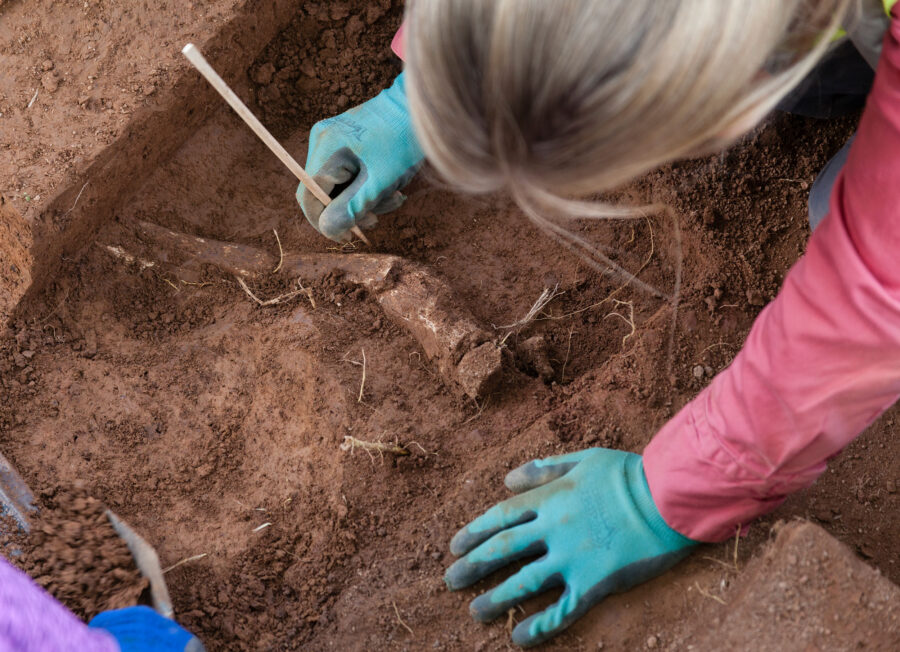
A worker uncovers human remains in a burial pit discovered in Manassas, Virginia, in 2018—a reminder that Civil War soldiers who died in battle were frequently interred near where they fell.
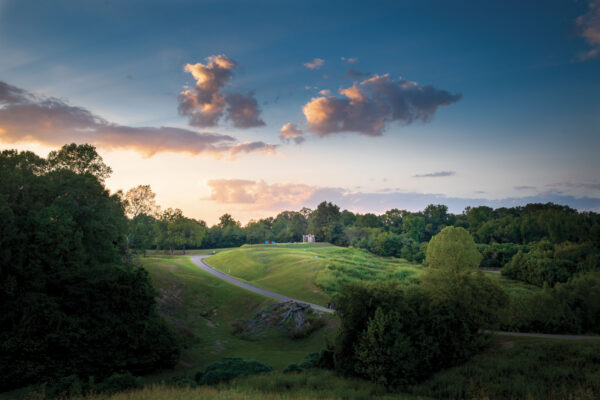
At the American Battlefield Trust, we say it all the time: Hallowed Ground, the name of our membership publication. But “hallowed ground” is more than just a phrase memorialized by Abraham Lincoln. Three times in the past year—in New Jersey, South Carolina, and Virginia—we’ve been reminded that the nation’s battlefields, Civil War and otherwise, are also cemeteries.
We know from first-hand accounts, from photographs, from S.G. Elliott’s exceptional maps of Antietam and Gettysburg, that those who died in battle were frequently buried near where they fell. Great thought and even greater manpower may have been expended later and over many years relocating discovered (and known) casualty remains to more formal cemeteries. But as discoveries in those three states prove, efforts to preserve hallowed ground can be frustrated.
They are only the latest instances of such discoveries. In 1988, it was Antietam where a relic hunter found four wartime remains. In 1996 it was Gettysburg, where erosion exposed remains at the Railroad Cut. In 2008, it was Antietam again, where a hiker spotted a bone and a button disturbed by burrowing animal activity. In 2009, it was Franklin, where a backhoe operating on a commercial development project found a burial. In 2011, it was Wilson’s Creek, where a canoer found and removed—and was later prosecuted for doing so—several human bones exposed in an eroded embankment. In 2018, it was Manassas, where a surgeons’ amputation pit was uncovered, holding remains of all sorts from wartime.
With such powerful periodic reminders, it is hard to understand how so many people no longer remember that these places contain long-dead and forever-unknown warriors. I can’t accept that people knowingly wish to build strip malls and distribution warehouses on top of or overlooking such vast cemeteries.
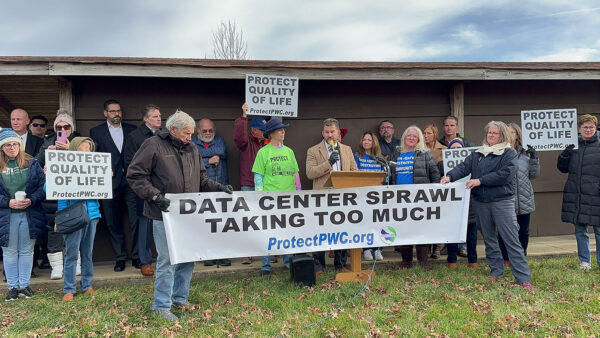
I look at the mega-development proposed near the Wilderness—where developers plan for 5,000 residential units, 200,000 square feet of mixed-use commercial development, 5 million square feet of data centers and distribution warehouses, plus space for additional light industrial use—through my critical historical lens. With the underbrush alight and the wounded burned to death, the 1864 battlefield I imagine must still be home to combat dead. To stand against the tides of erasure, I remind myself that we are taking a stand for those who lie there still. The Trust and its allies—members and supporters like you—must be their voice.
The next time you visit a battlefield, pause as you gaze across the open fields and offer a moment of silence for the many unknown buried there. Join me in offering a silent pledge that you will remember, that you will honor, and that you will fight to ensure their final resting place is treated with respect.
David Duncan is president of the nonprofit, nonpartisan American Battlefield Trust, which is dedicated to preserving America’s hallowed battlegrounds—Revolutionary War, War of 1812, and Civil War—and educating the public about their significance.