 Katherine McIntire Peters
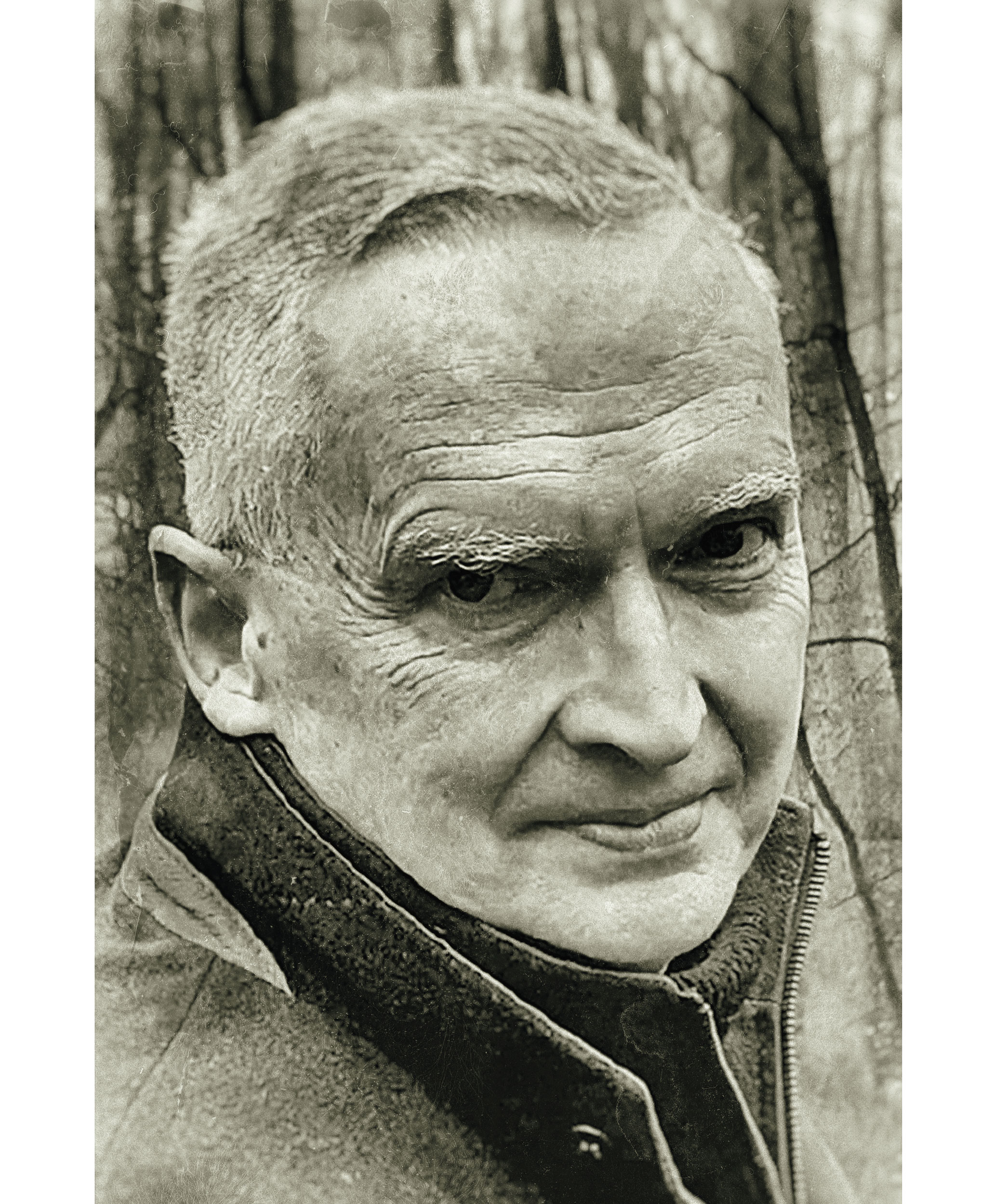
Author Ralph Peters
With good reason, Ralph Peters calls his “a wonderfully fortunate life.” When he retired in 2001 from 22 years in the Army—a career begun as an enlisted man and ending as a lieutenant colonel and decorated intelligence officer—Peters had walked the halls of the Pentagon and the White House and traveled from the Kremlin to the Andes, from sub-Saharan Africa to Central Asia. He had learned other languages, spoken and read in them, and come to believe himself a writer at his core. In and out of the service, Peters has authored 34 books and over a thousand articles on a range of military and security topics, and enjoyed both peer praise and commercial success. In his second career, he wanted to write full time.
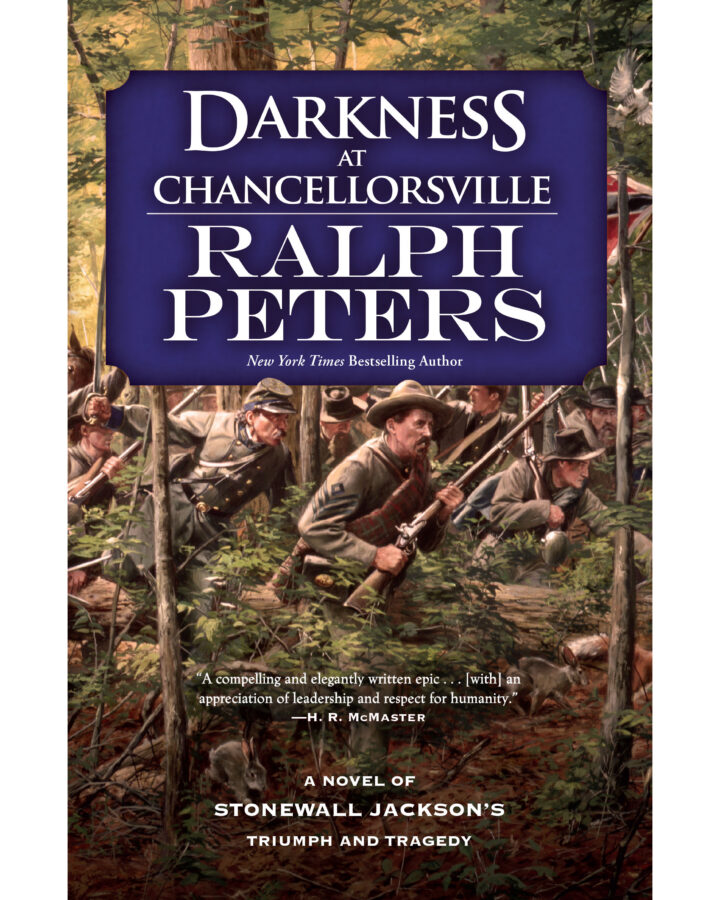
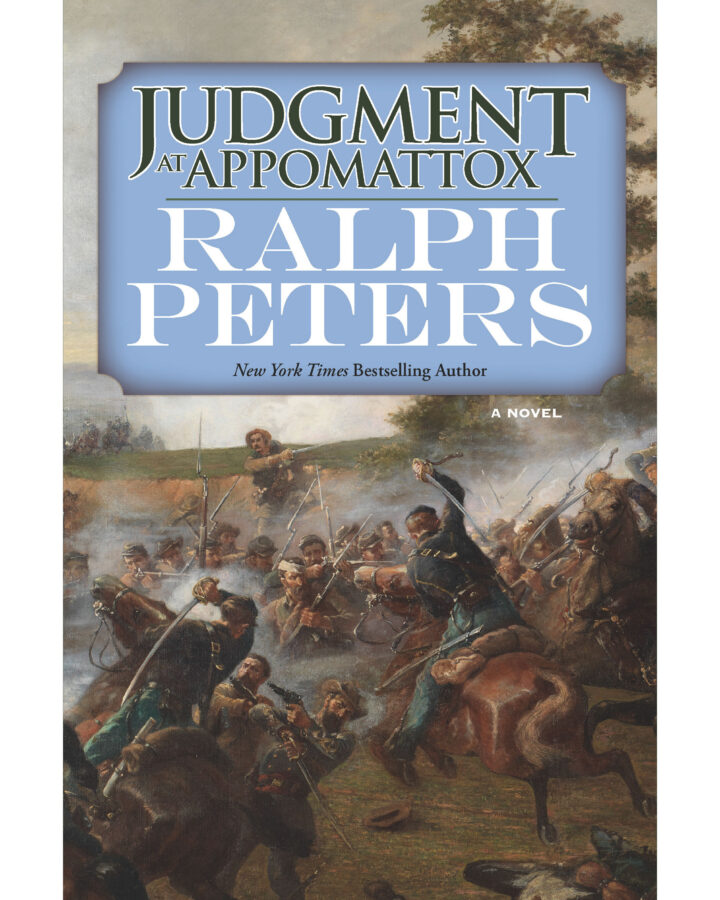
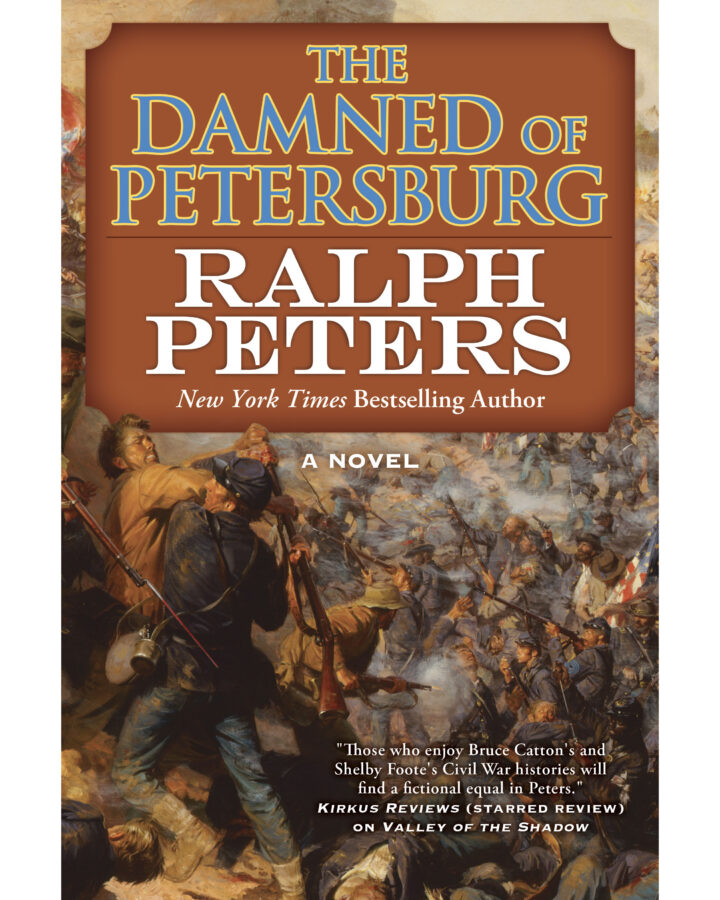
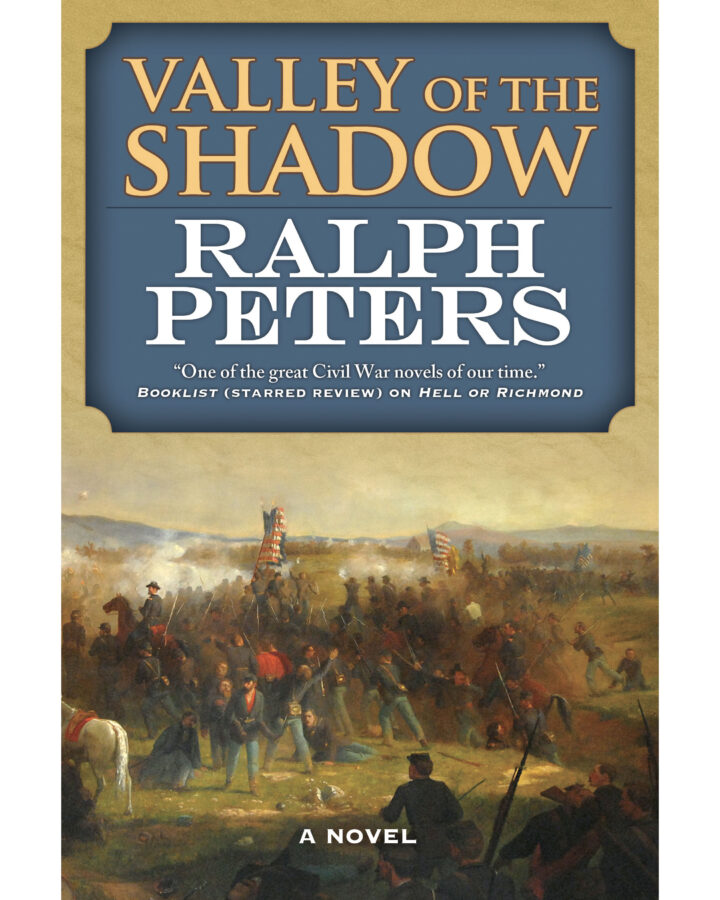
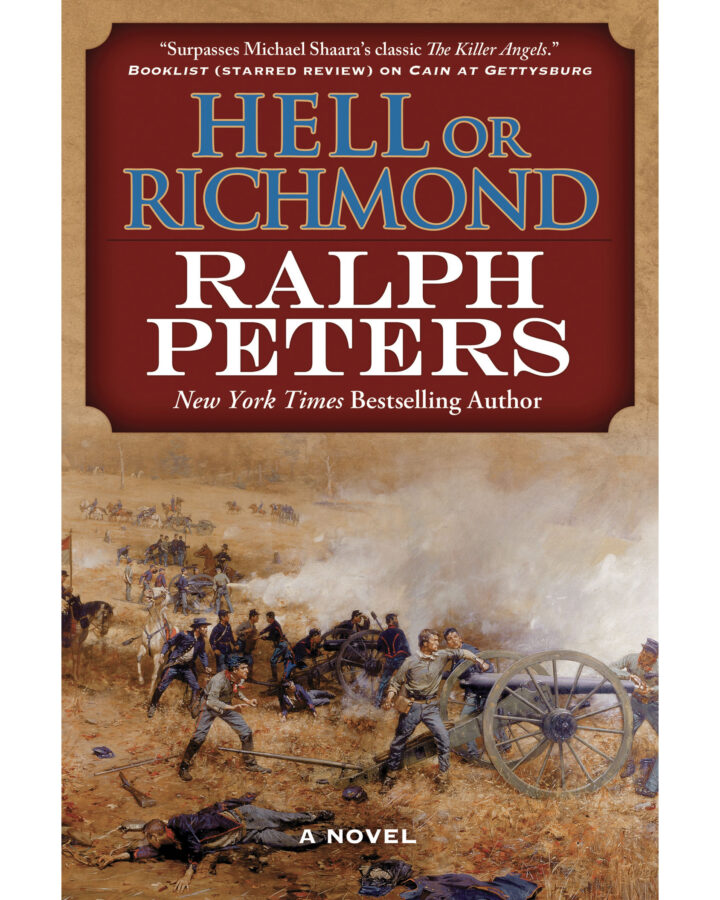
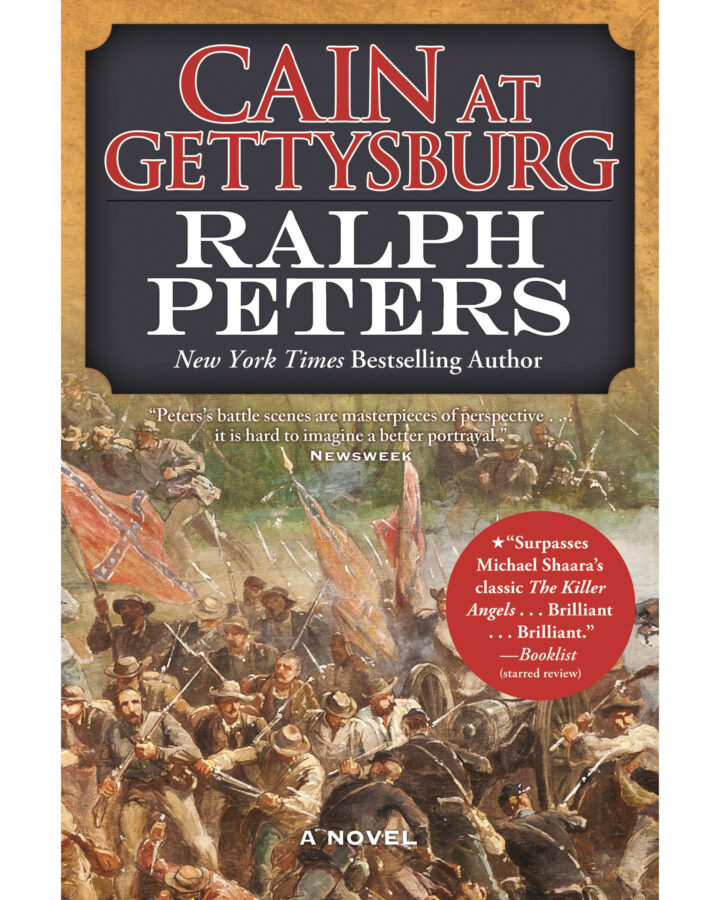
Peters first imagined a fictional “Civil War detective series” starring a sleuth named Abel Jones. After a sixth book finished that series, he embarked on what he considered his life’s work: three “big” Civil War novels that would follow soldiers and officers from Gettysburg to Appomattox. He began in 2012 with the award-winning Cain at Gettysburg, but halfway through the second book, Peters determined he would need five volumes to tell the story. Detailed, descriptive, tactically accurate, and bloodily realistic, The Battle Hymn Cycle concluded in 2019 with a sixth book, a prequel titled Darkness at Chancellorsville, the author’s treatment of the towering presence of Stonewall Jackson.
With that, Peters reckons he has mustered out of the fellowship of Civil War authors. He may be finished (as he put it, “No fresh insights? No more books”), but his characters now live and breathe with a power far beyond straight history. Peters believes he somehow went from chronicling history through diligent, painstaking research to channeling his characters, becoming “a vehicle for their voices,” an opaque but essential aspect of his creative process. He also feels that his time as a hard rock guitarist in the late 1960s helped his writing.
A strange trip indeed.
Peters felt the pull of Gettysburg growing up in eastern Pennsylvania. “[M]y father took us—my mother, brother and me—to Gettysburg every Memorial Day, and sometimes on Labor Day.” Given the avalanche of Civil War items that accompanied the 1963 centennial celebration, Peters “immersed [him]self in the subject.” He collected magazines, toy soldiers, and books (Charles Flato’s 1960 work The Golden Book of the Civil War being a favorite). He and his father attended the reenactment of the Battle of First Bull Run in 1961, although he was disappointed the viewing stands were so far away. “I expected bayonet fights within spitting distance,” Peters said, but that hardly dimmed his ardor. “The Civil War captured me and has never released me.”
He grew up wishing both to join the Army and be a writer, but like a lot of teenagers then, Peters heard the siren call of rock. Guitar gods like Eric Clapton, Jeff Beck, and Mike Bloomfield grabbed his attention, and he became lead guitarist of various bands working the eastern Pennsylvania–New Jersey circuit. “I was flamboyant [and] charismatic,” he remembered, “and supremely lacking in musical talent.” Now he reckons “an ear for music and an ear for language are aspects of the same characteristic.”
Peters graduated from Penn State University and enlisted in the Army, but his interest in the Civil War was unquenched. “As a junior officer, I bought the Morningside reprint of the Official Records on the installment plan—a purchase which, at the time, I could ill afford.” His ensuing international experience as an intelligence officer helped develop his love of language—he speaks German, Italian, and Russian—and deepened his appreciation for English. Both are crucial to the success of The Battle Hymn Cycle. He admits a debt to Ricarda Huch’s trilogy on the Thirty Years’ War, a “dramatized history” he read in the original German and “the best portrayal I’ve encountered, in any language, of how a society degenerates under the stress of extended warfare.” Peters’ own command of English (“the richest of all languages and the most versatile”) and its varied American dialects gives his work a singular brilliance.
Peters recalled, “Growing up in the Pennsylvania anthracite fields, I heard daily the rich, often musical accents of immigrant descendants in a melting pot that had not yet quite melted…. Irish, Welsh, Slavic, Italian … towns and even neighborhoods ‘sang their own songs.’ The voices, North, South, or immigrant, in the books were the soundtrack of my life.” His linguistic studies in the service included learning from Americans from every part of the country. “Lord bless the Army,” he said. “Anyone can learn quickly to distinguish an Ozarks accent from a Mississippi Delta accent … but distinguishing Low Country speech from up-country Carolina can be hard. And the nuances are very, very important in recreating the past.”
Peters’ subjects sound remarkably like they should. “Francis Channing Barlow has to sound like a Boston Brahmin schooled by the Transcendentalists,” he explained, “and William C. Oates—that magnificent savage of the battlefield—has to sound Alabamian.” As well, “a cultivated Virginian and a Louisiana politician did not sound the same.” If one stricture guided his efforts to channel the spoken word of the Civil War, it is: “To write about our past, I believe you must love and celebrate the many wonderful varieties of American English.”
Peters also mined his Army experience to capture how officers spoke to each other. “The specific vocabulary may change,” he explained, “but the human interactions are enduring.… Officers speak one way around enlisted men, another around subordinate officers, yet another way among peers.” And to those expecting 19th-century formality? “Those officers, North and South, who had West Point backgrounds knew each other so well from extended assignments to isolated posts out West that, unless it involved Lee, it would have been hard to maintain strict formality. You couldn’t keep much secret while serving in close quarters at Fort No-Name. They knew each other’s secrets.”
To the critiques of the characters’ rough language, the author recounted, “In my own military career, I frequently was astonished by the creative, imaginative, and incisive use of obscenity by NCOs. The drill sergeants were brilliant vernacular poets, and our running and marching cadences—now banned—were brilliant at a level no officer, with his instinctive adherence to grammar and inflexible meaning, could begin to match.” Of the common soldier, Peters added, “I’ve actually had people say, or write, that ‘They didn’t curse back then,’ which tells me that they’ve never noted how many ways a young soldier can misspell a four-letter word. Indeed, some religious-minded soldiers and officers did not curse—but the average soldier was the timeless average soldier. The soldier or leader in the heat of battle did not, and does not, speak in the stately, mellifluous tones of a kindly Victorian parson.”
Another Victorian nicety for which Peters has no use is the relatively bloodless, romantic approach to presenting the nature of war prevalent in movies like Gettysburg and Gods and Generals. Never has the day-to-day trial of the Civil War soldier been more descriptively revealed than by Peters, from the mental stresses of long campaigns to the gastro-intestinal tribulations of life in the direst of unsanitary conditions. Additionally, the sheer terror of his battle action rivets the reader, reminding all how violently bloody the war was. “I wanted to give readers a vivid, visceral, living portrayal of the final two years of the war in the East—when warfare became modern,” he said. “My sense is that the battles of the first two years are better known—more popular—for several reasons, including that this is a rare war after which the losing side wrote much of the history, and the South did well from 1861 until July 1863. Also, you can still ignore the gore and close your eyes to the horror and superimpose a romantic vision on those first two years—but not on the grim, grinding industrial-scale warfare of the Overland Campaign or Petersburg.” As he noted, “Warfare changes between The Wilderness and the Army of the Potomac’s arrival before Petersburg, and it’s hard to impose a romantic interpretation on Cold Harbor or The Crater.”
Nowhere is the effectiveness of Peters’ approach more startling than in the death scenes that anchor the narrative. “The key to writing death scenes, be they abrupt battlefield deaths or lingering torments, is not to romanticize them. The most effective approach is to portray the event straightforwardly and let the reader supply the emotion based on his or her perception of the character’s worth.”
Writers of historical fiction have to confront the almost universal criticism that they put words in the mouths of historic figures. An author presuming to know what Robert E. Lee, Ulysses S. Grant, Francis Barlow, or John Gordon were thinking or saying at any given moment treads dangerous ground. Peters sees his work closer to cinema. “I don’t regard my books as fiction,” he noted. “They’re hybrids, docudramas, for want of a better term. The historical details are precise. The only ‘fictional’ aspects are that I try to understand the thought processes and expand the dialogue-of-record to get the generals down off the monuments and back into flesh-and-blood form.” That’s not to say Peters hasn’t done the digging. His compulsive dedication to accuracy has led him from the many volumes of the Official Records to practically every written word on the war in the East from Gettysburg to Appomattox. He admits, “Those last six books utterly drained me—they literally aged me: My commitment to getting each detail right, down to the weather at a given time of day, became an obsession, and all obsessions have destructive force.”
Yet all the research in the world won’t unearth the nature of John Gordon’s desire for his wife, or the effect of Joe Hooker’s teetotalism on the Chancellorsville Campaign, or the degree of Robert E. Lee’s mental and physical anguish on the North Anna. Peters’ ability to illuminate interior processes and unrecorded conversations rests on something beyond his extensive research. “I hear them,” he said. “I don’t force lines into characters’ mouths. I study them until I can be a vehicle for their voices. For me, it’s just a matter of opening my ears. The characters want to be heard and don’t need to be coaxed to speak.” Peters attributes this skill to his lineage: “A fickle degree of clairvoyance runs in both sides of my family,” he said. “As an intelligence officer, I could ‘get’ things that seemed opaque to others.”
Peters employed another resource in the battlefields. “I generally visit battlefields alone and anonymously. I’m there to visit the dead. Walking—sometimes lying down or crawling—by myself, I open myself up to the ghosts; sometimes they come, sometimes not.” His process involves years, not hours. “I make multiple visits—and have been visiting some of those fields since childhood” he said. “I always visit at least once on the day, or in the week, of the fighting, for the heat, humidity, foliage and atmosphere, but I also visit off-season, when the leaves are down and you can really see the contours—which can explain many a surprise that occurred when the foliage was midsummer thick.” Peters shares the goal of the hundreds of thousands who trek America’s hallowed battlegrounds: “I visited many a battlefield, trying, always, to understand the men of the times and the decisions they made, on their own terms, not merely with the advantage of hindsight. Indeed, for me the key word has always been ‘understanding.’ I wanted to understand those generals and privates as best I could, not merely to collect data about them. War is, ultimately, a contest not just of bodies but of souls—and the best way to channel those souls is to walk and even crawl the battlefields, preferably alone, so the ghosts feel comfortable revealing themselves.”
Ralph Peters has no intention of resting on his laurels. He turned 68 in April and has two books about the Cold War in the works, but he looks back on The Battle Hymn Cycle with great satisfaction. “I feel I accomplished what I hoped to achieve,” he said. “I know of no other series of books, fiction or nonfiction, that gives so rich, human, and vivid a panorama of the last two years of the war in the East. Yeah, it sounds vain, but I’m proud of these books. I consider them my life’s work.” Perhaps his greatest satisfaction comes from the response of the Civil War cognoscenti; “I’ve had a very positive and generous-spirited response from most of the Gettysburg-supporting community,” he said. Of course, comparisons of Cain at Gettysburg to Michael Shaara’s The Killer Angels are inevitable. Of that groundbreaking work, Peters said, “I think The Killer Angels remains the finest Civil War novel for the general reader—it’s an enchanting romance of battle, while my books are gritty and too frank for some readers.” Perhaps it is time for Americans to confront the harsher elements of their history. “I’ve been honored and delighted by the overall response to the books from knowledgeable readers,” Peters said.
For all the author’s passions—for history, for literature, for the Civil War, for language, for the Army—a single dictum appears to ground his writer’s instinct. “We humans crave stories … so I try to teach my fellow Americans about our shared past by telling great stories—or, to be more precise, by helping those grand stories tell themselves.”
Grand stories, indeed.
Patrick Brennan, a member of the Monitor’s editorial advisory board, is a music producer, writer, and historical consultant based in the Chicago area.