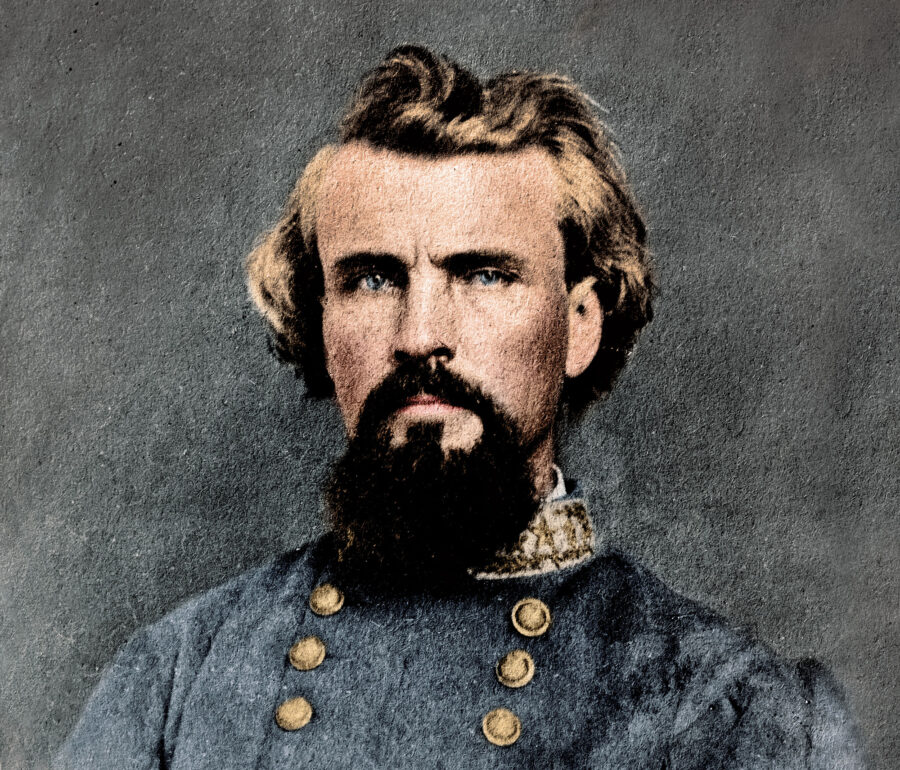
 Library of Congress, colorized by Mads Madsen of Colorized History
Confederate cavalry general Nathan Bedford Forrest
“Sing, goddess, the anger of Peleus’ son Achilles and its devastation,” begins The Iliad, Homer’s epic of war.1 Anger, rage, animosity, hatred—these emotions are inimical to war, and no study of armed conflict and interpersonal relations can ignore their consequences in shaping war. Like all wars, the Civil War had its share of conflict within as well as between armies; feuds, disagreements, and personality clashes not only helped define the opposing forces and their leaders, but also influenced the very course of the war.
The Confederate cavalry general Nathan Bedford Forrest, as maligned for his political and racial views as he is praised (by some) for his martial ability, certainly understood rage. Never a man to withhold his opinions or criticisms, Forrest soldiered as much by instinct as by knowledge and experience. While his temper was legendary, he seldom seemed to completely lose control of his emotions, even when sorely tested by circumstances or personalities. More often than not, Forrest’s anger was reserved for superiors he found wanting; while he certainly could, and did, blow his top, he also seemed able to move past controversies and let go of grudges. And this proved to be a good thing, for as we continue to learn, anger in war can have corrosive effects that linger for years. Studies indicate that veterans lacking the capacity to manage their anger and exercise self-control suffer higher instances of depression, post-traumatic stress, and other problems long after their active service concludes.2
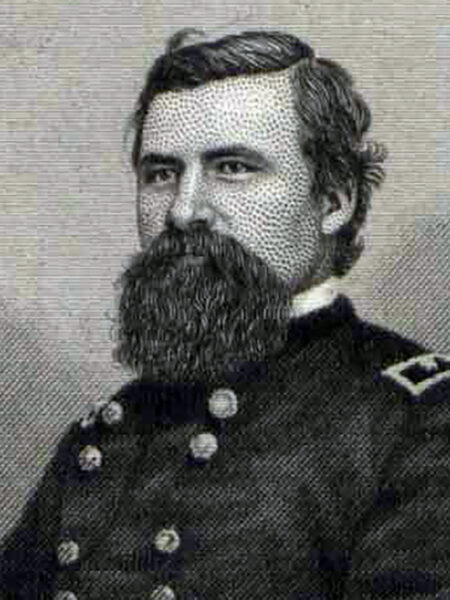
One of the most infamous episodes of Forrest’s anger occurred late in the 1864 campaign into Tennessee, when he clashed with his young and aggressive commanding officer, John Bell Hood. Hood’s army had pressed Union forces hard in November, and by the 30th of the month had dogged enemy forces to the outskirts of Franklin, a town just south of Nashville. As Hood rode up the crest of Winstead Hill, a low eminence outside the town, he had a clear vantage of the surroundings, including a panoramic view of the enemy defenses ringing Franklin.
No doubt an earlier encounter with Forrest must have weighed on Hood’s mind. When Hood initially arrived at the Harrison House on Columbia Pike, he and Forrest briefly conferred about the Union dispositions ahead. Forrest, according to his 1899 biographer, proclaimed the enemy position to be “exceedingly formidable, and that in his opinion could not be taken by direct assault, except by great and unnecessary loss of life.” Hood reportedly answered, “I do not think the Federals will stand strong pressure from the front; the show of force they are making is a feint in order to hold me back from a more vigorous pursuit.”3
Hood’s response to Forrest’s assessment is revealing. Time, and not emotion or vindictiveness, appeared to shape Hood’s thinking that afternoon. Hood feared further delays would result in the Federals eluding him yet again, as they had in encounters at Spring Hill and Columbia on previous days. His priority was to continue vigorous pursuit of the Union army and force a decisive confrontation as quickly as possible. Another moment of hesitation would, in Hood’s mind, permit the enemy to escape the snare yet again, and decamp to Nashville and its formidable fortifications. There was not a moment to lose—in Hood’s reasoning—and he had made up his mind to strike then and there. That Forrest, normally among the most aggressive officers in the Army of Tennessee, counseled caution ought to have sounded a significant warning. But it did not.
Dismayed and angered by Hood’s resolve, Forrest apparently realized that it was pointless to continue trying to change Hood’s mind. Instead, Forrest made a counterproposal. “General Hood, if you will give me one strong division of infantry with my cavalry, I will agree to flank the Federals from their works within two hours’ time,” Forrest is supposed to have said. He presumably intended to cross the Harpeth River downstream from Franklin and threaten the Union flank and rear by cutting the road to Nashville. The most logical places for such a movement would have been Hughes’ Ford, about 2 1/2 miles southeast of Franklin, or McGavock’s Ford, 1 1/2 miles from town—though local citizens reported the river could be crossed virtually anywhere.4 Forrest’s proposed flank march was exactly what worried Union commander John M. Schofield. For all the strength of their defenses, his forces could not simultaneously deal with the threat of Hood’s infantry in the front and the full weight of Forrest’s cavalry across the Harpeth River and in their rear. At 3 p.m., Scho-field had telegraphed his commander, George H. Thomas, precisely that. “I have no doubt Forrest will be in my rear to-morrow, or doing some greater mischief,” he declared.5 Still, for Hood to detach a division, likely from Alexander P. Stewart’s corps, and send it with Forrest’s three cavalry divisions, would take time.
From Winstead Hill, Hood could no doubt see the full sweep of the enemy position. Two miles of clear fields, an imposing half-moon of prepared works, and artillery positions covering the approach apparently did not deter him. Present with him on the hill were Benjamin F. Cheatham and Patrick R. Cleburne, who, respectively, assessed the Union line as “well fortified and in a strong position” and “very formidable.”6 With his personal reconnaissance finished, Hood turned his horse back toward the Harrison House and sent for his top commanders to engage in a council of war. In truth, the council was merely pro forma; he had, it seems, already decided to attack, and merely wished to solicit his generals’ support and impart final instructions. There, joined by Forrest, Cleburne, and Cheatham, Hood’s generals reiterated their objections to a hasty frontal assault. Cheatham told Hood, “I don’t like the looks of this fight.” Cleburne, perhaps the best division commander in the army, with a matchless combat record, warned Hood that an attack would result in “a terrible and useless waste of life.” Forrest, seeing general consensus from his colleagues, watched Hood dismiss all their objections. With no hope of changing Hood’s mind, Forrest finally lost his temper. He reportedly had some choice (and probably profane) words for Hood, and again asked permission to lead a flank attack. Hood denied his request a second time, given that daylight waned and the attempt would take too much time. Stewart was not present at the final Harrison House conference, as he was engaged in deploying his corps, and fellow corps commander Stephen D. Lee was still on the road from Spring Hill. Forrest stormed off and saw the battle unfold with a predictably disastrous result.7
Hood’s decision to attack at Franklin proved hugely costly. What is less clear, however, is whether and how Forrest’s advice might have changed events, or whether it was even possible for Hood to have done as Forrest so strongly urged him to do. Certainly Forrest lacked confidence that Hood’s decision was the proper course, and believed he had a better alternative. Forrest objected to Hood’s plan for an open ground frontal assault against a Union fortified position, seeing the quality of the fortifications and knowing the scanty amount of daylight left. Rather than launching a costly and hazardous frontal assault, Forrest proposed to flank the enemy with a combined force of infantry and horsemen. Others in the army’s leadership had also expressed concern at the strength of the Federal position and the Army of Tennessee’s ability to carry it. Taking Forrest’s advice, Hood could order a demonstration against the Federal front with Stewart’s and Cheatham’s corps already in position and foremost in Schofield’s mind at 3 p.m. Simultaneously, Hood could detach a division or more of Stewart’s corps, perhaps 2,000 men, and, accompanied by Forrest’s three cavalry divisions of about 4,500 troops, cross them over the Harpeth River southeast of Franklin, likely at McGavock’s Ford, about two miles upriver. A successful crossing and flank march could turn the Federal position and threaten to sever the route to Brentwood and Nashville, making the formidable defenses in town untenable. Forrest never got the chance, leaving as his legacy another episode of his anger. 
Andrew S. Bledsoe is professor of history at Lee University in Cleveland, Tennessee. He is the author of Citizen-Officers: The Union and Confederate Volunteer Junior Officer Corps in the American Civil War (Louisiana State University Press, 2015); co-editor, with Andrew F. Lang, of Upon the Field of Battle: Essays on the Military History of America’s Civil War (LSU Press, 2019); and author most recently of Decisions at Franklin: The Nineteen Critical Decisions That Defined the Battle (University of Tennessee Press, 2023).
Notes
1. Homer, The Iliad, trans. by Richmond Lattimore (Chicago, 1951), 59.
2. Laura Rico, “When uncontrolled anger becomes a soldier’s enemy,” February 27, 2012, UCI News.
3. John Allen Wyeth, That Devil Forrest (Baton Rouge, 1989), 480; Brian Steele Wills, A Battle from the Start: The Life of Nathan Bedford Forrest (New York, 1992), 285.
4. Eric A. Jacobson and Richard A. Rupp, For Cause & For Country: A Study of the Affair at Spring Hill and the Battle of Franklin (El Dorado Hills, CA, 2006), 252.
5. United States War Department, The War of the Rebellion: A Compilation of the Official Records 129 vols. (Washington, 1880–1901), Series I, Vol. 45, part 1, 1170.
6. Jacobson and Rupp, 241; Irving A. Buck, Cleburne and His Command (New York, 1908), 280–281.
7. Jacobson and Rupp, 241–242.