At the end of World War II, the United States squared off against its ally Russia for political and military supremacy in Europe—and then across the globe. This “cold war” involved Americans attempting to spread democratic ideals through Europe, Asia, Africa, and Latin America while simultaneously fighting communism. From Burt the Turtle teaching Atomic Age schoolchildren to “duck and cover” to McCarthyism and the fight against the “Red Menace” to Vice President Richard Nixon and Soviet premier Nikita Khrushchev’s iconic “Kitchen Debate,” this undeclared war encompassed many facets of American life—and inevitably spilled into popular culture.
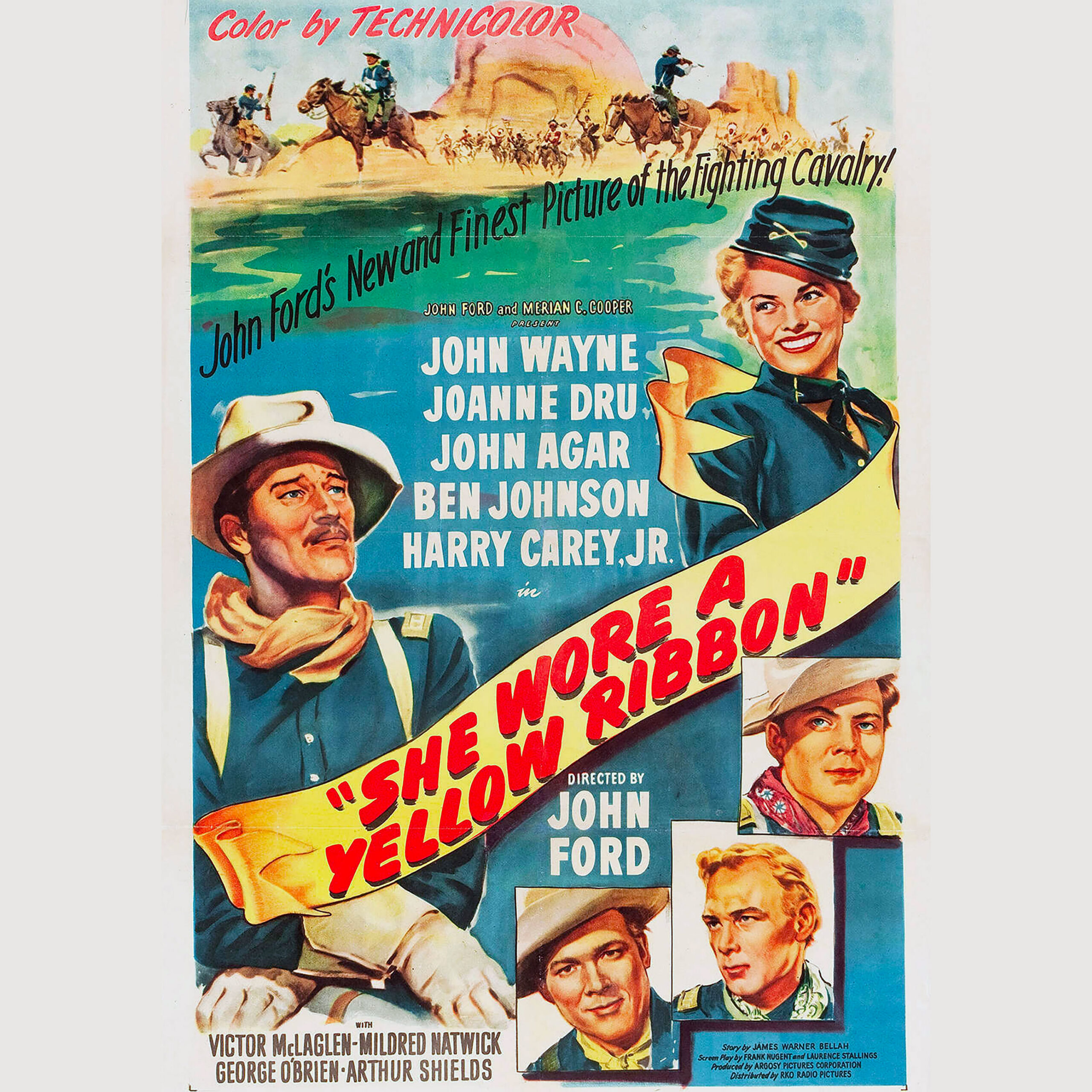
On the Hollywood front, nothing better signified how patriotic Americans imagined themselves—which is to say as rugged, independent, just, and democratic—than the protagonists of western movies. And given that scripting, no one carried more sway as a leading man with six-gun and saddle in the 1940s and 1950s than John Wayne. In Fort Apache (1948), She Wore a Yellow Ribbon (1949), Rio Grande (1950), and The Searchers (1956), Wayne portrayed tough but endearing characters—men with the kind of grit, fighting prowess, and can-do spirit that tamed the frontier, defeated fascism, and would rise to shield Americans from the false allures of communism.
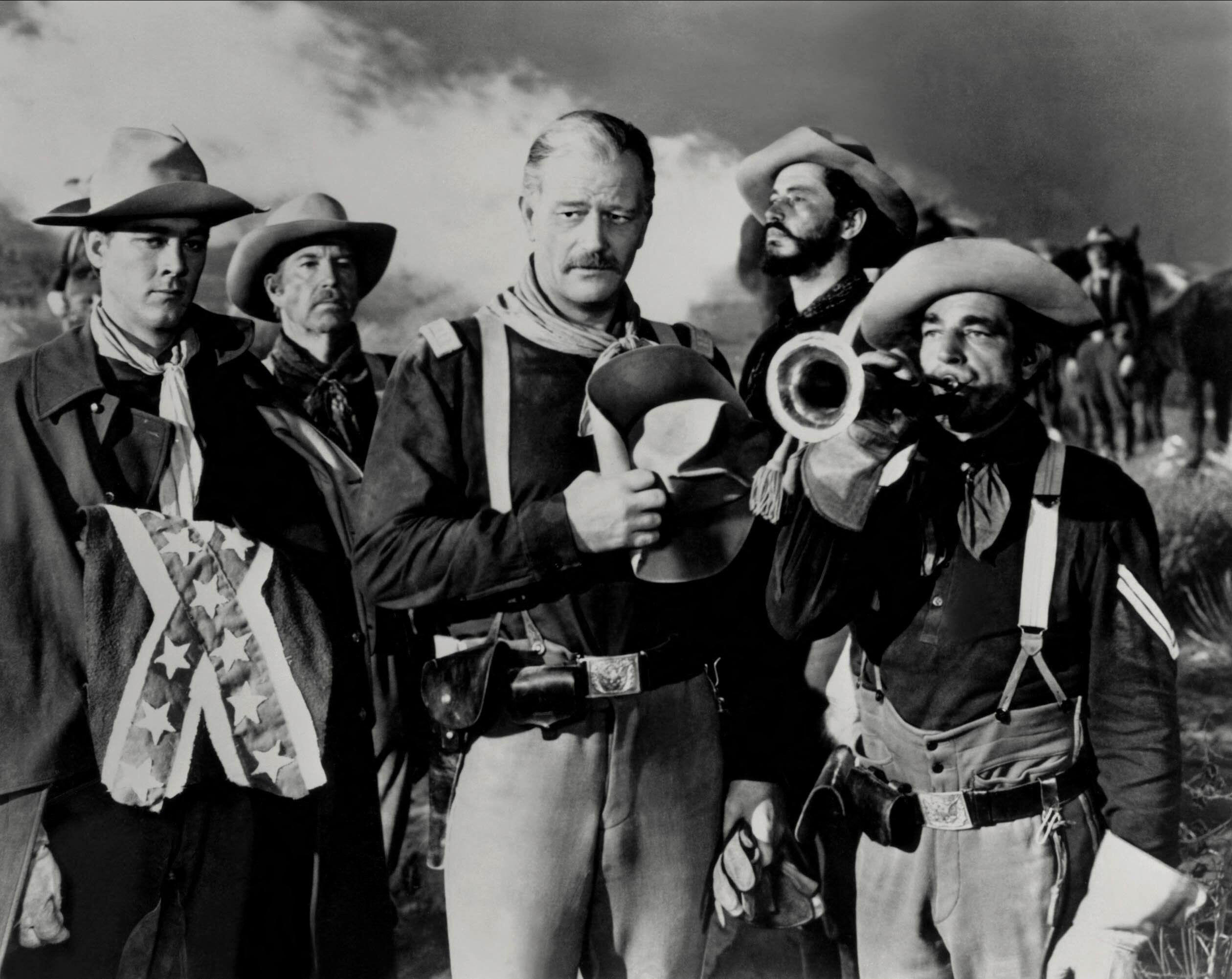
Interestingly, the Civil War, or memories of it, often played a major role in promoting American values in these films, particularly with the inclusion of Confederate veterans. For example, in She Wore a Yellow Ribbon, Wayne’s Captain Nathan Brittles of the 2nd U.S. Cavalry—charged with corralling a band of armed Indians who, prompted by news of the Battle of the Little Big Horn, had fled their reservation—allows southern members of his command to conduct a special funeral service for a slain trooper who’d been a Confederate brigadier general in the war. They bury the man with a homespun Saint Andrew’s Cross atop his coffin and Brittles labels him “a gallant soldier and a Christian gentleman.” Scenes such as these presented audiences with a version of the conflict in which Confederate soldiers had been honorable men waging an honorable war with little or no connection to slavery. In other words, if they had ever stopped being true Americans, this made it much easier to bring them back.
In the late 1950s and early 1960s, the popularity of western movies combined with a booming postwar economy and technological advances (i.e., higher wages and affordable television sets). This was the formula for a surge in weekly, western-themed TV programs. Virtually all the new shows featured Civil War episodes that mirrored the Confederate “re-Americanization” model established in movie westerns of the previous decade. And because they were on television and didn’t require travel or tickets, these 30- and 60-minute stories were accessible to a wide new audience.
 Cinematic/Alamy
In this still from the 1949 movie She Wore a Yellow Ribbon, Captain Nathan Brittles of the 2nd U.S. Cavalry (John Wayne) and fellow troopers pay their respects to a fallen comrade who had served as an officer in the Confederate army—one of many portrayals of ex-Rebels in popular media at the time that glossed over the war’s causes and deep sectional animosities.
An episode of The Lone Ranger from 1955 began with a Confederate officer named Jeff Stanton returning home to learn that Union soldiers had destroyed much of his family’s farm. Worse still, his destitute father had been forced to sell the property to a “Yankee” just weeks earlier. Stanton curses northerners and heads with his younger brother to find work out west. In the wake of war, they can’t find employment, but do bump into the Lone Ranger (Clayton Moore), who asks about the Confederate insignia on Stanton’s hat. “I served with Early and Jackson,” Stanton answers defiantly, to which the Lone Ranger replies, “Both brave soldiers and fine gentlemen.” The brothers are surprised to learn that the Lone Ranger doesn’t consider himself either a southerner or a northerner: “I like to think of myself as an American who believes in the future of our country with its people living and working together.” Later in the episode, after the Lone Ranger saves the Stantons from a scheming banker, one of the brothers asks the sheriff about the masked man’s true identity. “I don’t know his real name, son,” the sheriff confesses, “but I do know that he believes in our country as one nation, indivisible.”
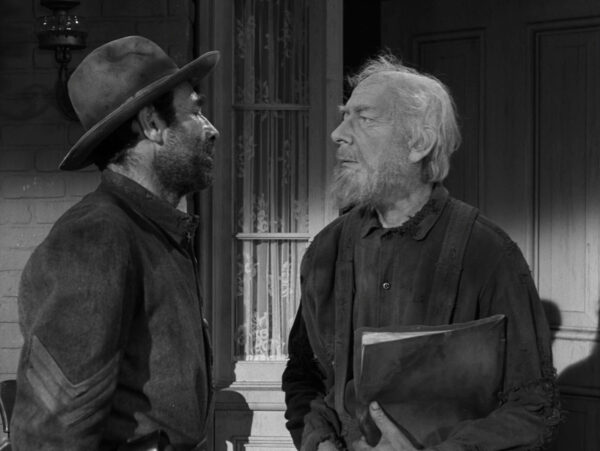
The plot of a 1958 episode of Have Gun–Will Travel called “The Teacher” involved the enigmatic Paladin (Richard Boone) protecting a western school teacher from former Confederate bushwhackers. The Rebels allege the teacher has been lying to children about the infamous war-era guerrilla leader William Clarke Quantrill and threaten to burn down the school. Paladin attempts to rally the townspeople, some southern, some northern, but they all refuse to fight. When the Rebels show up to make good on their threat, Paladin guards the school, staring down all five of them with an American flag in the background. As the fight begins, a Yankee shopkeeper grabs a pistol and runs to help. Then three Confederate veterans—one having lost an arm at Chickamauga—come charging down the street in their old uniforms, giving a Rebel yell. They force the leader of the Rebs to face Paladin, whence he’s exposed as a coward. The story ends with the townspeople putting their old regional differences behind them for the sake of their children and the future of the country.
In 1960, Bonanza revived the secession crisis with “A House Divided.” In the episode, a one-armed silver exporter named Frederick Kyle arrives in Virginia City looking for Little Joe Cartwright. Refined, honorable, and physically powerful even without his left arm, Kyle builds a friendship with Joe after saving him from a pair of thuggish card sharks. Joe’s late mother hailed from New Orleans, so he is the only member of the Cartwright family sympathetic to the “Southern Cause.” Kyle uses his connection with Joe to meet various mine owners in the Comstock area. Gradually, the rest of the Cartwrights discover that Kyle’s son died promoting secession, that Kyle lost his arm doing the same, and that he is now working as a financier for the Confederacy. If Kyle can secure enough precious metal for Jefferson Davis’ government, the war will begin in earnest. By episode’s end, Joe has, at least for the time being, come to his senses and rejoined his father and brothers on the Ponderosa.
All these programs prioritized the integration of ex-Confederates over recognition of the issues—among them being the expansion of slavery in the West—that had underpinned secession and triggered the war. The Lone Ranger promoted the bravery and honor of Stonewall Jackson and Jubal Early (while also disparaging William T. Sherman, a clear and easy nod to southern audiences); Have Gun–Will Travel allowed Confederate veterans to heroically distinguish themselves from murderous rabble and save the town schoolhouse in full uniform; and, in Bonanza, even after being exposed and temporarily thwarted by Ben Cartwright and his sons, Frederick Kyle is still presented as a dedicated, principled, even tragic figure.
Thus, through feats of commemorative sleight-of-hand, men who attempted to destroy the Union are almost offered as further evidence of American exceptionalism. And it’s worth pointing out that these episodes were hardly unique in their genre in the 1950s and 1960s. Over their various seasons, Gunsmoke, Wanted: Dead or Alive, The Rifleman, Wagon Train, and Rawhide all had scripts with similar themes. Whether one preferred Rowdy Yates (Clint Eastwood), Joshua Lucas (Steve McQueen), Matt Dillon (James Arness), or any of the other heroes of the TV West, the underlying moral was the same: Americans might clash with one another from time to time, but they were still rugged, independent, just, and democratic. As long as they came back together before the credits rolled, they were, this time, Cold War victors.
Matthew Christopher Hulbert is Elliott Associate Professor of History at Hampden-Sydney College. A specialist on the Civil War in the West, guerrilla violence, and film history, he is the author or editor of five books. His current projects include a new, narrative history of the Lawrence Massacre and a book about Abraham Lincoln in film.