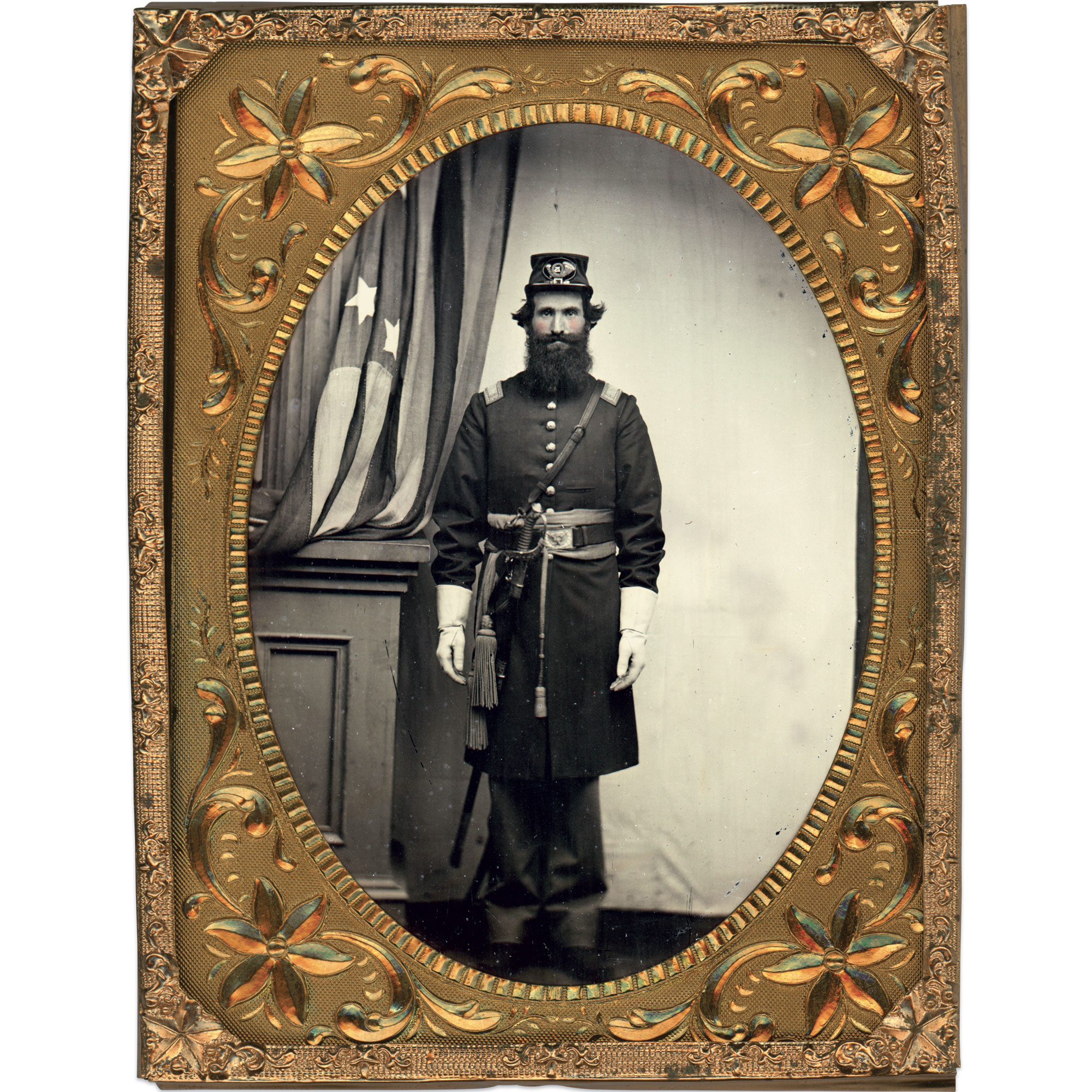
 Brian Boeve Collection
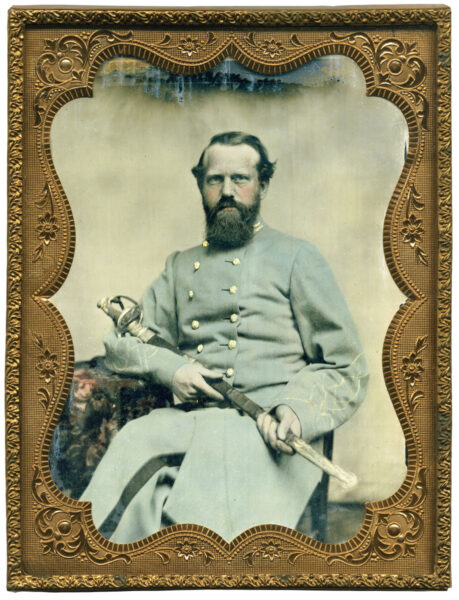
First Lieutenant Alfred B. Seavey, Company H, 15th New Hampshire Infantry
Port Hudson is remembered for the surrender of its Confederate garrison five days after Vicksburg fell on July 4, 1863. The surrender’s anticlimax belied numerous courageous acts during the Union siege.
The regimental historian of the 15th New Hampshire Infantry described one such event as “The Advance of the 50.” On June 13, five men from each of the regiment’s companies and the same number from the 26th Connecticut Infantry joined to determine the strength of the heavily defended Rebel stronghold. They made it within 200 feet of the parapet of the Confederates’ Battery 16 before overwhelming fire stopped them. They held the position until nightfall.
One of the trapped soldiers, First Lieutenant Alfred B. Seavey of Company H (pictured above), took cover behind a tree stump with a big tangle of exposed roots. Enemy fire riddled the roots and stump, but Seavey miraculously escaped injury. At one point, one of his men was under fire from a lone Confederate. Seavey asked for his comrade’s rifle, poked it through a rotted section of the stump, and fired a single bullet into the sand bags from which the enemy had been firing. The Rebel fired no more.
When truce flags allowed for retrieving the wounded, representatives met near the stump. A Confederate major said that Seavey’s bullet had killed a respected sergeant.
Seavey survived the siege, though two of his command died, and six were wounded. Almost four weeks later, Port Hudson fell, and soon after that the 9-month enlistment of the 15th New Hampshire ended.
Seavey returned to his wife and daughter in Gilford, New Hampshire, where he was a harness-maker. He did not enjoy the peace for long, dying in 1871 at 42.
Ronald S. Coddington is publisher of Military Images, a magazine dedicated to showcasing and preserving photos of Civil War soldiers and sailors.
Notes
1. Albert Barrère and Charles Godfrey Leland, eds. A Dictionary of Slang, Jargon & Cant: Embracing English, American, and Anglo-Indian Slang, Pidgin English, Tinker’s Jargon and Other Irregular Phraseology, Volume 1 (London, 1889), 198.
2. A popular song of the Civil War Era South. “Join the Cavalry.”
3. Richard Grant White, ed. Poetry, Lyrical, Narrative, and Satirical, of the Civil War (New York, 1866), 46.
4. Act I, Scene III, Line 2; Act I, Scene III, Line 11; Act II, Scene III, Line 16, William Shakespeare, The Merry Wives of Windsor (shakespeareswords.com).
5. Alvin F. Harlow, Old Bowery: The Chronicles Of A Famous Street (New York, 1931), 174.
6. Data gathered from letters online at Private Voices.
7. James S. Jones to “Sister Cad,” September 15, 1863, Private Voices.
8. James F. Goodwin to James Goodwin, November 26, 1864, Private Voices.
9. March 17, 1862, November 4, 1862, in the Arthur W. Hyatt Papers, Mss. 180, Louisiana and Lower Mississippi Valley Collections, LSU Libraries, Baton Rouge, LA.
10. Barrère and Leland, eds. A Dictionary of Slang, Jargon & Cant, 197.