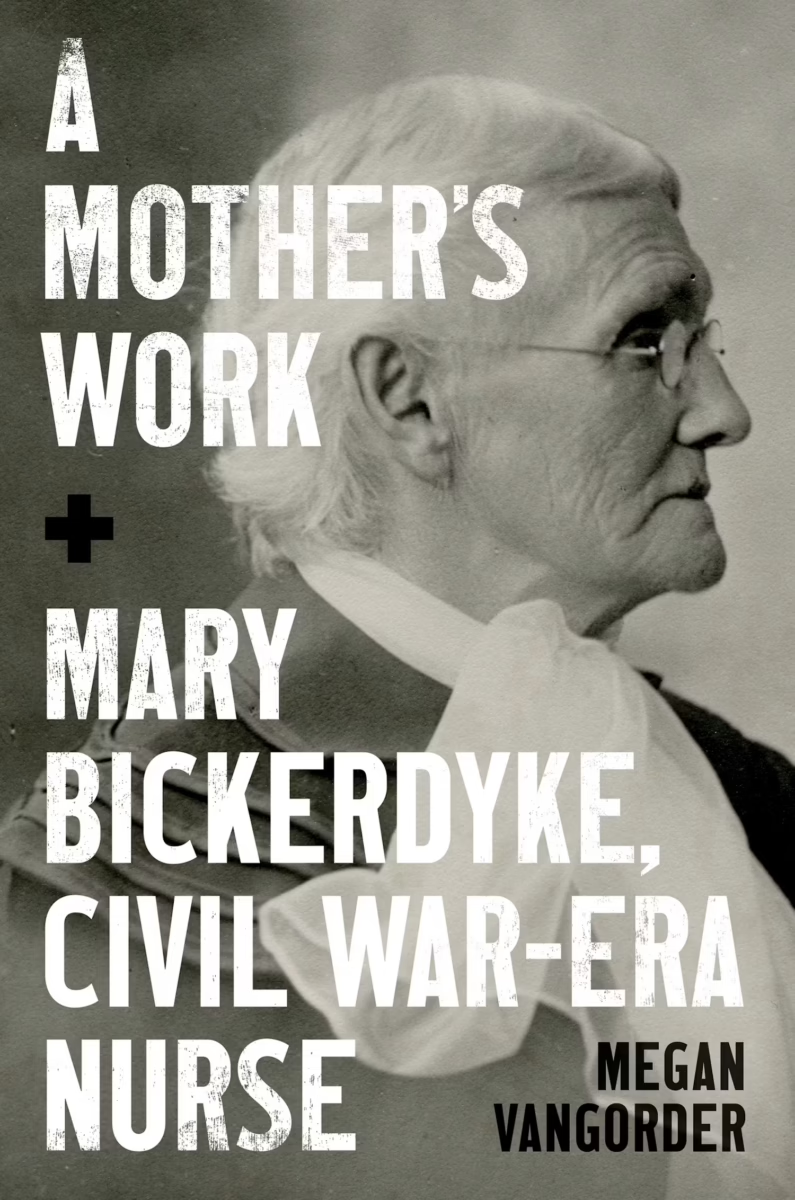
Few people were more closely associated with motherhood in Civil War era America than “Mother” Mary Bickerdyke. Indeed, Bickerdyke’s role as a nurturing maternal figure to suffering soldiers became so central to her public image that it superseded her real identity. Her first name, Mary, is typically dropped in favor of “Mother Bickerdyke.” And as historian Megan VanGorder demonstrates in this excellent monograph on Bickerdyke, this title not only to transfigured Bickerdyke into a figure of legend herself but also helped to create a myth that could stand in for all women war workers. That transformation was so complete that it has taken until now for a historian to critically examine the life of the real Mary Ann Bickerdyke.
A Mother’s Work: Mary Bickerdyke, Civil War Era Nurse is VanGorder’s answer to that oversight. The author presents a thoughtful microhistory drawing on an impressive array of scholarship—pulling together histories of war, women, childhood, medicine, nursing, and region—to place Bickerdyke within the context of “major shifts in women’s history and the history of medicine in the second half of the nineteenth century” (4). The result fleshes a Civil War stock character out into a woman enmeshed in interlocking identities as a mother, medical practitioner, nurse, veterans’ advocate, and Westerner, bringing us back to the realities behind the legend.
The importance of region in Bickerdyke’s life is one important intervention of this book. VanGorder places Bickerdyke within the context of the west, where she was born, worked, lived, and died. Bickerdyke’s medical specialization in “botanic medicine,” a medical practice based on common sense and herbal remedies, was especially popular in the west. Mary Bickerdyke’s early life in the frontier west also exposed her to care networks beyond the nuclear family: her mother died when Mary was two, and Mary was raised by her grandparents while her father remarried and began a new family. When her grandparents died, she went to live with an uncle rather than join her father’s new family. These experiences expanded Bickerdyke’s understanding of care and guardianship—meaningful care, she learned, could be provided by individuals other than biological parents.
As an adult, widowed and left to provide for small children, Bickerdyke turned her own many years providing care, first as a domestic laborer and then as a wife and mother, into a marketable skill. These experiences shaped the rest of her career: acting as a mother-figure to those in need, whether it meant breaking through red tape to secure food for soldiers in Tennessee or tending to dying veterans in Kansas. Yet, acting as a mother-figure also conflicted with acting as an actual mother. Both the financial necessity and her personal desire to work took her from her own children. VanGorder’s analysis of letters from Bickerdyke’s sons, Hiram and James, humanize Bickerdyke’s decision. “As she assumed each maternal role,” VanGorder writes, “she did so with the acknowledgement that both fulfillment and heartache accompanied each move that she made. And yet still, she continued to move” (187).
Throughout the text, VanGorder illustrates the realities of Bickerdyke’s life and work alongside examinations of the popular literature that helped to turn her into a myth. In one telling example, VanGorder analyzes an embellished version of the moment when Bickerdyke first answered the call to serve the federal army as a nurse. The story, according to the sources, is that Bickerdyke’s reputation as a medical practitioner in her home community of Galesburg, Illinois, led Dr. Benjamin Woodward, a neighbor serving in the army, to ask Bickerdyke to bring her skills to suffering soldiers in Cairo. While we know the invitation was issued and that Bickerdyke took it up, there are few further clues about how the interaction took place. VanGorder uses this moment for the first of many forays into the development of the mythical Bickerdyke. A young adult nonfiction book written in 1940 imagines a countrified Bickerdyke who speaks with a Western twang. According to this version, Bickerdyke heard Woodward’s plea for help from the pulpit, then rose from the congregation to respond: “I’ll go to Cairo and I’ll clean things up down there, You don’t need to worry about that, neither. Them generals and all ain’t going to stop me. This is the Lord’s work you’re calling me to do. And when I’m doing the Lord’s work, they ain’t nobody big enough to stop me” (28). Rather than isolating a consideration of Bickerdyke’s transformation into myth to a final chapter, VanGorder weaves literary analysis throughout this chronological narrative to show how later writers mythologized Bickerdyke into a “singular force of nature who asserted her pragmatic regimen of care throughout her life, despite her limited access to professional training or education” (30).
A Mother’s Work is an analytical, carefully written book that will be an important addition to scholarly conversations on women’s history and the history of medicine and nursing. But it should also find a place on the bookshelf of any student of the Civil War era who seeks to understand complicated realities rather than familiar myths.
Sarah Handley-Cousins teaches history at the University at Buffalo and is the author of Bodies in Blue: Disability in the Civil War North.