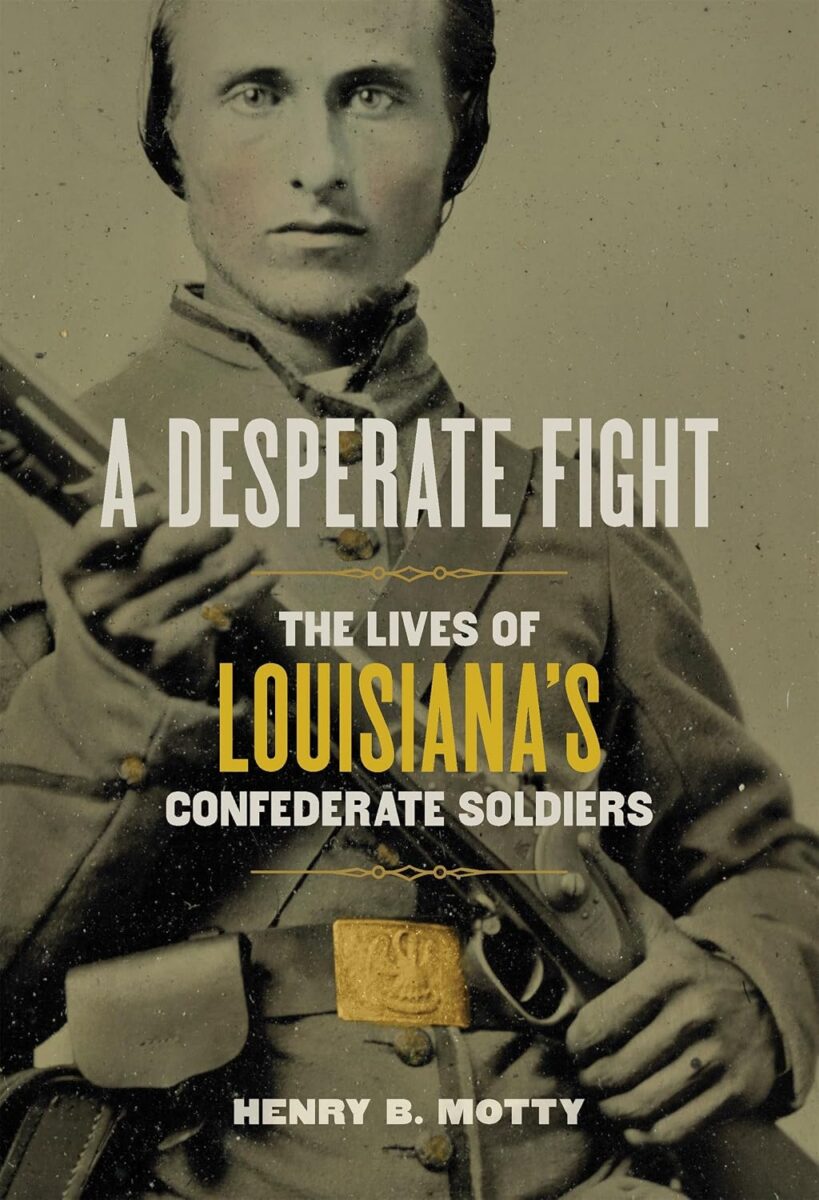
Henry B. Motty’s A Desperate Fight offers a social history of the U.S. Civil War in Louisiana. Motty’s research moves away from traditional narratives about battles and politics to illuminate the complex, nuanced discussion of how soldiers maintained familial and community ties—and vice versa. Motty discusses the frequency of exchanges between home and the war front, addressing issues like enlistment, military supplies, and expressions of local loyalty (2). The result is a superb examination of the human framework supporting wartime deployment. Motty shows how war was sustained not only by armies and leadership, but by the everyday relationships between soldiers, families, and communities.
Motty’s argument centers on the deeply rooted bond between Louisiana’s citizen soldiers and the families and communities they left behind. As a result of these soldiers moving from domestic life into military routines, they often retained their communal and familial ties. Further, Motty confronts familiar narratives that approach military discipline or vague nationalism as the impetus for soldiers’ endurance. Additionally, while Motty accepts patriotism as an initial driver for enlistment, he argues that the relationship with community and family ties furnished a purpose for continued service and morale. Soldiers stayed in the fight because they strongly believed they were defending their homes and local freedoms. On the other hand, civilians wanted protection, forming a mutual agreement that endured in the face of great material deprivation. This focus gives the book its impact. The Civil War in Louisiana appears not simply as a military struggle, but as a social conflict in which wartime relationships helped support the soldiers even when Confederate authority began to fail (1-3, 11-37).
Motty uses a bottom-up approach grounded in social history, military history, and anthropological studies. Furthermore, Motty uses a plethora of primary sources, such as letters written by the soldiers, military records and documents, and diaries. He also uses newspapers and manuscript collections to rebuild daily experiences: recruiting, conscription, camp life, trade, communication, and combat’s effects on civilians. Motty’s approach allows him to shift the focus from wide claims to concrete examples without losing the humanity in his narrative. The organization of the book also strengthens its argument, since the chapters move in a clear progression from enlistment and mobilization to camp life, correspondence, and the continuing ties between home and front. This structure helps readers follow the development of Motty’s thesis in a logical way and makes the work easy to read and understand (4-5, 58-107).
Among the book’s strengths is the steadfastness of Motty’s argument. Motty does not stray from his thesis, and the chapters reinforce it very well. Early chapters on leaving the Union, recruitment, and conscription flow easily into camp life, interactions, supply, correspondence, and the bond between soldiers and civilians at war. An additional strength is Motty’s ability to bind the intimate to the military. Motty illuminates how individual loyalties could coexist with Confederate nationalism, and how the harsh challenges shifted soldiers’ desire toward defense of home and community (6-10, 152-174).
The book’s weaknesses are related to matters of scope as a microhistory. Due to its focus on relationships between soldiers and civilians in Louisiana, the book leaves less space for the inclusion of subgroups within Louisiana’s population or for broader comparisons with other Confederate states. Readers may desire more on ethnic diversity, class differences, or the experiences of other groups such as Acadian and Creole. Additionally, the focus on interdependence, while persuasive, can cause tensions and disagreements between the soldiers, civilians, and Confederate authorities to feel less important when they may need further discussion.
Ultimately, A Desperate Fight triumphs as a thoughtful, well organized, and greatly researched addition to Civil War scholarship. It demonstrates that Louisiana’s Confederate soldiers were bolstered by more than ideology or coercion; they were grounded by dense social bonds that made the Civil War a shared civilian and military experience. A Desperate Fight deepens our understanding of the human costs of war and is a vital addition to the social history of war.
Tommie L. Stovall is a graduate student in the Department of History at Sam Houston State University.