Satterlee’s Saw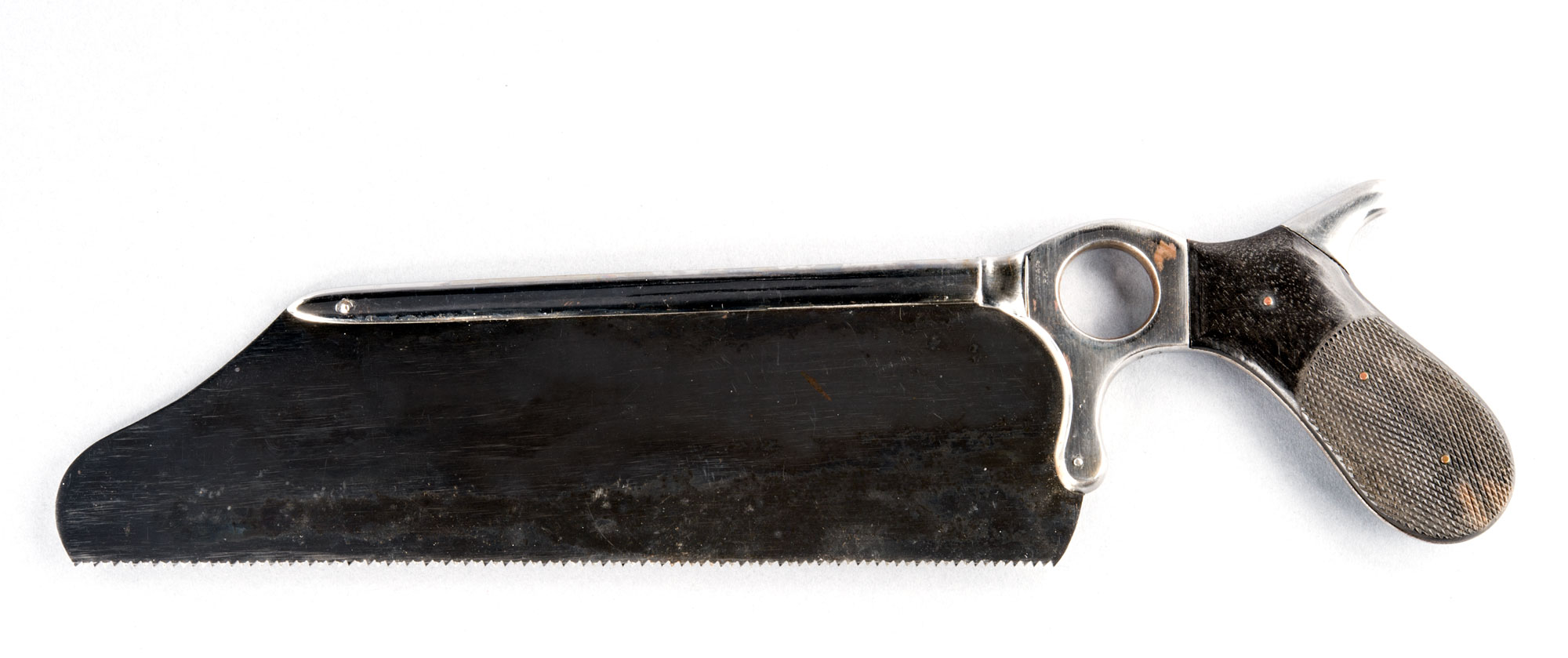 National Museum of Health and Medicine, photo by Matthew Breitbart (Disclosure: This image has been cropped to emphasize the subject.)
By the end of 1861, it had become painfully clear to the Union army that its medical personnel needed better equipment to treat serious wounds, and in particular to amputate limbs, a procedure that had been rare before the war. It would go on to purchase nearly 5,000 surgical kits during the conflict, many of them manufactured by George Tiemann & Co. in New York.
One of the more popular Tiemann-produced instruments (pictured here) was an amputation saw with a pistol-gripped handle that would come to be known as “Satterlee’s Saw,” named after the influential commander of the Medical Purveyor’s Office, surgeon Richard Satterlee. Due to its widespread use during the war—many of the approximately 17,000 physicians to tend to Union army wounded developed their surgical skills using this style of instrument—the Satterlee would become, in the words of the National Museum of Health and Medicine’s Alan J. Hawk, “a quintessentially American orthopaedic saw,” one that is still employed by surgeons in remote locations or extreme circumstances today.
Source
Alan J. Hawk, “Richard Satterlee’s Bone Saw,” ArtiFacts vol. 475, no. 9 (September 2017).
Related topics: medical care