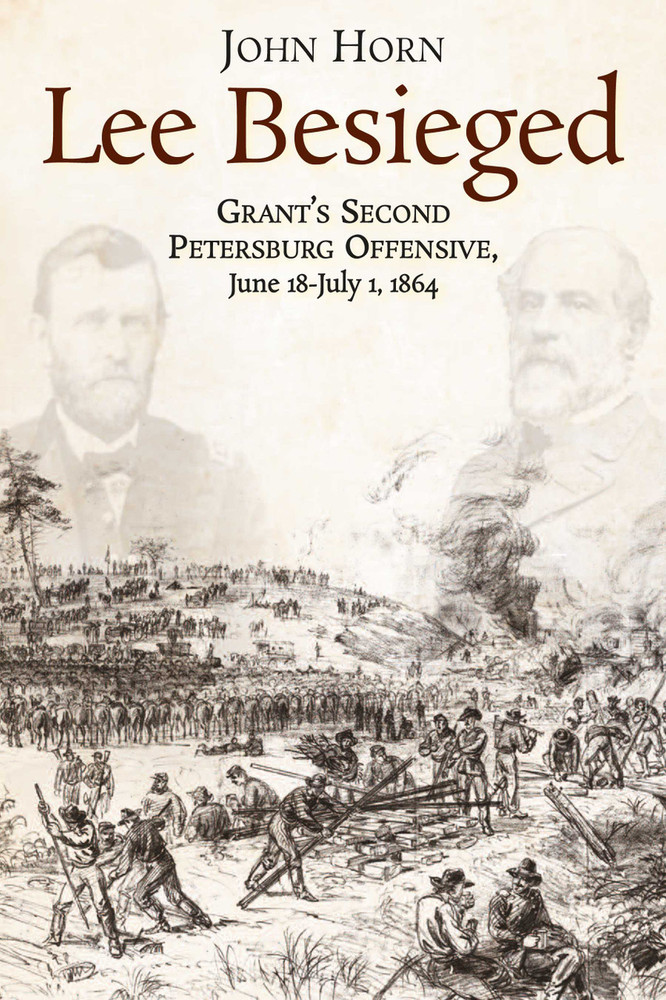
Ulysses S. Grant’s operations in 1864 and 1865 broke the backbone of the rebellion in the east and forced the Army of Northern Virginia to surrender. The lengthy Petersburg campaign represents an important part of that story, and the individual offensives during the siege are fertile ground for individual examination. John Horn’s Lee Besieged is a superb blow-by-blow account covering the two weeks of the Second Offensive. Horn looks at the offensive’s two components: a cavalry raid to destroy Confederate infrastructure, and the main offensive to capture the Jerusalem Plank Road south of Petersburg. Both were qualified failures.
The cavalry raid by James H. Wilson and August V. Kautz bookends the infantry advance in Horn’s narrative. Things started well, though the raiders lacked the critical equipment necessary to fully destroy the railroads. While many miles of track were damaged, nearly all were repaired before the end of July. This attack was to be supported by Phil Sheridan, providing an avenue back to the main Union line. Sheridan, however, was uncharacteristically slow after crossing the James River and, as a result, the cavalry was soon on its own. What followed was a running battle; the Yankee cavalry forced its way through a trap set by Joe Wheeler, finally straggling back to the Army of the Potomac after losing substantial numbers to capture and imprisonment.
The main infantry attack largely failed. Army of the Potomac commander George Gordon Meade ordered the II and VI Corps to take the Jerusalem Plank Road, extending the Union line and perhaps even cutting off Confederate reinforcements. Lacking a clear understanding of the terrain and roadways, Union forces stumbled into position and ultimately left large gaps in the lines. Robert E. Lee, finally regaining some aggressive spirit after having lost initiative to Grant during the Overland Campaign, ordered William Mahone to drive the enemy back. Mahone’s June 22 attack on Francis Barlow’s division rolled up Union lines: three brigades effectively removing seven, plus the capture of artillery and prisoners. In some respects, the removal of these prisoners to the rear, as well as thick underbrush, ultimately slowed the Confederate assault. As the advance pushed into Horatio G. Wright’s VI Corps, he was slow to respond to Meade’s requests.
Despite the difficulties faced by Union forces in the Second Offensive, Horn also points out areas of success that may not have borne fruit in July, but that set the stage for Grant’s ultimate victory the following spring. The efforts to settle at City Point created one of the largest ports on the east coast, critical to maintaining Union supplies through the winter. The bridgehead at Deep Bottom secured by Sheridan was not fully exploited until the Fourth Offensive in August, but it represented another drive closer to the city. In addition, more bridges across the James River were exposed to Union artillery fire. While Confederate logisticians effectively shifted supply trains in the short term, this was another step in tightening the noose around Lee’s army.
Horn concludes a full evaluation of the operation’s many participants, broken down by levels of command. He criticizes President Abraham Lincoln for visiting City Point, though acknowledges that the visit had no impact on any operations. Similarly, Jefferson Davis and Braxton Bragg are criticized for not integrating P. G. T. Beauregard more fully into the defense of Richmond due to their well-known disagreements. While Beauregard does appear in the narrative, Davis and Bragg barely do.
An overview of this offensive, much like other operations in the spring and summer of 1864, reveals the war’s changing character and the effect of continuous operations. The narrative shifts quickly between individual units and officers, and Horn puts significant effort into determining when information officially passed hands up and down the chain of command. He also includes substantial casualty information, which are some of the most heavily footnoted sections of the book. Like other Savas Beatie projects, the book contains many well-executed maps, helpful in keeping track of the shifting lines. Horn also includes two appendices containing full orders of battle. A reader interested in Petersburg will find much of interest in this focused account.
Keith Altavilla teaches history at Lone Star College-CyFair.