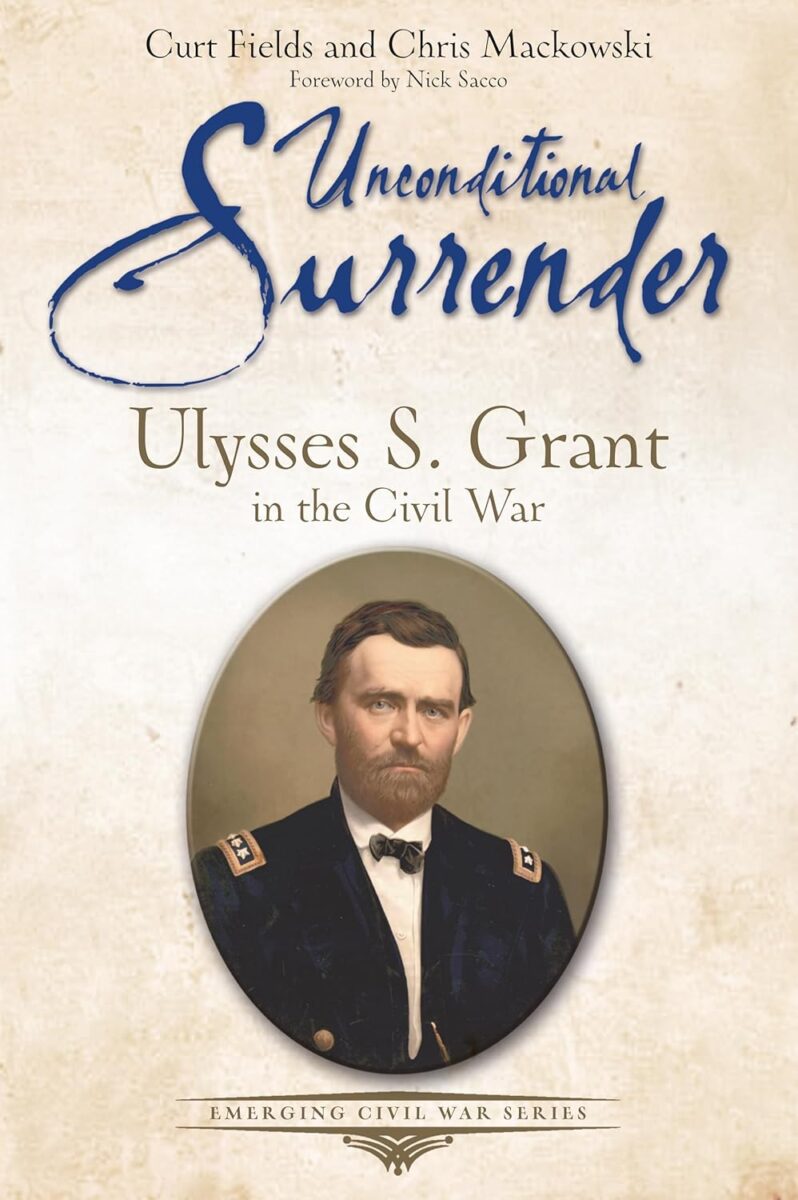
Few Civil War figures have invited more historical discussion than Ulysses S. Grant. In this, the latest entry in the Emerging Civil War Series, Curt Fields and Chris Mackowski attempt a herculean task: providing a fresh look at the lieutenant general who led the Union armies to victory. Fields, a living historian who has portrayed Grant for more than a decade, brings his unique perspective to bear, endeavoring to provide an “inside look” at “what [Grant] did and why” (xiv).
Unconditional Surrender aims to assess Grant’s wartime record. To the stage, the prologue begins in the weeks prior to Grant’s death. As he worked on his memoirs at a handsome cottage in upstate New York, the general was visited by an old friend and one-time battlefield rival, Simon Bolivar Buckner. With a colorful description of the visit, Fields and Mackowski introduce their book’s key themes: Grant’s relationships with his contemporaries, his decision making, and his memories.
Fields and Mackowski draw on large amounts of material from Grant’s memoirs, as well as from the general’s wartime correspondence and speeches. While Grant’s memoirs serve as an excellent source in understanding the individual, the authors acknowledge that readers should approach them with ample historical skepticism. The authors note that Grant’s memoirs, “ha[ve] the flavor of a judgment written 20 years after the fact and colored by subsequent events” (63). As such, Fields and Mackowski places greater emphasis on documents contemporaneous to the war. In doing so, they demonstrate that Grant expressed favorable opinions of Henry Halleck, John McClernand, and William Rosecrans before jealously and politics strained their relationships beyond repair.
Fields and Mackowski address each of Grant’s major campaigns. Nor do they eschew controversies, such as Grant’s General Orders No. 11, which expelled all Jews from his military district. As the authors note, the 1862 order was a major blot on Grant’s wartime record; however, overshadowed by the Union disasters at Fredericksburg and Chickasaw Bayou, Grant did not suffer major consequences at the time.
A short epilogue returns readers full circle to where the book began: Grant toiling away on his personal memoirs in his final days. The narrative in Unconditional Surrender tracks Grant’s memoirs with its exclusive focus on the general’s wartime service. Yet Fields and Mackowski go beyond by offering a relentlessly balanced perspective. Rather than delving into tactics, Fields and Mackowski focus their discussion on Grant’s decision making and professional relationships. Having lived in Grant’s shoes, Fields invites readers to understand the general as a complex individual who confronted head-on the enormous challenges of his times. This is a unique and essential addition to any Civil War library.
Riley Sullivan is a doctoral student in history at the University of Houston.
Related topics: Ulysses S. Grant

A must have for any Civil War library, especially those of us examining the topic as part of our own research.