For almost three decades, the University of North Carolina’s Military Campaigns of the Civil War series (originally edited by Gary W. Gallagher, but now in the able hands of his protégé Caroline E. Janney), has collected and published cutting-edge scholarship from some of the field’s most respected practitioners. Individually and collectively, these volumes have offered penetrating reassessments of the major operations in the Civil War’s eastern theater, at once situating key battles in wider contexts and demonstrating the capaciousness of military history. The series has seeded an entire generation of scholarship by suggesting promising new directions and rendering more legible the dynamic relationship between events at the front and happenings behind the lines.
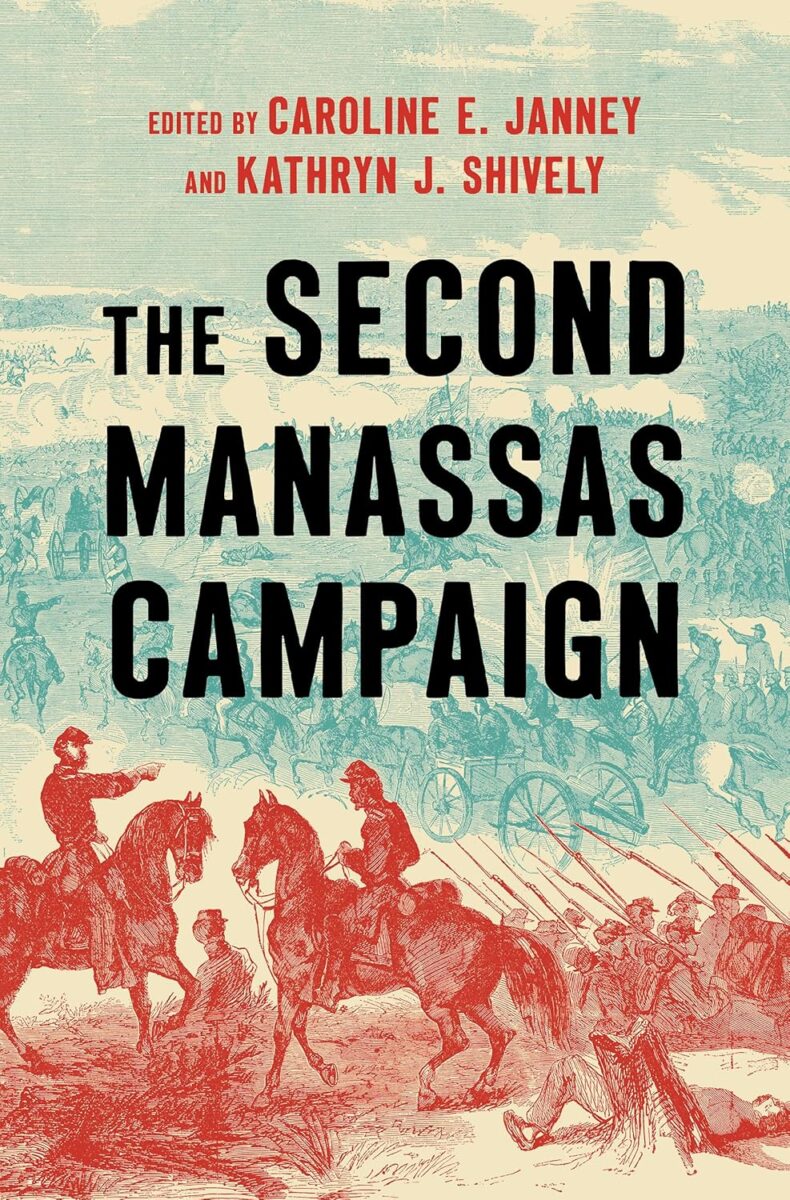
Caroline E. Janney and Kathryn J. Shively make a worthy entry to the series with this volume of nine splendid essays treating the chronically understudied Second Bull Run campaign, an operation during which “policy and politics critically intermixed with military” events (3). The many hallmarks of “Military Campaigns of the Civil War” are here on full display: contributions from both public and academic historians; essays that assess tactics and strategy; chapters that evaluate the performances of individual units or battlefield commanders; and articles that consider how contemporary Civil War Americans—soldiers and civilians alike—made sense of the campaign in real time. Janney and Shively have assembled an expert cast of contributors whose probing essays (and occasional interpretive disagreements) reveal that this pivotal engagement remains a promising subject.
The volume opens with co-editor Shively’s provocative essay which, by restoring to view the “interpersonal and logistical challenges” confronting the Army of Virginia, supplies critical and overlooked context for John Pope’s general orders. This is an essay that will be read and debated for years to come. Shively argues that the enormous political consequences of Pope’s orders—which invited an especial Confederate ire—have resulted in scholars “emphasizing only their political context,” rather than the practical challenges the Army of Virginia faced (27). By arguing that “Pope’s primary motivation” for his general orders was “practical army administration,” Shively draws “less of a straight line from ‘conciliation’ to ‘hard war’ than scholars have come to depict” (15). Shively further questions the traditional framework for understanding Pope’s orders by noting that the general “studiously ignored” freedom seekers (29).
That last observation makes a natural transition to the historian John J. Hennessy’s moving chapter. Hennessy, whose Return to Bull Run [1993] remains the essential book on its subject more than three decades later, places the battle of Second Bull Run in the context of slavery’s steady collapse and the development of federal policies on emancipation. “Few things had greater impact on the mind of the Army of Virginia’s men than close, extended interaction with the institution of slavery and newly freed people,” Hennessy writes (49).
While Hennessy places the battle against the backdrop of evolving federal war policies, Gary W. Gallagher observes that Confederate soldiers and civilians considered Second Manassas one part of a “transformative phase” in the war’s history: the “second of three acts in a sprawling drama extending from June through September 1862” (65). The rebels tended to regard the Seven Days, Second Manassas, and Sharpsburg as a single operation. Pope’s orders and the initial federal steps toward emancipation convinced Confederates “that they faced a dishonorable foe” (90), while the battle of Second Manassas provided an “initial testing ground for a new leadership style and command structure in the Army of Northern Virginia” (66).
Next, Cecily Nelson Zander considers Pope’s orders in the traditional context of Republican politics. “Pope’s ideas about fighting a harder war against the Confederacy pleased his soldiers and irked Confederates,” she writes. “But without a victory to back up his bombast, no permanent political changes occurred as the result of his campaign” (117).
Peter C. Luebke’s essay turns to the question of Confederate strategy. Luebke evaluates Robert E. Lee as “a leader simultaneously clear-eyed and rational about the slim chances for Confederate success in the war” (125). In the Second Manassas campaign, Lee sought to damage northern morale through “aggression” and risk-taking. According to Luebke, this strategy was “informed” by Lee’s “time as head of the military Department of South Carolina, Georgia, and East Florida in the winter of 1861-62” (126).
Recalling the experience of the 6th Wisconsin in the battle for Brawner Farm on August 28, 1862, James Marten’s essay—drawn from his recent “regimental biography” of the famous Iron Brigade outfit—explains how this “small if extraordinarily bloody fight” became a pivotal moment that “proved the mettle” of the unit, supplying a touchstone for its survivors in the sanguinary work that lay yet ahead (164).
A pair of biographical studies revisit critical aspects of the battle and its long shadow. Keith S. Bohannon supplies an assessment of John Bell Hood’s performance at Second Manassas, which marked the general’s debut as a division commander. “Hood’s two brigades captured four cannon, eight colors, and numerous prisoners,” Bohannon tallies, concluding, “Hood’s pride in the performance of his division at Second Manassas was warranted,” he concludes (182, 185). William Marvel recalls the “ordeal” of Fitz John Porter, whose “humiliating” court martial trial “provided the administration with an excuse for Bull Run and a measure of absolution for Fredericksburg” (205).
A final chapter by co-editor Caroline E. Janney turns to the distinctive sandstone obelisks erected on the Bull Run battlefield by Union veterans immediately after the war. This pair of monuments, Janney argues, tracks the larger history of Civil War memory, from “the immediate desire of Union soldiers to commemorate the human cost of war” to the turn of the century drive for reconciliation (237).
A useful bibliographic essay rounds out the volume. The Second Manassas Campaign takes its place on a growing shelf of books about this pivotal operation while making still another salient contribution to a legendary series. It whets the appetite for a forthcoming volume of essays on the first clash behind the steep banks of Bull Run.
Brian Matthew Jordan is Associate Professor of History, Chair of the Department of History, and Co-Director of the Civil War Consortium at Sam Houston State University. He is the author or editor of six books on the Civil War and its era.