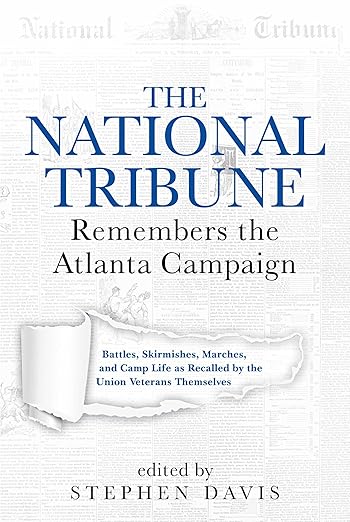
The National Tribune was the leading periodical for Union veterans. Edited by George Lemon, a New York captain who was wounded at the battle of Bristoe Station, the paper made its debut as a monthly newssheet in October 1877. Befitting Lemon’s postwar career as Washington, D.C., based pension claims attorney, The National Tribune’s earliest issues advocated for veterans’ benefits as a just expression of the nation’s gratitude. The paper’s columns plied Union ex-soldiers with updates on pension legislation pending before the U.S. Congress and dispensed sage advice about filing a claim and navigating the labyrinthine federal bureaucracy.
Within four years of its inception, the paper accelerated its publication schedule and began printing weekly issues. Lemon and subsequent editors like John McElroy (perhaps best known for his Andersonville narrative, and well represented here) widened the paper’s aperture. By the turn of the century, as the historian Steven Sodergren has pointed out, The National Tribune became an essential repository for reunion notices, information about veterans’ relief efforts, and, most significantly, veteran-authored reminiscent material. Columns such as “Fighting Them Over,” in which former Yankees revisited some of the war’s most controversial moments, supplied ordinary enlisted men with a rare and vital space where they could share the gritty truths of the war they fought—wholly distinct from war the nation preferred to remember.
Editor and veteran author Stephen Davis has selected, arranged, and introduced some seventy pieces related to the Atlanta campaign produced by Union ex-soldiers and then published in the pages of The National Tribune. The essays included here revisit the campaign’s major controversies and many clashes—from the missed opportunity at Snake Creek Gap to the affairs at Cassville; from the assaults at Pickett’s Mill to the charge at Cheatham Hill; from the death of Major General James B. McPherson during the battle of July 22, 1864, to the federal occupation of Atlanta and the expulsion of its civilian population by William Tecumseh Sherman. We read John McElroy’s gripping and “encyclopedic” account of the battle of Peachtree Creek (143), Private George Reynolds’s account of retrieving the slain McPherson’s body (193-196), and hear from an impatient soldier who wishes “to set the record straight” and identify beyond any cavil “which troops first entered Atlanta” (278).
Davis’s volume should remind readers of the vast and yet untapped potential of The National Tribune. Fortunately, the paper—once available only on creaky reels of microfilm in a select number of research libraries—has never been more accessible to modern students of the war. The Library of Congress’s “Chronicling America” website has digitized a four-decade run of the paper, and an impressive, three-volume index compiled by the historian Richard A. Sauers (and published by Savas-Beatie) allows modern researchers to quarry the paper for entries on specific battles, themes, or regiments.
An ideal companion to David A. Powell’s ongoing, multi-volume narrative of the campaign, serious students of Atlanta or Civil War memory will want to add this collection to their bookshelves.
Brian Matthew Jordan is Associate Professor of Civil War History, Co-Director of the Civil War Consortium, and Chair of the Department of History at Sam Houston State University. He is the author or editor of a half dozen books on the conflict.