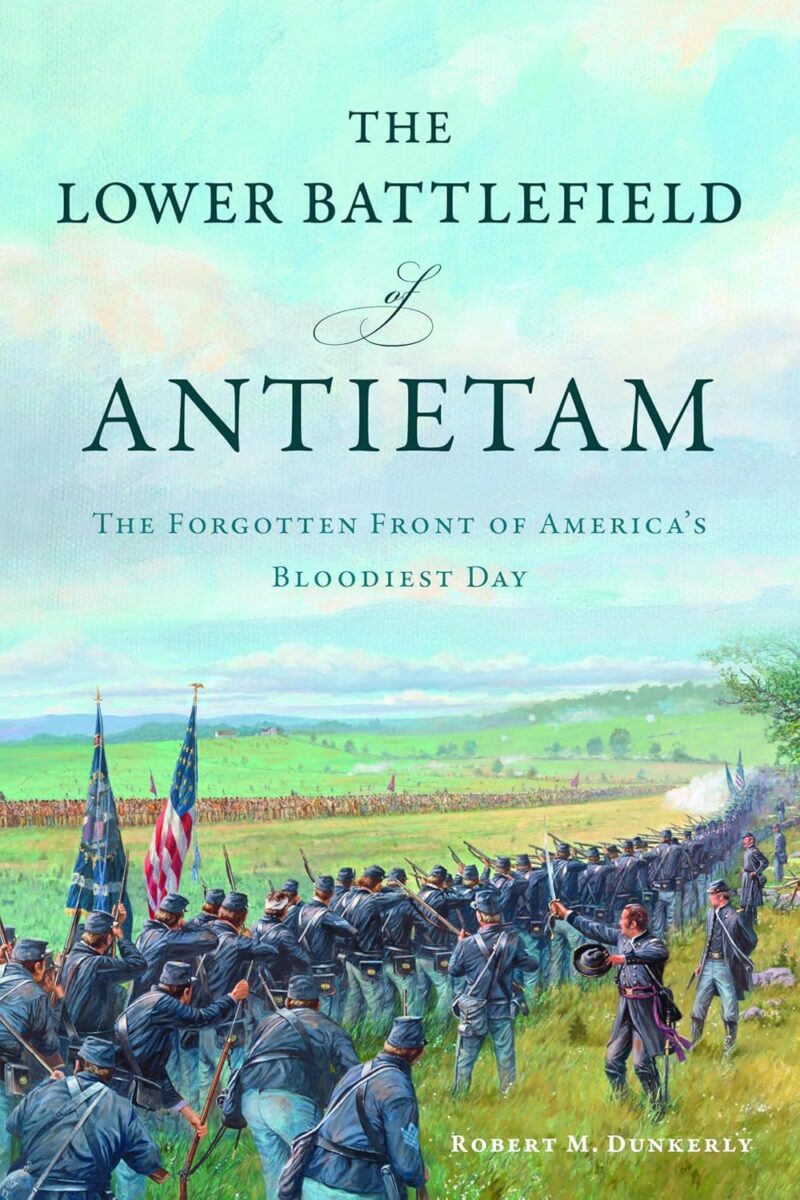
The author of this work makes clear his thesis: the “Lower Battlefield of Antietam” (more commonly called the Final Attack or Ninth Corps attack) has received neither the study nor the scrutiny given to other portions of the battlefield. As a long-time student of this battle, I agree with this viewpoint. As a long-time tour leader there, I can also attest that most people are experiencing informational and sensory overload by the time they reach the lower battlefield. So, his thesis is solid.
This study is not intended to be an academic work, and this publisher tends to print short paperback works for popular consumption. The length and footnoting likewise fit this pattern. There are useful photographs and maps which enhance the narrative, although at least one of the photos is mislabeled. Also, as is typical of History Press books, the index only includes proper names.
In the overview of the campaign and battle, Dunkerly seems to be using outdated sources, many of which have been debunked. For example, he accepts the “Burnside-Porter” controversy over Gen. Fitz John Porter’s animosity at Burnside for sharing letters criticizing Gen. John Pope. Kevin Pawlak’s article (“General Discord,” Civil War Times 58, no. 10, Dec. 1, 2019) has established there was no controversy, as Porter was unaware of it until after the campaign. Likewise, Dunkerly’s account includes the shopworn theme that the discovery of Special Order 191 was revelatory to Gen. George McClellan, who subsequently bungled his golden opportunity. This accusation has been discredited by several authors.
Dunkerly also criticizes Gen. McClellan for having a “vague battle plan,” which seems no vaguer than those drafted by most other commanders during the war.
More importantly, when discussing the muddled command structure in the federal Ninth Corps, he refers to the disbanding of all the wings of the Army of the Potomac. Actually, only Burnside’s Right Wing was disbanded (see OR, vol. 19, pt.2, p. 297). Still, Dunkerly correctly assesses that a muddled command situation contributed to the lack of success for the Ninth Corps.
Dunkerly sides with those who suggest the Ninth Corps attack at the bridge began at 10:00 a.m. That is the time stated in Burnside’s report, and although Cox initially wrote 9:00 in his report, he changed it to 10:00 when he saw Burnside’s account. Paradoxically, Dunkerly later quotes Col. Henry Benning, who commanded the Confederate brigade defending the bridge, as saying they had been fighting for “four hours.” Since all accounts agree the bridge was carried at 1:00, the attack most likely began earlier than 10:00.
The strongest portion of this book is the well organized and narrated description of the Ninth Corps’ futile assault on the remnants of Gen. D. R. Jones’ Division. The author divides the attack into two portions, which adds much to its clarity. Using many contemporary accounts and excerpts from reports in the Official Records, Dunkerly’s narration lends much clarity and understanding to this chaotic assault. He also correctly states that what was known for many years as “Otto’s Cornfield” actually belonged to the Sherrick family and was leased out at the time of the battle. Kudos!
Several Union soldiers mentioned Confederates wearing Union uniforms, almost certainly pilfered from Union stores in Harpers Ferry. Dunkerly corrects the several accounts which claim the Confederates were using Union flags to deceive them. The author also (correctly in my opinion) makes clear that the lack of Union artillery support, compared to the multiple Confederate batteries, played a significant role in the failure of the Union attack. Multiple Union sources repeat the myth of Confederate firing “railroad iron” at them. While the Confederate ammunition supply was low due to the capture of Longstreet’s ammunition wagons two days prior, there was not a railroad within 12 miles of Sharpsburg, and the labor of finding, dismantling and transporting “railroad iron” to supplement their artillery supplies seems extremely far-fetched.
Not surprisingly, there are far more Union accounts than Confederate, and the author weaves these accounts into his narrative to provide a clear and usable account of the long-overlooked fighting on the south end of Antietam battlefield. He rightly points out that probably the heaviest casualties of any Union brigade occurred here, and the “high water mark of the Union attack” also occurred on this part of the field.
Dunkerly deserves credit for calling much-needed attention to this decisive final attack at Antietam.
Thomas G. Clemens is a certified Antietam Battlefield Guide who retired after a thirty-four-year career as a history professor at Hagerstown Community College. He is the editor and annotator of Ezra A. Carman’s manuscript, The Maryland Campaign of September 1862, which appeared in three volumes from Savas-Beatie.