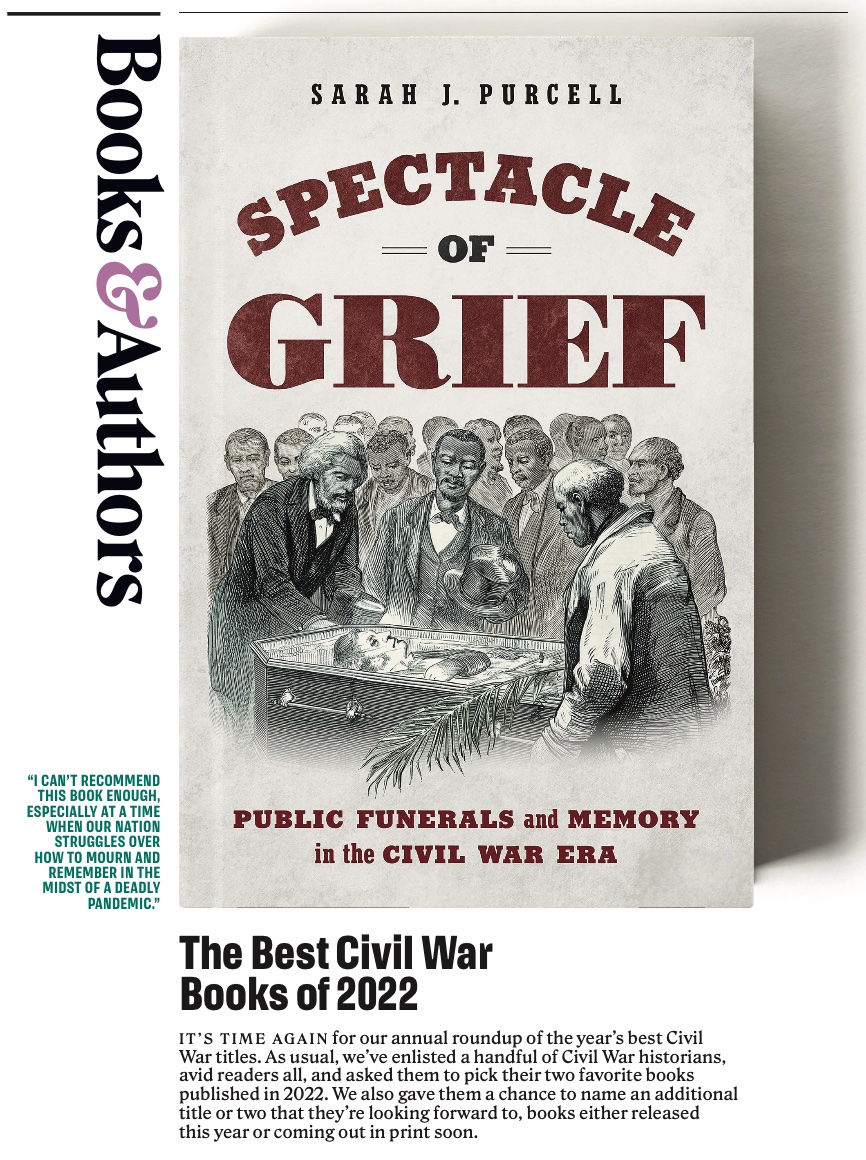
The Books & Authors section of our Winter 2022 issue contains our annual roundup of the year’s best Civil War titles. As usual, we’ve enlisted a handful of Civil War historians, avid readers all, and asked them to pick their two favorite books published in 2022. Below are their selections. We also gave them a chance to name an additional title or two that they’re looking forward to, books either released this year or coming out in print soon. You can find those picks in the issue.
Cecily Zander
Top Pick
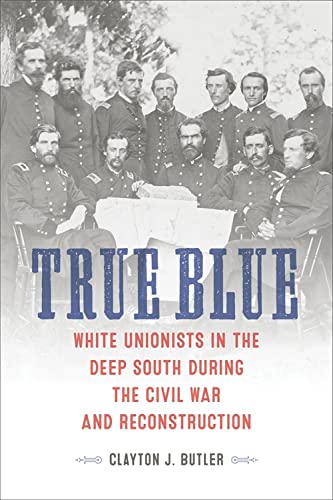
Clayton J. Butler’s True Blue: White Unionists in the Deep South During the Civil War and Reconstruction(LSU Press) transforms what we know about the cohort of white southerners who refused to accept secession. The people uncovered by Butler were not merely opposed to the Confederacy, they backed their ideology with action—striking out from Louisiana, Alabama, and Tennessee for Union army camps, where they donned blue uniforms and fought to preserve the nation. Butler’s narrative is compelling and written with verve. Of note is his chapter on the Tennesseans of Bradford’s Battalion at Fort Pillow. Though the massacre of United States Colored Troops by the Confederate cavalry under Nathan Bedford Forrest is well known, Butler recovers the story of white Unionists at the fort who were targeted for being “race traitors.” It may be Butler’s work on Reconstruction, however, that makes True Blue deserving of the crown for 2022’s best Civil War book. In investigating how and why Reconstruction failed to enact the transformative political changes longed for by the Radical, abolitionist element in the North, Butler shows that many of the white southern men who had picked up rifles to fight for the Union were not willing to fight with their vote for black civil rights, especially when faced with coordinated violence and intimidation by former Confederates. As the latest entry in a growing literature on Union and its meaning in the Civil War era, True Blue adds a great deal to the rich story of America’s transformational conflict.
Honorable Mention
David K. Thomson’s Bonds of War: How Civil War Financial Agents Sold the World on the Union(UNC Press) offers the rollicking story of Union financier Jay Cooke and his agents’ efforts to sell the Union war. Economic history can strike fear into even the most courageous readers, but Thomson alleviates any trepidation about facts, figures, and accounting—and rewards readers with much to consider in this extensively researched volume. Thomson rightly notes that for all that historians have written about the conflict, few have asked how the United States financed the Civil War. This book fills the gap, presenting not only the mechanics of selling federal bonds, but also the political and social arguments made by the agents who asked Americans to lend their dollars and cents to the war effort. Thomson shows how the selling of bonds got Americans from all walks of life invested, literally and figuratively, in the war effort. Readers cannot help but close this volume with a new appreciation for the behind-the-scenes financial work that made Union victory possible.
Looking Forward To
Hampton Newsome’s recently published Gettysburg’s Southern Front: Opportunity and Failure at Richmond (University Press of Kansas) is first on my list. This book tells the little-known story of Union general John Dix and his push toward Richmond in the summer of 1863. Newsome’s latest looks like a must-have for Gettysburg and military aficionados—and for fans of good history, from a reliably engaging author. I’m also looking forward to The Library of America’s edition of Bruce Catton’s Army of the Potomac Trilogy with a new introduction by Gary W. Gallagher. Though the books are not “new,” Catton remains one of the best to have ever written about the Civil War, and Gallagher’s insights are sure to shed fresh light on Catton and his masterpiece.
Jennifer M. Murray
Top Pick
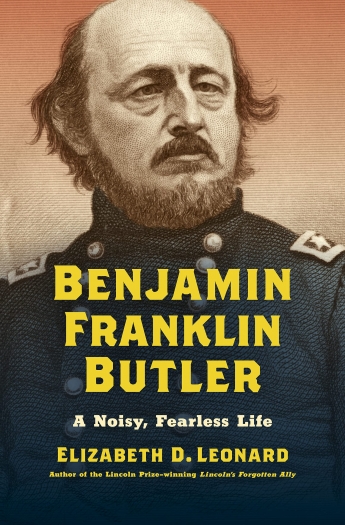
Elizabeth D. Leonard’s Benjamin Franklin Butler: A Noisy, Fearless Life (UNC Press) offers a fresh evaluation of one of the most controversial and maligned figures of the Civil War and Reconstruction. Butler graduated from Colby College (then Waterville) in 1838, the institution where Leonard taught for over three decades. Critical depictions of Butler dominated generations of Civil War historiography, with many of those interpretations rooted in Lost Cause ideology and propaganda. Leonard challenges judgments of Butler as militarily incompetent and morally corrupt, each a perception cultivated during Butler’s seven-month oversight of Federal occupation in New Orleans in 1862. White southerners’ widespread antipathy toward him took the form of various nicknames—“Beast” and “Damnedest Yankee” among the most popular. But, in perhaps Leonard’s greatest contribution, she chronicles the evolution of Butler’s racial sensibilities. Shaped by his own wartime interactions with slaves and contrabands, experiences added to in New Orleans, Butler emerged as one of the nation’s leading political voices for African-American freedom and civil rights. Leonard admits to being sympathetic to Butler (a susceptibility among biographers), yet she does not refrain from highlighting his shortcomings and flaws. Indeed, Leonard’s work reminds us of the importance of biography and encourages a reevaluation of Butler’s enduring pejorative, “Beast.”
Honorable Mention
While there is no shortage of books on the Overland Campaign or its individual battles, The Heart of Hell: The Soldiers’ Struggle for Spotsylvania’s Bloody Angle (UNC Press) by Jeffry D. Wert provides a particular and welcome perspective on the May 12, 1864, Federal offensive against the Confederate line at the Mule Shoe. Wert shifts the interpretive lens away from Ulysses S. Grant, George G. Meade, and Robert E. Lee and toward the rank-and-file soldiers in the Army of the Potomac and the Army of Northern Virginia. The Heart of Hell is a template of how to tell a familiar story in an engaging way, while privileging the voices and experiences of the men consumed by 24 hours of combat on one of the Civil War’s most iconic—and bloody—landscapes.
Looking Forward To
I am looking forward to reading Earl J. Hess’ edited collection, Animal Histories of the Civil War Era (LSU Press), a book that explores the critical and multifaceted ways in which the war affected tens of thousands of horses and mules, as well as scores of unit mascots and legions of wild animals. In addition, Evan C. Rothera’s Civil Wars and Reconstructions in the Americas: The United States, Mexico, and Argentina, 1860–1880 (LSU Press) promises to broaden our geographical understanding of the Civil War by placing the conflict in a transnational context and examining the relationship between the United States, Mexico, and Argentina.
Brian Matthew Jordan
Top Pick
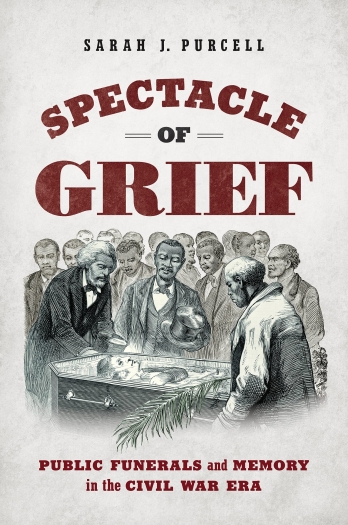
Civil War scholars have produced a steady stream of memory studies in the last two decades. Many of these books have affirmed the findings of David Blight’s Race and Reunion: The Civil War in American Memory (2001). A more recent body of scholarship has interrogated various obstacles to reconciliation: wounded veterans, grieving widows, and rows of graves. In A Spectacle of Grief: Public Funerals and Memory in the Civil War Era (UNC Press), Sarah J. Purcell deftly and persuasively moves the field beyond stale debates about the extent to which reconciliation triumphed in national memory. Identifying public funerals as a key battleground in the contest to define the meaning and legacy of the conflict, her crisply written and well-researched book demonstrates how different strands of Civil War memory could combine and coexist. Carefully analyzing the public obsequies for Henry Clay, Charles Sumner, Elmer Ellsworth, Thomas J. Jackson, Robert E. Lee, and other luminaries of the Civil War era, she shows how Americans—befitting the paradoxes of American nationalism—simultaneously held on to contradictory visions of the war. This is a richly textured, highly original yet accessible study that merits wide readership.
Honorable Mention
Joyce Dyer’s Pursuing John Brown: On the Trail of a Radical Abolitionist (University of Akron Press) is a compulsively readable reckoning with the uneasy questions raised by the abolitionist who raided Harpers Ferry. In a genre-bending work that bears some resemblance to Tony Horwitz’s Confederates in the Attic (1998), the author rummages research collections, squints to read lichened headstones, attends lectures and sesquicentennial commemorations, and contemplates the killings at Pottawatomie Creek. It’s an unforgettable encounter with the meaning of race and violence in our democracy.
Looking Forward To
Evan C. Rothera’s recently released Civil Wars and Reconstructions in the Americas: The United States, Mexico, and Argentina, 1860–1880 is next on my towering to-read pile. With its transnational lens and clear command of the sources, Rothera’s scholarship has already helped us to think about the Civil War and its era in new and fascinating ways. While scholars have begun to place the Civil War in a global context, this long-awaited work promises to shift our gaze and our sense of geography. The coming months promise a bounty of important titles, but I am most looking forward to new operational histories (both published by University Press of Kansas) from two of our most talented military historians: Ethan S. Rafuse’s From the Mountains to the Bay: The War in Virginia, January–May 1862 and Hampton Newsome’s Gettysburg’s Southern Front: Opportunity and Failure at Richmond. Transcending traditional chronological and geographical boundaries, Rafuse’s and Newsome’s books promise to deliver important new interpretations of events long studied in isolation.
Gerald J. Prokopowicz
Top Pick
Rarely does a biographer so completely overhaul her subject’s reputation as Elizabeth D. Leonard has done in Benjamin Franklin Butler. Like the rarely published image on the book’s cover, she offers a surprisingly attractive version of “Beast” Butler. Her research exposes the traditional caricature of an incompetent, corrupt, spoon stealer (an image that has long dominated both public and scholarly perceptions of Butler) as a relic of Lost Cause historical writing. In its place, she provides a detailed portrait of a remarkably effective military administrator and a lifelong champion of the underdog. Butler’s transition from Breckinridge Democrat in 1860 to wartime Republican emerges as a reflection of genuine sympathy for the enslaved. And then comes his postwar conversion to Greenback Party presidential candidate as a result of the Republican shift away from defending the formerly enslaved, to whose cause Butler remained committed. Some people outside of academia use the term “revisionism” as an insult, but without it, we’d all still be stuck with the myths of the 19th century. In setting the record straight on Butler, Leonard has crafted an example of historical revisionism at its best.
Honorable Mention
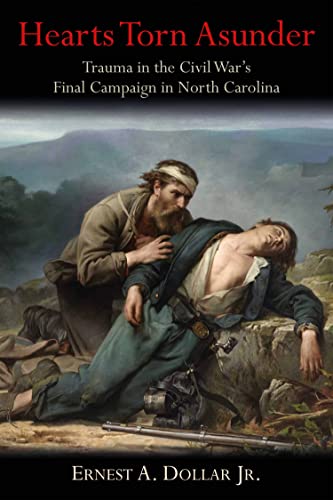
Ernest Dollar, with Hearts Torn Asunder: Trauma in the Civil War’s Final Campaign in North Carolina (Savas Beatie), does for North Carolina in 1865 what Carolina Janney did for western Virginia in Ends of War: The Unfinished Fight of Lee’s Army after Appomattox (2021), but on a broader canvas. Dollar’s work shows the confusion, suffering, and misery of the last month of the war, not just for the soldiers of the Confederacy, but also for their opponents, and even more, for the helpless white and black civilians caught in the vortex of Joseph E. Johnston’s and William T. Sherman’s armies. He captures the wide range of emotions, from joy to despair, that characterized the ending of the war, the assassination of the president, the impending loss of comradeship, the ambiguous dawn of freedom, and more. This is a moving and important book.
Looking Forward To
In The War after the War: A New History of Reconstruction (University of Georgia Press), John Patrick Daly argues that a second civil war took place in the South from 1865–1877. Following on William Blair’s The Record of Murders and Outrages (2021), Daly’s book promises to reveal just how violent Reconstruction really was. Donna McCreary, longtime Mary Lincoln presenter, has answered thousands of audience questions about her. In Mary Lincoln Demystified (Southern Illinois University Press), McCreary uses that experience to create a biography in an accessible question-and-answer format.
Kevin M. Levin
Top Pick
Sarah Purcell’s Spectacle of Grief is a fascinating study that explores the culture of memory and mourning practices surrounding some of the most notable Americans, from the antebellum era through the postwar period. Her study begins with Henry Clay, whose death in 1852 came at a time of increased sectional tensions and doubts about the nation’s future. Many Americans used the occasion to promote national unity while abolitionists pushed their own uncompromising position on the evils of slavery. Purcell uses the deaths of Elmer Ellsworth and Confederate general Thomas J. Jackson to highlight how the war promoted a distinct American and Confederate identity and how their deaths anticipated the postwar battle over Civil War memory. The final three chapters, which explore the deaths of Confederate generals Robert E. Lee and Joseph Johnston, George Peabody, Charles Sumner, Frederick Douglass, and Winnie Davis, challenge our tendency to analyze postwar battles over the legacy and meaning of the war as reflecting distinct and mutually exclusive narratives of Civil War memory. Purcell reminds us that Lost Cause, reconciliationist, and emancipationist narratives often overlapped one another. White southerners could both mourn Lee as a Lost Cause icon and claim their place as loyal Americans while Douglass’ funerals in Washington, D.C., and Rochester, New York, evoked a powerful emancipationist memory as well as a sharp white supremacist backlash. I can’t recommend this book enough, especially at a time when our nation struggles over how to mourn and remember in the midst of a deadly pandemic.
Honorable Mention
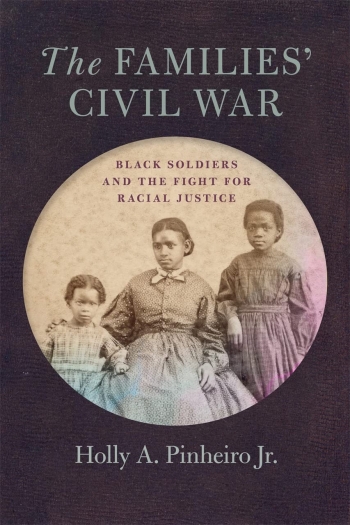
The past few decades have produced a wave of studies focusing on the lives of black Civil War soldiers. We know a good deal about their experiences on the battlefield and the dangers they faced at the hands of vengeful Confederates, but we are still lacking in studies of their families back home. Regardless of race, families struggled in numerous ways as fathers, sons, and brothers served in faraway places, but as Holly A. Pinheiro Jr. demonstrates in The Families’ Civil War: Black Soldiers and the Fight for Racial Justice (University of Georgia Press), free black families in the North faced distinct challenges rooted in decades of racial discrimination, violence, and disfranchisement. The focus on native-born, African-American Philadelphians and their families provides sharp interpretations of both challenges faced during the war and the hopes and dreams these families invested in a reunited nation.
Looking Forward To
We are in the midst of a contentious debate about how American history is taught, especially the history of slavery and race. Donald Yacovone’s Teaching White Supremacy: America’s Democratic Ordeal and the Forging of Our National Identity (Pantheon) explores school textbooks and other teaching materials—much of it published in the wake of the Civil War and Reconstruction—and its role in the distortion and mythologizing of this important chapter in American history. Eric Michael Burke’s Soldiers From Experience: The Forging of Sherman’s Fifteenth Army Corps 1862–1863 (LSU Press) promises a major reassessment of the importance of rifled weapons, physical terrain, and the extent to which interaction with southern civilians and the enslaved shaped the views of Union soldiers during a crucial transitional period of the Civil War.
The Top-Selling Civil War Titles of 2022
The books pictured here are the 10 bestselling Civil War titles published in 2022. They are ranked in order of copies sold through mid-October.
Source: Based on sales data provided by NPD BookScan for titles published in the category “Civil War Period (1850–1877).”
- Ways and Means: Lincoln and His Cabinet and the Financing of the Civil War, by Roger Lowenstein (Penguin Press) $30
- Lincoln and the Fight for Peace, by John Avlon (Simon & Schuster) $30
- To the Uttermost Ends of the Earth, by Phil Keith and Tom Clavin (Hanover Square Press) $29.99
- The Encyclopedia of Confederate Generals, by Samuel W. Mitcham Jr. (Regnery History) $49.99
- Gettysburg: Three Days That Saved the United States, by Ben Nussbaum (Fox Chapel Publishing) $14.99
- The Nation That Never Was: Reconstructing America’s Story, by Kermit Roosevelt III (University of Chicago Press) $25
- A House Built by Slaves: African American Visitors to the Lincoln White House, by Jonathan W. White (Rowman & Littlefield Publishers) $26
- James Longstreet and the American Civil War: The Confederate General Who Fought the Next War, by Harold M. Knudsen (Savas Beatie) $32.95
- The Heart of Hell: The Soldiers’ Struggle for Spotsylvania’s Bloody Angle, by Jeffry D. Wert (UNC Press) $37.50
- All Roads Led to Gettysburg: A New Look at the Civil War’s Pivotal Battle, by Troy D. Harman (Stackpole Books) $29.95
BEST BOOKS 2022 CONTRIBUTORS
Brian Matthew Jordan is associate professor of Civil War History and chairperson of the Department of History at Sam Houston State University in Huntsville, Texas. He is the author or editor of six books on the Civil War era, including Marching Home: Union Veterans and Their Unending Civil War(2015), which was a Pulitzer Prize finalist. In the spring, the University of Georgia Press will publish his latest title, Final Resting Places: Reflections on the Meaning of Civil War Graves (co-edited with Jonathan W. White).
Kevin M. Levin is a historian and educator based in Boston, Massachusetts. He is the author of Searching for Black Confederates: The Civil War’s Most Persistent Myth(2019) and is currently working on a biography of Robert Gould Shaw for the University of North Carolina Press.
Jennifer M. Murray is a military historian with a specialization in the Civil War in the Department of History at Oklahoma State University. She is the author of On a Great Battlefield: The Making, Management, and Memory of Gettysburg National Military Park, 1933–2013(2014) and is currently working on a full-length biography of George G. Meade, tentatively titled Meade at War.
Gerald J. Prokopowicz is a professor of history at East Carolina University in Greenville, North Carolina, and host of the podcast Civil War Talk Radio.
Cecily Zander is a postdoctoral fellow at the Center for Presidential History at Southern Methodist University in Dallas, Texas. She is at work on a book tentatively titled Republicans and Regulars in the Civil War Era: The Politics of Anti-Militarism and Western Expansion and has published several essays and book chapters on Civil War memory and the Civil War West.