Jennifer Raab discusses the power and importance of Civil War photography, including how the camera captured a brutal reality and shaped how we remember the war today.
Transcript
John Heckman: Jenny, I’m so glad you had time to come on and talk with us today about Civil War photography. It’s a tremendous subject and I really enjoyed your book. We’re going to go into that in detail. But again, thank you so much for being here.
Jennifer Raab: Yeah, it’s terrific to be here. Thanks for the invitation, John.
John Heckman: I’m going to start off with a big question here that can go multiple directions. In your view, what gives Civil War photographs their enduring emotional or historical power?
Jennifer Raab: I think in some ways, because they’re the first really to give us that kind of proximity to war, to suffering, to those physical environments of war, that they have a certain kind of power, a kind of originary power. I think there’s something a bit tentative and haunting about many of them because these are the first sort of battlefield images to be made. So photographers are working out, what does it mean to do battlefield photography? And because of the technical limitations of the medium—you know, this is a young medium, 20, 30 years old—they can’t capture action. So it has, I think, already a kind of pathos to it that at least we read in contemporary terms. Because it is about the aftermath, it’s not about action. They can’t capture action until much later. So it’s really about what has happened. It’s a kind of past tense.
And so I think there is something that’s very evocative in seeing these images. And thinking about violence and death and destruction and emotions through these images as people would’ve encountered them at the time. So I think that that’s in part why they retain their power, and especially now when we’re so used to seeing images of warfare and the instantaneity, or even in drone warfare the sort of live-streamed aspect of it, that there’s something that makes us pause over these kinds of images. And maybe reflect on violence and its toll somewhat differently.
 National Portrait Gallery
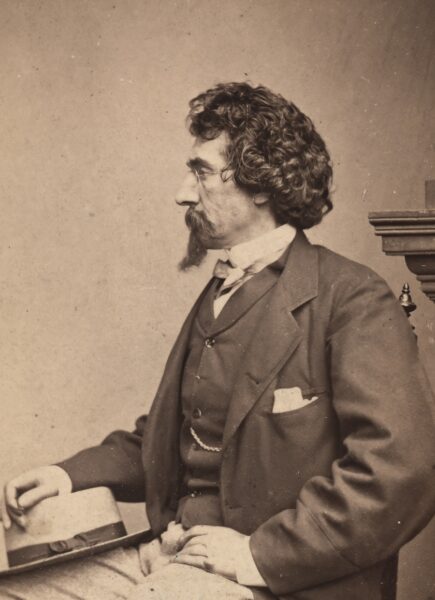
Mathew Brady
John Heckman: When we consider Civil War photography, a lot of us immediately go to Mathew Brady or Alexander Gardner or Timothy O’Sullivan. And I’ve often wondered, are these men, in your opinion, or throughout your research, do you think they’re documenting history or are they also shaping it in some way?
Jennifer Raab: Yeah, I think both certainly. And, I mean, this is also the time when those kinds of terms are being established or imagined. So I think now we think of documentary photography or artistic photography as very set categories and that’s definitely not the case then. Like what will photography be and what are the possibilities are really up for grabs at this point. And I think photographers like Brady and Gardner are interested in various different aspects of photography’s potential. And I think someone like Gardner, especially, who is doing such kind of sumptuous work with collodion photography, what he is able to do technically is so incredible. And you think about portraits of Abraham Lincoln, for instance. But what he’s able to do in the field. And Brady, who’s a master at creating the effect of the studio portrait, but also is this incredible mind in terms of the marketing potential of photography, what it could be, and in developing these studios and a whole fleet of photographers who would go out and photograph under his name during the war and really established the genre of wartime photography and its documentary function and its intimate links with the media, with illustrated newspapers, with this daily, weekly press and this idea that to understand war, we need to see something. And that’s something that’s very much established by these photographers. But there’s always a kind of an aesthetic too, and I think they’re aware of that and working within that as well.
John Heckman: Your newest book is Relics of War: The History of a Photograph, and it focuses on photographs as physical relics. This is especially true with the Andersonville relics piece, which not only you discuss greatly in the book, but I’ve seen before and I feel instantly engaged with it because I have an ancestor who died at Andersonville. Can you describe the story of how this particular image came to be?
 Library of Congress
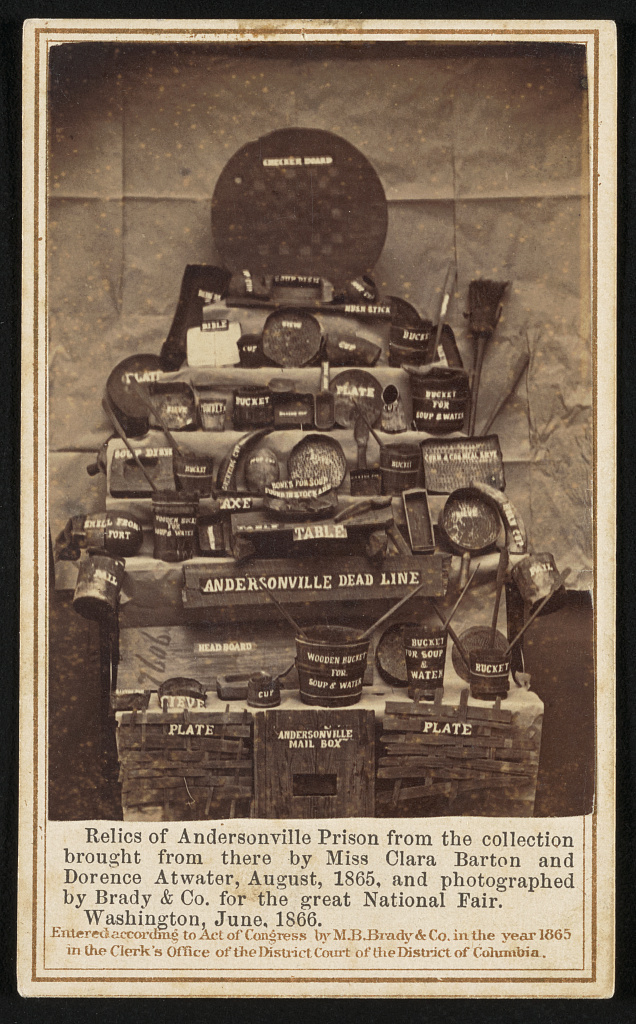
The “Relics of Andersonville” photo.
Jennifer Raab: Yeah, so this is a compelling photograph for a number of different reasons. One of those, I think, is that it doesn’t look like any other Civil War photograph. If we conjure in our minds what a Civil War photograph looks like, we’re probably thinking about a Gardner or O’Sullivan taken at Antietam or Gettysburg. And this is a picture that displays these relic objects that Clara Barton, who would later go on to found the American Red Cross and became famous of course as a nurse during wartime, goes down to Andersonville, which is this POW camp in southern Georgia, Confederate POW camp, and collects these relic objects that are sort of hand-hewn subsistence objects that the men who were imprisoned under horrifying conditions had created to try to stay alive.
And then she brings them back to her Office of Missing Soldiers in Washington, D.C., where she’s trying to connect bodies and names in the aftermath of the war. She’s trying to create a system where there is not one in the federal government to contend with the fact that half of those who are casualties of war are missing or unnamed. So in going down to Andersonville and collecting these relic objects and labeling them and displaying them for the camera, she’s trying to ask us what would it be like to see a photograph of warfare that is not a picture of dead bodies or a place, but rather evokes bodies and suffering and violence and martyrdom—which is of course the very idea of a relic in its kind of religious, early modern tradition. And to display those as part of her advocacy work for veterans and their families in the aftermath of the war and contending with death at this scale, which, you know, one of the hallmarks of the Civil War is just as really the first modern war, that sort of mass casualties and so many missing and unnamed.
So to display these strange objects, which are both at once very quotidian, like plates and cups, but don’t look anything like those objects, so have to also be labeled. So it’s this strange encounter in seeing this photograph of all of these things that are at once very normal objects or most of them, and then some that are very indicative of the violence taking place at this POW camp, like the deadline that encircled the camp. So these sort of objects of everyday life and objects of violence that are co-mingled that she gives us in this really evocative, almost altar-like display.
John Heckman: Does Barton think that these objects and the photograph that comes from it can relay the story better than she can of what she saw there?
Jennifer Raab: I think so. In certain ways there’s both the necessity of her narration as well as having these physical objects with her. And having the photograph allows the physical objects, the relic objects that touched these bodies, these martyrs, this place, to then be given photographic form and reproduced and held by those families who are still searching for loved ones or wanting to have their own object from the site, which is very remote.
So I think it went hand in hand with her advocacy work, which is at once very political, you know, asking legislators and politicians to think through the laws that did not allow families to claim pensions without proof of death, which meant proof of a body. So, in part, this photograph is a kind of counter argument to that—that you might not have a body, but that didn’t mean the sacrifices had not been there. So it tells a certain kind of story that furthers her political work, her work in the wake of the war. But it’s also very emotive and I think gives us a sense of the feeling of the place and of the kind of subsistence conditions there. And she does a lot of lecturing as well, I should say. Hundreds of lectures in which she carries these relic objects with her and also sells these photographs.
So it’s part of her stories that she’s telling or relaying stories of others. But I think there’s just something very powerful about the photographic image to also relay that story even more instantly and even without her, if she were not to be there, that continues to tell the story and keep it in the public light. That again is the power of visual representation, which is certainly something that we have now more than ever in our modern world.
John Heckman: We see the idea of photographs being witnesses, actually taking shape in the trial of [Henry] Wirz, the commandant of Andersonville at that time, the Confederate commander. This is probably the first time or one of the first times that photographs are used in a courtroom setting. Isn’t that correct?
Jennifer Raab: Yeah. So they’ve been used in a smattering of different ways for like forgery cases or land disputes starting, I think, in the mid-1850s, early 1860s. But this is without a doubt the first time that photography is used in the courtroom where the death penalty is at stake in a criminal case. This is a war crimes tribunal, so it’s not civil, it’s a military tribunal in which, as you said, the captain of the prison of Andersonville is put on trial. And he’s the most prominent Confederate to be tried after the war and only a captain, which tells you a lot, obviously.
 Harper's Weekly
The trial of Captain Henry Wirz, commandant at Andersonville Prison, as depicted in Harper’s Weekly.
And photography is an essential part of this case. And that had never been noticed before, in part, I think, because those photographs don’t remain with the case. But what’s fascinating is, these photographs predate the central photograph of my book, but they really shape it. People had these in their minds. They were very well circulated by the press. This was a huge trial that was covered by the media. And at the center of it are photographs of the prisoners of war, just when they’ve come back to U.S. Army hospitals and they’re photographed as these men are being seen by surgeons. And so often the surgeons are put up on the stand to testify to the condition of these men. And there’s just a fascinating interaction in the trial between what does it mean to look at a photograph as a form of evidence, and can that stand in for the person that it’s representing or the condition that it’s speaking to, and who should be a sort of expert witness. And the defense is trying to negate the expertise of the surgeons by saying, well, did you take the photograph or did you treat this patient? Or were you there at Andersonville as opposed to the military hospital?
So there’s this fascinating interaction about what constitutes photographic evidence, which is now just a mainstay of trials, right? And also a mainstay of proving war atrocities. As someone like Susan Sontag famously writes, the idea of atrocity now in our modern idea necessitates photographic evidence. But that was not the case then. And it’s fascinating to see the courtroom trying to wrestle with what is a photograph and can it be evidence, which is such a fundamental assumption that we have of a photograph, that it has this kind of facticity. And that was not the case then.
To go back to one of your previous questions, I think one of the fascinating things about thinking about these photographers who are documenting the war, like Gardner and O’Sullivan, because is it documentary? Is it artistic? Where are those categories? And again, they’re just so malleable as people are experimenting with what the medium can do and where can it be and who can it speak to, and these different audiences and possibilities. And the courtroom is certainly one of them. And that’s a fascinating piece to this story.
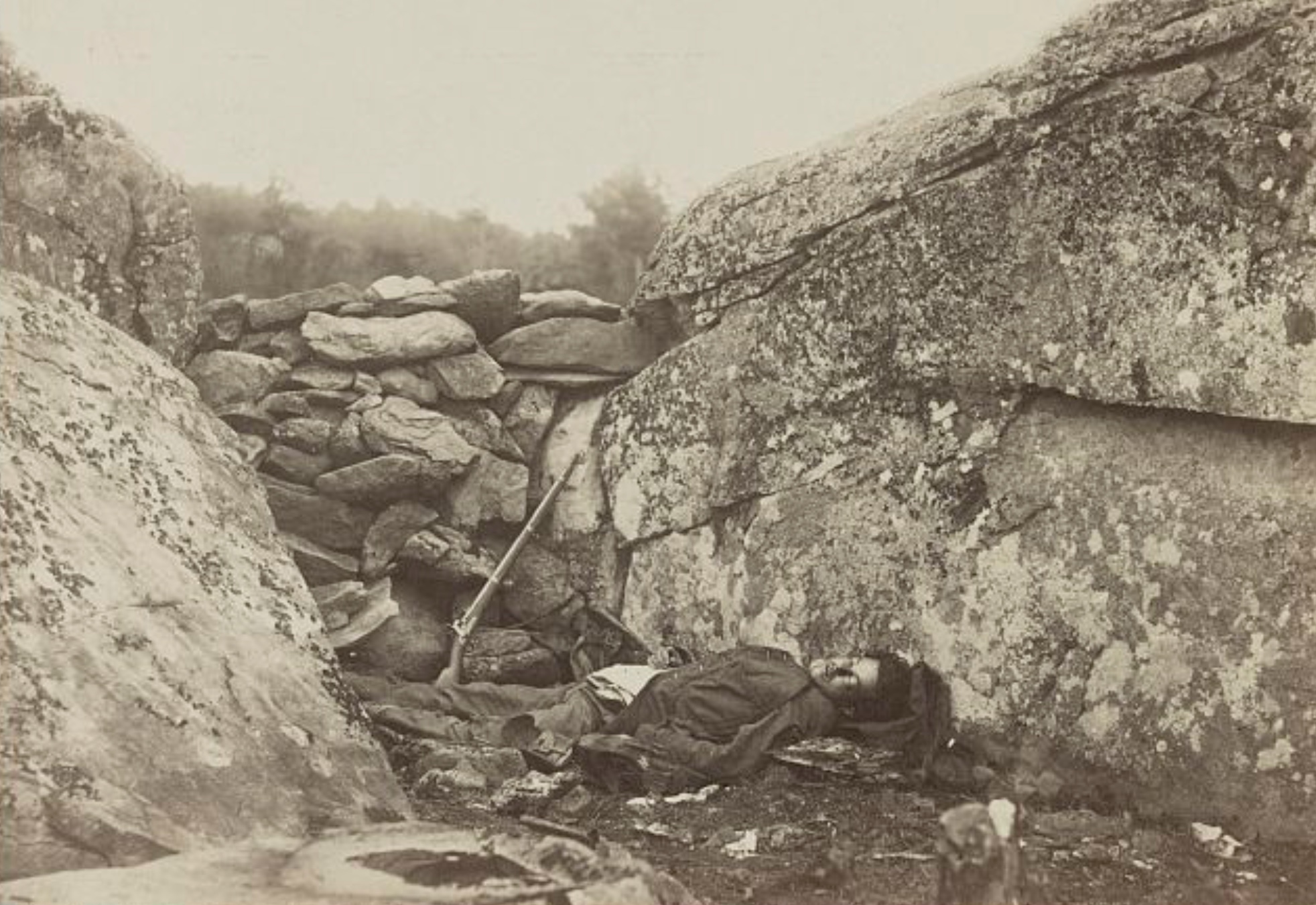
John Heckman: I actually started a small firestorm between my friends because I talked about the image of the Rebel sharpshooter at Gettysburg, the infamous image of the Rebel sharpshooter. And I argued the case that this is one of the first disinformation campaigns. And that started a whirlwind because we don’t think of it that way. We think, yeah, it was staged, but we don’t really think about how it intersects us, how we would talk about this in a modern way. And that really started an interesting discussion about how we engage with these images. How do we interpret these images, because they are of a material nature. And it could mean something different for a generation. Do you think there has been an influx of new thought around some of the images that we see now, especially those that don’t get published a lot? Or the Andersonville relics image, which isn’t published as much as the Gettysburg sharpshooter is?
 Library of Congress
Alexander Gardner’s photo of a dead Confederate (identified by him as a sharpshooter) at Gettysburg.
Jennifer Raab: You know, what interests me, is trying to put these images back in their rich, historical context—to think about how viewers at the time might have been encountering them. And I think that’s not just one way with a lot of these more famous images, especially, or you know, in the case of “Relics of Andersonville,” which to us is not well known at all, but at the time circulated in various different formats of photography. And I think that’s another really fascinating part of this moment in photography is that we have to, as you said, think about its materiality and its circulations. You know, this is not a digital image that is just morphing into all sorts of spaces. These are material things that are, in the case of a, say, a carte de visite, which is a kind of calling-card-size image and is one of the most widely reproduced—people had them in albums, carried them around. Or a stereoscopic image, which is like this three-dimensional experience you put into a viewer and has a kind of proto-cinematic aspect to it and being able to see depth and a sense of three dimensionality. Or something that would be engraved and reproduced in Harper’s as part of a news story.
So there are all these different ways in which viewers are encountering these images that I think are then helping to formulate their response to it. You know, whether this is part of a story that is trying to think about the Battle of Gettysburg and sharpshooters, etc., or whether this is in the postwar album that Gardner does of 100 photographs that gives a history of the war, the Sketchbook of the Civil War, in which we see the sharpshooter again. And there’s an elaborate caption, a little description of it, which is very sentimentalizing, tells this whole story of the man, which we know is not the case. So there’s this sort of fabrication of his identity as well as the whole choreography of the scene.
But I think there’s also something about choreographing the scene that would not have struck viewers at the time as necessarily a fabrication. That is more part of our modern sense of what is right and wrong, and taking a photograph and the kinds of ways—a sort of sense of what truth value is. And that both hasn’t yet been fully established at this time, but I think is also not necessarily the assumption of viewers that, like a sketch artist who’s working for Harper’s, who’s out there doing drawings, and then those are mediated again by the engravers, that there’s something about giving the sense of the war that is different than giving an absolutely accurate account of this person there. But, of course, it takes a different twist when these stories are published, say in the sketchbook, that narrativize this moment of death. And give a different sense of how to read this image, which is not the one that we would’ve necessarily seen right after he took it.
John Heckman: I’ve been thinking a lot, too, as I was reading through your book about Sontag’s work and talking about the pain of others, and Frames of War by Judith Butler. I’ve been looking at some of these images and I’ve been thinking about how I’ve interacted with these images previously. How would you tell others we should look at these images and look into these images in an ethical way? Sometimes I feel like many people just look at it and they’re like, wow, that’s a really cool image and they move on. Even if it’s a scene of battlefield death, they move on from it. They don’t really interpret the image. They just look at the image. Do you find that that could be an issue that pops up even with 19th-century photography, as we see in the modern sense when we are just flicking through the latest feed on our phone?
Jennifer Raab: Yeah. I think in part it’s about spending deeper time with images rather than that sort of quick swipe. And especially maybe those that are taken around the same time. There are just these really iconic images that we see again and again. And I think there can be a kind of desensitization to really looking, really even looking at the image any longer because we assume we know what we’re seeing. And I think that’s always the fascinating part about seeing photographs, and I think especially 19th-century photographs, seeing them in person because they’re fascinating paper or metal objects. The scale is surprising, the clarity, the context. And so not seeing them on the screen, I think, can be quite helpful.
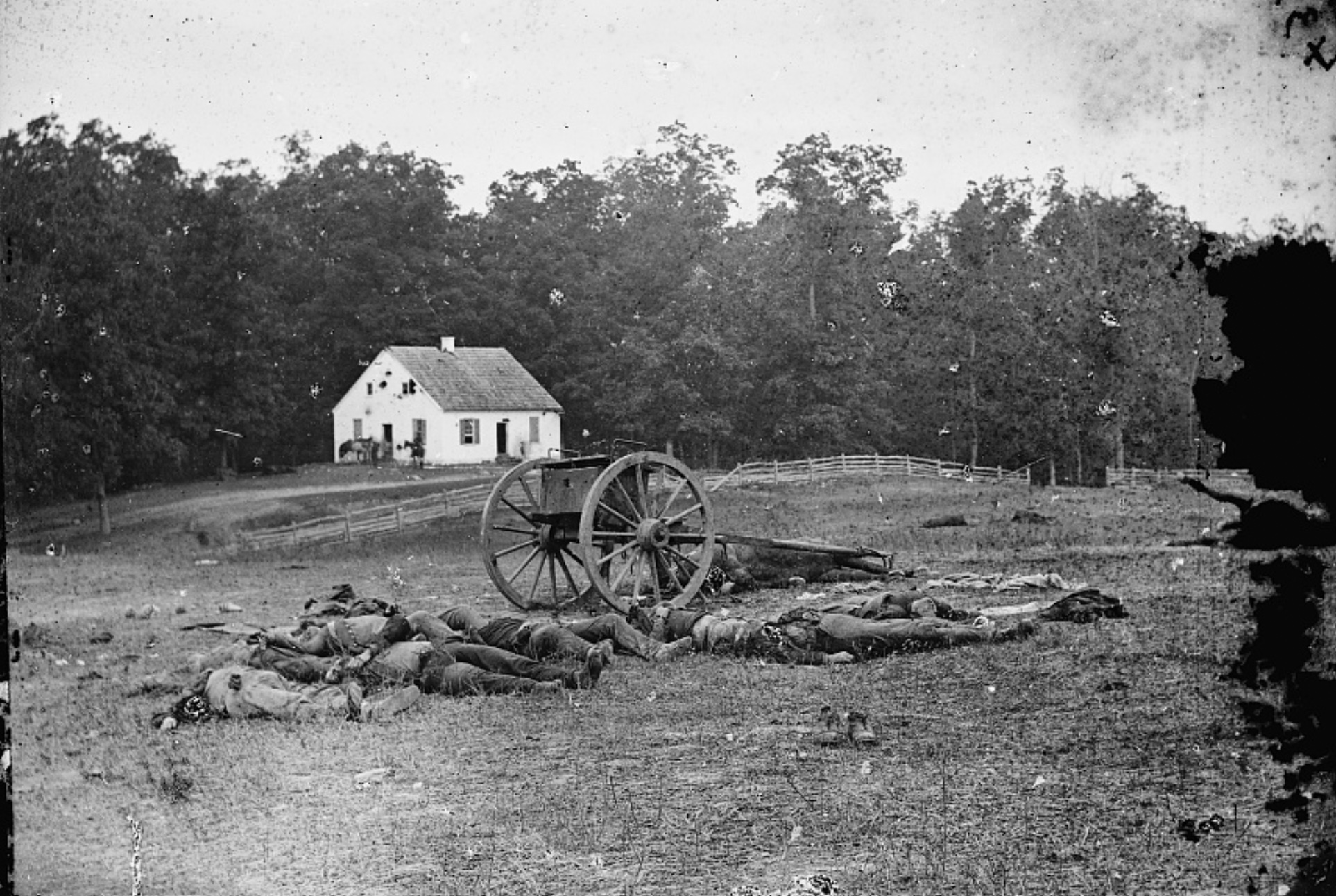 Library of Congress
One of the photos from Mathew Brady’s “Dead of Antietam” exhibit.
And for me, this project began years ago, seeing an exhibition of Civil War photographs at the Met for the sesquicentennial of the war, and encountering a large-scale format print of “Relics of Andersonville,” and just staring at it for a really, really long time. And that time spent, you begin to see things that you don’t at the quick glance. And it’s always fascinating to go back to some of the earliest commentaries on encountering Civil War photographs that are run in The New York Times right after the Antietam photographs are put on view in Mathew Brady’s studio in New York City. And they’re just wrenching and evocative descriptions of what it means to encounter these images amid the rush of everyday life and the marketplace of Broadway, because that’s where Mathew Brady’s studio is, amid all the department stores and Barnum’s American Museum and so forth.
So it’s that these photographs of dead bodies are on view and that people might just rush around and not see them and not contemplate what that really means. That these are men who are husbands and sons and brothers and are no longer with us. That these are, in other words, not representations of people, but are actually images of them. And trying to find the language for that. And that is a fascinating set of articles to return to, that first encounter. But also the struggle right off the bat with some of these ethical questions that you’ve posed. Like, what should it demand of us? Should we look longer? Should we pause everything? Is it uncouth to look? What are the proper conditions, if that is such a thing? So I think that, you know, that struggle, too, is something that those at the time are really contending with. And I love the idea that a colleague who’s a curator at the National Portrait Gallery raised that Abraham Lincoln might have seen the photographs taken of Gettysburg as he was writing his speech for the consecration of the cemetery. And the idea that that short speech, three minutes, following Edward Everett’s two-hour oratory, would be also a nod to the new rhetorical power, visually speaking, of the photograph. That this warfare demands a different kind of response. A different, in this case, mode of oration and commemoration. I think of Everett’s as the equivalent of like the large-scale cycle of history paintings that is just endless and massive and sentimental and flag waving. And Lincoln’s brief address that is all about this place and these men, is sort of photographic in nature. So I think, yeah, there’s something that photography demands in terms of a response that is perhaps different.
John Heckman: With that idea of the “Dead of Antietam” in New York City being put on display, do you think that changed anything for the photographers themselves? Do you think that made them ponder the impact behind what they were doing? Do you think that kind of changed or made them rethink what they were doing and saying, Hey, there’s something here that we need to document, or there’s something here that the people really want to understand?
Jennifer Raab: Yeah, I think that it is all happening in some ways so quickly that I’m not sure there’s a moment of reflection or consensus. I think certainly in looking at what is reproduced in illustrated newspapers like Harper’s or Frank Leslie’s, or what is being bought by the public in terms of like sets of stereographs. Most of those are not gruesome images until far later, 1880s, 1890s, when a market for the memory of the war crops up as veterans are really aging and coming back together to do, you know, GAR reunions and so forth. And then having these images that are horrific becomes part of that memory.
But I think it’s very delicate during the war. And so I think that there is this sense of documenting what is happening in the aftermath of these battles and the violence that’s taken place. But that’s often not what’s published or seen. So there’s, I think, a sense maybe with the photographers of realizing that it’s not necessarily clear what the remit is, but that they are on the front lines. And I think this is the case often with wartime photographers, that you’re going to take a lot of photographs and it’s not necessarily clear in the moment what will be needed or run. And maybe also the sort of afterlives, and how those might speak to a different audience at a different time. So I think there’s something about just being aware of what one is seeing and trying to do justice to that, that becomes the work of photographers on the front lines.
John Heckman: So, Jenny, as we wrap up, I have to ask this question: For those who are studying this period of history or who are just genuinely interested in it, and they may read a book from time to time on it, why should they study the visual history of this war? Why is it important?
Jennifer Raab: Oh, gosh. For so many reasons. Well, I think it’s a history that allows us to understand our present in so many interesting and complex and often distressing ways. Because it is the birth of a kind of media culture, where images are absolutely at the center of illustrating and conveying what war is. And I think we couldn’t imagine thinking about conflict without thinking about images now, and that really isn’t the case before the Civil War. I mean, there are, again, painted representations and so forth, but photography gives a much quicker access to the place. And, in certain ways, far less mediated. So I think it’s just a fascinating history—technologically, visually, materially—that allows us to see this war and American culture and history in all sorts of interesting ways that have really fascinating connections with the present.
About the Guest

Jennifer Raab is an associate professor in the Department of the History of Art at Yale University and author of Relics of War: The History of a Photograph.
Additional Resources
-
- Clara Barton Missing Soldiers Office Museum
- Frames of War: When Is Life Grievable? by Judith Butler
- Mathew Brady’s “The Dead of Antietam”
Sponsored By