Historian Scott Huffard talks about how railroads became the engine of the war, transforming everything from logistics to troop movements.
Transcript
John Heckman: Well, Scott, thank you for coming on this episode of the podcast to talk about Civil War railroads.
Scott Huffard: You’re welcome. I’m happy to be here.
John Heckman: I have to ask you right off the top: Why should people look at Civil War railroads as something to study or think about?
Scott Huffard: I think it’s impossible to understand the Civil War era without understanding the railroad. You have this new technology—newish, I mean, 1820s is when we start to see them coming into the South—that is rapidly developing, rapidly changing everyone’s lives. The South goes through a big boom in railroad construction in the 1850s. So we’re trying to understand this conflict that takes place in America, and particularly in the South, and we want to know what’s going on with the railroad because it’s of course not just important for society, it’s essential for the military to move supplies around and move troops. We can almost see the war as these two different governments, North and South, trying to figure out what to do with the railroad networks, how to best utilize it. And there’s not really a playbook for these governments to follow because we’re still experimenting with all these sort of new things here during the war. So, yeah, I think Civil War railroads are essential to understanding both the war and its aftermath and many debates that arise as the war ends.
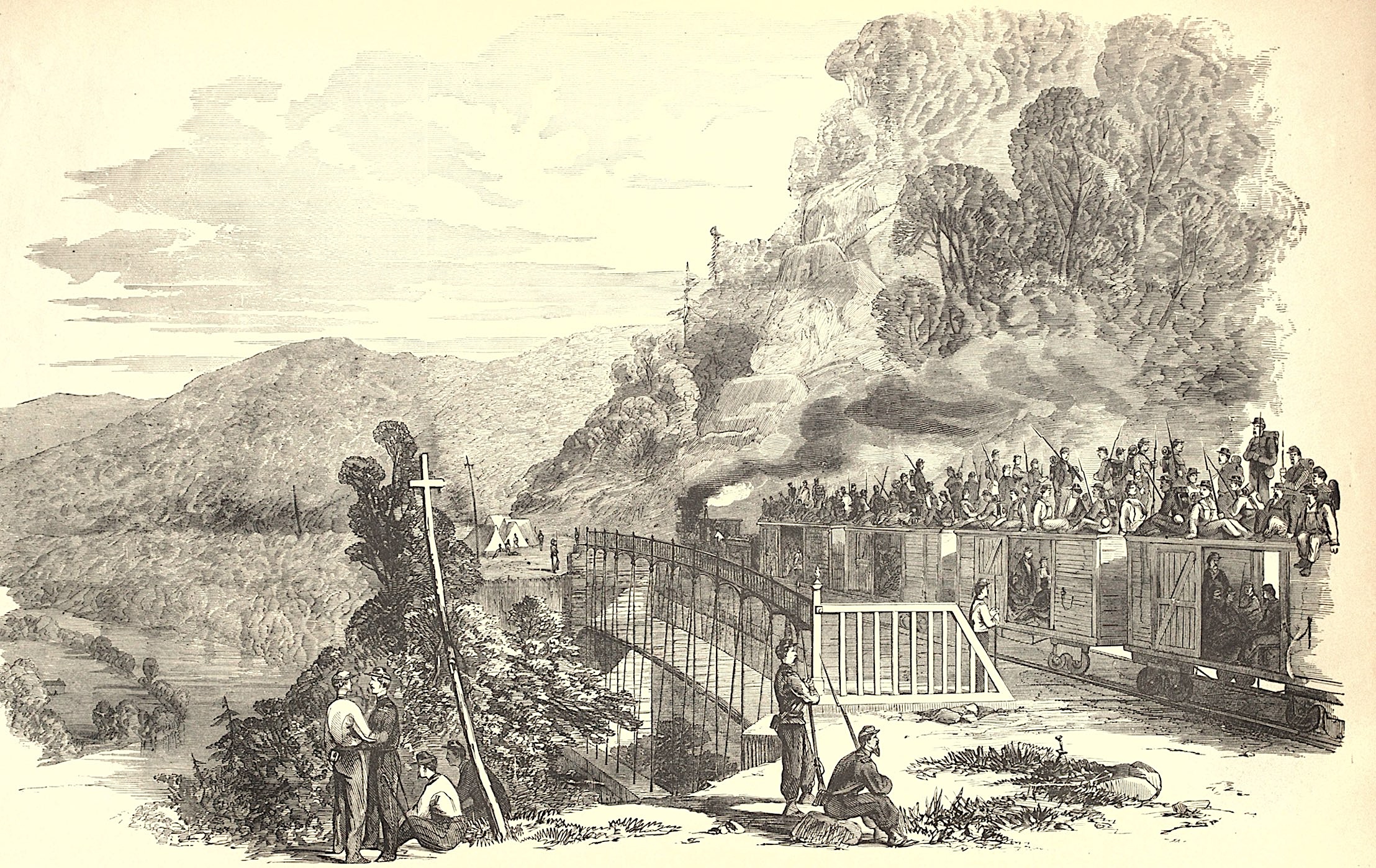 Frank Leslie's Illustrated History (1895)
Union soldiers are transported by rail car in this wartime illustration from Frank Leslie’s Illustrated Newspaper.
John Heckman: What’s the railroad system look like just before the war? What does American rail look like in general?
Scott Huffard: America had built a pretty big chunk of railroads. In the Northeast in particular there’s a very kind of dense network, which makes sense. The North is industrializing. There’s lots of capital for this. People are forming corporations now to make the railroads. So the Northeast is doing quite well with the railroad game. The South’s not out of the picture, though. The South is building a fairly decent network given the fact that it is a plantation economy. Historians have made the argument the South is not as inclined to railroad investment because you have people who are investing in the South, but they’re putting their capital into slaves, they’re buying land. In some ways, the argument goes, this stifles investment, stifles innovation, and investment in things like railroad lines.
But despite this, the South does have a decent amount of railroads, which will be pretty important when the war gets going. A lot of times it would be the southern states that come up with the railroads. Again, private investments not chipping in as much. So maybe North Carolina builds a railroad. Or South Carolina builds the South Carolina Railroad. Georgia, it has a state-owned system. And they were largely building these to serve the plantation economy. The goal is often just to make sure cotton is getting from the interior to the coast, to port cities and things like that. So the South’s building these railroads and there is close to what we’d call a system as the war breaks out. But the fact these are state-owned, it’s going to be kind of a problem because the states were trying to get a leg up on each other and not really thinking about this as an integrated network. It’s more what can I do to boost South Carolina’s economy, boost South Carolina’s cotton. Not so much the South as a whole. When the war breaks out, that’s going to become a problem.
But we can definitely talk about the 1850s South as a modernizing society. There are pockets of industrialization happening, lots of railroad construction going on. The South’s even using slavery to propel this stuff forward. Again, we often think about slavery as this backwards, pre-modern form of labor. But railroad companies are owning slaves. They’re using slaves to construct these rail lines. There are interesting counterfactuals: What happens if the war doesn’t break out or the Confederacy gets independent? And we could even foresee industrial slavery happening all across the South’s economy if slavery had been allowed to continue. So yeah, there’s railroads in a pretty big sense in the Northeast. And the South’s doing all right, actually, in terms of building railroads.
John Heckman: What role did these railroads play in shaping military strategy in 1861 and forward, because they’re pretty much seen as major targets. I mean, we’re talking about a place like Chattanooga and later on Atlanta. What kind of things come into play with these areas?
Scott Huffard: Yeah, it takes the generals on both sides a little bit of time to figure this out, but the railroads give us this kind of new geography that they have to master. They, of course, are used to dealing with rivers and mountains and they have those maps out. But the South has these rail lines and if you can start punching holes in this rail network, that really starts to hurt the South in a pretty big way. Because they use these railroads pretty heavily.
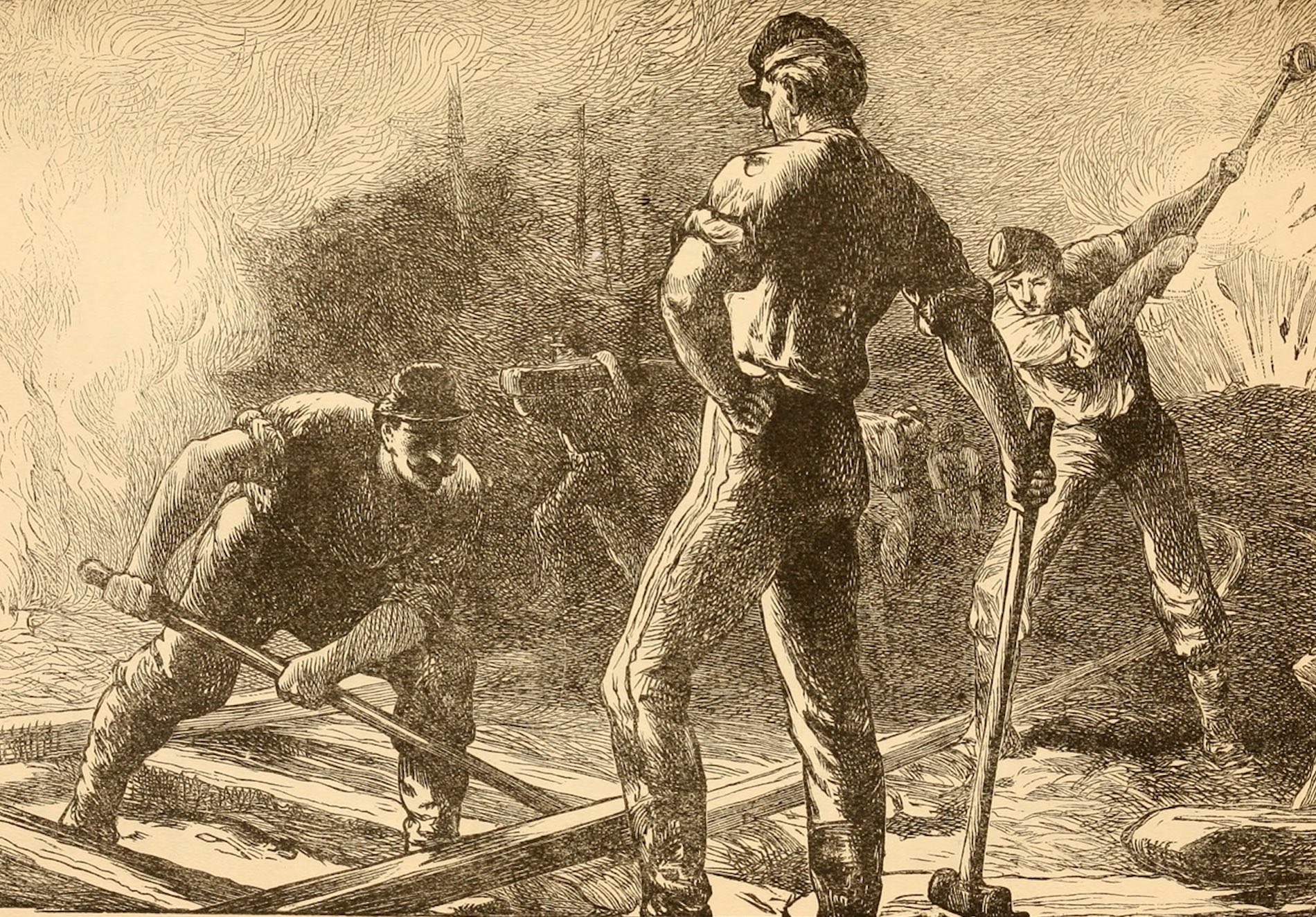 The Boys of '61 (1862)
Union soldiers are depicted tearing up a stretch of southern railroad in a wartime illustration.
So as the war goes on, we see more and more northern generals just going after the rail lines. As you mentioned, junctions are becoming super important. Of course, Atlanta and Chattanooga become pretty essential by 1864. Even before this, of course, we have a battle at Manassas Junction where rail lines are meeting. Or at Corinth in north Mississippi. That’s the target of the campaign that gives us the huge battle at Shiloh. So, yeah, they’re realizing pretty quickly we can, of course, take territory. We can take cities. But if we can cut the South’s rail network, northern generals start to realize that that’s going to really give us a leg up. Confederate generals aren’t always as attuned to this. We think about giving up Atlanta, which they of course kind of had to do. That ends up being this huge blow in terms of infrastructure. So some historians have made the case that the North gets this railroad strategy a little faster than the South does. But they become huge, huge targets, of course, during the campaigns.
John Heckman: Were there any notable figures or people who you came across who were pivotal in advancing railroad technology?
Scott Huffard: A lot of my research deals with the decades after the war. And there’s a whole host of these Confederate guys and southern guys who reinvent themselves as railroad executives. And there are some interesting parallels between running an army and building a rail line. Some of these guys are going out west to build the railroads. My own work about this guy, Samuel Spencer, who was a Confederate veteran, he was quite young when the war breaks out, he ends up by the 1890s the president of the Southern Railway, which is this huge southern network, almost a monopoly of sorts in some areas. And this guy Samuel Spencer, and so many of these guys, they would use their Confederate ties or their veteran status to gain support in the South. So a lot of the guys were able to parlay their service in the war, into postwar railroad success, starting companies. P.G.T. Beauregard famously gets involved in some railroad schemes during Reconstruction. So there’s a whole host of guys like this that make that transition in the postwar period.
John Heckman: You talked about that limited railroad infrastructure in the South as compared to the North. How is the Confederacy going to overcome some of the stress that’s placed on that? Do they ever overcome any of the stress that’s placed on that because of the war effort or by the Union army?
Scott Huffard: It’s a good question. On the one hand, the South does have fewer railroads and we can see that as a big disadvantage. But they are actually using it effectively in a couple different campaigns that they’re able to shift people around pretty effectively. There’s a kind of interior network that the South puts together. They had to do some work to put this network together because again, like I said, these are state-owned lines. One big gap is a 50-mile gap between Danville, Virginia, and Greensboro, North Carolina. And that’s a big problem because Richmond connects to the rest of the South via this line. So the government has to step in and get this 50-mile gap built. Even though North Carolina was still complaining about this, they wanted to keep this gap to make sure their state could have the railroad advantage basically.
So they have to overcome these various difficulties. Pave over the gaps. There are different gauges in different states—the gauge is the width between the tracks. And again, some states are deliberately putting theirs at different gauges before the war so they make sure they capture all the traffic in their states. They have to make sure they standardize the gauges, get them on the same page basically. We see in this, this interesting test of the Confederacy’s states’ rights idea. They’re seceding because of this overarching theme of states’ rights, but we have to fight a war. We have to consolidate a railroad network. That takes a pretty strong national government to do this. So throughout the war we have this strain in the Confederacy. Do we take dictatorial measures to patch up the railroad? And states are complaining about this. And this in some ways hampers the South, the fact that they’re going with the states’ rights, almost libertarian-esque ethos, even though of course it didn’t really play out that way as the war gets going. So that becomes a challenge.
The South has a huge problem with rolling stock—the engines, the cars, the stuff that rolls on the railroad. The South has some industry, but they don’t have anything that can make the rolling stocks. That becomes a huge problem. We’ll see the lines get degraded. We’ll see the rolling stocks start to fall apart. You can even read accounts of journeys on railroads in 1865. And it’s a pretty rough ride between the degrading rolling stock, the rail lines are being targeted, they’re being destroyed. So yeah, it becomes a challenge.
So do the railroads doom the South? Not necessarily, because the South is using them effectively, this interior network. But there are all these pretty big picture problems the South’s having in terms of utilizing the railroads effectively.
John Heckman: I was wondering about that, Scott, with the gauge of the railroad. I had read about how there’s different gauge depending on the state in the South—and different ideas of who’s actually supposed to repair these rail lines when they are destroyed during war. That had to hamper a lot of stuff. And then on top of that, maybe you don’t even have rail schedules that are working from one state to another. Is that an American issue as a whole with schedules and gauges, or is this mainly something we see in the southern states?
Scott Huffard: It’s a problem all throughout the nation. They don’t really get the gauge thing fixed till the 1880s, really. That’s when the South shifts like 3,000 miles of railroad to match the North in just one day. So it takes some time to figure it out. But the South has a more acute problem here. Because again, it’s all these sort of state-owned companies. They’re not really thinking about this in terms of a system. And that’s what you want with railroads: a system that’s integrated and connected. And, again, even the Jefferson Davis administration’s having trouble with this. They’re not really getting that they have to make a system. You know, there’s accounts of all these railroad workers getting drafted into the army. And that’s a pretty bad problem if you’re losing all these competent people here. They never were able to get this centralized transport system.
The North does pick up on this a little better. I know Abraham Lincoln worked as a lawyer for the Illinois Central Railroad. A lot of these guys had some kind of railroad experience. And they do this kind of hybrid thing, the North, where they don’t nationalize the railroads, but they threatened to, really. They give the Lincoln administration the authority to manage the railroads. They don’t really use this. They just threaten the railroads. If they really need to, they can step in and command things. But they largely leave stuff in private hands, which is actually a pretty effective way to run things during the war. Because these private railroad managers were pretty good at their jobs in the North.
So, again, we have these big challenges. How do we manage the railroad? How do we control it? And the South, the entire war, is behind the eight ball in lot of this, I think.
John Heckman: I’ve read a couple accounts from the Crimean War about how trains were used for troop transport, materiel, medical needs, and things like that. Are there similar instances other than, let’s say, Manassas, where we’re seeing some troops or materiel getting shipped to different parts of the line based off of need and logistics and what is necessary to keep an army moving, or to supply a town that has just been destroyed during a firefight that needs to be resupplied so the citizens can survive and move forward?
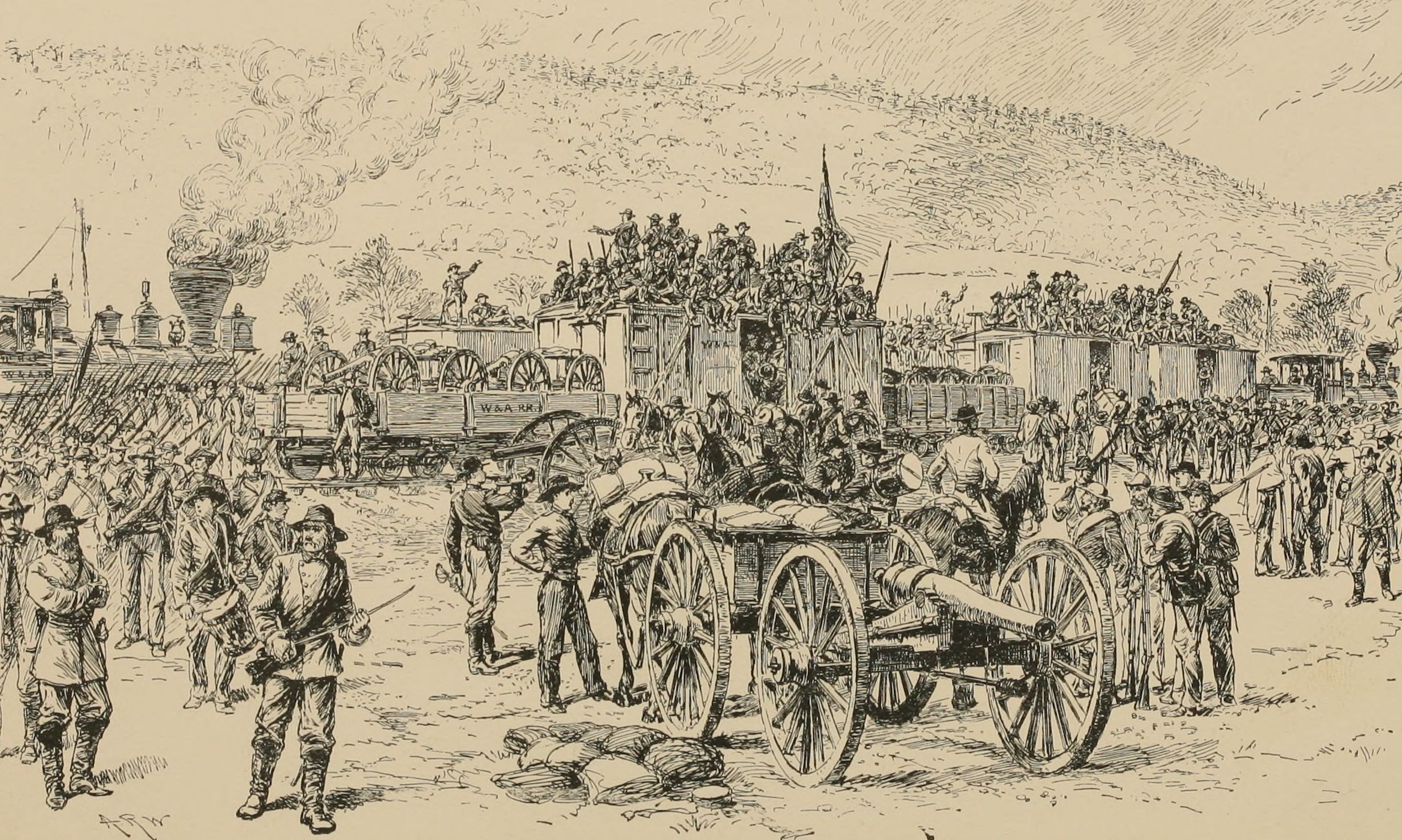 The Mountain Campaigns in Georgia (1890)
Confederate soldiers arrive by rail to fight at the Battle of Chickamauga in September 1863.
Scott Huffard: Yeah. A lot of the stuff’s happening behind the scenes, not making the headlines. But they’re able to pretty effectively move stuff around. The 1864 big example we could talk about is the Chickamauga and Chattanooga battles. The Confederates moved 13,000 troops by rail from northern Virginia to Chattanooga to help win the Battle of Chickamauga. And the Union then moves 23,000 to essentially save Chattanooga. So we have examples like this. Manassas, of course, is one as well. And again, if you can figure out how to move your troops quickly through these lines, that’s a huge advantage. The problem is these lines aren’t really in their ideal state because they’re not superfast to begin with at this point in history. They’re being disrupted. In the South, too, we have all these interruptions as the rail lines are being destroyed. There’s a blockade going on that also disrupts the regular supply of goods. So, yeah, all throughout the war people are still relying on the railroad. And the armies are doing a pretty good job, for the most part, of shifting troops around as they need to, as they’re able to. Of course, the railroads start to degrade, especially in the South.
John Heckman: You alluded to it earlier, and you talk about it a lot in your work: How did this war effort impact the peacetime expansion of railroads in that immediate postwar period?
Scott Huffard: Yeah, I mean there’s this overlooked aspect, though many historians are looking at the West a lot more during Reconstruction. But during the war, Republicans are all in charge in Congress and they’re not just waging the war. They’re also funding the railroads out West and they’re really launching the Homestead Act as well, western expansion, which again is being all driven by the railroads.
We focus—Civil War historians especially—on the battles and what’s going on in the East. But we’re seeing the West really get launched forward. You know, four years after Appomattox, 1869, we have Promontory Point and the Transcontinental Railroad is done. And, of course, we have Indian Wars breaking out all across the rail line essentially. So yeah, if we’re going to see the Civil War era as the North expanding its power into the South, we have to look at the West too, where a very similar story is happening. It’s the railroad that’s the leading agent of this.
I often like to talk about Jesse James as one of these guys that bridges this story. He gets his start as a partisan. He’s in Missouri, he’s doing essentially war crimes. A pretty awful thing is the partisan history. Then he becomes, after the war, this avenger of sorts and a folk hero because he is going after the railroads, and banks too, which many folks were not very into. But he also is very much this pro-Confederate partisan. So he helps us, I think, bridge this story of the Civil War, western expansion, and the railroad.
John Heckman: Were there any technological innovations that come out of this war with railroads that you really gravitated toward in your research?
Scott Huffard: Just the idea of being on time and being faster. That’s one of the lessons that at least many Confederates take from the war is that it’s important to have a railroad system. We don’t want to have these state lines that are fighting each other. We also want to have speed. After Reconstruction in particular, you have this huge boom in railroad construction largely driven by outside capitalists, at this point. Not so much the states. The lesson that they go back to is that we need to have good railroads. The railroads were not good enough during the war. Jefferson Davis is complaining about this in his memoirs that we had bad railroads. That was the problem. So, what can then save the South? It’s having a robust railroad network. And a lot of my work I write about how the railroads become the symbol of the New South because they’re going to revitalize the region, move on from Reconstruction, move on from that.
That’s not so much a technology, I guess, but it’s just an idea of, hey, we have to make these things faster and faster. That becomes the ultimate quest, especially after the war.
John Heckman: Was the destruction of those rail lines in the South by Union forces, especially as we hear in popular history under General Sherman and others, was that actually the foundation of a rebirth of the railroad in the South?
Scott Huffard: Yeah. I think we could actually make the argument that we have all these people traveling the South in 1865, and they’re talking about all kinds of different things. Obviously, the economy and slavery, but they’re always talking about the railroads. That’s how they get from point to point. The New South idea that the South is this new land of industry is predicated on having a kind of year-zero moment where there’s total destruction and that’s what the New South recovers from. So there was destruction and there was literally fiscal Reconstruction going on. But even in the 1880s and 1890s, they overemphasize this sometimes and maybe make it seem even worse than it was. because if we are going to say that the South was totally prostrate and destroyed, then having new railroads proves that it’s not prostrate and destroyed anymore. So we have a kind of recovery story.
Of course, Atlanta also is part of this too. Atlanta is the phoenix that rises from the ashes. It’s destroyed, but by the 1880s and 1890s, it’s this huge rail center again. Sherman even visits the city and is welcomed there. So, the railroad destruction helps these New South boosters give us this story of rebirth.
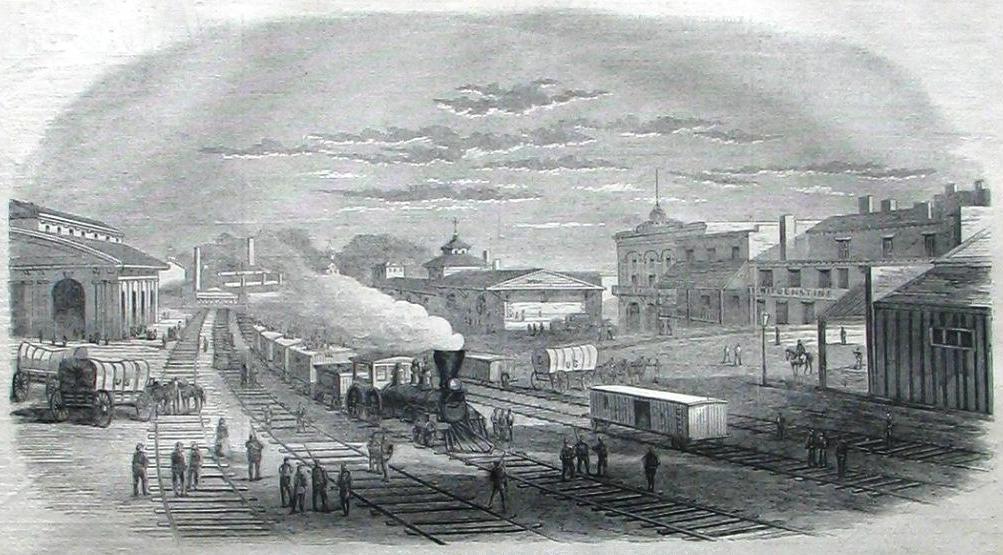 Harper's Weekly
The railroad in Atlanta during the Civil War.
I’d add, too, the destruction actually recovers fairly quickly because the federal government moves in and by 1865 they’re really rapidly rebuilding a lot of these lines. So, it’s not like the South was prostrate forever. They exaggerate this a little bit and they also exaggerate the horrors of Reconstruction, these New South boosters. But they’re very much using the railroad to make their case that, hey, we have made progress and we have a New South. Even though of course a New South also is a contested term. How “new” is the New South? That’s the classic qualifying exam question in southern history, really.
John Heckman: I had read through some of the books that were affiliated with the B&O Railroad about some armored trains or armored cars that had gone through that area. Never realized that these were going up and down the line as defensive mechanisms and defensive pieces of hardware. Was there anything that really stood out to you as far as cars or engines or things being used on the line during the war that stuck out to you?
Scott Huffard: Just the idea of we can move troops by rail, that’s an innovation of sorts. And we can incorporate this in the military planning. That’s a new thing we could talk about. Now, after the war especially, the railroads become battle lines again. We have in 1877 the Great Railroad Strike where they are, I think, in some cases mounting machine guns even and Gatling guns onto some of these rail cars as they try to suppress these strikes. And the B&O becomes a huge flashpoint in that.
Another lesson we can talk about is just in slaves. Slaves are also using the railroad as a technology of escape. They’re gravitating to rail lines as the war ends. They’re hopping on trains. They’re using this to escape to the South and reunite with loved ones potentially. So we see all this movement with freedmen and women that happens as well because of the railroads.
John Heckman: That’s almost like they are utilizing the power that was used against them for their own benefit. They may have built the line. They may have had family taken on the line to some other city for sale. And now they are repurposing it for their own freedom.
Scott Huffard: Yeah. We’ll see all these accounts from emancipated slaves and freedmen, and they say we want mobility, we want to be able to move. And that was denied to us by slavery. So there’s this huge movement that we see throughout the South that they’re using the railroads for. And, of course, this is the continuity in African-American history. Because by the 1920s we have the Great Migration ramping up. And again, that’s very much being focused on these rail lines that link the South to the North. Illinois Central, which connects Chicago to Mississippi, becomes this huge corridor in the Great Migration. So yeah, this interesting flip dynamic that we start to see with African Americans and the railroad. As you point out, these were, for many, sites of oppression. And after the war they were too. Of course, convict labor is building many of the South’s railroads in the 1870s and 1880s.
John Heckman: If we had to rethink how railroads changed the war, not just tactically but culturally, what might we be missing from the traditional narrative about logistics or moving troops or moving materiel? What should we be thinking about culturally that we may be missing out on?
Scott Huffard: I always think the idea of just isolation and connection is a big thing with the railroad. We have the 1850s where the country gets pretty used to having a connected rail network. You’re used to getting the mail coming in a certain time. You’re used to your supplies coming in when they’re ordered. And in the South we see all this stuff interrupted. And southerners are complaining about this. Civilians are saying, well, I can’t get the mail anymore. I’m feeling cut off. And, of course, the blockade is part of this as well.
So we think about some of these slow effects of years of war. There are southerners who are starting to feel more isolated because they were used to these connections and now these connections are going away. And that’s, I think, an interesting factor of the home front experience for sure. It’s a very subtle thing. You’re not getting the mail, you’re not hearing from your friends. But that is a way the war is going to hit home, even if you live far from an actual front. Just this sort of disconnection that starts to happen as the work progresses in the South.
John Heckman: When you speak to others about your work and about your book and you go out and talk to students or you talk to people in the public, what’s something that you have heard that maybe you’ve had to say, no, that’s not entirely correct with railroads? Or what is something that is a lesson that you want people to take away from your work in general?
Scott Huffard: So, a lot of my book is more 1880s and 90s. But my book undercuts this idea that the railroads are always good and always leading to progress. There’s the idea of connection of systemization, which is good for many folks, but my first book especially points out some of the darker sides of this. Yellow fever epidemics were spreading along the rail lines in the 1870s and 80s. The South has the highest rate of train wrecks by the 1890s. There’s all kinds of issues with that and damage. I have this great quote at the very end of my book. It’s in 1906. Tom Watson is this populist figure, anti-corporate obviously, anti-railroad. And he’s commenting on the death of Samuel Spencer, who was Confederate, he runs Southern Railway. And Tom Watson’s almost celebrating. He says, well, this is, not a big loss. Samuel Spencer’s railroads killed more people than Sherman did. So he’s even making this comparison of these railroads are so bad, they’re worse than Sherman.
So there’s all these dangers and darkness. What drew me to the project of southern railroads too is that there is this ambiguity with the railroad in the South. It’s not always something we think about in positive terms. And my work tries to accentuate that. And, of course, we have to think about the idea of the monopolies too. We often think about debates about the railroad monopoly is taking place in California. There’s the book The Octopus that famously talks about this. But there are pretty robust debates about monopolies in Georgia and North Carolina. They’re going after these consolidating railroads in the 1890s.
So the overarching theme of a lot of my work is that the railroads in the South were really not this varnished idea of progress. They led to all kinds of problems that impacted black southerners, white southerners. People across the nation were getting hurt by some of these problems.
John Heckman: These generals, and other officers who during the war saw what the rail line could do and how it could work and then they get into the industry, like you said earlier. Does that help them to rebuild their own status or, obviously, wealth? Does it help them to get back into the swing of being a part of American society in peacetime?
Scott Huffard: Oh yeah. A lot of these guys rebuilt themselves pretty quickly. Running a railroad, like I said, has some parallels with wartime service. That’s what the country is doing. It’s hard to go back to the planter lifestyle. Of course, people are still landlords and sharecropping and things like that. But the railroad construction is going on in a very large scale all across America in the 1870s, 1880s. And that’s a great route back for a lot of these guys. And it’s a route back that will get you the approval of the North in many a sense. Part of the New South movement’s idea is that we’re not going to shun the North. We’re going to welcome the North. We’re going to be nice to the northerners because they have money, they have investment. We want to get the South going again. We have to have investment flowing in. So it really is for so many southern leaders, and even for the common southern soldiers as well, a great way to get yourself back in the United States. And some of these guys, like I said Samuel Spencer’s one guy I write about a lot, ends up working with J.P. Morgan and is very tightly linked with Wall Street capitalists. But he comes from Georgia originally.
John Heckman: That’s an amazing thing that I never even considered until our discussion about how they are rebuilding their brand. P.G.T. Beauregard and others are making money and making a new life off of this. And we have formerly enslaved people making a new life using the rail line. It’s almost like everything attached to the rail line is lessons learned during the Civil War, but lessons put into place afterwards. They are being utilized in new and dramatic ways. Is that how you perceived this, where this is a possible turning point with how the railroad is seen in the 1865 era and forward?
Scott Huffard: Yeah, I mean, I don’t have the foreign military history expertise to follow up on this, to make this point with too much detail, but I know there’s wars, the Franco-Prussian War, that are being waged after this, that are using the railroad. So I think European powers are taking note of what’s going on here. Even during Reconstruction, I think we could talk about the railroads being super important. The railroad depots were how the occupying federal government would project power by having people at the railroad depots. There also are many accounts of the Klan being more active along the rail lines. You want to go after some newly empowered black workers or just target where the important stuff is, you go after the railroad areas. The Klan activity also in some ways is mapping along with the railroads. So, that’s a huge lesson that I think is being applied both in the United States and abroad, that, you want to control a place, you’ve got to control the railroads. And that’s, again, something you wouldn’t have really talked about in a war in the 1840s, for example. It’s just not the same story.
About the Guest
 Scott Huffard is a professor of history at Lees-McRae College and author of Engines of Redemption: Railroads and the Reconstruction of Capitalism in the New South.
Additional Resources
Sponsored By