Historian Nathan Madison talks about the crucial role played by northern and southern industries during the conflict, with a focus on how Richmond’s Tredegar Iron Works fueled the Confederate war effort.
Transcript
John Heckman: Well, Nathan, I’m so glad to have you on this episode of the podcast. The thing that we barely talk about anymore is factory work in the American Civil War. We don’t hear it a lot. It’s not put into documentaries very much, sadly, and I’m so happy to have you on to talk about this industry.
Nathan Madison: Yeah, thank you very much for having me. I’m very happy and honored to do so.
John Heckman: You know, I heard about you through the grapevine, Nathan, in a good way. And I had some colleagues and friends say, hey, you need to reach out to Nathan about Tredegar and about industry in Richmond and beyond that. I’ve been to the area around Tredegar and you’ve done research on Tredegar. What was that facility like before the American Civil War? Because sometimes we concentrate on the Civil War, but not the antebellum period.
Nathan Madison: Right. Around the James River there, right on the banks of the river, there were a good number of small industries before the war. Some textile work, some tanyards, stuff like that. You really don’t get large scale operations down there until Tredegar shows up, founded in 1837. Before that, though, you did have some small manufacturies. Adjacent to what would later become Tredegar was the Virginia Manufactory of Arms, later the Confederacy armory, and that would later become incorporated into Tredegar. But, in the early 19th century, that was on the banks of the James River as well.
That facility and the other facilities there and Tredegar later would make use of the James River and Kanawha Canal. Specifically its water power, but also in transportation of goods and everything. So you had some small operations along there, but you really don’t see large scale operations until the 1830s, when a man named Francis Dean, along with a number of investors, founds the Tredegar Iron Works.
 Wikimedia Commons
Richmond, Virginia, as depicted in a Harper’s Weekly illustration in 1862.
John Heckman: So with this new technology at Tredegar and this idea of expanding the industrial output in the Richmond area, what are some of these broader advancements or industrial thought processes that’s going on in 19th century America before the Civil War?
Nathan Madison: Well, in Richmond, and largely throughout the South, you had a lot of businessmen who were looking to try to compete with the North in some ways, but they never quite get there. And the reason the North had so many more factories and was more of a home for industry than the South was speaks to geological differences, geographical differences, cultural differences. But you had businessmen in the South who were wanting to become independent of northern industries, particularly when you’re talking about metallurgic industries, iron, later on steel, but that’s a little bit ahead of ourselves. And one of the problems facing them, both in terms of technology, but also in manpower, was the fact that due to the South not having much of a manufacturing history, unlike the North, they really had to look abroad to find both the technology and the workmen to be able to build these facilities. That’s why in Dean’s case, when constructing Tredegar he looked to Wales, specifically Tredegar, Wales, where the name eventually became American southernized down here to Tredegar, to get the workmen who were iron masters in what was at the time the largest producer of iron in the world. He had to reach out to them to get that expertise, to build the first rolling mills, to build a lot of the structures that would be down there at Tredegar.
And also, technology was something of a problem too. Back during the colonial period, it was actually a crime for men trained in these skills, but also blueprints and machinery itself, to be transported out of Britain. So that combined with the British system of mercantilism, where the colonies were largely there to produce the raw materials and they would be finished in Great Britain, led to circumstances where Americans really had to work to get that industrial knowledge and import it in some cases. And the North just did that more, partly because more European settlers settled in the North when immigration picked up after the Revolution. But also too in an antebellum slave economy, there just wasn’t, on a societal level, a great push for industrialization. It’s one of those things about the slave economy is that it really exists to fund itself and the people who are running it. If you’re cornering the industry on, let’s say, cotton, you don’t have a great incentive to really diversify into anything else or to really up your manufacturing technology.
So when Dean and his fellow investors were building Tredegar, they had to compete with both a culture that really wasn’t too interested, broadly, in the most advanced technologies, but also having a dearth of workmen who could actually do that work that they were hoping to do.
John Heckman: So I never realized that, Nathan, that’s basically when America becomes independent from Great Britain, it has to catch up with factory work and factory designs and machinery designs and stuff. So you can almost say that the thing that we’re going to talk about here in the 1860s has its roots in the 1760s.
Nathan Madison: Absolutely. In a lot of ways, it really was a catch up. When the locomotive industry started in this country, our engineers were studying the work of those who had come before in Britain, who had designed the first locomotives at the turn of the 19th century. The same was true for metallurgy. Later on, the Bessemer steel process really became ingrained in America, but that was originated in Britain as well. So it really was a catch up game really, I’d say, before the war and certainly to a large degree during it. The North did a pretty good job in that just because they had the ability to do so, and it was really a wartime need to advance everything that they had in order to achieve their objectives.
John Heckman: What does a factory do for a local community like Richmond? How does that help the economy or does that bring people in from across the Atlantic, perhaps, where they’re seeing new job opportunities? How does Richmond change due to this facility?
Nathan Madison: I would say it largely depends on the type of industry itself. Richmond had a number of industries before Tredegar that it was very well known for. Flour milling was a particularly large one. The Gallego mills that were down not too far from Tredegar, relatively speaking, they were one of the largest flour producers in the early years of the United States. That was employing local individuals and everything. As far as Tredegar and the iron working, initially, the nucleus of the workforce were foreign born, again because there weren’t really too many homegrown ironmasters. So, you did have some kind of ancillary industries, people that were making a lot of the tools they were using, unskilled labor that was brought in to move materials around. But your really skilled laborers at the very onset were coming from abroad.
As things pick up, as Tredegar begins to diversify into other fields, locomotives for instance, they pay top dollar to bring down some engineers from the North to get their expertise and everything. But that was a process in and of itself to create that home-based workforce that could accurately produce everything that they were hoping to produce.
John Heckman: What was daily life like for this workforce?
Nathan Madison: It doesn’t sound fun. I’ve toured a couple of modern-day ironworks, and it is hot. It is a unique smell, let’s say that. And I think back then it would’ve been even tougher. A lot of workplace injuries happening fairly often. You had workers setting up kind of mutual aid societies to help injured workers—this is before OSHA or insurance or anything. So, industrial accidents were pretty common. It was hard work. Long work. Tredegar, for a lot of its existence, had day and night shifts. So, a lot of workers working in very extreme conditions. And it was all, to a large degree—and that’s another problem the southern industry was facing. There were some industries, Tredegar included, where the North had advanced to using machinery that would help in the labor. And the South was slow to do that, really far later than they probably should have. They were using manual labor to haul stuff around the foundry and everything. While up in the North, you had really advanced, specifically designed cranes to carry this stuff around. And I think that’s partially because you have a mentality more so in the South of this is what laborers do, this is what they should do. Especially when Tredegar was using enslaved laborers at the site. They weren’t too interested in making things really easier for their workers.
So it was hard work. It was certainly tough work. It was dangerous work. Depending on your position, you could make a fairly good living. There was a community up around the hills around Tredegar called Oregon Hill, and that largely started as a neighborhood of Tredegar workers that would just come down the hill and work and then go back up for the night. They had some housing on site as well in the earlier years. But it was a full-time job in every sense of the word. You were there a lot and very, very demanding.
 Library of Congress
Richmond’s Tredegar Iron Works, as depicted in a wartime illustration.
John Heckman: You mentioned the enslaved laborers a few times. And I was wondering, was there a time where you wouldn’t have seen too many of them? Is there a time in the antebellum years where you had maybe more of a white workforce, but then during the Civil War there are more enslaved laborers there? Or was it pretty consistent throughout its early history?
Nathan Madison: It kind of ebbs and flows really. The demands of the war, just because you had so many men going into the armed forces, relied more so on an enslaved workforce just by the nature of men being conscripted and everything. But even before that, there was a history of using enslaved workers just to create more of a profit for the company itself. In the 1840s there was a strike amongst the white workforce, which was still at this point largely foreign-born Irish and Welshmen. Tredegar’s management was essentially forcing them to take on enslaved workers as their apprentices. And these were guys from Europe, they were very heavily invested in the guild system—a master chooses his apprentice, this sort of thing. They went on strike essentially against that, fearing not only what they considered an insult of having an apprentice, whoever it was, forced on them, but also they were worried about them being phased out of a job.
They went on strike. The proprietor of Tredegar told them, okay, so long, you’re out. And he tried to rely on a largely enslaved population for the workforce, but I don’t think they had enough time to really learn a lot of those skills that they needed. So he eventually ended up hiring a lot of those guys back. But it was something that Tredegar in particular would rely on at times, partially to try to turn more of a profit. Either the company would own the slaves or they would rent them from another owner. Or Tredegar would be using them as a wartime necessity as the need for skilled workers increased.
During the war, this issue was such a problem that something called the Tredegar Battalion was formed. And that was largely composed of Tredegar workers, white workers, and they were allowed to be essentially kind of a home guard. If something was going on around the vicinity of Richmond, they would be called out to help defend or build entrenchments or anything. But they were stationed at Tredegar because it was such a vital role in the Confederacy’s war effort.
John Heckman: When war comes, what happens to Tredegar’s output? What are they actually producing and where’s it going?
Nathan Madison: Before the war started, Tredegar was producing canonry for what would become the Confederate States, but also the United States, armed forces. So, you have instances where in battles there are Tredegar canons firing against Tredegar canons. Really up until Virginia decides to join the Confederacy, Tredegar is fulfilling orders for the Union army. After the war starts, there are problems with them getting the needed supplies. Tredegar for most of its lifetime up until the 1950s was largely powered by water power from Kanawha Canal. It goes about 200 miles west of us here ends up in Buchanan. And out there there were a lot of blast furnaces, a lot of pig iron production. Coal was mined out there. And a lot of those raw materials were brought down the Kanawha Canal to Tredegar.
As the war began, both the canal, but also rail lines—by the time of the war, Richmond had five rail lines coming into it—those were increasingly being cut off by the Union army. So supplies were dwindling as the war continued. Eventually they had to stop using bronze in canons and had to make them in cast iron. So the war affected what they were making. And by the end of the war, approximately 1,100 cannons were produced by Tredegar for the Confederacy. So they were able to maintain output fairly close up until the end of the war. They also rolled the iron for the CSS Virginia. So they were able to produce what the Confederacy needed initially, and as time went on the ability ebbed and flowed based on what materials they were able to access.
Before the war, Chesterfield coal basin, just outside, but also encompassing part of Richmond, was the source for coal throughout the entire country, until the 1840s and you have anthracite coal discovered up in Pennsylvania. So during the war and shipments from Pennsylvania were cut off, they were reopening some of these old mines that have been closed for a decade or two to supply them with coal to run their furnaces and everything. But as the war dragged on, supplies were lessened and lessened. And that affected what they were able to produce.
John Heckman: When you were doing all of your research on this particular factory, was there any event that really stood out to you when you were looking through the records that was either a surprise or was something you just weren’t expecting to see happening around Tredegar? Or is there a personality that really jumped out to you?
 Library of Congress
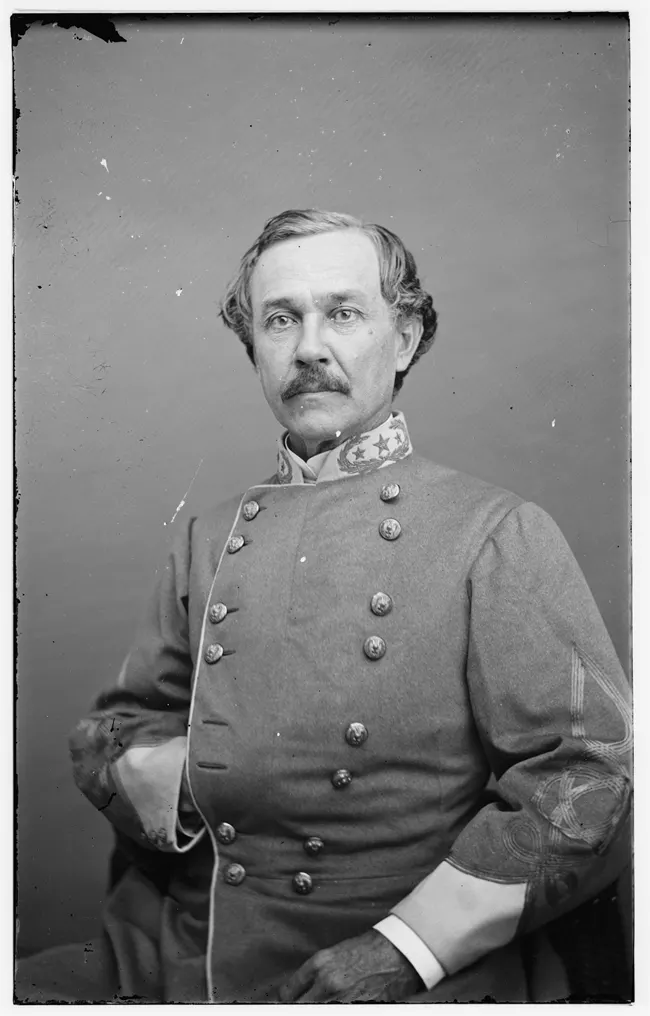
Joseph Reid Anderson
Nathan Madison: Yeah, Tredegar was full of nothing if not personalities. The proprietor, Joseph Reid Anderson, was a general in the Confederacy. He was injured during the Seven Days Battles and was returned to Tredegar. And the government told him, we need you running this facility and managing it as you have at that point for about two decades. And his family continued to maintain Tredegar as a private company. His son ran it. His grandson ran it. It’s interesting, actually. One thing I came across in my research was in the 1930s, his grandson had gone back to all the Civil War veterans who were still around and had asked them to essentially write memoirs of their experiences at Tredegar during the war. And one of them, I’m sure other people have seen this, but I don’t think it had been published until I came across it and put it in my book, was one of these workers had drawn out essentially a crew diagram of how the iron plating for the CSS Virginia was produced. Their process for that, basically they were taking cast iron boxes and putting scrap iron in there and consistently heating it, rolling it, reheating, re-rolling it, to produce what eventually was a couple-inch-thick armor for the Virginia. So it’s interesting. And that’s something if you’re looking just in Civil War history, you wouldn’t have found it. But you’re looking throughout the entirety of the place, you come across things like that.
So the role that that family played in Richmond history and Tredegar specifically, but also greater Richmond and Virginia history, is very, very important and interesting. Because you can see, later on after the war, his son and then his grandson is flirting back and forth with trying to bring steel to Tredegar. Tredegar never converted to steel production. That was one of the reasons why they eventually went out of business in the 1950s. And just seeing the machinations that they were trying to bring or failed to bring to try to revamp the company, but also maintain its kind of historical roots, is really fascinating.
There is a family, a German immigrant family, the Osterbinds, who had a combined working history at Tredegar, I want to say it was about 250 years. The patriarch came over in the 1830s, I believe, started working at Tredegar in the 1840s. He worked there for a number of years. His son worked there, a couple of his grandsons. It was a very family business in that regard. Another family that I’ve done a good amount of researching was the Delaneys. They were immigrants from Scotland and they were at Tredegar before and during the war. And right afterwards, one of them went to go start what would be Richmond’s next biggest industry after Tredegar began to subside, which was the Richmond Locomotive Works. So there are a lot of individuals that are very important to Richmond history that are connected to Tredegar in some way. The famous 1920s novelist Ellen Glasgow, her father was in the administration of Tredegar. He was related to Joseph Reid Anderson, the proprietor of the works. So you have literary history tied in. One of her novels actually is based around a lot of the people she would encounter when she was walking around Tredegar with her father.
So there’s a lot of personalities that are important to not only Tredegar’s history and its functioning as an industrial entity in the city, but also to the larger cultural and social history that you see in Richmond before and following the war for a good number of decades.
John Heckman: That cultural history is really appealing to me. I’m really interested in historical memory. And when we talk about factory work, a lot of people go straight to Springfield Armory. And people that I know from the South will say Tredegar is the one we want to focus on. What do you think the footprint is for these places to Americans who think about industry? Why do we focus on Springfield or like Tredegar as like these things we hold up as, this is what Industrial Revolution America looks like?
Nathan Madison: Well, I think in a lot of ways your antebellum and industries during the war, and certainly afterwards, they play a large role in how America would be shaped going forward. The history of industrialization of America goes hand in hand with the corporatization of America. As these businesses advance more, you see a more rational approach applied to business. You have people who are trained, college educated, in business, business strategy, coming to these places and really adding rationale to what was before, kind of, you know, this guy runs this company because his dad ran it. Some bookkeepers at Tredegar up beyond the Civil War were still doing their accounting in shillings, which hadn’t been used in America for a little while by that point. But as America grows as an industrial power and then as a corporate power, hand in hand with that you see a lot of what has come to define American life appearing: set work times, the rise of labor unions, things that are a lot more familiar to a lot of Americans. So I think as far as in that sense, a cultural sense, that’s why people look back at these places. Because I think it’s always interesting for folks to look back at something and say, oh, I recognize that as something from my own life. Like, I understand what they’re talking about when they want more workplace safety or harsh working conditions, or something like that to a broader national sense. You know, the history of America is the history of industrialization. It’s what led us to become a global power. And that’s something that I think resonates with a lot of people as well.
 Library of Congress
The Tredegar Iron Works as seen after the fall of Richmond in April 1865.
I think Tredegar gets the short end of the stick in that sense, partially just because the Confederacy lost. So, it’s probably not paid as much attention as maybe other sites. But there’s just a lot of, you know, I’m familiar with a lot of the terminology and everything just because I’ve been studying it for years. But when I first started researching this topic, terminology being used by like previous history books was being written by people who didn’t need to explain what this was, what that was. You know, how a blast furnace actually operated. How a puddling furnace operated. Why it was called puddling. Like all these sorts of terminologies that I think is kind of intimidating when you first start looking into it. And I think that’s a hindrance as well for people really trying to get into this history.
I know I had to find, when I first started years and years ago, books that explained, okay, what is this? Because a lot of these works were written by people who, this was just second nature to them and they didn’t need to explain it. I ran into that when I was researching the Richmond Locomotive Works. I had to go back and find explanations of some terminologies they were using just because nobody at the time bothered to really think about writing it down. So Tredegar does, I think, get the short end of that stick. It was around for 120 years, roughly. It has an interesting history that goes through all the really important eras of American history. The antebellum years, the Civil War years. For a while, it was on the forefront of industry in a lot of ways, and then after the war and into the 20th century that declined quite rapidly. But, overall, I think industrial history speaks to folks in a lot of ways about why history matters to them, either on a personal level or what they think of as kind of general American history.
John Heckman: Do you also think that a place like Tredegar was written off by popular history for the postwar years? We heard the stories of, oh, Richmond was burned to the ground and there was these explosions and it had to be Tredegar that was exploding. razed, it’s gone. And say, well, why are we talking about this in the postwar era? Because actually it does have a history after that.
Nathan Madison: Yeah. It was actually saved from fire during the Richmond fires and it was able to bounce back very rapidly. When they need to rebuild the rail lines and just rebuild general city infrastructure, Tredegar was able to bounce back right into production. And some of their biggest, most profitable, and successful years were post-Civil War, 1890s, certainly when they were getting munition contracts before and during World War I. But I also think it depends on where you’re actually from. Probably a lot of historians that aren’t from this area would maybe write it off or, maybe not, maybe they’re aware that it wasn’t destroyed, but it’s just not something that they’re focused on.
Around here, I would say that it had a cultural influence that lasted a very long time. General Anderson, I just said it. He carried the title of general up until his death in 1892. His son was a colonel in the Civil War, and he carried the title of colonel. And these were bigwigs in Richmond society. I think it depends on where you’re from and where you’re approaching it from. Around here, Tredegar was the big deal. Richmond papers would talk about what the owners of Tredegar were doing, what they thought about topics, all the organizations they were founding in your society papers. But it also I think was glorified probably around here due to the kind of Lost Cause mentality. And that’s one of the things, like when I started researching it, when I first approached it, the idea, the indisputable fact was that after the war, Joseph Reid Anderson, in a bid to try to unify the country and everything, paid his formerly enslaved workers, now freedman, the same rates as his white workers.
And that wasn’t true at all. I dug through all of the old ledger books. Thankfully, Tredegar’s records are immaculately kept at the Library of Virginia. Even as late as the 1920s that wasn’t true. But it was one of those things that was just around Richmond. That’s what Tredegar did. That’s what Joseph Reid Anderson did. And it did have this kind of cultural power. You really don’t see that stop until you get into the 1930s, when Tredegar is starting to get on its last legs and it’s not the industrial concern that it once was. And the family doesn’t have as much clout as they did previously.
So as far as why historians may or may not write it off, I think it really depends on how you’re approaching the Civil War and if you’re approaching it from a way that would take into account those sort of cultural and societal aspects that linger on long after the war.
John Heckman: If someone wants to research this kind of thing, what would you give them as advice? What would you tell them? Would it be something related to learning all this vocabulary from generations ago? Or would it be something else?
Nathan Madison: Yeah, I would say that would definitely be the most important, just because a lot of the processes they were using were specific to that time period. I mean, technology has advanced so much, some of the terminology is still around, but a lot of the actual processes and machinery they’re using is just so radically different now. You really do have to go back and learn what a lot of this stuff meant. Again, thankfully, Tredegar’s records were kept; the Library of Virginia here has every receipt, for the most part, every pay ledger, every letter in, every letter out. It’s really an unbelievable amount. It’s to the point where you’re researching it, and you want to write a book or something, you really do have to figure out what you’re going to leave out because there is just so much information that is available there. Not all industries have that. On the flip side of that, the Richmond Locomotive Works, their internal records, as far as I can tell, don’t exist. So you have to go through into personal papers and things like that.
So, I would say yeah, definitely learning a lot of the terminology. Also, too, learning about it from the cultural and societal perspectives. I think you can learn a lot about a company like this if you read about its owners, its workers, going through the newspapers and just finding, instances of a company funding some of its workers to go to the beach for the day. Like that sort of thing, it kind of amalgamates altogether to create this overall history that’s not just related to this is what they’re producing, this is how much money they were making. Taking into account what this industry may or may not have meant to the people directly involved in it, but also to the larger community, I think is a view that you need to have if you’re going to really understand what these companies and what these industries were.
 The American Civil War Museum
The site of the Tredegar Iron Works today.
John Heckman: Many of these factories that are in operation during the American Civil War are no longer there, or they are being used in different ways. How is a visitor going to interact with the Tredegar site today?
Nathan Madison: Even just in the last decade, it’s changed a great deal. The majority of the buildings that were there during the Civil War are not there any longer, partially just because after the works shut down, nobody was using it. So it went into disrepair and eventually a lot of the buildings collapsed. In the early 1970s, we had hurricane Agnes come through and that further damaged a lot of the facilities and a lot of them had to be torn down. Now there are only a couple of buildings left. The pattern storage building, the gun foundry that was built specifically for the war beginning in 1861. The original company offices are still there. Those are really interesting to walk around. But a lot of them have been remodeled internally over the years just because they’ve been used, in the case of the office building offices, for the museum. Or the museum itself making it easier for visitors to walk around.
The central foundry building, the original building that was there built when Tredegar started operation, that’s largely gone. Some of its walls are still intact. I remember when they were, because they built a new museum down there, I remember talking to them like, you’ve got to preserve these walls. And they did. They preserved those original walls inside the building. The company store is still there. That was built in the late 1860s, I believe. That actually serves as a, if I remember correctly, a ticket office. They just built a large amphitheater, a musical venue, on the hills just above Tredegar.
The site has changed a great deal, even in the last couple of years. The American Civil War Museum has its main museum there. So you can still walk the grounds. Unfortunately, a lot of the machinery that was on the site, previously held by the museum, has been moved. Some of it has been scrapped. Some of it has been moved offsite and preserved elsewhere. So, unfortunately, aside from being able to see where a lot of the waterways were, a lot of the raceways from the James River [and] Kanawha Canal behind Tredegar, and the water wheel, or recreation of a water wheel, that would’ve been used there, there isn’t a whole lot of the industrial footprint there. But I’m thankful for what we do have still there. And like you said, a lot of these sites are no longer in existence. So having even just a little bit, I think is a good thing.
John Heckman: Yeah. For anyone who’s going to be visiting Richmond, you have to go down around that area. It is magnificent.
Nathan Madison: They’ve really done a great job of building out a lot of pedestrian walkways around there. They have a pedestrian bridge where you can cross from one side of the James River directly to the other. A lot of historical markers along that bridge, but also around the various islands. I actually helped produce a good number of interpretive signage down at Tredegar years ago. Unfortunately, due to changes to the site, a lot of those are no longer there. But there are still some that are, that speak to the industrial nature of the site. It’s still there. It’s not as complete as I would like or a lot of other historians would like. But for what is still there, I’m thankful that it is.
About the Guest

Nathan Madison is a historian, researcher, documentary producer/consultant, and author of Tredegar Iron Works: Richmond’s Foundry on the James.
Additional Resources
Sponsored By