Historian Aaron Sheehan-Dean answers questions relating to Civil War soldier life, from the ways in which troops spent their down time to how they navigated the hospital system when sick or wounded.
Transcript
Terry Johnston: Thanks for joining me, Aaron. Wayne in Ohio wants to know about soldiers’ everyday camp life while between engagements. He asks, “Did they forage for local food? What sort of entertainment did they enjoy? Were they punished for minor camp offenses? And so on.” Well, so that’s a big one.
Aaron Sheehan-Dean: That is a big one. Yes.
Terry Johnston: Yeah. Civil War soldiers spent most of their time in camp rather than combat. So, how do you want to tackle that one? I mean, were there common denominators?
Aaron Sheehan-Dean: Well, we can start with some of the logistics and then maybe move on to the really interesting cultural and social questions because there have been whole books written. Lorien Foote’s The Gentlemen and the Roughs is a great kind of cultural history and social history about class tensions within units, and all of this manifests off the battlefield. But to start with the first part of that question about do they forage, how do they feed themselves? Both Union and Confederate armies have huge quartermaster departments that are supposed to be requisitioning food, that is, obtaining supplies from a chain that goes back to their home fronts, and then they’re distributing those supplies, rations, in an organized fashion. It is also true that that is rarely sufficient to actually feed men. And so there’s a huge range of what counts as foraging. And foraging becomes intensely politicized, especially as Union troops push further into southern space, and especially once Sherman and Grant in particular are willing to separate from their supply lines because those supplies, as the western Union armies push deeply down into Mississippi and through Tennessee into parts of Alabama or into Louisiana, they’re depending on long supply chains. Also dependent on railroads, which are incredibly easy for guerrilla attacks or cavalry attacks to break. And finally, Grant and Sherman decide we’re going to uncouple from our supply line. And as Sherman famously says, “Where a million people live, my army won’t starve.” There’s actually great apprehension about whether an army can live without supply lines.
 Harper's Weekly
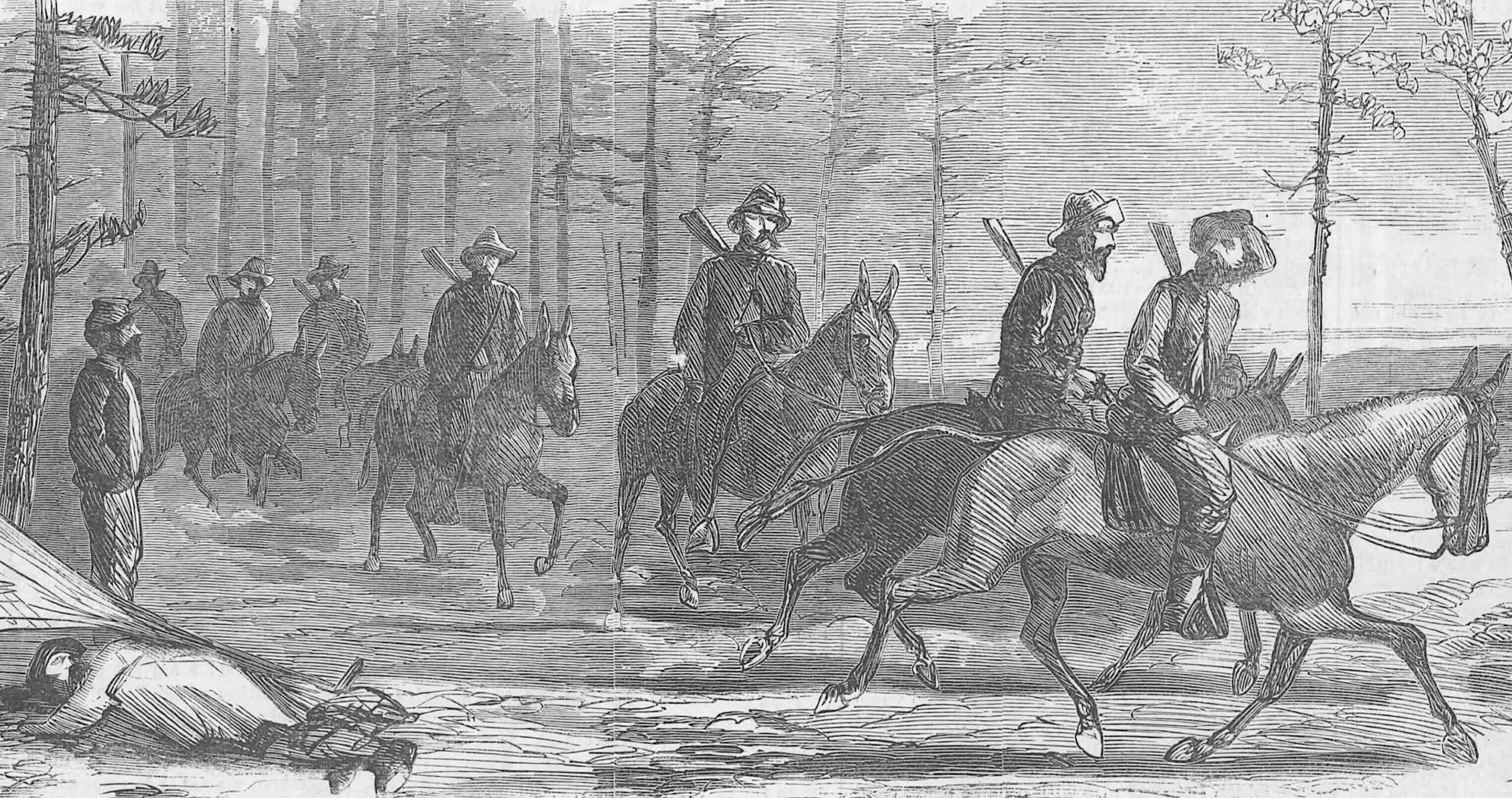
Union troops are depicted leaving camp early in the morning on a foraging mission in this illustration published in Harper’s Weekly in January 1865.
And Sherman is stating what we would regard as the obvious today, which is there is plenty of food, the question is getting it. And in this case, the way armies are supposed to do this is establish foraging units whose sole task is to go out and obtain supplies for their armies. This means, in some cases, simply walking into a field and cutting down the corn and taking it back. In other cases, they’re going to go into homes and smokehouses and seize bacon and ham and meat products. If those people can somehow demonstrate that they are loyal in the case of a Union army, they might receive a receipt that would allow them, theoretically, in the postwar world to claim money for that, particularly if they lost a whole herd of hogs or if other animals were taken, mules or horses or things. And there’s a Southern Claims Commission that sorts through these, which is a whole separate question. Confederate armies paid southerners in Confederate script, that is paper money, which devalued very rapidly. And so most southerners didn’t see much difference between having the Confederate army stop at their farm and the Union army stop at their farm. In either case, they were going to lose all of their supplies and they were going to be left with worthless paper. Or if they’re bona fide Confederates, the Union wouldn’t even leave a receipt.
So there are rules around foraging and you’re not supposed to leave people entirely destitute, but of course the calculation there might be a very hard one, that is, “This family can make do with one side of bacon. And I’m going to take the 50 that are hanging in the smokehouse because I have 50,000 men to feed.” And for that family, in fact, one bacon isn’t going to see them through the winter. So foraging becomes one of the chief critiques that southerners lob against Union armies, they would probably call them depredations or stealing. There are certainly “bummers” and other irregulars that follow Union armies that simply rob people. But there is a system to foraging. There are orders, there is a command structure, and those men are responsible to the laws of war. But I would say that the line, it can grow very fuzzy. So foraging is one of the most, it’s kind of a flashpoint for the conflict between soldiers and civilians. And soldiers on their own, without belonging to a forging unit, might well on their own recognizance, as it were, go into communities, seize chickens, seize hogs, help themselves to orchards, and bring that back, to say nothing of fence rails and other kinds of agricultural infrastructure to keep themselves warm in the winter, and to feed themselves. And even when this is happening against your own people, that is, you know, Lee has forging units that are going out in Virginia. He wants his men fed first. That is, if the army isn’t able to feed itself, it can’t fight, and the result is you lose. So civilians bear the brunt of this, to be sure.
Terry Johnston: Well, so other than forging, and we talked last time about drilling…
Aaron Sheehan-Dean: Yeah. There is a huge amount of downtime. Men spend much more time in camp not doing anything than they ever are in battle. And so every variety of entertainment that you might imagine from the wholesome, that is ministers—and priests in Catholic units—trying to encourage men to spend their time reading. There is actually a huge trade in regimental newspapers—Chandra Manning has done very good work on this, and she relied on those for her great first book, What This Cruel War Was Over—hundreds of regiments produced their own newspapers. And so this means there are men who are writing and there are men who are printing, and then there are all these men who are reading. So they’re widely reading anything they get their hands on. Ministers and priests obviously want them reading Bibles, or religious books. There was a huge proliferation of just regular fiction and nonfiction that makes its way through armies. Victor Hugo’s famous novel comes out mid-war and Lee’s men take to calling themselves “Lee’s miserables” after Les Misérables is published. So, soldiers are actually reading sophisticated literature as we would call it today. Victor Hugo is no joke. And there are some cultural historians today that are thinking about the ways in which that literature helped shape how soldiers understood what they were experiencing.
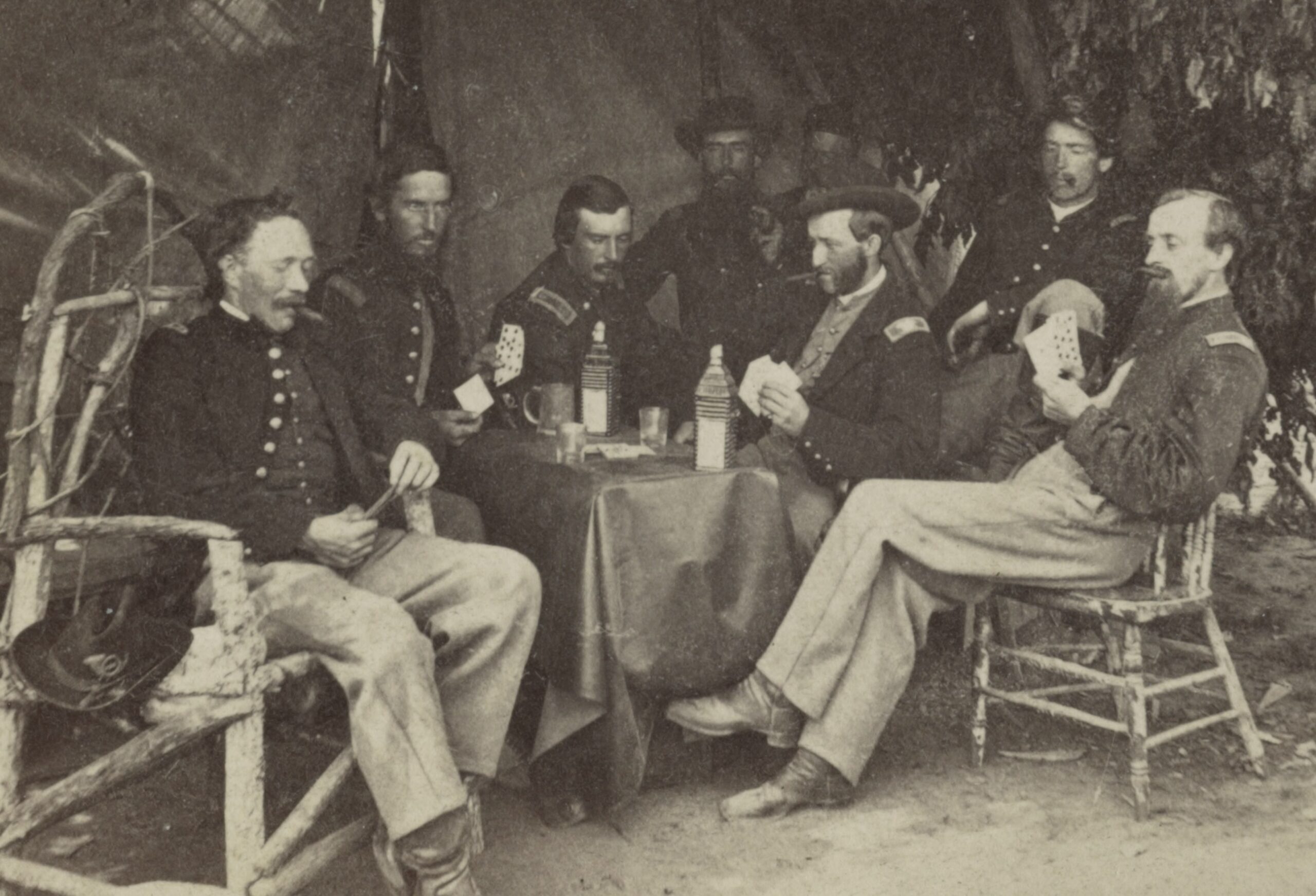
There are theatrical troops, so soldiers putting on Shakespeare, for instance. This happens in both in the North and the South. Sarah Gardner down at Mercer is working on a book on this, looking at the ways that soldiers use theater as a way to understand their conflict. Are you going to put on Romeo and Juliet and have a kind of lighthearted comedy, are you going to put on one of the tragedies, and sort of force men to confront the reality of history and killing? And then there’s all of the pastimes that worried the ministers and the soldiers and the wives at home, that is, gambling. Men, of course, are playing cards ubiquitously. Every card game imaginable is going on in Civil War camps and they’re also betting on almost anything. You know, today’s sport betting system has nothing on the ingenuity of Civil War soldiers for figuring out, you know, can you put insects on the back of a hot skillet and pay to see which one gets off first? Your regimental animals, your dogs, are going to fight. The boxing matches, of course, all of the wrestling competitions.
And there’s tremendous anxiety among evangelical leaders about the corrupting influence of time in Civil War camps, of the gambling, of the alcohol. Soldiers are buying alcohol from civilians. They are producing their own if they stay anywhere long enough. Soldiers, many people, knew how to distill alcohol. They certainly could ferment and produce makeshift beers. It takes a little bit more technology and scientific know-how to distill for a hard liquor. But even still, that was technology that was available and pretty widely understood. Here in Baton Rouge, there are no fewer—I’ve seen in our archives—no fewer than three or four orders from the local provost marshal restricting civilians from selling alcohol to soldiers. And this happens in every town because, of course, civilians want to make money. And they can do that by selling alcohol to soldiers. And the last thing a provost marshal or a local mayor, I would note, wants is drunk soldiers in a confined space with basically vulnerable women—all of the men of Baton Rouge are enlisted and in Confederate units. So these are largely female-headed households.
 Library of Congress
Union officers drinking, smoking, and playing cards in camp
It’s a very toxic stew. And so alcohol is a huge problem. Lynchburg, Virginia, famously initially is very eager to have soldiers come in. And there’s a whole section of Lynchburg called Buzzard Town. That’s the brothels and the bars. But, increasingly, those men become violent and difficult to manage. They’re fighting with each other, they’re attacking people. And the mayor is trying to, this is a southern space, a Confederate place, but is nonetheless trying to negotiate both with Confederate officials and later with Union officials in order to try to protect townspeople from drunk, unruly, bored soldiers. And that’s really the kind of chief problem is from the kind of the sin side of this. And Judy Giesberg writes very well on this, that soldiers, these are mostly young men, remember 18 to 25, and they are bored and a little bit of alcohol or even not alcohol will give them an excuse to sort of engage in what we would view today as dangerous and destructive behavior.
Terry Johnston: We had Megan Bever on last season who wrote a fabulous book about the presence of alcohol in Civil War armies. And it’s just amazing. It’s so prevalent. I mean, if you wanted it, you could get it. But it gets to another point. You were just alluding to these soldiers who were getting into trouble because of alcohol and there were many of them. What about punishments in camp as a result of such offenses or others, serious or otherwise? I mean, that obviously occupied quite a bit of time, disciplining troops when they weren’t in combat.
Aaron Sheehan-Dean: Yeah. Huge amount of disciplining and punishment. We have today all of the courts-marshal records for the Union army. Unfortunately, they are unorganized at the National Archives, and so it’s very difficult to get a kind of comprehensive view on this. There’s a few studies that have done some work to get a wider view of this. But even short of a courts-martial, tons of soldiers, certainly those that are drunk or that are obstreperous, that get convicted of conduct unbecoming—and that has a very wide latitude, that can mean anything from you got drunk and knocked your corporal’s hat off to you violently attacked a civilian. Tens of thousands in the Union case. The Confederate records are mostly lost. The Confederate government burns a lot of its records when they evacuate Richmond in early April 1865. And the courts-martial are one of the things that just really disappeared. We have kind of regimental or sometimes army level court-martial records that you haphazardly find, and there’s a register of about 18,000 offenses in the Confederate records that are at the National Archives.
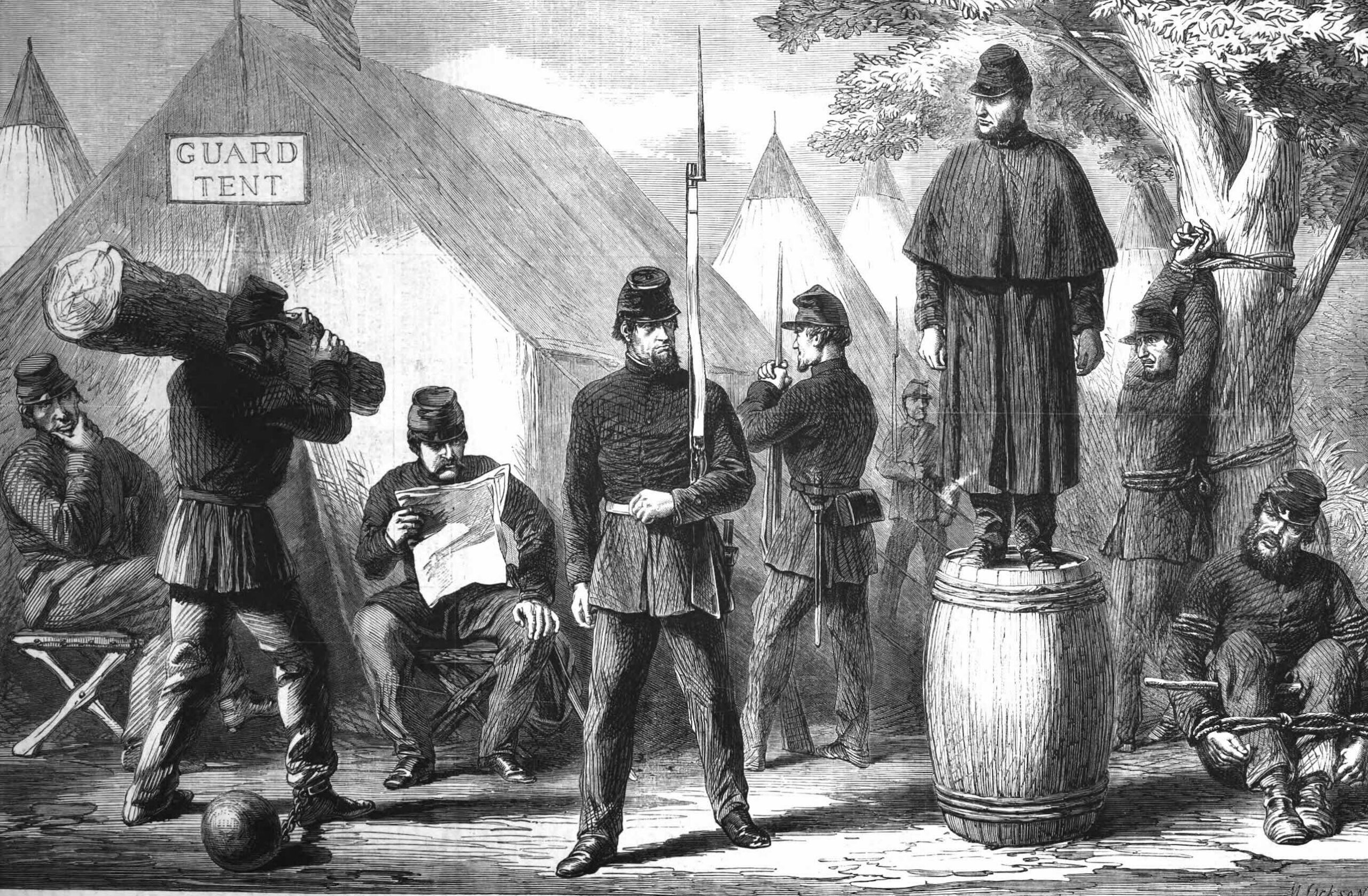
But huge numbers of infractions. Men punished with either just being confined to the stockade, that is a kind of camp jail, for days or weeks at a time. Other men are going to be made to stand all day with a sign around their neck that says “drunkard.” Or maybe they stand on a beer barrel all day. Sometimes they’re going to be bucked and gagged, this is, you squat down and there’s a bar that’s threaded between your knees and over your elbows, and it sort of locks you in a very uncomfortable position. Your muscles are going to cramp up. And again, it’s meant to publicly humiliate and embarrass people to discourage this kind of behavior.
 The Illustrated London News
An array of Civil War punishments are depicted in this illustration published in The Illustrated London News in November 1861.
There are officers that zealously punish their men, and there are officers that are more lenient. And it’s not quite clear, over the long haul, which of these strategies is better, both for discipline and also for ensuring that you’re not subjected to early punishment. You know, fragging is not invented in the Vietnam War, of course, and there are martinet officers who are wounded by friendly fire. But the punishments, the U.S. Army outlaws whipping, which had been a common punishment up until the Civil War. There are still isolated cases where soldiers are whipped. If any of your listeners remember watching the movie Glory in which, famously, Denzel Washington’s character is whipped as punishment for leaving camp one night and basically foraging, he’s going to get shoes, as it turns out. That has really dangerous political implications, that is, whipping black soldiers. Also whipping white soldiers. And there was an effort with this all-volunteer army to leave that behind as a kind of relic of the past. But there are also officers that believe enlisted men need to be punished quite vigorously. And, you know, men are occasionally hung by their thumbs as a punishment. Again, that’s more often deployed against black soldiers than white soldiers in U.S. armies. But things that we would consider today quite barbaric punishments are certainly more routine, though enlisted men will push back on that. Most of what counts as mutiny in the Civil War, and there are a lot of mutiny charges levied against soldiers, are in fact soldiers pushing back against officers who are singling out fellow soldiers with really inhumane punishments, like hanging them up by their thumbs. And then you’d end up with 25 or 50 men sort of cutting them down, and then a junior officer who charges mutiny. And those often get adjudicated away, though rarely with black troops.
But it reveals this sort of simmering discontent that’s present in both armies. There’s so much class conflict and cultural-ethnic conflict because these armies are big microcosms of the world more broadly. And there’s lots of nativism and there’s lots of class conflict in American cities in the 1830s and forties and fifties. So the army has really just helped focus a lot of that.
Terry Johnston: Am I right in thinking that there’s likely a significant difference in camp life between seasons, the winter season where you’re not really on active campaign as opposed to the warmer spring and summer months when, even if you’re not in battle, you’re on the march, you’re moving camp much more regularly? It’s got to affect the way soldiers are experiencing the time between engagements.
Aaron Sheehan-Dean: Yeah, certainly. And the soldiers who know they are going to be basically dug in for the winter are going to try to build more durable structures. You know, you want to get out of a tent, you want to get into something with a wooden floor that’s elevated and you have to build that yourself. It would be great if you could get a stove to put in, even if it’s got canvas walls, you get a stove to add a little bit of heat. All the better would be to have an actual roof that maybe you kind of crudely shingle in order to keep the rain off. And, you know, 19th century men have probably wider experience than we do today with being able to put these kinds of buildings together. And they do so as soon as they can.
And then, yeah, you’re sort of conditioned or in a position now to last a winter, and that’s where you might get the opportunity and the time to hold regular religious services. There are famous revivals in the Army of Northern Virginia in 1863 and 1864, and those are very good for the esprit de corps of the army. Those both happened during the winter because that’s a chance for men to stay put, to have not just one week of service. And where ministers can come from nearby towns and come into the camps and minister regularly and try to recruit and convert men. Lee is strongly encouraging of this, as is Longstreet. It’s obviously better from an officer’s perspective if men are in church on Sunday rather than gambling.
And just the pace of what the experience of Civil War soldiering would’ve been in the winter as opposed to the campaign months when, you know, you stop and you don’t know if you’re stopping now for a week or just an afternoon. Soldiers got pretty adept, even in the field and marching, at quickly digging and being able to entrench themselves and setting up tents quickly and being able to find and scavenge wood and other materials to protect themselves. But they would’ve much preferred the kind of longer-term condition that you had for a winter camp.
Terry Johnston: Yeah. And you mentioned, finally, the amount of reading that soldiers on both sides did. But they did a lot of writing too. I mean, letter writing was a huge occupier of free time for soldiers, wasn’t it?
Aaron Sheehan-Dean: It is. I mean, that’s one of the first things that everybody is going to do. And as soon as you can get paper and some utensil, a pencil or a pen that can leave ink, you know, no scrap of that paper will go unturned. Much to the bane of us Civil War historians, one of the techniques in the 19th century was called crosshatching. So you, if you only had one sheet of paper, you’d write a full letter. And then you would turn the paper 90 degrees and you would write across perpendicular, which makes it incredibly hard to read. You might double your actual word count. And both sides have a remarkably efficient postal system, both a formal postal system that conveys letters back to the home front, and then a huge informal one where men on leave, chaplains are key to this. Chaplains in both armies function as postmen bringing letters back home. It’s kind of remarkable. I mean, there are officers that exchange two or three letters a week with their wives, sometimes. It makes me wonder how our modern postal system can’t always do that level of efficiency. I mean, I have props to the USPS for the work they do, but certainly by late war, both armies had a very well-developed system.
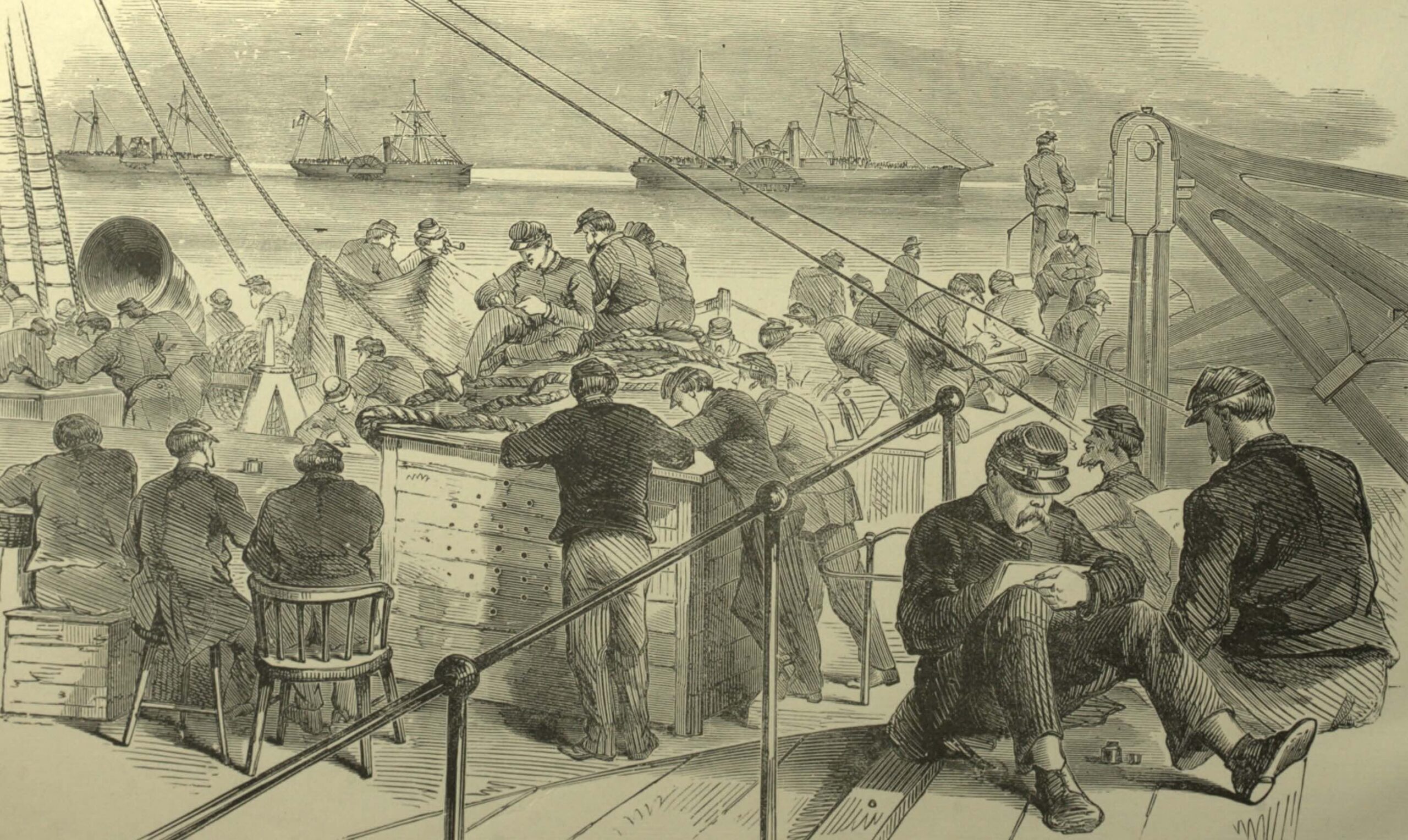 Frank Leslie's Illustrated History of the Civil War (1895)
Union soldiers are depicted writing home on the deck of a transport ship in this wartime illustration.
That being said, of course, as you went on march, you would leave your spot and then you might not get mail for weeks, and then all of a sudden you would get a dozen letters. Soldiers, the smart ones, numbered their letters as well as dating them so that people at home knew, “I’ve got one and two, and seven and eight just showed up, which is why this communication seems so broken and fractured and why you didn’t answer all the questions that I sent you in the letter when I responded to those first two.” But it was a smart technique for knowing how to keep them in order basically, because often they weren’t regular and the letters would get out of sequence and men would be waiting to hear, “Did you give birth?” Or, “What happened when the raiders came through?” And they might sometimes have to wait weeks or months for the answers to those questions. But the volume, as somebody who spent a lot of time in archives, the volume of durable writing that we still have is just staggering, at the state level archives, certainly at the National Archives. There’s a lot of that material that’s still never been read and that is still coming in. I had somebody bring me a zip file with a whole bunch of letters from their family, from a New York soldier who was down here in Baton Rouge, and I don’t think any researcher has ever seen those letters. They were literally just in this family’s personal collection. And that’s one of the great things about the Civil War, is that it was fought by two very literate communities on a substance, paper, that tends to last if it’s protected from light and humidity.
Terry Johnston: Yeah. And who knows, not to completely change the subject or to get either of us started on this, but, when scholars are looking back a hundred years from now, 150 years from now, at our modern wars, they’re not going to really encounter, I wouldn’t think, the paper trail we can in looking at the Civil War. I mean, emails aren’t usually printed out and archived.
Aaron Sheehan-Dean: No. It worries me a lot, I will be honest. As a historian, you know, looking ahead to the future, obviously you don’t have Skype transcripts and those emails might be stored somewhere digitally, but 150 years from now, are we going to have something that reads Microsoft Outlook formatted 2026 emails? Probably not. So my advice is print them out and store them, folks.
Terry Johnston: Yeah. As weird as that might sound, please do.
Aaron Sheehan-Dean: Yes. It will help future researchers.
Terry Johnston: Alright, well Aaron, onto our last question. This one’s from Nancy in Pennsylvania. She asks, “When wounded soldiers were discharged from hospitals, sometimes after months-long stays, how did they locate and rejoin their regiments?”
Aaron Sheehan-Dean: So, with great difficulty. I mean, if they’re in their own hospital, those hospitals are really well networked in terms of communication, quite typically, through the postal system that we just mentioned. So they might be able to find out quickly where is there a unit currently, and then a hospital would write a pass to put them on a railroad to send them to this particular place. If they’re in an enemy’s hospital, they’re going to have to get released and usually make their way home and then find a newspaper and try to locate, just on their own sort of recognizance, where is my unit currently, and then walk or train to wherever that unit is. There are men that, they don’t seek an opportunity to be wounded, but the convalescence that might have to happen at home does provide an opportunity for leave that is very difficult to come by if you’re a normal soldier. And this is one of the accusations, is that there are some men that sort of run up front and get shot in the foot precisely so that they can end up back at their home for a couple of weeks. There aren’t that many men, I think, actually doing that.
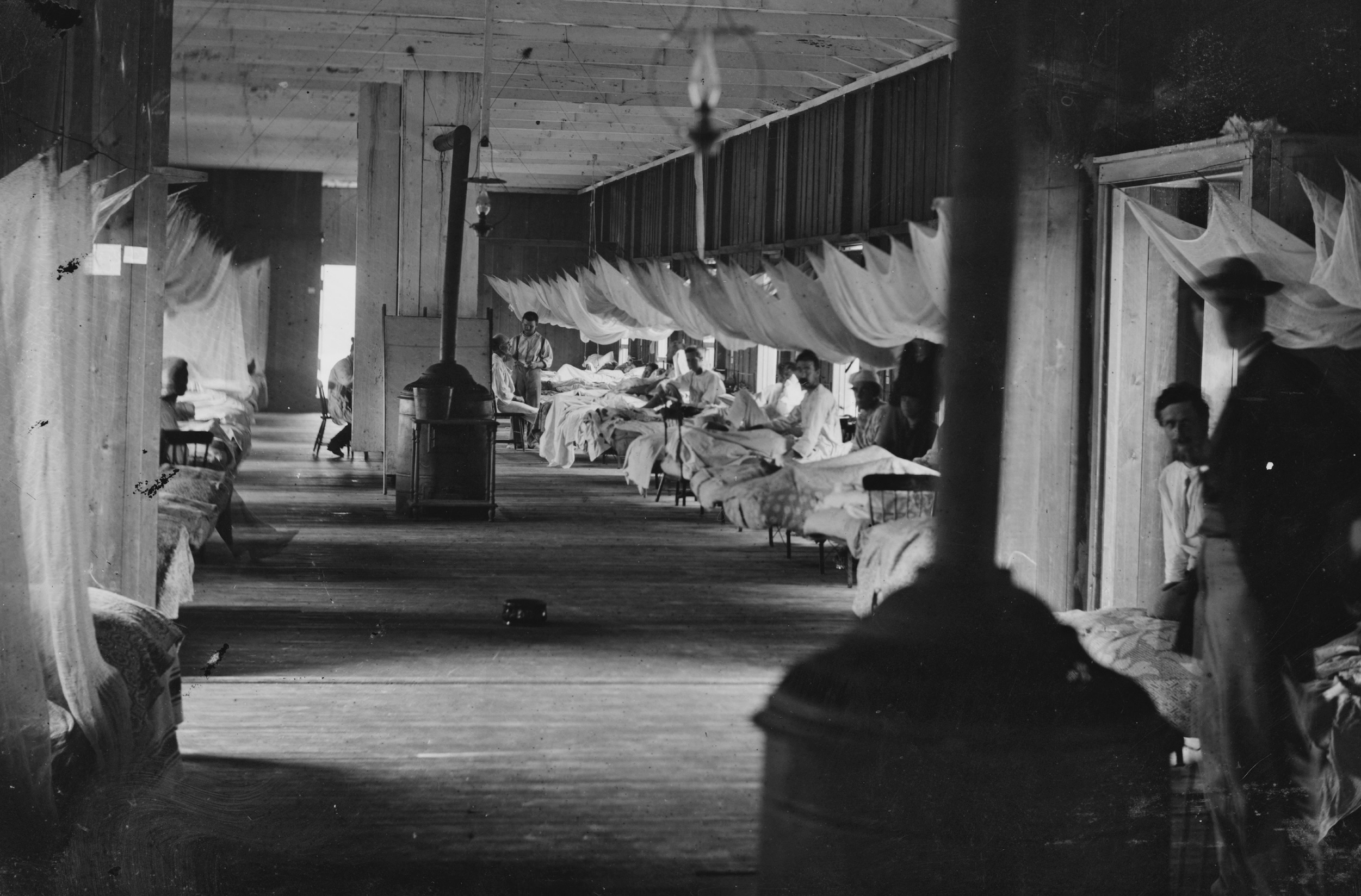 Library of Congress
Sick and wounded Union soldiers recover in a ward of Harewood Hospital in Washington, D.C.
But the movement from hospital or from POW status back into active service can take a very long time. And again, you’re looking in newspapers to try to see where your unit is maybe deployed. If you get home, you might get mail that would return from a commander saying, “Men of the 12th regiment that were captured at Shiloh, we’re currently here, return to duty when you can.” And they have some amount of time. But they might also end up being classified as absent without leave, or, even worse still, as deserters. My first job, before I went to graduate school, I actually worked on Capitol Hill and I worked for a Michigan senator. And one of my first exposures to Civil War history was a family coming to us hoping to get a charge of dishonorable discharge overturned because their ancestor had been in a hospital and had returned home and had been home so long they had been marked as absent without leave, and then eventually desertion. And they had been dishonorably discharged. And they had done the research in the local newspapers to indicate there was no way for this particular man to find out where his unit was in the amount of time that was required before he was labeled a deserter.
And it was obviously posthumous vindication, but they made a solid historical argument that he couldn’t have known in the two weeks or whatever it was that his commander gave him. And we petitioned the U.S. Army and they actually changed the discharge to an honorable discharge. Again, it didn’t do anything for him in his postwar years. This came 150 years later. But it was a sort of first lesson for me in how much ambiguity there was and how decentralized these forces were that your best bet was to walk home and then just sort of wait until somebody asked for you or you needed to spend a little bit of energy trying to track them down. But depending on the vigor with which your unit is reorganizing after a big battle or after the capture of half of their men, you could very well be marked absent without leave and then have to explain, “I was in the hospital and I have proof for that. And then I went home, and then I immediately reported back for duty.”
Terry Johnston: Is that confusion a product of poor record keeping, on either the part of the army or on the part of the hospitals themselves? I mean, it strikes me too that there were times when a regiment just recently in combat might think that Private Smith was killed, but Private Smith wasn’t killed, he was wounded and they had to figure this out somehow. So, is it just poor record keeping? Or not a great system?
Aaron Sheehan-Dean: It is. No, it is poor record keeping. I mean, particularly after big battles, it’s enormously hard, it takes a very long time to figure out who was killed, who was injured, who was captured, and it might take weeks, in fact, for injured men who are seized by an enemy and given medical care to recuperate enough to be able to communicate who I am and what unit I belong to, and for that information to make its way back across the border. So there are initial reports, wounded lists will go into local newspapers of men who are wounded, and people fly into a panic because one of their family members is listed. And then weeks later it turns out that, in fact, they were captured and they weren’t wounded. Or they were wounded and then they died behind enemy lines. And there’s a hundred varieties of how this happens. And most of them are quite benign. They are really just problems of record keeping and communication. When men are captured, they’re supposed to honestly say their name and their unit designation. And that’s partly so that both sides can keep accurate lists and can exchange that information even if the men aren’t formally exchanged so that news of who’s captured can make its way back to anxious family members. And so the commanders know how many of my men are actually eligible and how many of them are not eligible for fighting.
You know, we kind of take advantage of the bureaucratic systems and we might complain about bureaucratic systems, but today’s army has a very, very good bureaucratic system for keeping track of people. Probably too good, enlisted men today might claim, but it means that we sort of instantly know where people are. In the 19th century, there’s just a whole lot of slack in that system and it often takes weeks or sometimes months. If your listeners know The Return of Martin Guerre, the famous kind of medieval, early modern story. And then there’s a Civil War film version of this with Jodi Foster, I think, and Richard Gere called Summersby, about a man who comes back and pretends to be, or maybe he actually is, the husband that was declared dead years before. And, to modern readers, it can seem impossible that you wouldn’t recognize a husband who comes back. But it sometimes took years to actually identify where people were and they turned back up unexpectedly. And that’s, I think, a sort of inevitable part of the systems that were in place in the mid-19th century.
Terry Johnston: I wonder, too, how reluctant, if that’s the right word, were the militaries of both sides to release sick and wounded soldiers from service? We know that the Union army created the so-called Invalid Corps in 1863, that was renamed the following year to the Veteran Reserve Corps, in which disabled soldiers could serve out the remainder of their service. And also veterans who had been wounded could get back into the army, who could still perform light military duties. But were the militaries themselves reluctant in letting these wounded and sick soldiers go?
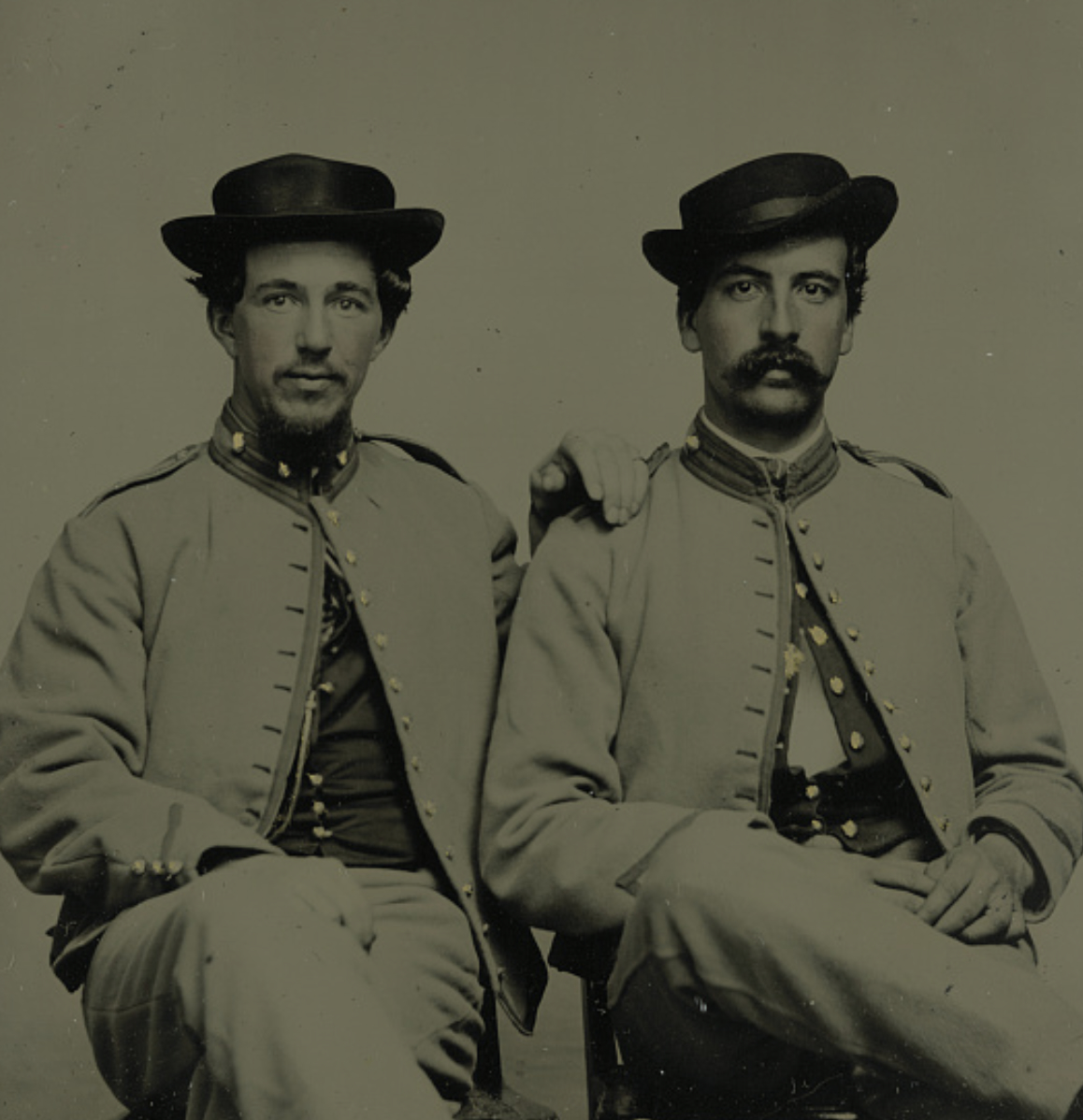 Library of Congress
Members of the Veteran Reserve Corps
Aaron Sheehan-Dean: Yeah, deeply reluctant. And especially the Confederates, who are fighting at a huge manpower disadvantage, about five-to-two disadvantage on the Union as opposed to the Confederate side. And that disadvantage doesn’t matter if the war only lasts six weeks. But if the war lasts four years, as the Civil War does, then trying to keep every healthy man, and even those injured or disabled men, in some form of service is really crucial. The Confederate draft starts with ages 18 to 35, and it eventually expands to 17 to 55. So, really, basically every adult man is eligible for military service. And even when injured, they are very reluctant to do this. Grant and Lincoln are both aware by 1864 of the imbalance, particularly as they see men taken out of commission for injuries or being captured. Lincoln calls it the awful arithmetic of war, which is the Union can keep fighting these battles in which six or eight or 10,000 men are injured or captured, and it can basically do so forever. There are 22 million northerners and there are 9 million southerners, and of those 9 million southerners, 5 million are white. And of those 5 million, a million are men ready for military service. By 1864, that imbalance works. And Lincoln isn’t trying to bleed Confederate units. He doesn’t gain anything from a war of attrition. But he is also cognizant of the fact that there is an imbalance there. And it’s especially pronounced as, in the late war, Confederate armies work very hard, and Union armies too, to try to keep men that aren’t fully disabled in some form of active service. Because there are, of course, a lot of occupations within the military, a lot of work that can be done by men who are wounded or are slightly disabled, but not fully incapacitated.
Terry Johnston: I wonder, too, how big a role the doctors themselves played in this decision. I mean, we know that there were requirements for entering the service, you had to pass some basic physical test. And that could be hit or miss depending on the doctor you got. Was it the same thing with getting discharged? Did it depend on your doctor? Were they more reluctant, more often than not, to let people go?
Aaron Sheehan-Dean: Well, it certainly depends on your doctor. And I think, I mean, my sense is that doctors span the spectrum, so that there are some that are quite sympathetic to wounded men and also to traumatized men. And they might be willing to let someone stay, perhaps even after they have actually recovered. On the other hand, there are doctors that are deeply suspicious of what they called malingerers, men who were feigning illness or feigning a wound in order to stay out of combat. And I think it was sort of just your blind luck what doctor you got and whether they were somebody who was likely to send you back as soon as you’d stop bleeding or whether they might, in fact, be willing to tolerate a pretty high degree of a long recuperative period for soldiers who were demonstrating or manifesting signs of great reluctance about going back. The doctors are certainly under pressure from the higher officers and doctors, surgeons, were officers themselves, usually majors, certainly above the captain level in both armies. And so, they are attentive and alert to the manpower needs. So, in general, I think they probably err on the side of sending men back before they are entirely ready for action. But there are examples on the other side, of doctors that are looking at what’s happening to men who are broken in ways that they don’t feel competent to fix.
And there’s good writing on this both in, I would say, the historical literature as well as in fiction. And I’m stalling because there was a very good novel by Jayne Anne Phillips last year that involves a number of scenes set in a Civil War hospital where a West Virginia soldier ends up. Anyway, it’s a really brilliant, very tough Civil War novel, but I think brilliantly realized, and it involves one of these questions and a soldier who more or less gets himself detailed to work in a hospital and develops his own medical skills and so on.
But there’s a huge spectrum of outcome there, just as there is for men depending on what officer they get, whether they’re subject to harsh discipline or lax discipline.
About the Guest

Aaron Sheehan-Dean is the Fred C. Frey Professor of Southern Studies at Louisiana State University and the author or editor of a number of books on the Civil War era, including The Calculus of Violence: How Americans Fought the Civil War and, most recently, Fighting With the Past: How Seventeenth-Century History Shaped the American Civil War.
Additional Resources
- Lorien Foote, The Gentlemen and the Roughs: Violence, Honor, and Manhood in the Union Army (2013)
- Chandra Manning, What This Cruel War Was Over (2007)
- Megan L. Bever, At War with King Alcohol: Debating Drinking Masculinity in the Civil War (2022)
- Jayne Anne Phillips, Night Watch: A Novel (2023)
Sponsored By