Historian Aaron Sheehan-Dean answers several questions pertaining to the training that Union and Confederate soldiers received during the Civil War.
Transcript
Terry Johnston: Thanks for joining me, Aaron. We have several questions for you today, all of them pertaining in some way to Civil War soldiers and soldiering. First up is a two-parter from Matt in Virginia. He asks, “What training did new recruits receive before joining a regiment? And did newly commissioned officers receive any kind of training themselves?” Let’s take these in order. So, what kind of training did rank-and-file troops receive?
Aaron Sheehan-Dean: Well, I think from the perspective of Regular Army soldiers, “not enough” was the very clear answer. And it is important to remember the prewar army is 15,000, of which about 10,000 stay and fight for the North in units that remain intact. So those aren’t dispersed. The South gets about 5,000 enlisted men from the Regular Army who are dispersed. But the overwhelming number of soldiers on both sides are volunteers and they come in with very little knowledge. So what they are primarily being trained with is drill. So the assumption is they can cook their own food and they know how to dig a latrine more or less and sort of care for themselves, but they probably don’t know anything about marching or fighting. And so in training camps, and these pop up in 1861 around Washington, D.C., around Richmond, and then around smaller towns all over the North and South before soldiers are then deployed to a central spot, usually outside Richmond or Washington, and actually assigned to some field position.
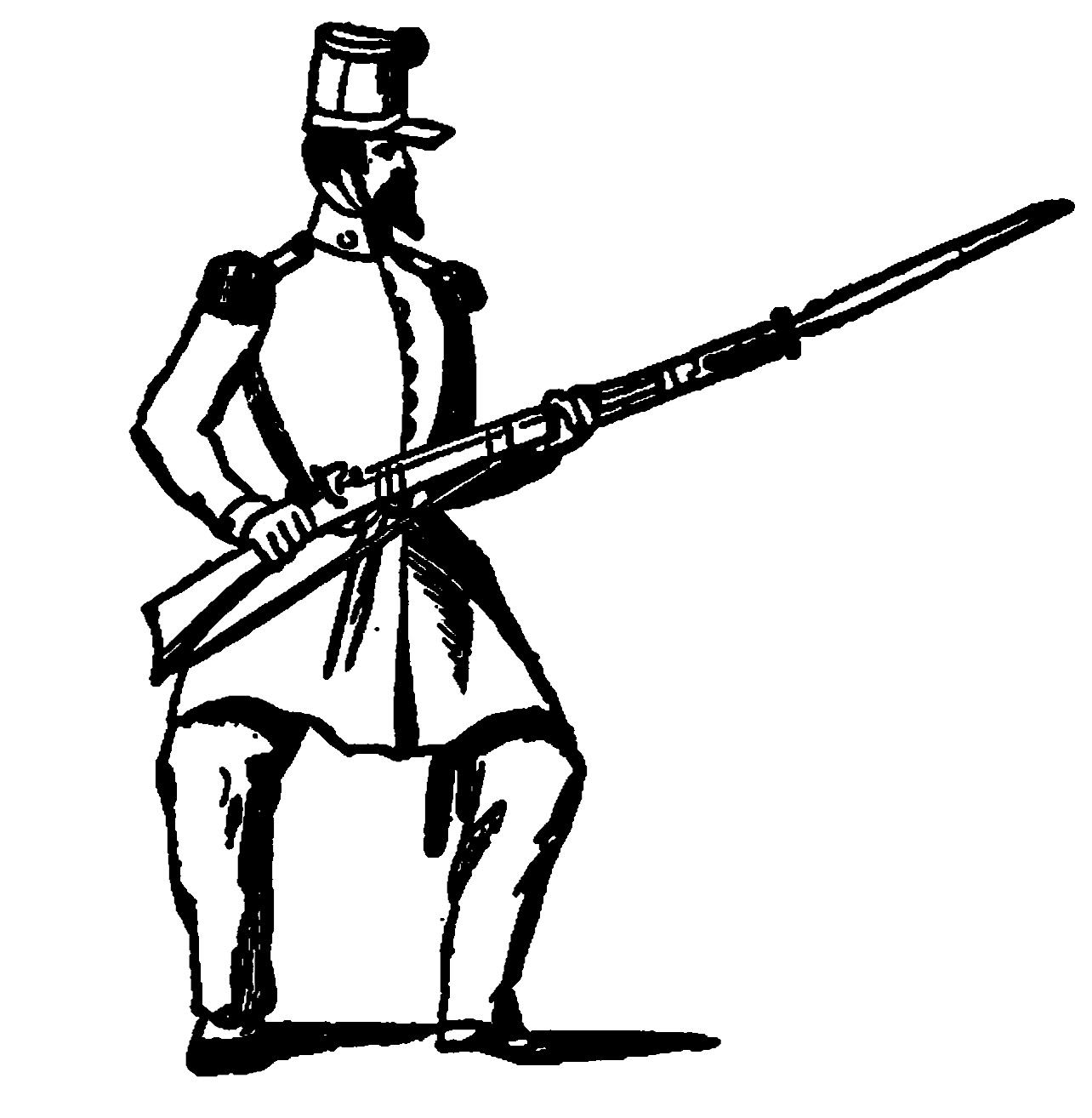 Rifle and Light Infantry Tactics (1855)
An illustration from William J. Hardee’s drill manual, Rifle and Light Infantry Tactics.
So they would have been subjected to a huge amount of drill to learn how to march in uniform, that is to march in step with each other. And you’re going to get instructions on ordinary marching to a battlefield, double timing, how to run for an attack and still maintain your shape in terms of an attacking column. And then lots of weapons training and applied drill. There’s a couple of manuals that circulated in the U.S. Army beforehand. Hardee’s Drill, and Hardee is a Civil War general, but Hardee’s Drill, a manual of infantry tactics mostly developing the French Antoine Jomini’s tactical manuals that were published widely around the western world in the early 19th century. And then those are adapted for American audiences because most of these guys were starting from scratch and they’re mostly commanded, certainly at the level of colonels and up, by officers trained at West Point. So those officers are deeply worried about whether men will be able to go kind of from zero to 60 overnight, which is what the expectation seems to be in 1861.
So long hours of drill in April, May, June, July of 1861 of soldiers just—and this is, we get a lot of complaints from soldiers—all they do all day is march around in step and then do it again and do it again. Then of course, you know, the purpose of this is to produce men that will be able to do this in the shock of battle.
Terry Johnston: So there wasn’t any set program as far as a length of time, like soldiers or new recruits would see today where you’re going to go through, I don’t know what it is today, two to three months of rigorous, regimented training? It seems like it was immersive, but I guess it could vary from regiment to regiment?
Aaron Sheehan-Dean: It does vary, right. So, there’s nothing like basic training today where, you know, we know if people enlist as a service member, they’re going to go have basic training that’s uniform and standardized and each branch of the military does those slightly differently. But the process is very uniform. There were state militias in every state. Those were very informal and rarely, to be honest, meant more than guys got together once a month and drank, and then sometimes put on uniforms before they drank. So there are times when regiments are organized locally and they actually outfit men and begin that training process in a more rigorous way locally. But as you point out, that’s almost regiment to regiment. At the company level, a company would’ve had 100 men all recruited from the same community or the same space, often related to each other. Ten companies in a regiment, so ideally 1,000 men, though they rarely actually met that. And once they got out into the field, they often had half as many men in an active regiment because of illnesses and details that sent men elsewhere.
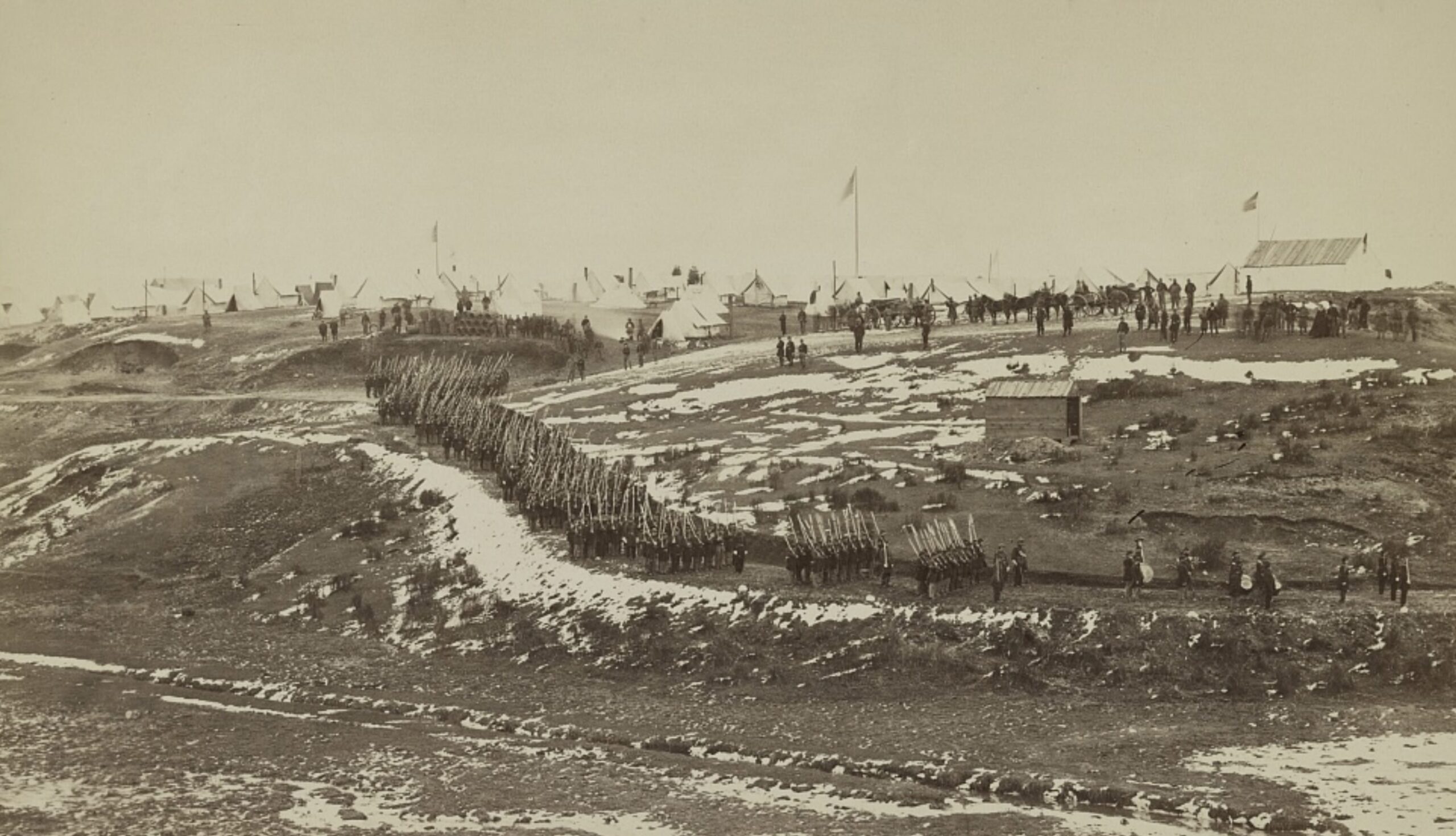 Library of Congress
Union soldiers drill at a camp near Washington, D.C.
So once they come to a collection point, as they were usually called, outside Richmond or outside Washington, there would’ve been more organized instruction. But if those were units organized in June and they get to Washington, D.C., let’s say in July 1861, you know, we know that Bull Run is going to happen in the middle of July 1861. So, at that point, it might be a sort of “giddy-up” week and a half and then you send them out. And this happens even late in the war where new recruits are brought in and they are sent to battlefields very “green,” as they would’ve been termed at the time, that is, really not properly trained. And if they’re confronting veterans, that produces a severe imbalance because men are very prone to panicking when shells start exploding around them and men start falling. Knowing how to load a musket—in an ideal world, you could load and fire three times in the space of a minute, and it’s a complicated series of steps. Gun ownership was not nearly as widespread as I think we assume it was. And they’re also using often different weapons than they would’ve had at home if they did own weapons. So that kind of training takes time to learn. And if you are learning it under fire, it’s not ideal.
Terry Johnston: Yeah, and that’s an interesting observation. So there really was, I guess, an appreciable difference between training received, say, by those early war recruits into newly forming regiments as opposed to those enlistees who are joining, say, a veteran regiment in 1864.
Aaron Sheehan-Dean: Yeah, and there are competing schools of thought on whether it’s better to keep existing units intact and you recruit new recruits into them to help keep some of that original esprit de corps. And lots of men get very angry when their regiments are broken up. The advantage of breaking them up, that is when you have to reorganize fully, is that those veterans are then distributed among other new recruits and can help socialize them and instruct them. I mean, this famously happens in Red Badge of Courage, if listeners have read that, where there’s men of widely varying experience and the newbies very quickly would have realized it actually will protect me to pay attention to how these veterans do things. How do they spend their time in the minutes before a battle? If things tail off, they drop down on the ground, they don’t stand up, you know, sort of fundamental things.
But the general trend, yes, would’ve been over the course of the war that the systems for training people improved. That being said, the U.S. Army is incredibly decentralized in the 19th century, so some general officers would’ve been very rigorous about this and had provost marshals that would, you know, ensure that men were in their camps and ready to be drilled. And others were much more lax. So there’s a lot more inconsistency in the 19th century than there is in today’s army where we imagine this as a very routinized and organized system.
Terry Johnston: Before we move on to the second part of Matt’s question, one more thing: Was there one branch—infantry, artillery, cavalry—where the training was more comprehensive or complex or lengthy?
Aaron Sheehan-Dean: That’s a good question. Certainly, artillery requires a lot more attention and focus. You have to have somebody—the artillery units, a given gun might have anywhere from six to 12 men manning it—somebody among those men needs to know how to do really sophisticated math because the charges to launch these have to be weighed out. And they’re supposed to be pre-measured, but you still have to calculate trajectories, that is, a lot of geometry to know, “If I’m putting an eight-pound shell 400 yards in front, the charge to launch that shell is going to be different than if I’m putting it 1,200 yards in advance or 200 yards.” And so, the balls have separate charges, that is, a charge to detonate a ball, separate from the charge used to launch a projectile, and that launching charge has to be calibrated at that moment based on distance, the height that it has to be projected to. And so that requires math that would challenge most of us, I think, today, even if we survived 10th grade geometry.
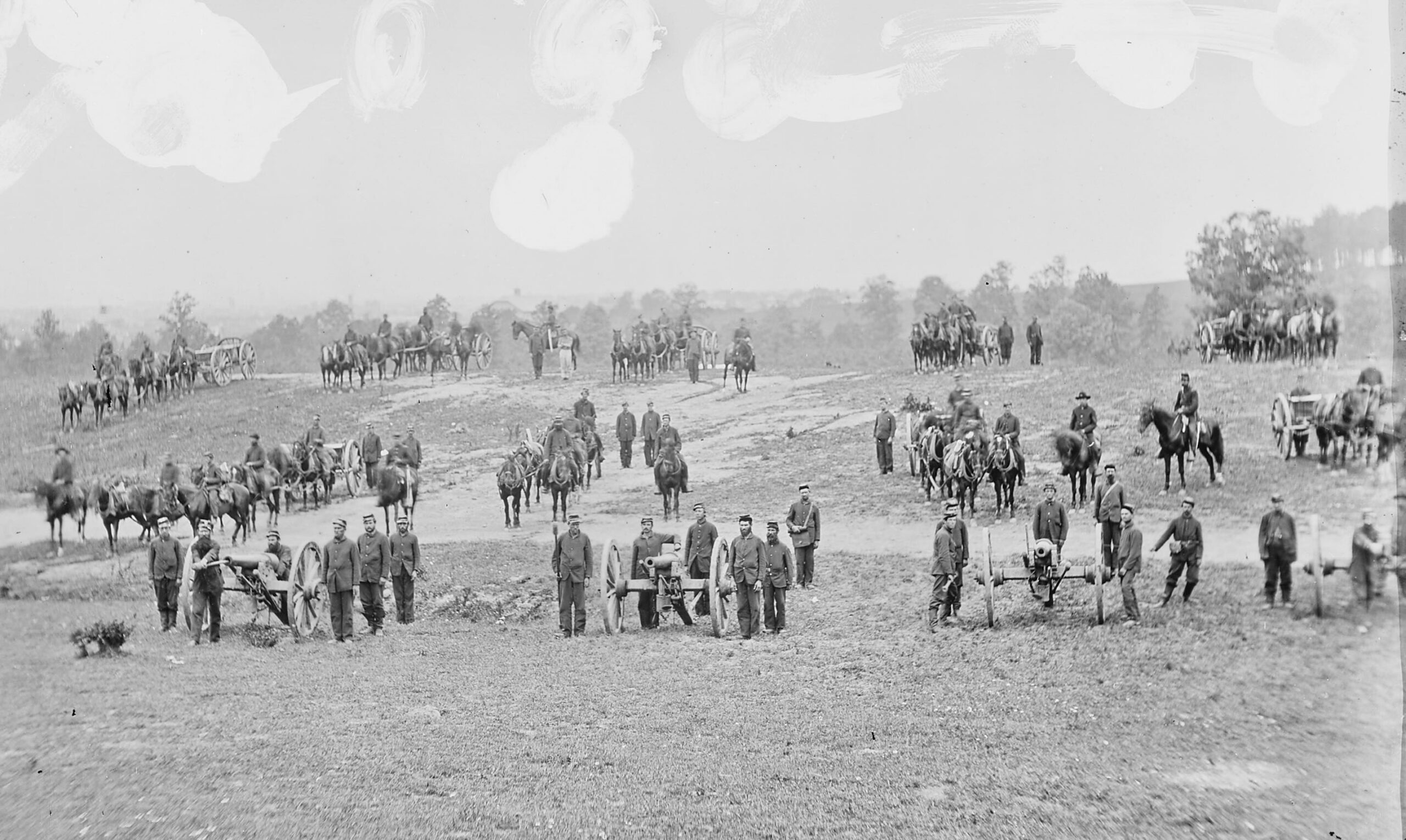 National Archives
Union artillerists drilling in Georgia during the war
And then you have to have people that can follow very careful orders about measuring and packing. And they, of course, have to do this while taking fire themselves. And also those men are being very careful because if they mishandle that weapon and it explodes, which happens more than we would like to know, they’re probably going to be killed or at least seriously wounded. So you have to make sure that you’ve cleaned the cannon before each firing because you get residue and extra powder might be not yet discharged, so you’ve kind of preloaded it. And this happens in the heat of battle. Also, sometimes those cannons are not well made. And there are various innovations over the course of the war, particularly at the breach. So you often get these brass bands that are fitted, and that’s really to help contain the explosion that’s launching the projectile, and also to ensure that that gun—these are usually cast iron guns—doesn’t overheat and then suddenly just explode, in which case it’s like setting off an enormous charge. And it would, of course, scatter those iron fragments in every direction.
The infantry is much more, there’s less work to do in terms of training infantrymen. Cavalry tactics do evolve over the course of the war, and our assumption is that most men would’ve been familiar with animals. You know, 80% of both the North and the South is rural at the start of the Civil War. And that’s true, but it’s a very different thing from having an old mule or horse that you harness a plow to and work on a farm to attacking and moving in battle on a horse. And so, cavalry tactics develop and men have to undergo a fair amount of training and a lot of in-battle experience to actually be adept. In most cases, even cavalry often fights dismounted. They’re getting to battles on their horses, but it’s rare to have true cavalry charges as we might know from the charge of the Light Brigade or something from earlier 19th-century European warfare where men drew sabers. Swords are almost entirely ceremonial in the Civil War.
Terry Johnston: Yeah. And you see the statistics on the major causes of battlefield wounds, where bayonets and sabers make up less than 2%, probably even 1%, of the greater whole.
Aaron Sheehan-Dean: Yeah. Swords, I mean, officers sometimes use their swords in their scabbards to whack men as a kind of humiliating punishment. But yes, charging in with a sword was a pretty infrequent thing.
Terry Johnston: Well, speaking of officers, that’s a great segue, Aaron. Let’s get to their training. So, what training did newly commissioned officers receive, and how did it differ from what the rank-and-file whom they trained received?
Aaron Sheehan-Dean: So, again, Regular Army officers would’ve said “not enough.” You know, if you went through several years at West Point and graduated, you were then commissioned a first or second lieutenant. And the people in the Civil War, you have a total of northern men, about 2.1 million eventually under arms in the army over the course of the war, for the Confederacy about 900,000. The vast majority of the commissioned officers at the rank of lieutenants, and even captain—a captain is the officer in charge of a company—are actually beginning as volunteers. So usually what’s happening is the major or the lieutenant colonel running a regiment is basically going to hand out copies of Hardee’s Infantry Tactics and then the captain and the lieutenants are going to sit up late at night in their tents studying these, and then the next day are expected to basically teach them. I think of my own experience as a graduate student teaching African history where I thought, well, I’m reading the same book they are, and I don’t know a lot more than they do, but I’m somehow supposed to be guiding them in conversation about it as though I know all of the answers when, in fact, we’re using the same book. My stakes were substantially lower, but it’s not that dissimilar. In both the Union and the Confederacy, the vast majority of those officers functioning at the lieutenant and captain level—and those are really the line officers in battle with men—are volunteer soldiers, which means that they are having to learn as they go as well. And they would’ve received a very light instruction from the higher-ranking officers in a regiment. But for the most part, they’re really learning alongside their men.
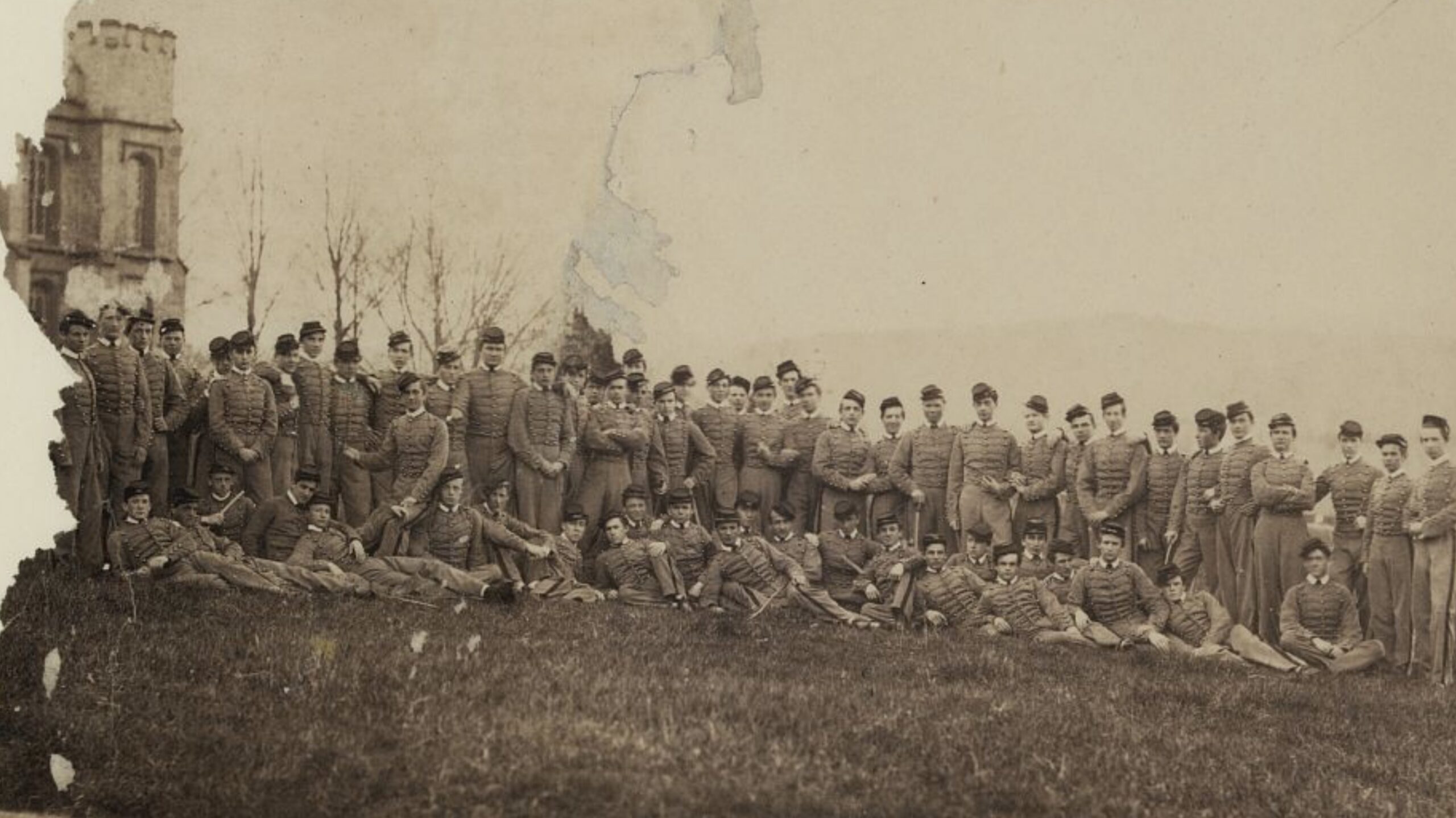 Library of Congress
Cadets at the U.S. Military Academy at West Point during the Civil War
And there are deep concerns about the right way to select and identify captains and lieutenants. In both the North and the South, over time, many of these become elected positions, that is, the men in a company would elect their company-grade officers. For West Point-trained soldiers this is anathema, this is the worst way of political influence corrupting what should be a professional process. And there is weight to that argument. Certainly, you end up with captains who just promise to keep their men out of battle and do their best to do that. On the other hand, it often means, and I’m basing this on the soldiers’ letters that I have read, that what happens is the promotion of those men who are competent leaders. And soldiers, even infantrymen who want to stay out of a battle, realize over time that what they need are men they can trust and who will deal with them fairly. So, it’s true that excessive disciplinarians are unlikely to win an election to a position of, say, captain of an infantry company. But it is also true that a man who drills properly and who imposes burdens on his men that he also takes up himself is likely to win that position and be respected.
So it’s a very difficult sort of balancing line. There’s lots of tension over this question of electing company-level officers. Lots of the senior rank and file oppose it bitterly. But they are yielding to a kind of “lowercase d” democracy in American life that they have to acknowledge, that this is not a West Point professional army where the officers can really impose their will on enlisted men who are getting paid to take those commands. And this is one of the interesting fault lines between volunteers and professional soldiers that really last the whole war through.
Terry Johnston: It’s interesting. You mentioned these newly minted line officers who, in reading their letters and diaries, and I’ve done the same, you’re really struck by how they really do seem to be self-training. They’re pouring over Hardee’s Tactics and the like and writing about it and saying, “Geez, I’ve got to really learn this,” and “I’m trying it out on the men.” The training camp is a big classroom for them as well. It is really pervasive. I mean, it’s really how things are working back then.
Aaron Sheehan-Dean: Yeah. Andrew Bledsoe has a very good book on this, one of the few books that we have on these officers. You know, we have a lot of biographies of generals, of course. And then a few like Donald Stoker’s book from several years ago that are at the sort of operational level, big, sweeping histories of how the Civil War armies actually function. We have a few good studies of the men who are actually doing most of the leading. And Drew Bledsoe is a good historian and he actually wrote a book about these junior officers. And they are, as you say, they’re sort of learning as they go. And they’re the ones really in battle with men and they’re also the ones having to implement the orders that are coming to them from officers who may not, certainly regimental officers would’ve been on a battlefield, but brigade and division commanders are often not always present. They’re getting written orders from a commander who is often a mile or two off the battlefield. And so there are runners bringing written orders, but what you end up with is these line officers actually having to implement them and having to make a call if they’re in battle about what’s reasonable to be able to accomplish and what isn’t.
The regimental officers, that is the colonels, are the ones most often on the hook for whether orders have been executed properly. But that’s typically where the kind of sequence of this stuff flows downhill. And being a lieutenant or a captain in the Civil War is both a pretty deadly occupation, but also a very difficult one, both on battlefields and in camp, where they’re having to manage, in disciplinary terms, men who are volunteers and aren’t real eager to live as though they’re professional soldiers.
Terry Johnston: What about politically appointed officers, generals in particular, who had no military background? They’re not West Point grads. I’m thinking Daniel Sickles and Nathaniel Banks. They were just thrown into the fire and hope for the best?
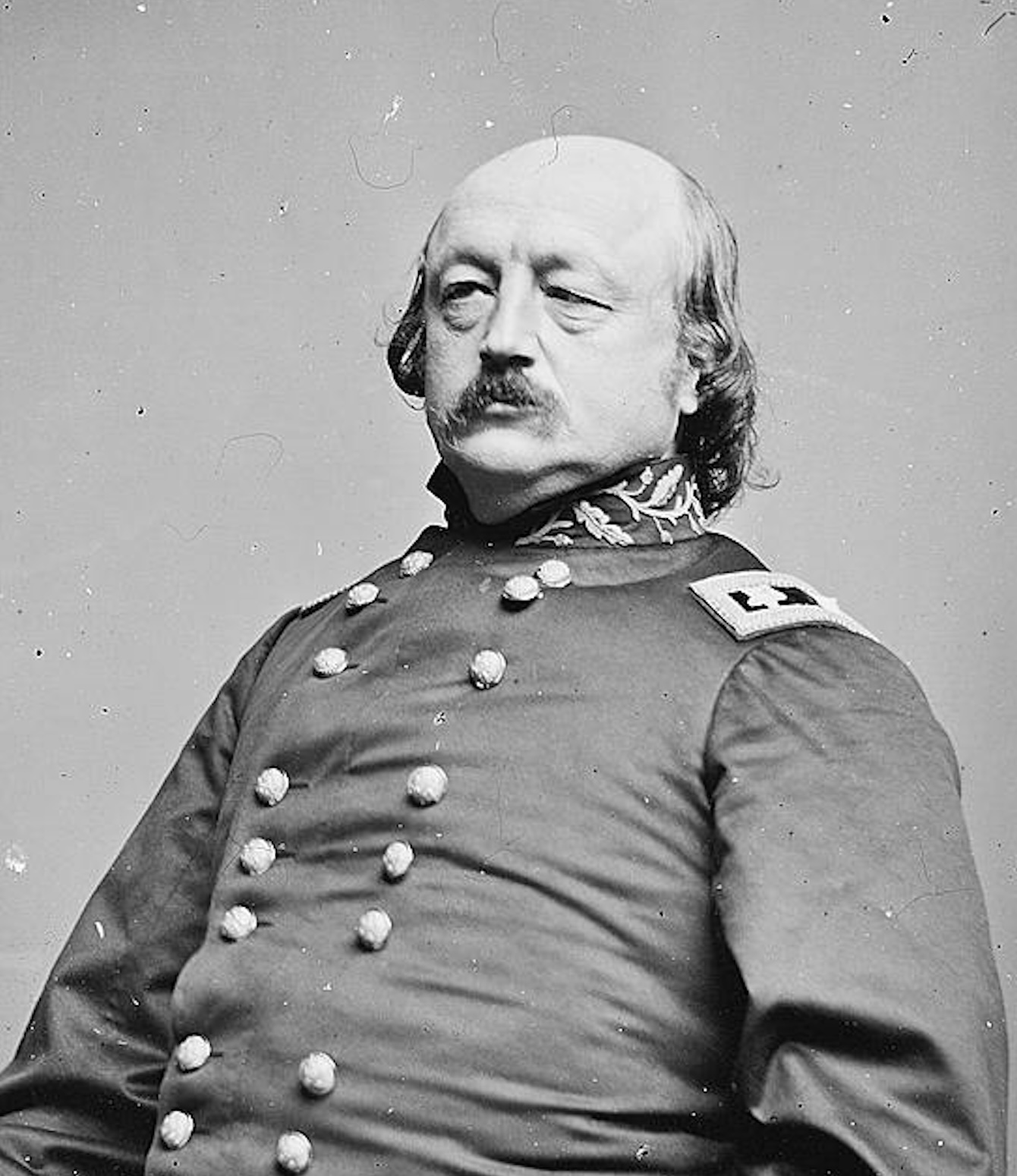 Library of Congress
Benjamin Butler
Aaron Sheehan-Dean: Yeah, I mean, both the North and the South have political generals, what we call political generals—they were just generals—but that is men who are appointed because they satisfy a particular political or maybe an ethnic or a regional constituency. And both Lincoln and Davis make these decisions because they need the political win of appointing somebody as the head of a unit. Then the goal is to keep them out of harm’s way. You actually don’t want them in battle. Banks is a good example. Before him, his fellow Massachusetts officer, Benjamin Butler, who is sort of Zelig-like in his capacity to manifest at every important juncture of the Civil War, but you really don’t want him on a battlefield.
And at that point, they’re relying on brigade or division commanders who are actually experienced officers who can manage the men in a more effective way. But there are battles, there are Civil War battles, I mean, Butler famously at the Peninsula in 1864, where he’s supposed to be bottling up Confederate efforts on the south side of Richmond. This is part of Grant’s big strategic vision for how they’re going to move against Lee’s army aggressively in the spring of ’64. Lincoln famously says, when Grant explains to him what’s supposed to happen, “Oh, I get it. Those not skinning can hold a leg,” in a very 19th-century barnyard kind of analogy. And of course Butler, he lets the leg go, and the Confederates are able to move up and Grant doesn’t have as much effect there on his front, partly because Butler’s not doing his job.
And soldiers pretty quickly took the temper of their general officers. And there are the ones like Lee and Grant who earn their respect. And so when they are asked to do difficult things—attack at Malvern Hill, turn south after the Battle of the Wilderness—they do it because they have a confidence in those men. And there are other general officers that lose the confidence of their men precisely because they’re not exercising discipline and command leadership in a very effective way.
Terry Johnston: Before we move on, I wonder: Were there any significant differences that stick out to you between the type and degree of training received by Union and Confederate troops, regardless of rank?
Aaron Sheehan-Dean: Hmm. That’s a good question. I don’t think, I mean, generally, I think the popular presumption is that Confederates were better generaled and had more natural soldiers because their men, you know, lived closer to the land. That’s actually not true. The Confederacy had more successful generals in the East in the early part of the war, and the Union had more successful generals in the West in the early part of the war. And I’m thinking in the West, particularly of Grant and Sherman and Sheridan, George Thomas. And those men, of course, eventually come east to then fight the successful Confederate generals, people like Lee and Longstreet, Jackson. Though of course Jackson’s dead by the time Grant is facing off. So it’s important for listeners to remember that the distribution of them is geographic and that over time what happens is basically the A-team fights the A-team, in terms of your most qualified generals in the eastern theater, after that Union team having really dominated the western theater over 1862 and ’63.
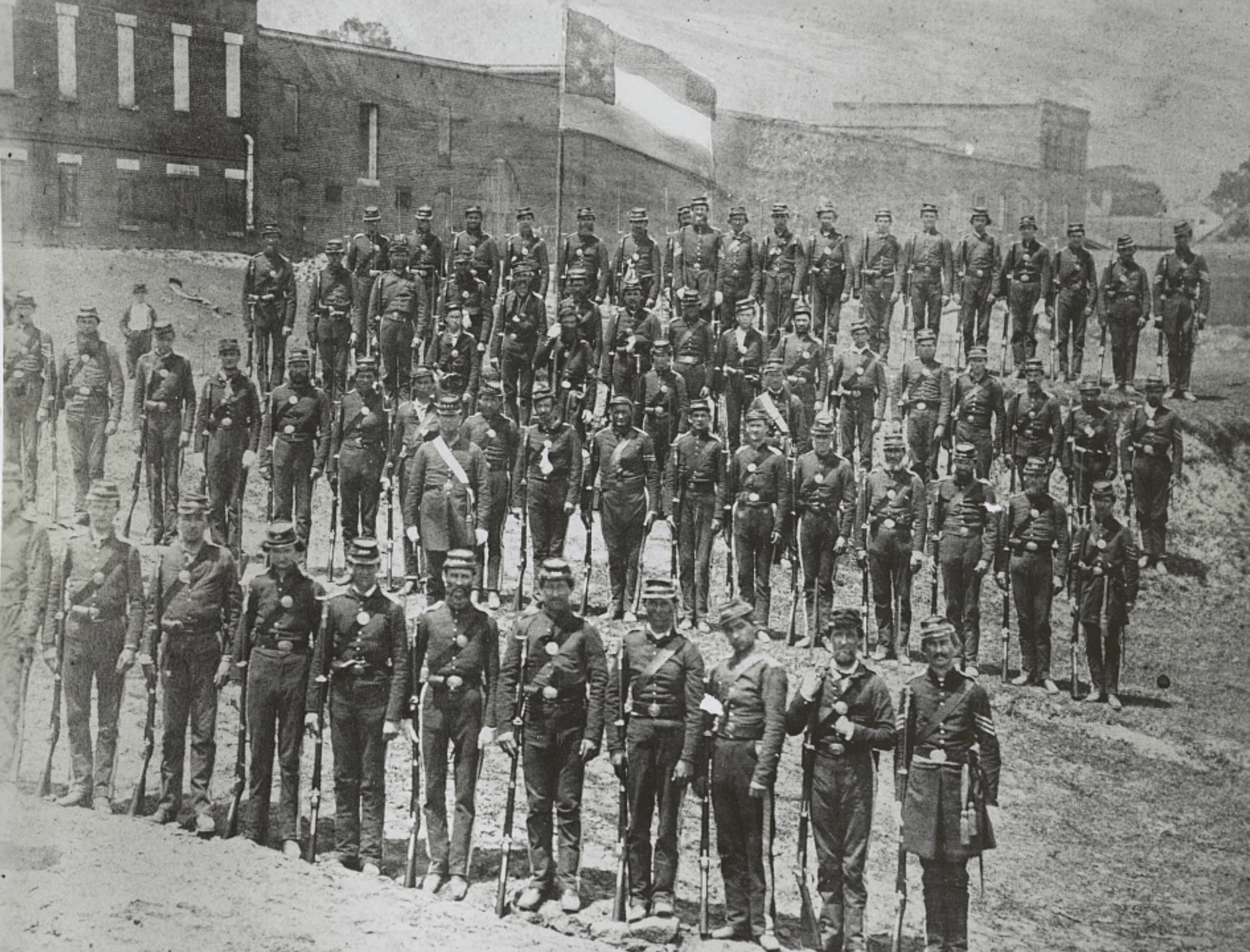 Library of Congress
Soldiers of the 4th Georgia Infantry in 1861
In terms of distribution of men and training, it’s important also to remember that even though the North is industrializing and urbanizing at a faster pace than the South had been in the 1840s and 1850s, the vast majority of northerners still mature in rural places, nearly 80% of them in 1860. And so they have as much experience with animals and with outdoor hardship as southerners do. The Confederate saw that any Confederate can whip four Yankees, it just doesn’t bear out in the actual fighting. And if you think in particular of Sherman’s armies, the men that come out of Michigan and Wisconsin and Iowa and Indiana and Illinois are sort of farm boys, just as those filling the Confederate ranks are. And both of them, that is both sets of armies, Union and Confederate, learn how to train and drill and move their men at sort of equivalent paces. They both incorporate new technologies, breach-loading rifles later in the war, certainly rifled weapons as opposed to smoothbore muskets. They’re learning to slowly adapt. They both move about as slowly and awkwardly to adapt the changes that rifled weapons bring to a battlefield as opposed to the less deadly smoothbore muskets that they might have known growing up.
So there isn’t really a huge advantage for one side or the other. What I try to impress upon students at the macro level is just that the distribution of competent generals is not even by theater. The Union runs through a whole series of less successful generals in the East, people like McClellan and Pope and Hooker before they get to people like Meade. And then when Grant comes east, he’s the one devising ultimate strategy. Meade is the operational commander of the Army of the Potomac for a long time in ’63 and early ’64. And Meade is a very competent officer. The Union had to work through those less competent men to get to the more competent ones. The Confederates are fortunate in that they start, particularly with Lee and Jackson and Longstreet, their really most competent commanders early on in the war in that most important eastern theater.
Terry Johnston: Okay. Well, onto the next, which is also about training. Stephen in Arizona wants to know: “What type of training did Union and Confederate sharpshooters go through?”
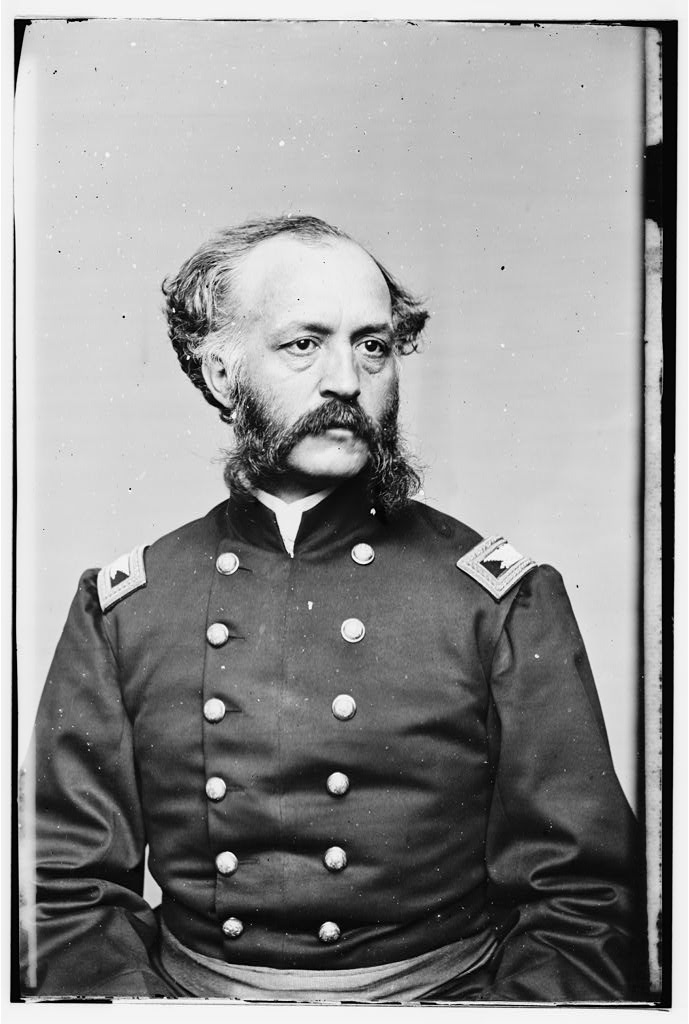 Library of Congress
Colonel Hiram Berdan
Aaron Sheehan-Dean: Yeah, this is an interesting one, and it actually took me a little bit of time to research it. The most famous sharpshooter unit is one called Berdan’s, B-E-R-D-A-N, Berdan’s Sharpshooters, and they actually form the 1st and 2nd U.S. Sharpshooter regiments. There are sharpshooter regiments from almost every state. These tend to get formed in both the North and the South in a very ad hoc way, that is, someone decides, specifically, “I have the money and the resources and I want to recruit and train a sharpshooter regiment.” And then they’re more or less putting up flyers hoping to attract men who think they’re good shots. So the key is that you’re basically coming in already with the skills of a good marksman. And there’s extensive testing to get into these regiments. So this would be in a very controlled environment where men would report to a given place and try out more or less for recruitment into one of these units. And they’re going to have to put a series of shots, often up to 10 shots, within a very small diameter. At the widest, what I’ve read is maybe 25 inches, at the smallest, even within a kind of 12-inch diameter space, to cluster those shots, usually at 200 yards, maybe at a farther remove, which is a skill of marksmanship that eludes most of the men in Civil War armies.
So you’re basically recruiting men who can already shoot quite well and then subjecting them to a lot more drill and marksmanship training before they are deployed into battle. There is not much, to be honest, and maybe this deflates all the tension, there’s not much evidence that these units perform so well that they change the outcome of any particular engagement. Certainly, over the course of the war, soldiers on both sides become aware that each side has marksmen that can shoot with lethal accuracy at 600 or 800 yards, a very long distance. Again, the key distinction for listeners is that in the prewar period, you’re generally firing, for long arms, a smoothbore musket, which has no rifling in the barrel, and the result you’re firing a spherical ball and it’s coming out with unpredictable spin and wobble. And those muskets would have been lethal at 100 yards and maybe accurate at 300 yards. You could sort of hit something at 300 yards. If you’re wearing a wool uniform and you get hit by a musket ball it might break something that is a bone, but it might also feel like you got hit, if your listeners know this, by an unexploded paint ball, you’d get a nasty bruise, but it doesn’t necessarily break the skin. At beyond 500 yards, it’s very unlikely. And then with the rifling in, that is, grooved rifling that goes into rifle barrels, you get a spherical projectile with a tip on it that is shaped like a bullet, as we’d call them today, or a minie ball would’ve been the earliest term. And those exit with defined spin, they’re much more accurate and much more lethal at much greater distances. So there’s also a scale-up in terms of the weapons. And as I say, most men aren’t familiar with rifled weapons. They panic in battle.
So the marksmanship and those sharpshooter regiments would’ve had to train intensively. They are also, certainly the northern units are pressing very hard to get breach-loading weapons. Nearly all of both the smoothbore and rifle muskets were loaded from the tip. So you have to plant the barrel on the ground, plunge it to clean it. That’s difficult with a rifling. Push a ball down that rifling, that takes time. So there are a number of gunsmiths and gun manufacturing companies that over the course of the war are designing new breach-loading rifles where you break the way a shotgun would today so you can load much faster. Those are going to have rifling in them to try to increase accuracy. And then eventually we’re going to get to Sharps carbines that are breach-loading, but would carry several balls, several bullets at once. Those are late in the war. And officers, I’ll be honest, are quite reluctant to see those go in the hands of untrained men because they feel like they waste ammunition. You bring up all of this ammunition and then with breach loaders, guys just fire all their ammunition in a minute or two and are left basically defenseless.
And so those sharpshooter regiments are much more careful. And the experience, certainly as we move to a place like the fighting in the trenches outside Petersburg and Richmond, the sharpshooters really become a serious threat there because both armies are barricaded. But as you leave the protection of the trenches to, say, use the latrine or move into a different part of camp, you are then vulnerable. If there’s a sharpshooter who’s 600 or 800 yards away and can still fire with lethal accuracy, that becomes a very dangerous thing.
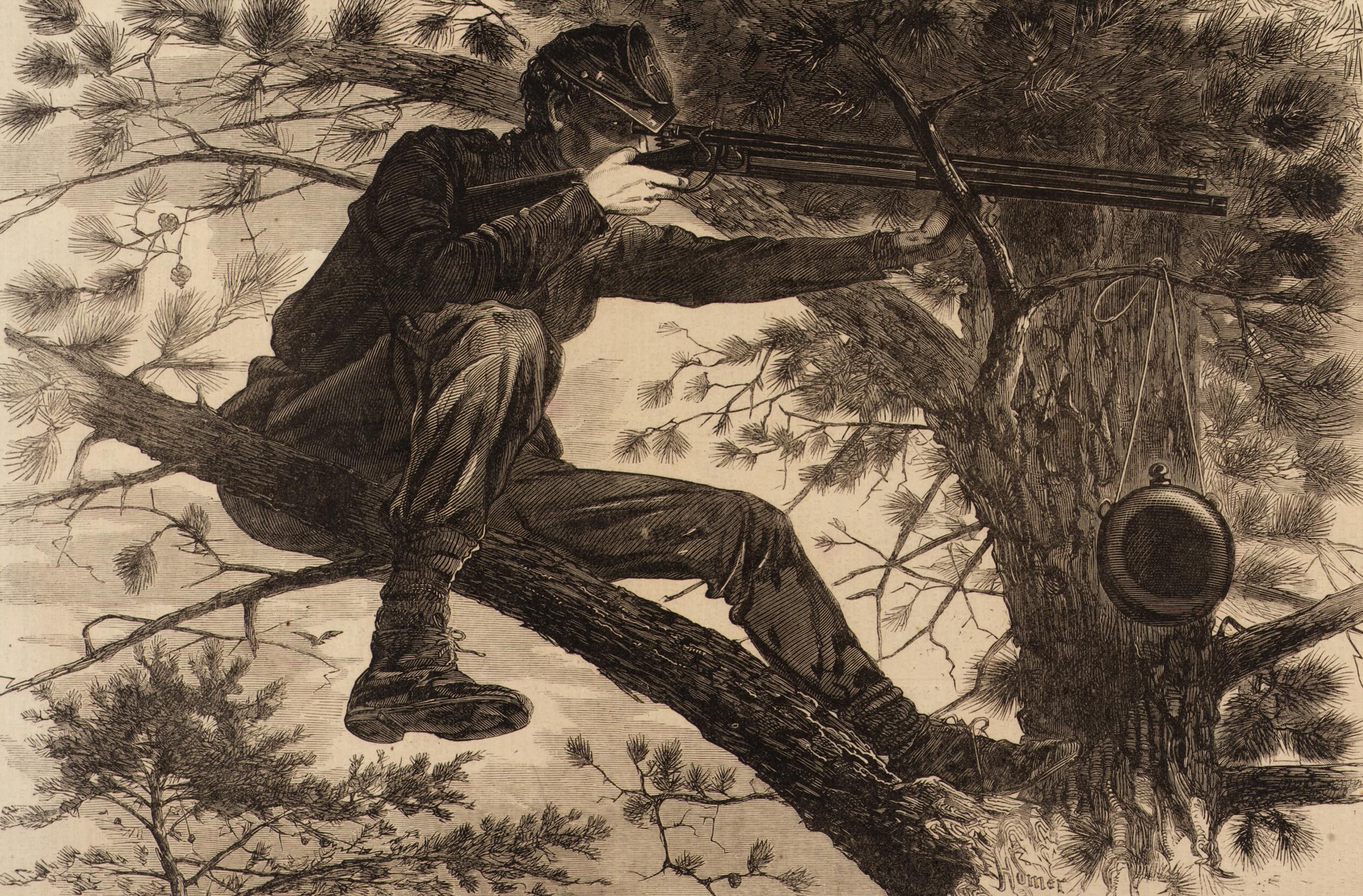
For a lot of men, sharpshooters weren’t real soldiers. They considered that form of distance firing cowardly and unmanly. You aren’t face to face with your enemy. Readers might know, or if not they should google Winslow Homer’s famous wartime painting, “The Sharpshooter,” which shows us a Union sharpshooter in the crutch of a tree with a long rifle, with a telescopic sight braced in that tree branch. He’s hidden from view. We can see him, but we know that the people that he’s firing on cannot. And in Homer’s portrait, which is drawn, you know, Winslow Homer traveled with Union armies and drew from experience, he chose to isolate that man. And I think the painting is very telling in the ways in which for some sharpshooters, they felt themselves isolated. And other soldiers also viewed them as doing something that was not, what’s the right way to say this? Really not kosher in terms of habits of 19th-century warfare, which involved public displays of courage. You charge your enemy, you see them. And sharpshooters could hang back from obscured or concealed locations and fire and kill people.
 Harper's Weekly
Winslow Homer’s “A Sharp-Shooter on Picket Duty”
Terry Johnston: That’s always interested me. You and I—you more than I—have come across references in soldiers’ diaries and letters calling out sharpshooters as something dishonorable. But contrast that, though, with the early war response to when Berdan’s units are forming. There’s coverage in Harper’s Weekly. I mean, they’re not creating celebrities out of these guys, but it’s certainly positive press. You might know more about this than I do, but there’s that “California Joe” Union sharpshooter who pops up in the press every once in a while, and it’s positive coverage. They’re impressed by the skills of these guys. And yet then you fast forward to later in the war where, again, the soldiers are not responding to the craft of the sharpshooter the same way.
Aaron Sheehan-Dean: No, you’re right. And, I mean, this is really how norms change in warfare, which is, it’s not strictly the introduction of new technology, and it’s not strictly the ability of soldiers to absorb and learn that new technology. But there is this important public dynamic in which, in a democratic society, the conversations we have, and in the 19th century these happened in the press, occur widely—that is, they’re going to involve a lot of non-combatants—about what they see as a legitimate form of warfare. And what’s interesting here, as you point out, is the kind of celebrity status that these units obtain. And they do. Both sides are quite eager to laud the accomplishments and the fact that we have now trained sharpshooters going out and it’s going to give us an advantage.
And soldiers, as you point out, feel very differently about these things. And there’s tension there, I would say, between combatant communities and non-combatant communities. And the parallel today is the use of drone technology. And, you know, in some respects, some of the greatest apprehension about the use of drones comes within the military from experienced officers who have learned the laws of war around intimate combat and for whom a drone creates a kind of distance, not just you’re in a tree 800 yards away, but you’re in a trailer in Denver operating a drone in Afghanistan, a kind of emotional distance to that landscape that changes what it means to be a soldier. And we’re only really now learning what this means psychologically for the people, both victims of this as well as the people participating. And you’re right that units were lauded. I mean, there’s a Michigan sharpshooter regiment that famously involved several indigenous communities. Company K was recruited very heavily among the Odawa and Ojibwe of northern Michigan, who were regarded as being very skilled hunters. And they’re incorporated into a Michigan sharpshooter regiment that the Michigan press really celebrates.
But, especially once you’re an infantryman, you know, barricaded in at Petersburg or Richmond, you view this kind of fighting as unmanly. And I would remind listeners that this is the kind of, you know, that in a democratic society, norms change in this awkward give-and-take as new technologies present opportunities. But then we as citizens wrangle with what we believe is ethically and culturally appropriate.
About the Guest

Aaron Sheehan-Dean is the Fred C. Frey Professor of Southern Studies at Louisiana State University and the author or editor of a number of books on the Civil War era, including The Calculus of Violence: How Americans Fought the Civil War and, most recently, Fighting with the Past: How Seventeenth-Century History Shaped the American Civil War.
Additional Resources
- William J. Hardee, Rifle and Light Infantry Tactics (1855)
- Stephen Crane, The Red Badge of Courage (1895)
- Andrew S. Bledsoe, Citizen-Officers: The Union and Confederate Volunteer Junior Officer Corps in the American Civil War (2015)
- Donald Stoker, The Grand Design: Strategy and the U.S. Civil War (2010)
Sponsored By