Gettysburg Licensed Battlefield Guide Garry Adelman discusses the enduring legacy of the 1993 movie Gettysburg, including what he thinks it got right and wrong historically.
Transcript
 Terry Johnston: Thanks for joining me again Garry. Our question for you is, “Historically speaking, what did the movie Gettysburg get right and what did it get wrong?” Now before you answer, let’s start with a little bit of background. The movie, released in 1993 and directed by Ron Maxwell, was based on Michael Shaara’s 1974 Pulitzer Prize-winning novel, The Killer Angels. For those unfamiliar, this book wasn’t a comprehensive depiction of the three-day fight, but rather one that focused on a few of the battle’s key aspects as viewed through the eyes of several prominent Union and Confederate officers, like Robert E. Lee and Joshua Lawrence Chamberlain. So for the record, when we’re assessing the movie Gettysburg’s historical accuracy or lack thereof, we’re also at least in part, assessing the strengths and weaknesses of the book on which it’s based, right?
Garry Adelman: Yes. And, first of all, thanks for having me. I love talking about this stuff. You know, of course, I would say not only in part, but in large part, this is a movie based upon a novel and we can only judge them together, I would suggest. And I would say that a lot of the issues that people take, whether these are historians or novice historians or just visitors, that might take issue with it, aren’t taking that into account. So you’ve kind of taken the wind outta my sails. That’s the number one problem here with the movie, is that it’s based on a novel, and a novel tells a story rather than a retelling, as you said.
Having said that, I have experienced more than 30 years of people telling me how they feel about this movie. I say that as both a battlefield guide at Gettysburg and sort of a Gettysburg guy. And it ranges from the tiny, the wristwatch you can see, or the minivan, to the massive, where was Stonewall Jackson and things like that. So, I’ve entertained a broad array of things on this front for a long time, Terry.
Terry Johnston: I’m sure you have. Well, let’s back up then and unpack this. Why don’t we start with the positives. What did the movie Gettysburg, in your eyes, get right historically?
Garry Adelman: Yeah. So first of all, what I’ll say is, like, I don’t know what Ron Maxwell’s goal was and Turner’s goal. I’m sure that money had something to do with it. But to me, if I’m going to judge accuracy, I’ll say like it’s accurate enough to have really moved the needle in getting more people to Gettysburg. So it might not be exactly what everybody expects me to say, but I was a new battlefield guide. Guides are licensed at Gettysburg. Pretty hard to become one. And right when I became a guide was in this wake of the Ken Burns series and the Gettysburg movie. And a solid percentage of the people who were there, were there because of the movie. And they told us and had questions about it and everything like that.
So I come at it that way. Having said that, you know, if you watch the battle for Little Round Top, which took place over the course of about 45 minutes or an hour on July 2, 1863, I think you’ll see something that plays out almost in real time in the movie. And you could say the same about the movie’s depiction of Pickett’s Charge. And while you could take issue with the numbers and, you know, maybe count threads on uniforms and stuff like that, there are so many little goodies in the battle for Little Round Top and the drama is so good that in a way it’s one of the high points for me. I think they did a really good job, even though they didn’t shoot it on the real Little Round Top, which is very bouldery and the set they used doesn’t have boulders. When you talk about the back and forth of the fighting, I think it interpreted not only the battle, but The Killer Angels’ novel telling of the battle very well.
Terry Johnston: Yeah. And that was probably my favorite part of the movie, the depiction of Chamberlain and his 20th Maine anchoring the extreme left of the Union line on Little Round Top, and the 15th Alabama repeatedly attacking this rather thin line. That was quite suspenseful as they depicted it.
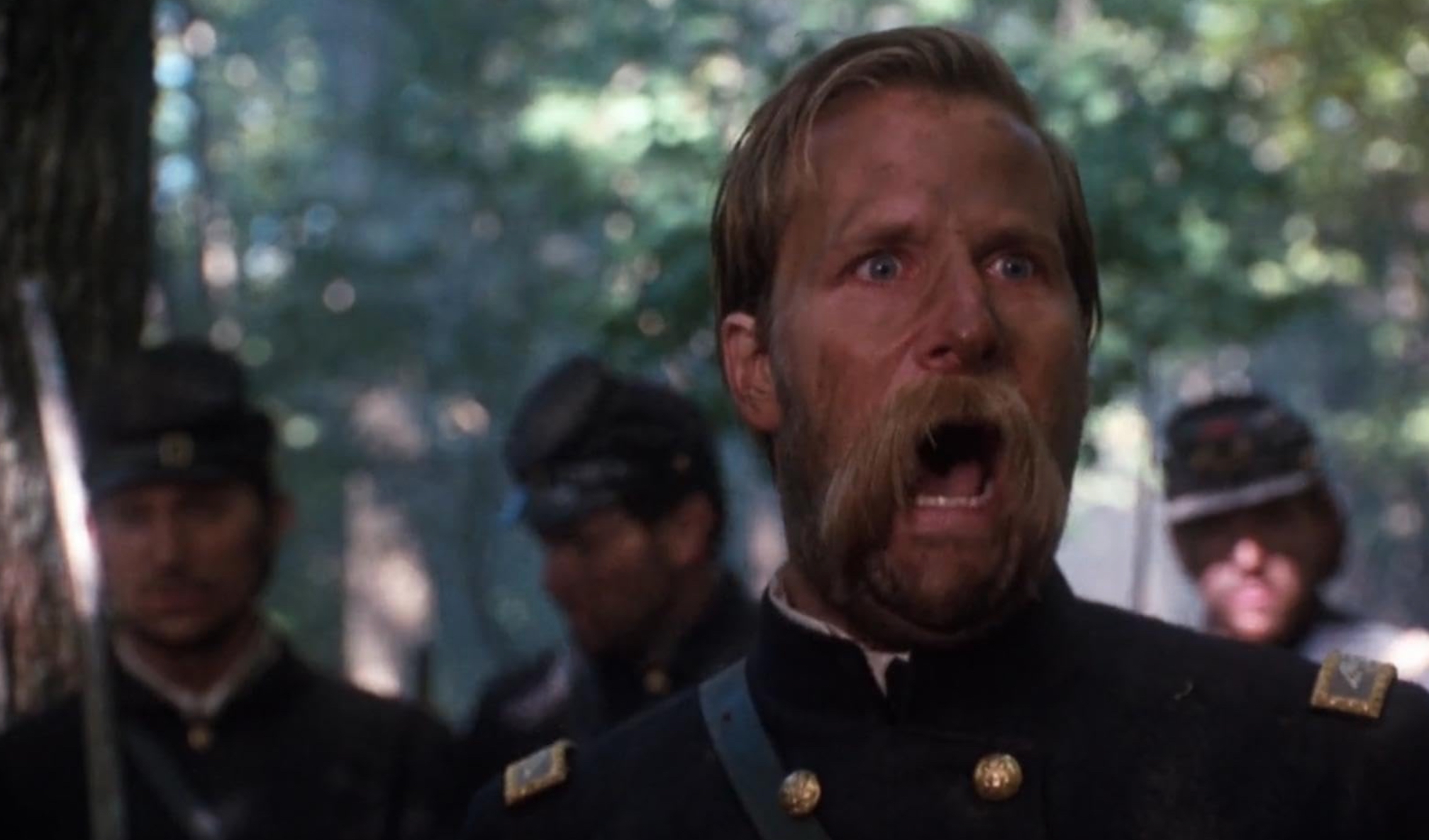
Garry Adelman: Indeed. And they showed some of the major maneuvers that way while teaching people about the Civil War at the same time, you know, that officers might plug a gap with their pistols and hand-carried weapons. You might see people searching through the cartridge boxes of the dead and wounded so that they would have enough bullets to continue the fight. And most namely, the idea of refusing or pulling back your line when a threat comes from a different direction, which happened during the battle—we know exactly where it happened during the battle, below Little Round Top—and sort of getting the viewer to understand how this happened. And then the fierce terror of the bayonet charge, which is something we also know happened. We know this because, when there’s enough accounts about something and both sides agree on it to some degree, you can state it with enough historical fact I think that it actually happened. So it not only was one of the most dramatic parts of the movie, but it told the battle of Little Round Top very well and Little Round Top has been, some say, loved to death as a result of that movie scene.
 IMDB
IMDBJeff Daniels as Joshua Lawrence Chamberlain orders the men of the 20th Maine to fix bayonets during the fight for Little Round Top as depicted in Gettysburg.
Terry Johnston: Right. Well, I’m sure it has. And speaking of other combat scenes, Pickett’s Charge, you alluded to earlier, maybe not the scale, obviously, that it was in real life, but they tried to really give you a sense of how big this thing was. How did they do in that regard, do you think?
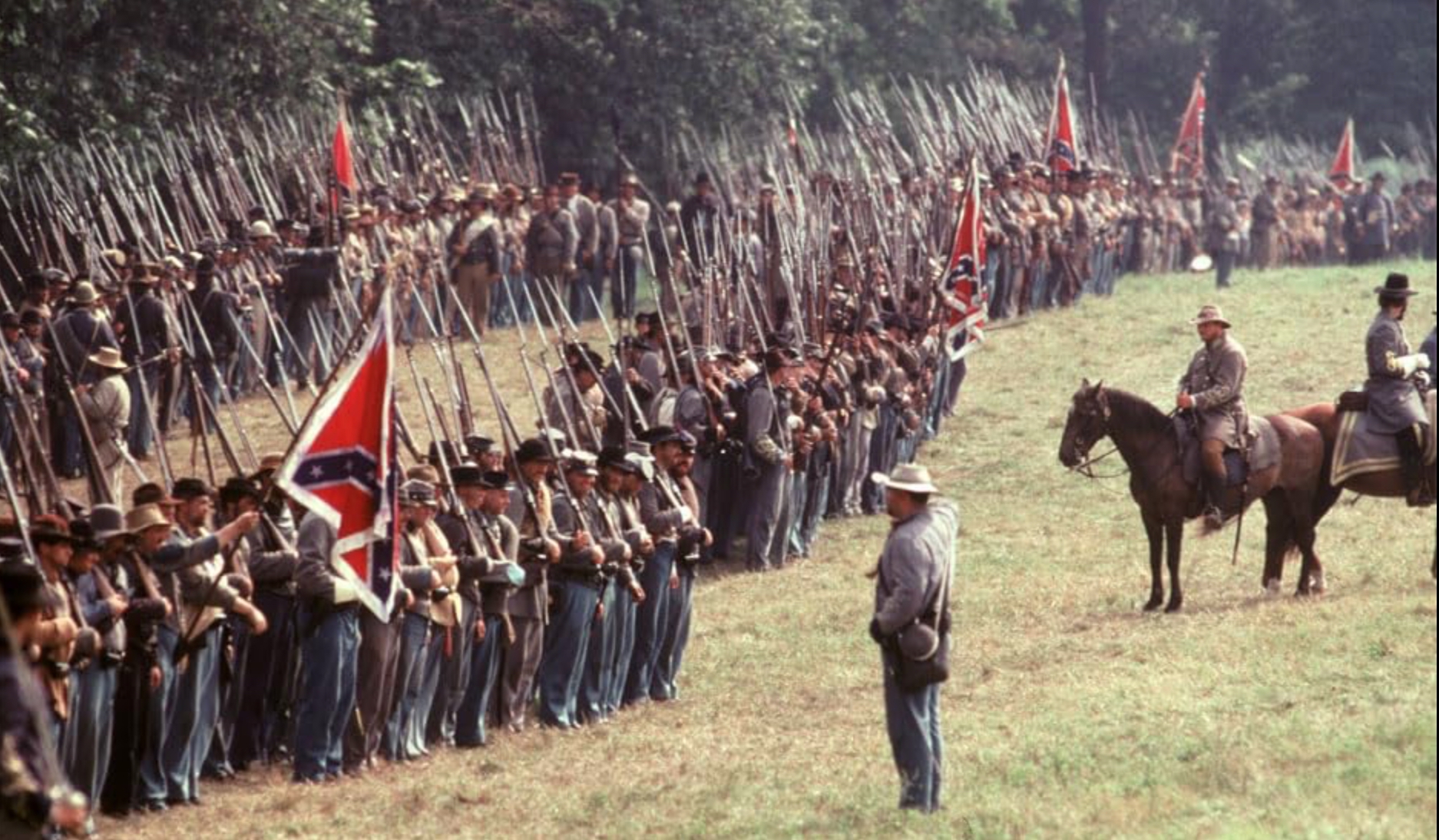
Garry Adelman: I think they did well. I remember I was in Gettysburg for Gettysburg 150 in 2013. And there was about 25,000, maybe more, people crossing the field at once. And I immediately realized, whether I was up high on the tallest monument on the battlefield, the Pennsylvania Memorial, at least the tallest one you can stand on, I couldn’t get a good view of everything even from there, let alone on the ground. It was said by soldiers to encapsulate your entire field of vision. So if there was about 12,500 in the actual charge and in the movie they had 3,000 or 4,000, it’s obviously, like you said, in terms of scale, it’s a little bit off, but I think it did a good job of presenting the grandeur of it. You could take issue—and I think they got the artillery bombardment very right. The set that they used for the Union position on Cemetery Ridge with the facade of buildings in a repositioned stone wall, I thought it looked very much like we know it to look today. And, you know, I could take issues with some of it, but I thought it did a great job teaching you what was happening while depicting what actually did happen.
Terry Johnston: Well, and an extra layer of authenticity was lent by the fact that some of this movie was actually filmed in Gettysburg, right? How did that happen?
Garry Adelman: It’s interesting, you know, the two things we’ve talked about, really, Little Round Top and Pickett’s Charge, like, those are two places where they actually filmed things where they happened, or at least where something happened during it. So, first of all, this was a different time, a time where the National Park Service was very interested in supporting this movie, thinking it might bring more people here and tell stories about humans instead of telling stories about 10,000 soldiers moved here, 2,000 soldiers moved there. So I think the Park Service was a very willing partner, but they did have rules and guardrails. Did the park allow them to cover up memorials and screen monuments and other modern features? Absolutely. Could Pickett’s Charge happen all the way across the field and all the way to the real Cemetery Ridge? No. Not only was that a non-starter for the filmmakers, because there’s a lot of monuments on Cemetery Ridge where Pickett’s Charge sort of climaxed. There’s a real idea of protecting the resource.
But whatever it was, Ron Maxwell was able to work closely with the park and they filmed in multiple locations on the park: at Devil’s Den, at Little Round Top, which they used for its bigger brother, Big Round Top, for the movie, and on part of the field of Pickett’s Charge, as well as even privately held sites like the Lutheran Theological Seminary, which depicted things that actually happened, even if not owned by the federal government.
Terry Johnston: What about actual depictions? And again, this is tied in large part to Shaara’s novel and how he wrote these characters, but the actual command decisions as depicted in the movie, from Lee’s maybe overconfidence in his army’s abilities, therefore ordering Pickett’s Charge on the third day, to Longstreet’s portrayal as the reluctant subordinate. How did these and other depictions of actual command decisions strike you?
 IMDB
IMDBThe beginning of Pickett’s Charge as depicted in the movie Gettysburg.
Garry Adelman: Yeah. When you know enough about the battle and then you read The Killer Angels or see the movie, I think you come away knowing the combination of sources that Michael Shaara was using. Clearly he was reading John Pullen’s 20th Maine book. It’s about that unit that fought on Little Round Top, among many others. But you clearly see both the desire to get it right. Longstreet was reluctant to attack the way Lee wanted him to on July 2. Longstreet later expressed that he was a reluctant partner in Pickett’s Charge. But you also saw at the same time that the novelist, and it is a novel, was forced to invent conversations like any novelist would, unless you’re in the room with a tape recorder with all these people from the past.
So, for instance, we have very little information about what Robert E. Lee and Jeb Stuart, after he came back from “missing” or his long ride around the Union army, we don’t know what was said. I think people have inferred that Lee was unhappy and that Lee was not the type of guy to dwell on that, but it’s basically forced to be invented. Some of the soldiers who were there that wrote about it weren’t in the room. So what you see is a combination of historical truth, historical maybes, plus inventions, which would sort of go along with these characters in the story that Shaara was writing.
Terry Johnston: Before we move on to what the movie didn’t do so well, anything else on the positive side of the ledger you want to mention?
Garry Adelman: Yeah, I mean, what’s interesting is that, you know, the more you’re interested in the Civil War, it seems that you want to tear down Civil War things. I’m not talking about monuments, I mean products, whether it be a video or a Facebook post, or a major motion picture, or a book. It seems that the pull is very intense for you to demonstrate your knowledge, for one, to demonstrate his or her knowledge in order to say why something is wrong, okay? I’ve never looked at it this way. I tend to be happy with what I’m given in terms of historical movies. They are some of the most popular movies of all time. So when I see Gettysburg, when I see Napoleon, when I see Titanic, I see them for what they are. And this is cinematic depictions of something rather than eager to jump on the bandwagon and destroy that particular product. And that’s not new. I’ve always liked Abraham Lincoln: Vampire Hunter. I mean, it’s not exactly historically accurate as far as we know. But if it moves people, if it gets people interested, I would much rather undo the historical mess later, because that’s much easier than creating the spark in the first place. So that’s a disclaimer I wanted to make, that I tend to be pretty easy to please, even with a movie like Sahara with a monitor ship in the desert. I’m okay with all that stuff as long as, you know, if it drives people there and it’s not illegal, I’m probably going to be okay with it.
Terry Johnston: That’s an interesting take and it reminds me of something you alluded to earlier, about how the movie Gettysburg and Ken Burns’ Civil War documentary, really, I mean, those came out, I think Ken Burns’ work came out in 1990, Gettysburg comes out in ’93, and that was on the tail of Glory, another wonderful Civil War movie that came out in ’89. So within those four years, you’ve got all kinds of Civil War goodness happening out there. And it really drove big interest in the American Civil War through the nineties.
Garry Adelman: Yeah, no, and I’ll go straight from this into some of the issues with the movie, but what I’ll say is it’s no surprise that the modern battlefield preservation movement was born around that time, ’87, ’88, ’91, maybe what some people call the reenactor heyday, although some reenactors today would dispute that suggestion that the heyday was in the early ’90s or something like that. But it was definitely a confluence around the 125th anniversary and all these media products that simply reach so many more people than books. So, I mean, it’s another reason to take movies and mass media seriously, because you can write your book all you’d like that 1,100 people might read or 5,000 people might read, but for a movie or a documentary that is going to reach millions, in the case of Ken Burns, 40 million. And in the case of Gettysburg, it’s more popular now than it was in the ‘90s, so Ron Maxwell tells me, because of streaming TV. So, I mean, we have to take these things seriously and I think go with the flow rather than pushing against them.
That doesn’t mean, however, that we can’t and shouldn’t point out things that are wrong. I would say the things from the movie on battlefield tours that I find myself sort of fixing the most is one, the size of the battle of the first day. Gettysburg consists of three days of fighting and the first day saw some 17,000 casualties inflicted by some 49,000 soldiers. It’s in the top five costliest days of the entire Civil War. It is a huge battle, only small compared to the next day. So I find myself wanting to tell people, and I do, that the cavalry action mostly depicted on the first day in the movie, it does nothing to talk about the two-mile-wide Confederate line encircling the Union army and outflanking them and driving them through the town. It’s just not depicted in the novel and it’s therefore not depicted in the movie. But people are blown away when they realize that this first day fight is the real deal.
Terry Johnston: Yeah. Alright, well, what else? Other aspects that…
Garry Adelman: Yeah. Right away I find, you know, I think on a good two-hour tour, a good guide will only reference a handful of names and sometimes I don’t even reference first names, because in two hours you’re packing a lot in, you don’t want to confuse people. But people are absolutely blown away when I start talking about general this and general that because they think there are maybe five or seven generals in the battle, not 120. You know, the movie necessarily focuses on, if I’m correct, five generals, a colonel, and a British observer more than anybody else. And they have no idea that there are all these other generals. In fact, a lot of people come away from it thinking that Joshua Chamberlain basically commands the entire Union army. And I’ve met a lot of these people who convinced themselves of it, even though General Meade, who commands the Union army, is in the movie.
Again, my two biggest issues that I’ve brought up that I find the need to correct are inherent in that the movie’s based on a novel and a novel cannot tell the story of 120 generals, let alone 500 colonels. So those are definitely the two things I find myself talking about the most. I would also address sometimes, you know, the age of the reenactor s that they used in the movie, and the movie could not have been made without all of these passionate people basically giving of their time in order to help with this movie. People just don’t know that most Civil War soldiers are neither kids nor old men, in fact, that they’re 21, 23, 24. So I find myself pushing back against that too.
 IMDB
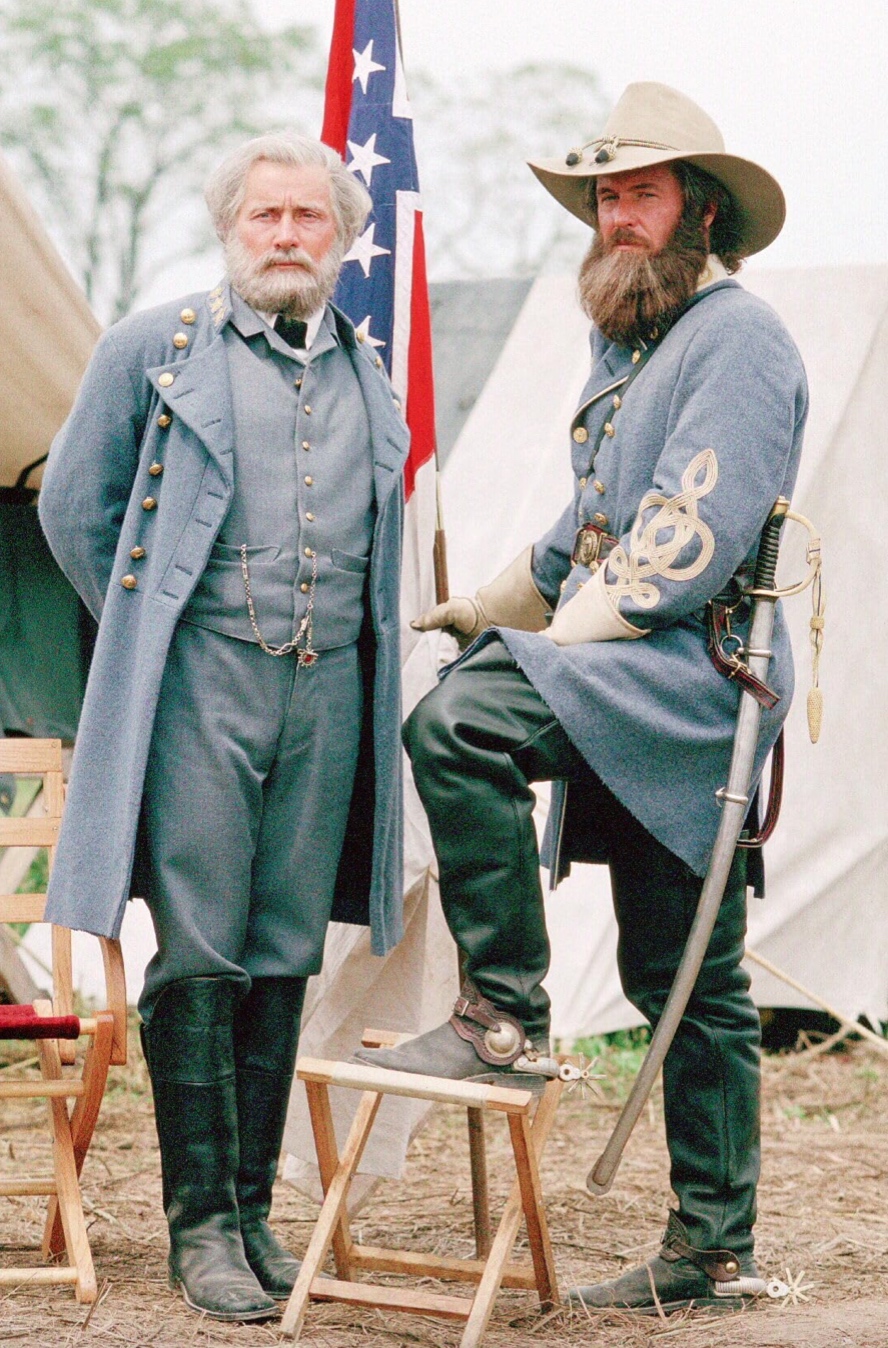
IMDBMartin Sheen as Robert E. Lee (left) and Tom Berenger James Longstreet in Gettysburg.
Terry Johnston: Yeah, the age of the reenactors does seem to be something that comes up quite a bit. I’ve also heard a lot of, I guess criticism, of Martin Sheen’s performance, not just the performance, but of his physical size. I mean, he was a much physically smaller man than the real Lee was. But what are you going to do about that, really? I mean…
Garry Adelman: Yeah. If, I were to ever be a filmmaker, it would be interesting to be faced with this. What if I found the perfect actor, but they might not be the right age, the right size, the right eye color. What would my choice be? As a manager of people and things, I know what my choice would be, is use the tools you have. So General Hood in the movie was 50 years old, and he was 33. Yes, Martin Sheen has maybe a similar build but is not remotely as tall as Robert E. Lee was. And Lee, you know, Sheen had to learn that accent on the quick. It’s not like he knew about this role months in advance. So it makes me all the more impressed that he got it as close. But people certainly criticize that performance. I don’t. Namely, I’m trying to think whether they made Lee as the marble ideal or if they made him a human. And I thought Sheen’s approach to that was really good. In fact it’s hard for me to pick apart the actors really in this. I might pick apart Lewis Armistead’s affection to the degree that they did it with Winfield Scott Hancock and a few other things, but they’re really minor.
I thought the performances in the movie, I mean, they used real-deal actors, including you got a James Bond in there as well playing Confederate general Johnston Pettigrew. I mean, who can disagree with that? So I come away pretty happy with it. And I’ve watched that movie a lot. I’ve watched that movie literally dozens of times and it is not a short movie. And you know, that’s partly because I need to deal with the movie as a licensed guide, but also because I’ll just put it on once in a while and get re-inspired as to the Battle of Gettysburg. And then we make fun of other things, the things that Joshua Chamberlain finds it necessary to explain to the viewer. “We’re going to swing like a door.” I don’t think he would need to explain this with the professional soldiers under his command. So you make fun of the moviemaking even while you’re watching the movie.
Terry Johnston: Yeah. There’s another thing that Chamberlain does in that vein where it’s either Chamberlain or his sergeant explaining how troops are probably ramming down multiple minie balls without firing and it’s going to foul the rifles. I think that they as officers or even noncoms would’ve known that already, that they wouldn’t have to explain it in the heat of battle on Little Round Top to each other.
Garry Adelman: Yeah, I think you could accuse a lot of the characters in the movie, including maybe John Buford, who was beloved, played by Sam Elliott, as the perfect cavalry commander for the North. You could even accuse him of doing some pontificating for the camera. But show me the historical movie, whether it be Titanic or I remember in The American President, or no, in the Lincoln movie, I mean, where Lincoln is explaining to his wife, “When we came into the White House three years ago,” I mean, she would know exactly when they came into the White House. He wouldn’t have needed to say that to the First Lady. But they’re saying it to us. And I think that people can take issue with the necessity of doing that or not. It’s not a problem for me.
Terry Johnston: Sure. What about the movie’s depiction of Harrison, the Confederate spy? That was a character that I appreciated, but was there such a person? And did he play as significant a role in gathering intelligence as the movie seems to imply he did?
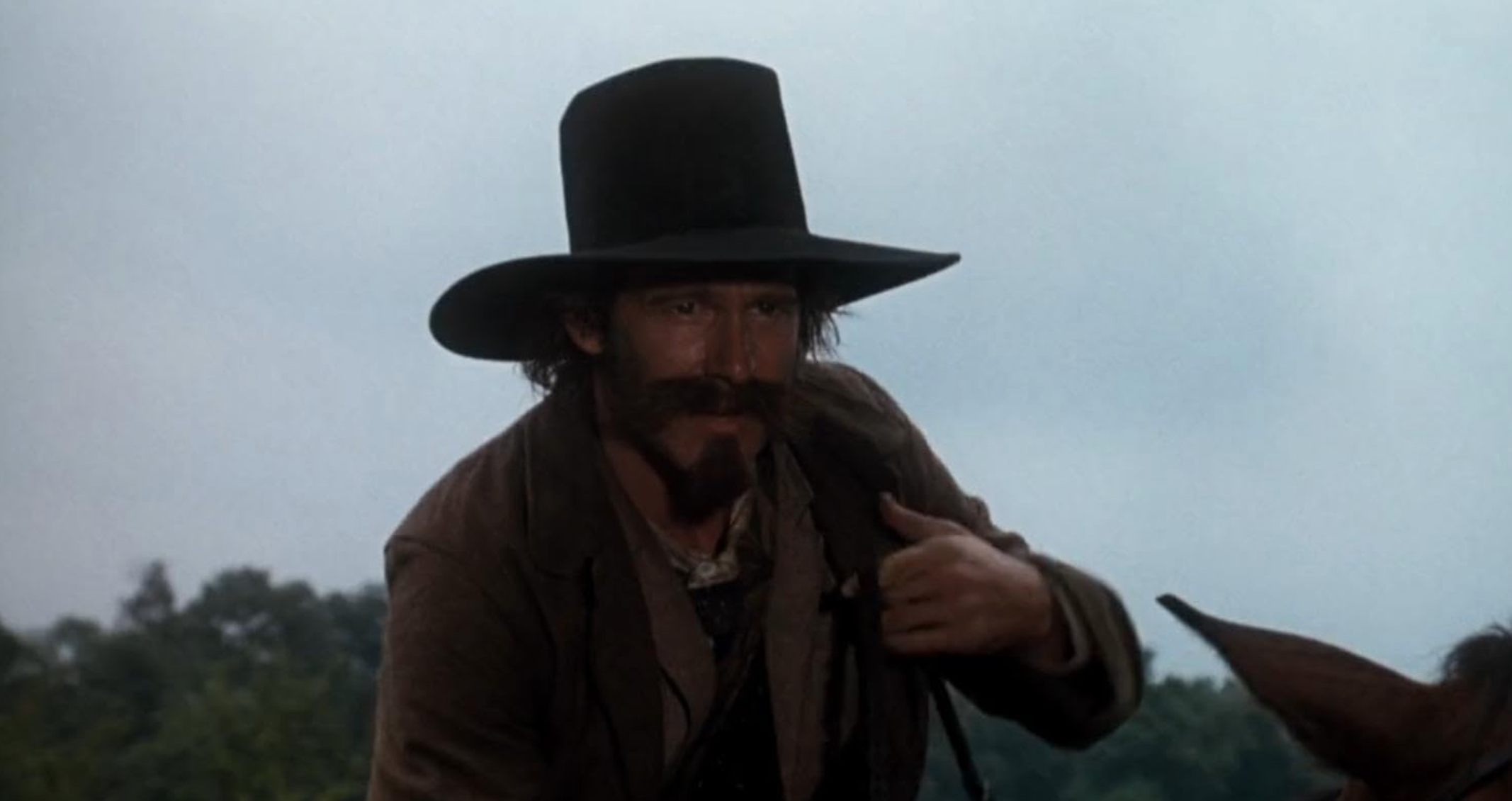
Garry Adelman: Yeah, so first of all, this is based on a real person, but then the nature of spy work is that we don’t know a lot about it. And if you do know something about it, you never know as much as you would like to about it. So yes, it does seem like there is somebody named Harrison and we think we know who that is. Did he enjoy Shakespeare? There’s sort of a loose connection that maybe he did. Was he a straight-up actor? Probably not, that we can tell. Did he provide intelligence to Lee’s army about the Union army being on the move? Yes. It seems like he did. Did he go on this special scouting for Longstreet? We know Longstreet sent some of his scouts. We know some of his subordinates sent picked Texas scouts and other people around. So there could be some amalgamation of character going on. But, you know, as some might say, I think it’s right enough. I mean, he certainly opens the movie. He’s a charming character played by Cooper Huckabee, if I’m correct. I spoke to him once and I know he really enjoyed the role and I thought he did really well with it.
 IMDB
IMDBCooper Huckabee as Harrison the Confederate spy in the movie Gettysburg.
Terry Johnston: Cooper Huckabee, who our hardcore Civil War movie and miniseries buffs will recognize as one of the actors in the old Blue & Gray miniseries from the mid-’80s.
Garry Adelman: Yes. And he shows up too in Gods and Generals, some of the director’s cut. He shows up, acting away like right on the stage, John Wilkes booth and things like that.
Terry Johnston: I haven’t seen the director’s cut of that. And that’s a whole other—don’t get people started on Gods and Generals as compared to Gettysburg. I don’t think it’s as beloved for a number of reasons.
Garry Adelman: No, there’s no doubt about it. And the director Ron Maxwell knows it. As he says, he’s had 20, 30 years of feedback on these movies. He knows exactly what people like and don’t like about them.
Terry Johnston: Well, getting back to Gettysburg, it strikes me that one of the things that the movie got wrong was how it treated the issue of race. It seems like we were avoiding the issue of slavery as a cause of the war. There’s that one scene where there’s a Confederate prisoner being talked to by Chamberlain’s brother. And Chamberlain can’t understand the accent of the southern prisoner, who’s saying he’s fighting for his “rats” and balks at the idea that slavery had anything to do with the war. There’s the James Longstreet quote around the campfire, I think on the night of the second day of the battle, that they should have freed the slaves and then fired on Fort Sumter. Again, dismissing slavery as a cause. And then one thing we don’t see really are the thousands of black men who served in non-combat roles at Gettysburg in both armies: cooks, teamsters, laborers, servants. And I guess one final thing that just popped into my head is that, and again, this is a different movie, I’m starting to go off on this, but we know in history that the Army of Northern Virginia, during its incursion into Pennsylvania, ended up seizing, I think it’s hundreds, maybe up to a thousand African Americans, many of them who were free. And they rounded them up and took them south into bondage. So anyhow, I don’t know what your thoughts are about the depiction of race in the movie, or lack thereof.
Garry Adelman: Yeah, I’ll just say that, you know, anybody who knows me probably has recognized that they underestimated my positivity and understanding, that that person you see on camera is actually real in my case. You know, I refused to join the chorus of people who, when this movie turned 25, when Ken Burns turned 30, who came out of the woodwork and thought they should have done better with this issue or that. I just never got onto that. When I look at the time when these things were put out, and what people were finding out about what race relations books were out there, how much the Lost Cause had been debunked. Really since the nineties is really when that has happened. When I went to Michigan State in my undergrad, I was taught that the main cause of the war was state’s rights. Now, I’d come to the conclusion that it wasn’t before the Gettysburg movie came out but, you know, it wasn’t evident to me. So I just can’t blame Michael Shaara in the seventies or the filmmaker in the early nineties for not doing what, later in life, people think they should have done. I take the same approach to the people of the past when it comes to the Civil War, that if only we were there to instruct them upon their morals or how to run their government or how to fight a war, then—then they would finally get it right. And the fact is that what we think people should have done in the Gettysburg movie now will change in 20 years from now again, and the people making those assessments and suggestions that this movie should have covered X or Y, by the way, who have no problem that it didn’t cover most of the generals, that it didn’t have any blood in it and things like that. Don’t have issues with that, but want to pick apart one little thing about it. They will not be looked upon so well in 20 or 30 years either. So I have a long view of these things and I just, you know, could hope for so many things the movie could have covered better militarily, socially, racially, but in the end, the movie is the book, and the book was a Pulitzer Prize winner that proved to be very popular. So as long as it’s not doing everlasting damage, I never found the desire to criticize it for its lacking.
Terry Johnston: Fair enough, fair enough. And I think you’ve just basically answered this question, but I was going to ask you too, if you thought there were any missed opportunities with the movie. And again, it gets back to what we said multiple times, that it is based on a novel. So if Maxwell is following that as a script, his hands are tied to a certain degree. But if we’re magic-wanding this and you could have seen some part of the battle depicted as well as we’ve already admitted they did with the fighting at Little Round Top and with elements of Pickett’s charge, what would it be? What would you like to see come to the screen?
Garry Adelman: If I could come up with two, how about the rest of the second day? They have Devil’s Den and Little Round Top, which are some of the least costly portions of the fighting. Dramatic, yes. Important, yes. But no Wheatfield? No Peach Orchard? No Trostle Farm? No Cemetery Ridge? The biggest attack at Gettysburg is not Pickett’s Charge, but is rather on the second day, Longstreet and elements of A.P. Hill’s troops as well. So I would say that, plus I would put General Meade on close to equal footing with Lee so that you get the lens of both commanders. Again, the book did not do this for either one, so I don’t blame it, but that’s what I would wave my magic wand for.
About the Guest
 Garry Adelman is the chief historian at the American Battlefield Trust, the vice president of the Center for Civil War Photography, and, since 1995, a Licensed Battlefield Guide at Gettysburg. He has written, co-authored, or edited over 75 books and articles about the American Civil War.
Additional Resources
- Michael Shaara, The Killer Angels
- John J. Pullen, The Twentieth Maine
Sponsored By