Historian Brian Matthew Jordan discusses how the need to care for Civil War veterans pushed American medicine into a new era.
Transcript
John Heckman: Brian, I’m so glad to have you here on the podcast to round out this series on the medical renaissance that is the American Civil War. Would you consider it a medical renaissance? That’s an interesting question to start with, but I’d like to go there.
Brian Matthew Jordan: First, thanks so much for having me, John. It’s a pleasure, as always, to be with you. Absolutely, I would say that the war was a medical renaissance, if only because of the scale of the conflict, the stunning range. And I tell folks that the Civil War did few things better or more creatively than wound and maim and injure. And the other side of that is that it created opportunities where medical professionals in a lot of nascent fields had to intervene and, in some cases, save lives, and in others, make life livable in the post-war.
John Heckman: A lot of your research challenges the idea that the Civil War ended at Appomattox, or in North Carolina, if we’re talking about that particular theater. For the men whose bodies you spent years studying in letters, diaries, and medical reports, what did the physical reality of coming home actually look like, and what did medicine leave these men carrying?
Brian Matthew Jordan: They came home with a staggering array of physical, psychological, and emotional wounds. And came home to a society that often didn’t have the diagnostic language that they needed to accurately or adequately address those injuries. For at least 45,000 men, Union veterans, that meant coming home without an arm or a leg. For others, it meant coming home with rheumatism, with other invisible injuries and afflictions. And in my work, when you go through pension files in the National Archives, you immediately get the sense of how the U.S. Pension Bureau is, in real time, trying to catalog and tally all of the various things that the war did to bodies. Because so many of these injuries are non-linear and are only manifesting themselves decades after the conflict, and soldiers are always attempting to, in this era before we have a real strong concept of war trauma, especially on the mental side or emotional side, trace the origins of their ailments. So, for so many of them, coming home, it means the daily assistance of a caregiver is now something that’s required. It means that they need a prosthetic appliance, that they need an artificial leg, that they need medical treatment that, in many cases, the federal government, through the red tape of the pension process, they’re not able to provide in a timely way. And that’s where a lot of civilian groups or even veterans’ groups like the GAR are going to step in to take care of these men in that way.
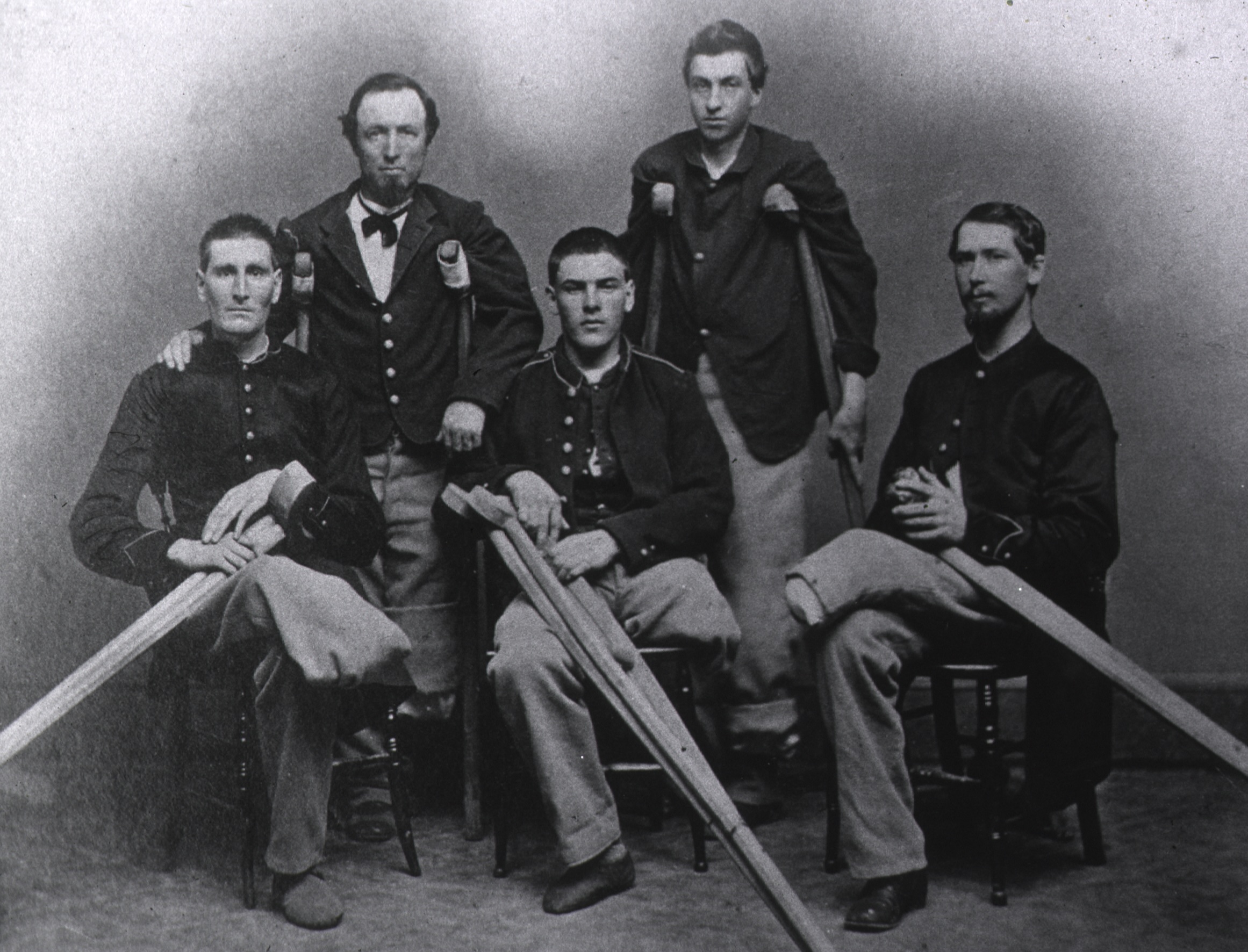 National Library of Medicine
Union veterans who had had legs amputated during the war are highlighted in this photo made at Armory Square Hospital in Washington, D.C.
John Heckman: The primary sources you’ve worked with over the years, especially concerning your book, Marching Home, which is a classic in my mind, were deeply personal documents of suffering. What did those sources reveal about how veterans themselves understood the medical treatment they may have received?
Brian Matthew Jordan: Yeah, they understood, John, I think very powerfully the relationship between what was happening physically and mentally with their bodies and the relationship between their bodies and minds and the war. They understood a lot of what modern scholars, I’m thinking here of KT Myers’ book, Nature’s Civil War, where she’s building this connection between the lived environment of war, the lived theater of war, and soldier health and morale. And they got that, right? They understood that. And they’re working through in real time trying to articulate that often to people, whether it’s civilians or medical professionals or pension bureau agents, exactly what their bodies went through and exactly those relationships. I’m thinking in particular of the regimental surgeon of the 10th Connecticut [Infantry]. His name is memorable for any Civil War students, Horace Porter, no relation to [Ulysses S.] Grant’s staff officer. But Horace Porter, in his work with veterans immediately after the war, he was noticing all sorts of symptoms and behaviors of what we would today call post-traumatic stress or combat stress reaction. And, at first, he’s just trying to catalog how common these reactions are among the men, but then he’s trying to label it, and he actually delivers an address—I remember just being floored in the archives when I discovered this—an address that he delivered to the Northern Kansas Medical Society, I think in the late 1870s or early 1880s. And he’s casting about for what do we call basically combat stress? And he comes up with this term that obviously didn’t catch on. He called it “neurokinesis.” But he was talking about, “What does battle do to the nerves and to the nervous system? It’s not just combat, but it’s all of these years that we spent anticipating battle and being anxious about going into battle that strung out our nervous systems.” And his argument was that Civil War veterans were not living long lives or they were having all sorts of nervous issues later on in their life because of the effects of battle and combat stress on their nervous systems. He called this neurokinesis. You can imagine it’s not just what they experience, what they go through. It’s not just this gulf of understanding, but it’s casting about for language and diagnostic terms that people don’t have ready access to in the late-19th century.
John Heckman: You’ve described illness, poverty, and suicide as “endemic badges of service” for veterans. When you look at those three things together as kind of interconnected outcomes of the same medical treatment or social abandonment, what argument does that make about what this medical renaissance actually delivered to these soldiers?
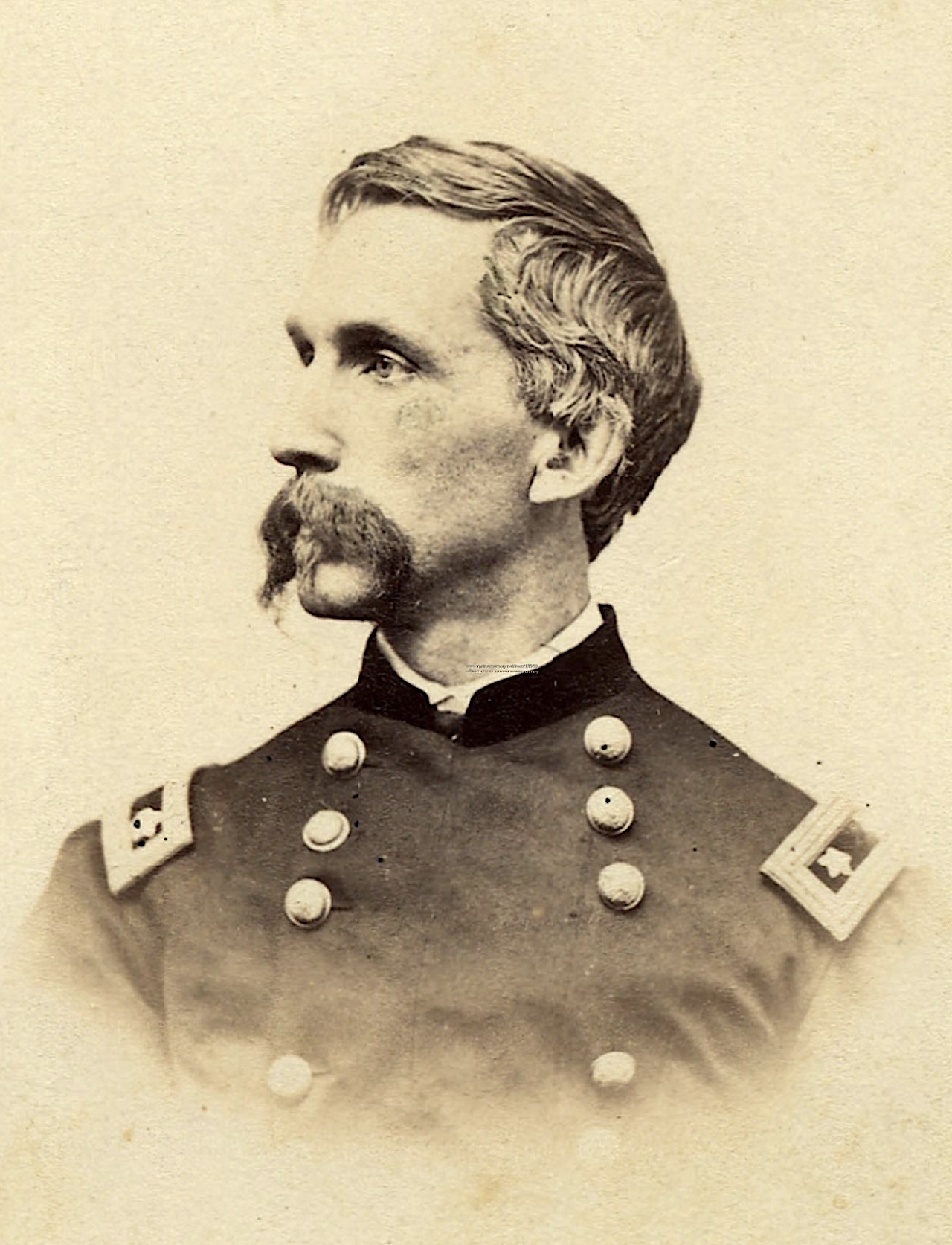 Brewer Public Library
Joshua Lawrence Chamberlain
Brian Matthew Jordan: I think it’s veterans’ homecoming and reintegration, demobilization, combat stress, all of these things manifest themselves in a stunning range of ways, and it’s often individual. It’s based in large part on the soldier’s biography, who they were before the war, the community that they came from, the support network that they had, caregivers that were available to them, socioeconomic class. All of these factors are so terribly important. There’s a range of responses, and some veterans are able to come back home and live civically engaged and meaningful lives. Others are able to do that, but bear the burden alone and out of the public’s sight. I’m thinking in particular here of someone like Joshua Lawrence Chamberlain. My friend Sarah Handley-Cousins has written powerfully about Chamberlain and the way that, you know, here’s a guy who’s a president of Bowdoin College, elected governor of Maine four times, delivers all of this stirring battlefield oratory, a paragon of masculinity in the late-19th century, and yet he goes home and in private he’s dealing with incontinence, with sexual impotency, with the effects of his wound, and she suggests that there’s this private side that didn’t manifest itself publicly.
But then for others, and I tally a lot of them in the pages of Marching Home, homecoming for whatever reason is not possible. Either that says something about their own kind of itinerary during the war, maybe the nature of their service, the reception that they got back home, again, family situations, socioeconomic classes. So, suicide does become a major response to the war, and there are powerful examples of this, both immediately after the conflict when you get a lot of men who place their discharge papers on their person as sort of surrogate suicide letters, and newspapers are reporting those details all the time. But then later on, too, anniversaries of battles or even drug overdoses. Jonathan Jones has done such great work on opium addiction, and we’ve got a lot of other work, too, on alcoholism. So, that’s something that I hope people have taken away from all of this, this renaissance in the medical historiography and in this moment where we’re getting a lot more work on the post-war and on veterans’ experiences, is that it really is an individual thing. Yes, they’re a part of this larger body, and they insert themselves into national conversations over the meaning and legacy of the war, and that’s important. But, ultimately, the way that they engage with the nature of their participation in the war and the meaning of their participation in the conflict’s violence, that’s something that happens at the individual level, and that, happily for us, we can trace through pension files and letters and diaries and manuscripts.
John Heckman: For you, what was it like reading these stories of men coming home and they’re not the same person, they’re not marching home to glory? We as historians like to push back against that familiar narrative that everyone went home, went back to the farm, went back to the factory, and then life goes on. We know that not to be the case, and it makes an uncomfortable conversation sometimes with people. What was it like to read those kinds of documents, and how would you say people should read those documents when they go to an archive?
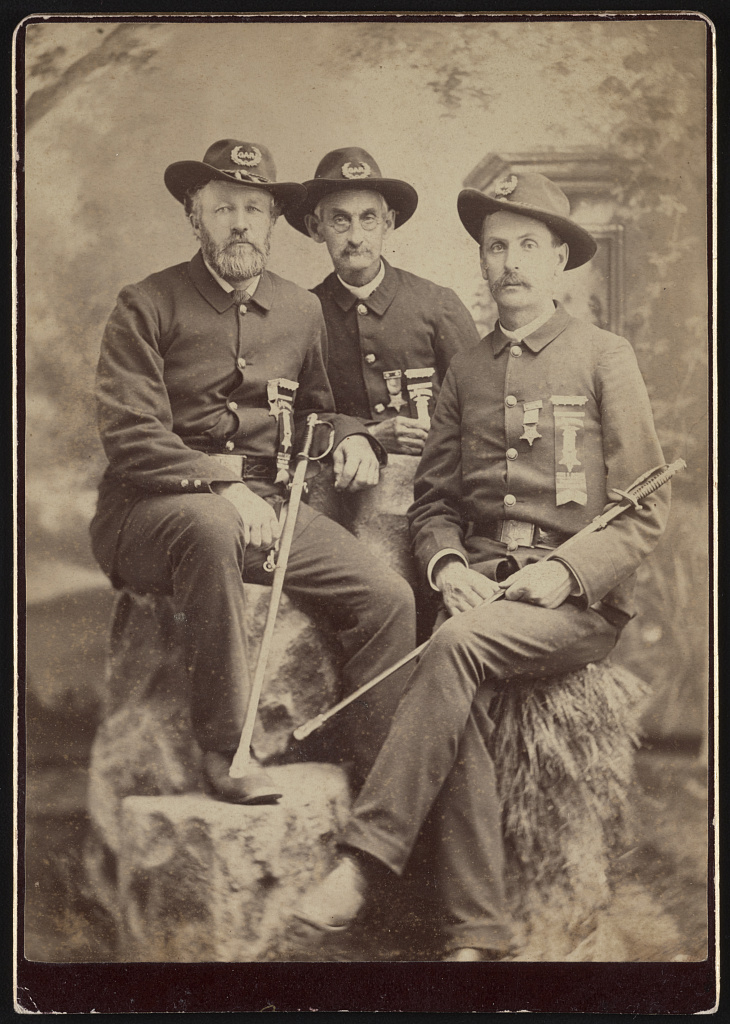 Library of Congress
Three unidentified Civil War veterans in Grand Army of the Republic uniforms in a photo from the late 1800s
Brian Matthew Jordan: What struck me when I was working on Marching Home is that, yeah, there’s a pathos obviously to veteranhood. There’s a sense of grief. There’s a sense of loss. Some of them are afflicted with survivor’s guilt. But there’s also just this sense that the single most important thing that they did in their lives happened on the battlefields of the Civil War, and it happened on the battlefields of the Civil War when they’re 18, 19, and 20 years old. And they come home and it’s like separating from the unit is like separating from the family. It’s like giving away a part of their identity. And it’s grieving for the loss of the unit, but it’s also this sense that they’ll never again in the rest of their lives do something so important. And that to me is a really fascinating aspect of war trauma. It’s not just that it’s the nightmares or the cold sweats or the memories of the Bloody Angle or the Wheatfield, but it’s also the fact that they just thirst for the adrenaline rush. They confess that they never felt something so intense as what they felt on those battlefields, and dealing with that as a sense of loss, I think, is terribly important.
John Heckman: Your research addresses disease, alcoholism, drug abuse as direct consequences of wartime medical treatment, not just as some kind of personal failing. How do you argue for that distinction, and why has it taken so long for some historians to make it that clear, although we are seeing more historians embracing it?
Brian Matthew Jordan: Yeah, I would begin with that. I think there’s a lot of really great recent work. You mentioned Jonathan Jones. I would add Dylan Carroll, Diane Miller Sommerville. They’ve done a wonderful job. I think it’s taken us so long, one, I think you put your finger on it earlier. We have always wanted the Civil War to be a story of drums and bugles and glory and gleaming bayonets, and we have done a remarkable job tracking with great fidelity what Johnny Reb and Billy Yank did on the battlefields, but had precious little interest in—[we] never wanted the story to have an unhappy ending. And for so many of these guys, it had an unhappy ending, or at least a less than uplifting one, even for those who were well-adjusted, right? That’s one of the things I hope people take away from Marching Home is that they’re living in the era of Reconstruction, and they’re left to wonder. If you’re a Union veteran, you’re left to wonder, “Did I really win the war after all? Did I sacrifice in vain? Did I suffer these injuries in vain?” Because they’re seeing not only the fragility of Union victory, but so many of the gains going backwards. And so many of these soldiers write that political context was as devastating as any of the combat stress or even the physical injuries that they suffered. Yeah, I think we’ve always wanted to hermetically seal the war off from the rest of the 19th century to suggest that it was this aberration, and we came back together, and we had sectional reunion, and all of the issues were resolved, and we gripped hands across the stone wall when, of course, for so many of these guys, that wasn’t possible.
John Heckman: A lot of these veterans had to advocate for psychiatric hospitals, even veterans’ homes, institutions that didn’t really exist in the form that they needed at that time. What does it mean that the men who needed those institutions not only had to fight the war, but they had to fight to get them as well?
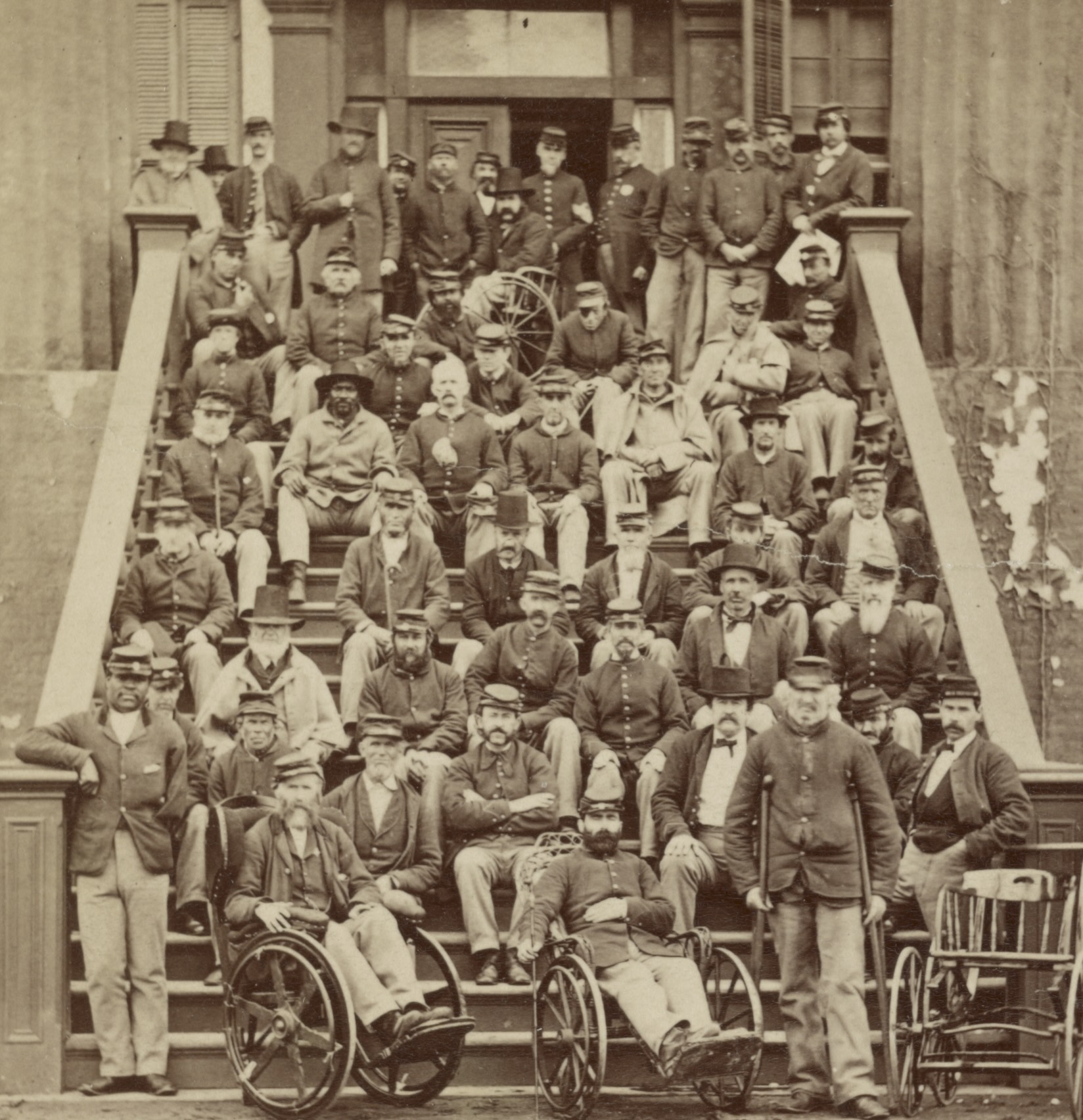 Library of Congress
Veterans gather outside the National Home for Disabled Volunteer Soldiers
Brian Matthew Jordan: So many of our histories regard the Grand Army of the Republic, the largest fraternal society for northern veterans, they regard the GAR as just a crass adjunct to the Republican Party. This was just a political lobby. What it was instead, I think, and I have argued in a lot of different places, was the first organization that was putting forth a real definition of what we would today call veterans’ rights. The idea that if you go off to war and you suffer in the name of the nation, there’s an obligation that the nation will take care of you, take care of your body, take care of your mind, your family, your widows, your orphans. And we owe that to the GAR. They are the ones who are advocating at the state, local, national level for veterans’ homes, for what we call the National Home for Disabled Volunteer Soldiers initially had four campuses, later many more. They are lobbying for hiring preferences, for pension benefits, for the government to pay fixed rates for prosthetic appliances, travel to medical examinations, the gradual liberalization of the pension laws that by 1890 basically provides an old-age retirement pension for every honorably discharged Union veteran.
That’s an aspect, right? Union veterans, I argue in a lot of ways, for them Appomattox was only halftime, that they believed that the work was yet unfinished, both in terms of ensuring that Civil War amendments were going to be secure, ensuring that their former comrades were going to have access to the ballot. But it also was not over in the sense that they really wanted to make the argument, and they had the range of injuries and the number of folks to make this claim so eloquently and compellingly with their own bodies, that the nation owes something to its veterans. And you can trace that all the way till this very day. It’s a strikingly novel for the late 19th century, but also modern definition of veterans’ rights, and we owe it to the men of the GAR.
John Heckman: What would you say about the men who basically had to use their bodies as evidence of wartime trauma to a pension system that wasn’t really keeping up with the times, or couldn’t keep up with the times because there were so many wounded men from this war? Talk about that bureaucratic system, because they’re not only fighting for those psychiatric hospitals and soldiers’ homes, they’re fighting the red tape of the bureaucratic system involved with the pensions.
Brian Matthew Jordan: Yeah. The critical thing that we have to remember is that there’s no Veterans Administration. There’s no cabinet-level Department of Veterans Affairs in the time of the Civil War era. We have only this nascent pension bureau, started during the war, that initially is doling out $8 per month to those who are missing limbs. And then the government discovers—and you can trace this by reading the pension files and looking at the kind of the growth and development of the government forms that are used—they have to figure out it’s more than just missing an arm or a leg, right? How do we make an equivalency between missing an arm and a leg, and say, being permanently disfigured? How do you pension for or account for the person who is blinded or deafened by the conflict? What is the equivalent to missing an arm or a leg?
And you see them walking through this—very awkwardly—walking through this process, and they’re in conversation the entire time with veterans and veterans’ organizations who are advocating for these various classes of pensions. But it’s a very long and nonlinear struggle, because there are lots of bad actors that get mixed up in the process, shark pension attorneys that will come in and simply, quite frankly, try to fleece veterans, and often their widows, that charge exorbitant fees and then never file the paperwork. Veterans complain all the time, especially if you’re a rural veteran and it’s a long way to get to an examining doctor or physician, how do you do that, especially if you are an amputee or you are very sick? Those who are able to get to the examinations complain about their prying nature. They’re—and you can see this in pension files—they’re always making chatty asides about their, quote-unquote, “moral habits” and they’re really—the evidentiary standard that they have for doling out a pension is very high. A lot of these men, they need affidavits, sworn affidavits from regimental surgeons. In many cases, that regimental surgeon could’ve been killed, could’ve lost contact with the unit, could’ve moved, and they have no idea how to get that.
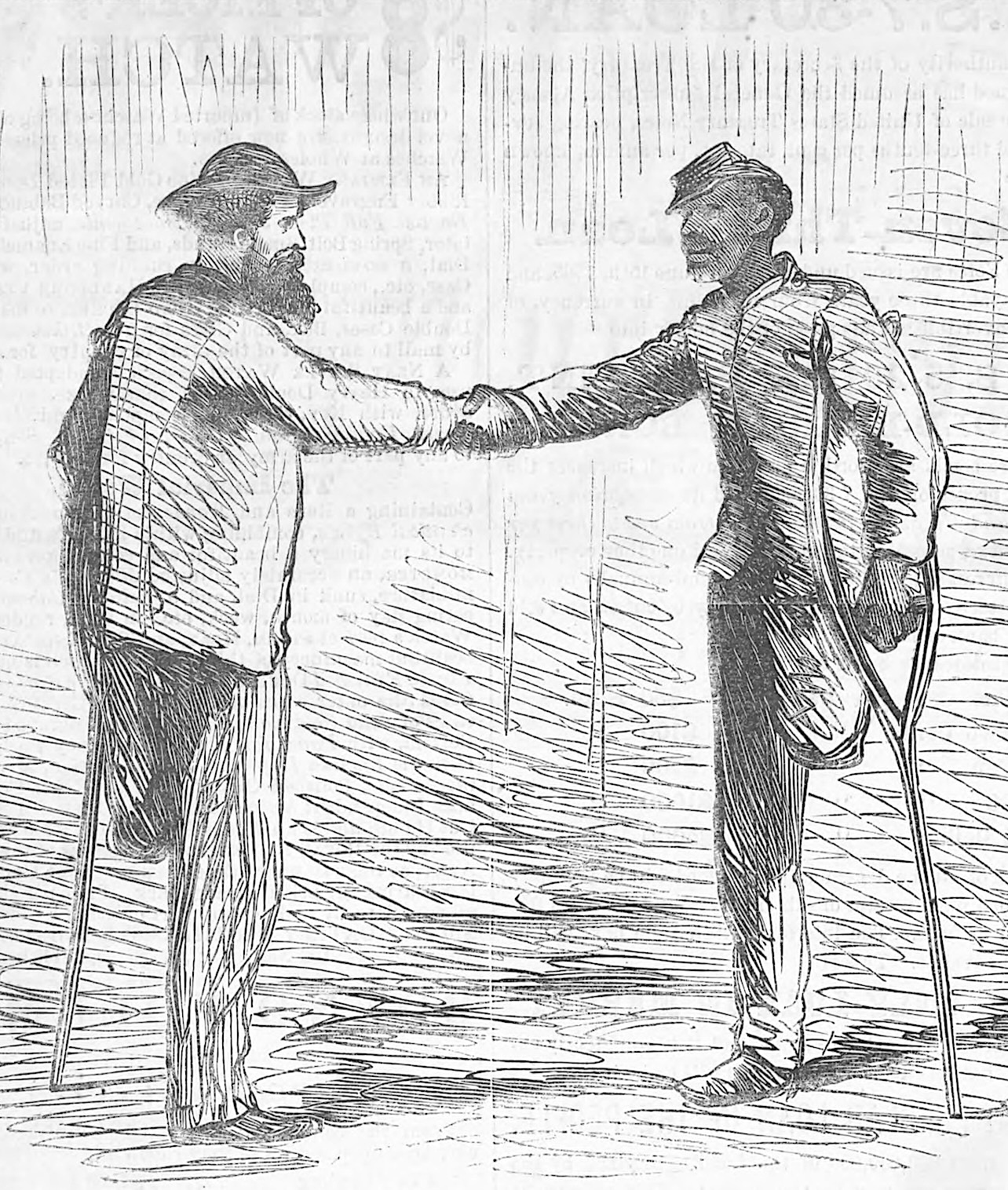 Harper's Weekly
In this April 22, 1865, illustration from Harper’s Weekly, a black and a white Union veteran—both amputees—greet each other after war’s end.
This is especially a problem for African American veterans. Think about it. They fight in federalized USCT units. For a lot of the white northern veterans, they come home and, yeah, their units in some sense never really demobilize. They’re living in the same towns and communities and counties as the guys that they fought with. But if you’re in a USCT unit or even something like the 54th Massachusetts, that’s men from Ohio and Illinois and Pennsylvania, and your former comrades that you now need testimony from in order to support your pension claim, it’s a struggle. You don’t know how necessarily to get in touch with that person. They’re working through all of these things, to say nothing about if you’re formerly enslaved, you likely don’t know your birthplace or your birth date, so you’re working through those challenges as well.
To say nothing of the politics of the whole situation. Civil War pensions become one of the hot-button political issues of Gilded Age America. It’s one of the things that, alongside economic policy and the tariff, distinguishes Democrats from Republicans. Democrats are virulent opponents of Civil War pensions. Grover Cleveland, who had hired a substitute during the war, makes it an unofficial pastime to veto individual pension legislation. So, it’s a real battle, ideological and otherwise. It challenges this kind of classical small R republican citizen-soldier idea that you should go off and fight your country’s battles and then return home and demand nothing. And GAR men are saying, “No, the extent of the injuries are such that it demands government intervention,” and there is a contract here, an implicit contract between the nation state and the individual veteran that is opened with enlistment and that should never expire.
John Heckman: The negative aspects of the pension system or a negative experience, someone being turned down and rejected, must have felt like a second wounding to a lot of these men. What have you found with them? What were they saying about their experiences, or in general, how were they feeling being a wounded individual, giving an arm or a leg literally for their country, and then having a denial of a claim?
Brian Matthew Jordan: Yeah. You can trace it by when you call up a pension file in the National Archives. Some of these things come out and they’re very thin, but others are very thick, hundreds of pages. And you can see the desperation in appeal after appeal. And even those who are successful then, you know, saying, “Look, I need an increase because of this,” or, “Now my rheumatism is so much worse,” or, “Now this injury has manifested that I didn’t realize.” And they literally make the case that, “I am evidence of what was done and suffered on behalf of the country, and therefore I’m entitled to this pension.” I’ll tell you, those who were most earnest about this and zealous on this point were ex-POWs. Those who had spent time in Andersonville and Millen and Libby, and we all know of the horrific conditions of men made to writhe in mud and human misery without access to food or clean water or medical care for very many months. And those who survived, they not only had the greatest challenges of reintegration, but then they had all of these psychological and even physical effects from captivity, and they appealed for a specific class of ex-POW pensions. And, believe it or not, what stung them the most is the fact that there were some GAR posts who petitioned to the Committee on Invalid Pensions and asked Congress not to grant an ex-POW pension.
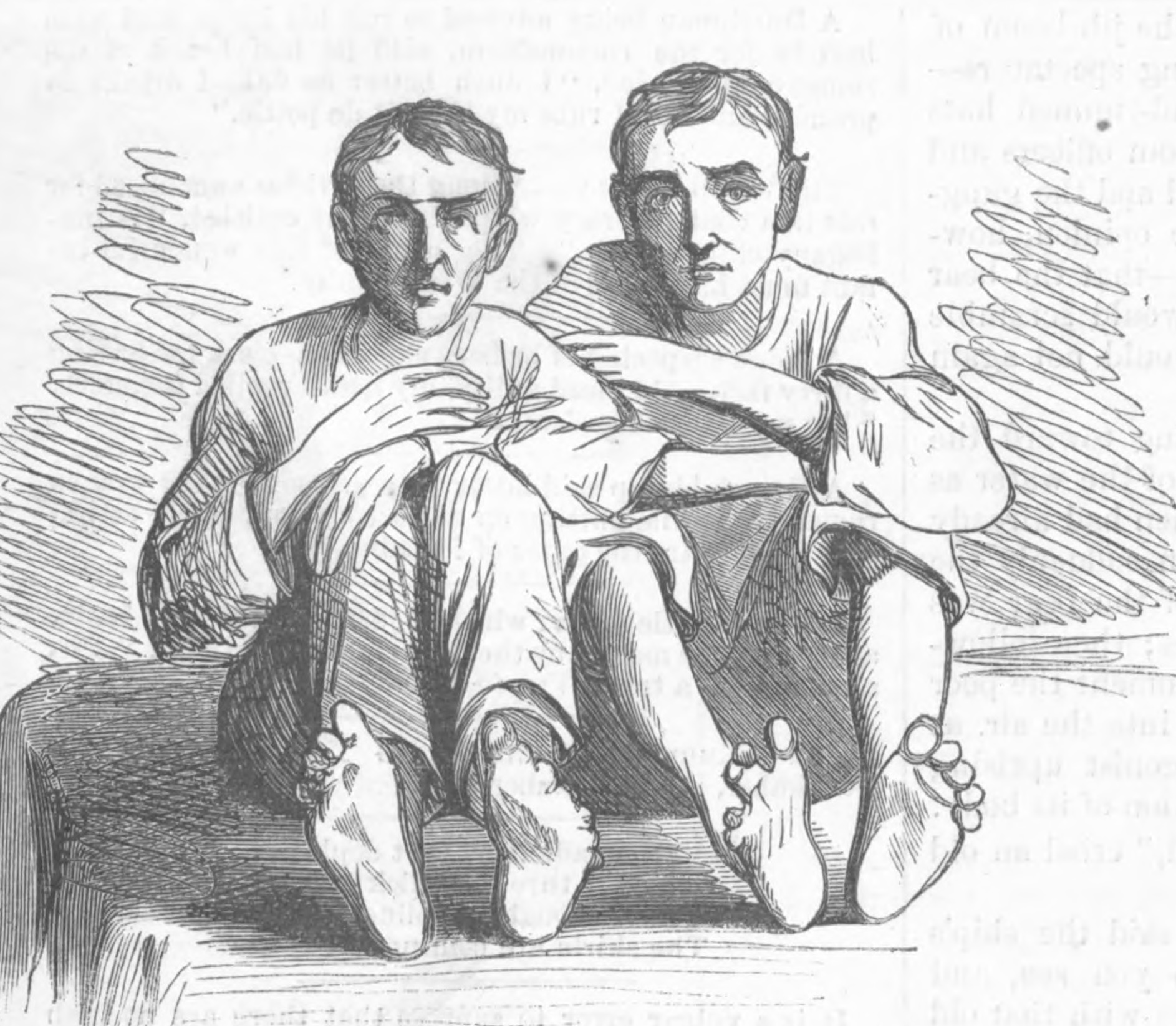 Harper's Weekly
This Harper’s Weekly illustration, based on a late-war photo, shows two recently released Union POWs, both of whom had lost toes due to exposure and one of whom “was bereft of his reason” as a result of his prison ordeal.
And they were so taken aback by this because, of course, the GAR becomes so famous for being a pension benefits lobby. And a lot of these GAR posts were saying, “Oh, no, we were…”—it kind of becomes a classic contest of suffering—“we were out fighting the hard battles. We were on the grinding Overland Campaign or suffering out in the sunbaked trenches of Petersburg, and you were just off at Andersonville.” Of course, completely unaware of what that scalding experience was like. And, in those who were appealing for the ex-POW pensions, the sense of betrayal from the members of the GAR who were advocating no ex-POW pension is really profound, and I think does a lot to explain why ex-POWs kind of formed their own guilds, their own survivors’ associations. That experience was so inimitable, so distinctive that even other veterans, it was an incommunicable experience for them. But yeah, you’re right, absolutely a second wounding, not only to have to say, “This is what my war was about,” but also that, “My injuries are real, that they testify authentically to what happened, and that I’m owed something by the nation for them.”
John Heckman: Do we get a picture of the longevity of Civil War medicine when we look at reunion photos, let’s say of the 1913 Gettysburg reunion, we have these men lined up and some of them are missing an arm or walking with crutches, etc.? Some of it could just be someone getting older, but some of these are actually Civil War wounds and how they are living with it. Should we look at those photos in that way as well, where we’re seeing how the medical treatment lasted over time? Because there are U.S. Army medical personnel there as well, keeping track of these men.
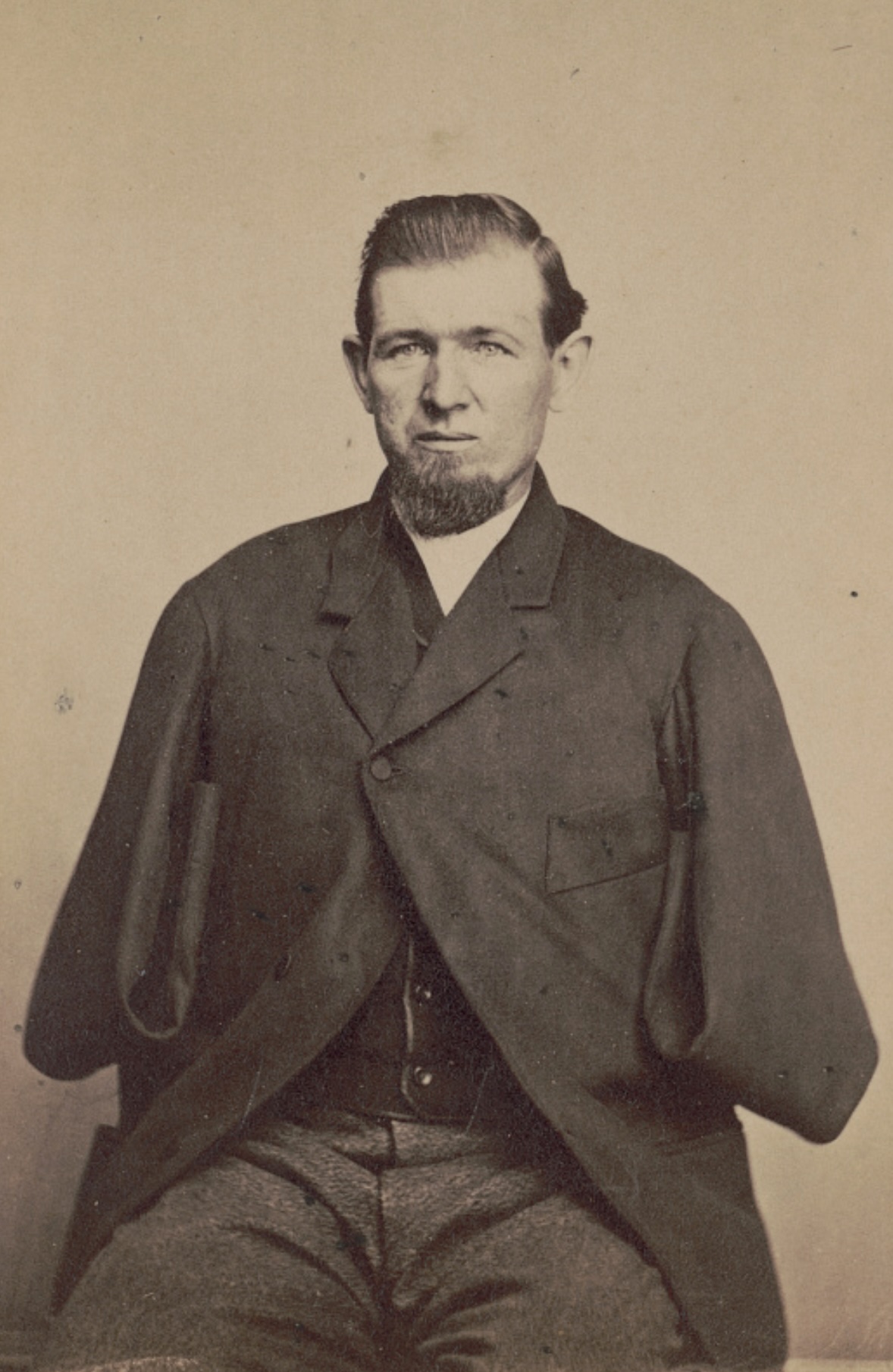 Library of Congress
Civil War veteran George Warner
Brian Matthew Jordan: Oh, absolutely. And there’s a, both 1913 and 1938 in Gettysburg, there is a whole active hospital tent and an ambulance corps that are out there tending to these men. 1938, I believe the average age of veterans is 94. They only lose one veteran, amazingly, during the event. But I think, and this I think is really interesting, I’ve written a lot, of course, about amputees, and I think contrary to what a lot of previous historians have said about them, there’s this idea that they were somehow emasculated by their injuries, this of course being drawn from the idea that virility and manhood were literally inscribed on the body in the 19th century, and therefore to have a dismembered body or a disabled body was to suggest or to note something about one’s capacity for manhood, about one’s virility. I think just the opposite is true in the case of Civil War amputees, because you look at photographs of Memorial Day parades, of monument dedications. I’m thinking about a double amputee named George Warner, who fought with the 20th Connecticut, and this guy gets asked to go around the country to dedicate veterans’ monuments, and he made a stage trick out of it. He would unfurl the flag that was draped over the about-to-be-dedicated monument, and he would pull the halyard with his teeth, because he doesn’t have his arms that he lost in battle. But Warner is an example of, alongside these other guys who are very prominent, very conspicuous—monument dedications, Memorial Days, battlefield reunions—I think they were intentionally conspicuous because they wanted to communicate to folks. They knew and understood how eloquently their wounds spoke about what they were willing to sacrifice, what they had suffered, what they continued to suffer. And so, I think you look at a lot of those photos, and it’s very deliberate on their part.
And so, yes, that tells us something about the longevity of that. I also can’t help but think about the longevity of—we, about a decade ago, had all of these debates about what was the actual body count of the Civil War? And J. David Hacker did this statistical analysis, this census-based count of the Civil War dead and said, “We missed the count by about 20%,” right? This number of 620,000 casualties that we had used forever, maybe it was as many as 752,000 or maybe even 800,000 dead. And I look at that and I say, “Yeah, that could be right,” but then you have to look at those who, again, are dying of directly battlefield-related wounds and injuries and diseases, but many years later. What do you do with somebody like Joshua Lawrence Chamberlain, who dies in 1914 as a result of the lead that was lodged in him on the Boydton Plank Road? He is a casualty of Petersburg who dies in 1914. I have dozens of examples in the book of veterans who are coughing up bullets in the 1870s or, you know, are dealing with lead poisoning from metal that was lodged in them or, again, just dying of diseases they had contracted in prison camps or in the squalid conditions that they were made to live in.
That longevity question, yes, it’s a testament to the practice and the care and the treatment of the professionalism of doctors, but we also shouldn’t get too triumphal in remembering that there are a lot of casualties that I think if we were to take all of the, this is just an educated guess, but to take direct battlefield-related injuries that consumed and took the lives of veterans after the war, we’d be looking at north of a million casualties. One government worker or government clerk actually attempted to calculate this after the war, and he estimated that in the 1870s, another 250,000 men died of battlefield-related wounds. And we don’t talk about those stories or at least we don’t want to or haven’t wanted to, and happily now we’re in this moment where we’re recovering a much longer Civil War era, not only socially and politically, but ideologically as well.
John Heckman: Did we not talk about it for a while, do you think, because we tend to like those clean breaks in history where it’s like, “Okay, the war is over, and we’re moving on to the next thing”? But the echoes of that, that enduring pain and trauma, is still lasting.
Brian Matthew Jordan: Absolutely. I think we love the romance of Wilmer McLean’s parlor. We love the perfectly dressed ranks at the Grand Review, to say that they came home and picked up the plow and went on to the next thing. But I was thinking about this, John, just very recently with the news that the last child of a Union veteran had passed. He was a centenarian. But there it is, the last child of a veteran in 2026, and you think about all of those widows’ pensions and orphans’ pensions that we’ve paid. We just now are able to close, in a bureaucratic sense, that chapter of this conflict. And then you think about things like—which Civil War historians have only begun to scratch the surface of—things like generational trauma, the way that wartime trauma was then communicated to children, and there’s a lot of fascinating work that has been done for other conflicts that we can now be thinking about in terms of Civil War studies. And I think it’s just such a massive and multifaceted and complex event that, it was predicted, right, that it would take generations for us to take stock of it, and I think that’s been borne out.
John Heckman: You’ve argued that the experiences of Civil War veterans have disturbing echoes in our contemporary time. When you look specifically at the medical dimension, the chronic pain, the addiction, the things that we’ve been discussing today, what is the most important thing in your mind that history can still tell us about that experience?
Brian Matthew Jordan: I think there are two sides to veterans’ reintegration, to veterans’ care. One is infrastructural and the other is intellectual. The infrastructural piece is where people always go, right? And for good reason. That now we have a Veterans Administration, we have a cabinet-level department, we have a VA medical system, we have lots of governmental services in place. And when people talk about the struggles of veterans, their access to medical care, their reintegration, the statistic that 23 military personnel commit suicide every day, that 49,000 veterans of Iraq and Afghanistan are homeless. They often point to that, because it’s the easy thing to do, to say, “We can put more funding at it, we can expand the VA hospital system, we can cut the red tape.” That’s often where we go. And where we have gone. Things like the GI Bill of Rights, the access to higher education, to VA home loans, even now things like veterans’ courts. It’s easy to go infrastructural.
The more difficult piece, and the one that I think that consistently, time and again throughout all of our conflicts, we struggle with is the intellectual piece. What does it mean to go off to war and to come back and to have to explain that? How do we as a nation provide a platform for our service men and women to tell their stories authentically? How do we as a nation provide a receptive and a respectful audience for them that acknowledges the truth of their experience, and that creates a space when they come home that they don’t come back to political rancor, but they come back to a place where they can talk openly about what it means to experience combat, and where they can maintain authority over the meaning and the narrative of their war? We don’t know how to do that, and we haven’t done a good job of that as a nation. So, I get frustrated when I think we should fund our VA hospitals and veterans’ medical care and provide them all of those resources, but that’s only one side of the equation. Don’t stop there. Continue to think about what it means, what it looks like to create and curate the cultural space as a nation where we can ensure that our servicemen and women can tell their stories and tell them authentically, and we can provide that receptive, respectful audience that they need and that they so often feel that they don’t have.
Certainly, that’s what Billy Yank was telling a lot of Americans, what Billy Yank waited impatiently for, the opportunity to tell his truth authentically. Instead, what people wanted in the romance of reunion was to remember a war that was profoundly not the war that he fought. I often think, what would our politics look like, what would our foreign policy look like if the wars that soldiers actually fought in our name are the ones that we talked about and remembered?
About the Guest
 Brian Matthew Jordan is chair of the history department at Sam Houston State University and author of Marching Home: Union Veterans and Their Unending Civil War (2015).
Additional Resources
-
- Kathryn Shively Meier, Nature’s Civil War: Common Soldiers and the Environment in 1862 Virginia (2015)
- Jonathan S. Jones, Opium Slavery: Civil War Veterans and America’s First Opioid Crisis (2025)
- Diane Miller Sommerville, Aberration of Mind: Suicide and Suffering in the Civil War–Era South (2018)
- J. David Hacker, “A Census-Based Count of the Civil War Dead” Civil War History Volume 57, Number 4 (December 2011)
Sponsored By