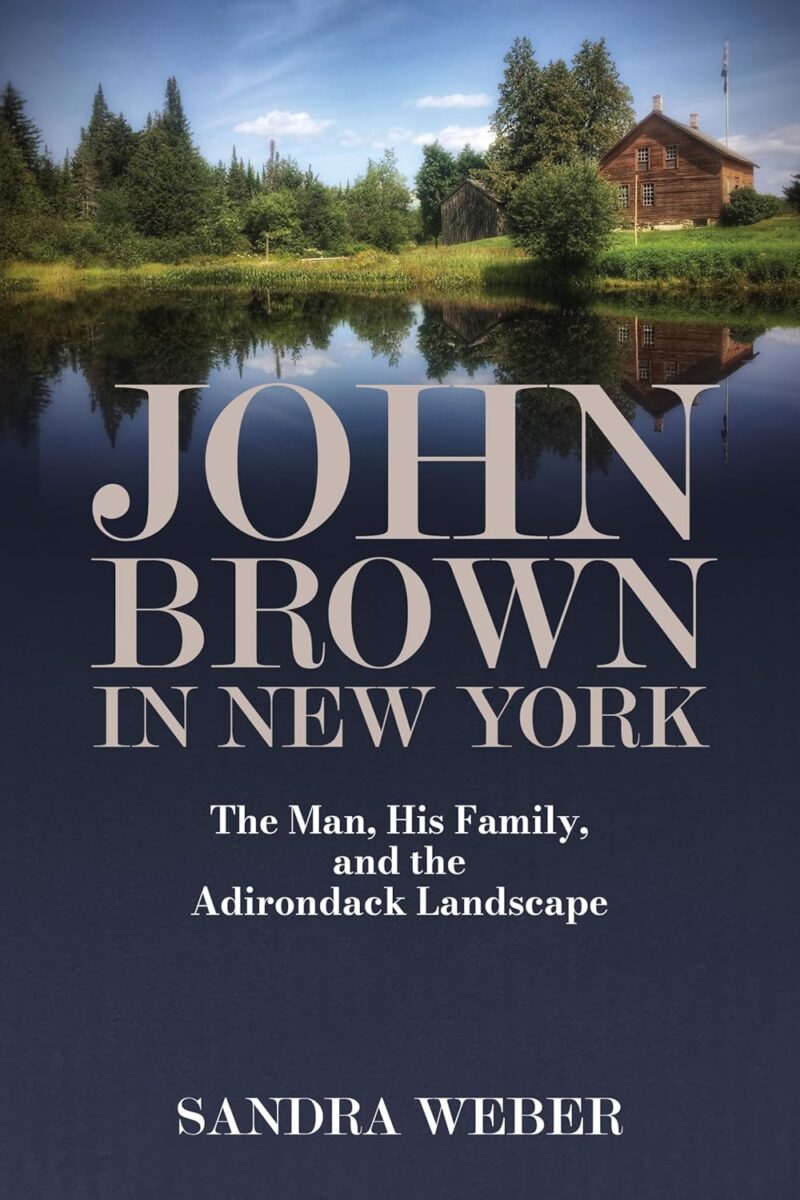
John Brown has invited no shortage of biographers since he was cut down from the Charles Town scaffold six weeks and five days following his failed Harpers Ferry raid. And yet, so much of the man remains inscrutable. The abolitionist confounds even the most careful students of United States history, forcing an uneasy confrontation with questions about courage, violence, justice, and treason. Sandra Weber, who has published widely on both history and hiking, supplies a “new perspective on John Brown’s inner self, moral fiber, and principles” by peering at “The Old Man” from the Adirondack Mountains. For more than a decade—“off and on from 1849 to 1863”—the John Brown family called the “wilds of northern New York” its home (5). It was on the hardscrabble farm that John Brown established at North Elba, Weber argues, that his ideas about slavery “intensified” and “took greater form and action” (7). It was on that farm, too, where the abolitionist’s body would eventually a-moulder in the grave, something that turned a “humble home” into a site of “national and international significance” (133).
Weber contends that previous historians and biographers have paid scant attention to Brown’s Essex County years, or else have relied on “bits and pieces of biased recollections, repeated myths, and misinterpretations” (6). Brown’s move to New York, Weber writes, was “a strategic decision to disengage from business ventures and dedicate himself wholeheartedly to his Godly mission of ending the sin of American slavery” (7).
He “came to assist” the free Black families who settled on “forty-acre plots” granted them by Gerrit Smith, the abolitionist who would later enlist in the bankrolling of Brown’s efforts as a member of the “Secret Six” (18, 96). As a “rugged frontiersman of uncompromising principle,” John Brown found a natural home in the shadow of the Adirondacks (98). Contrary to some previous scholarship, the Brown family became “kindred friends, allies, and schoolmates of the black families in North Elba” (36).
Weber narrates Brown’s story but keeps a well-trained eye on his family at home. This approach exposes how the family dealt with Brown’s absences during the days of Bleeding Kansas, with the ordeal of Harpers’ Ferry, and with the trial and execution that followed. In gripping detail, the author relates John Brown’s post-mortem journey back home. The abolitionist’s body became the object of some “ghoulish” proposals (even P.T. Barnum made a pitch for Brown’s remains to Virginia Governor Henry Wise!), but it was Mary Brown who ensured that none of them came to pass. Trekking to the Old Dominion, she retrieved her late husband’s corpse and escorted it on a winding journey home, where it would rest beneath an old stone marker on his beloved farm (134).
That marker became a site of pilgrimage, beginning with a gathering of abolitionists on the Fourth of July in 1860 and continuing for years thereafter. When the John Brown Farm was deeded to the State of New York in 1896, “a Civil War veteran donated a U.S. flag” to stand sentinel over the abolitionist’s grave (226). Weber misses an opportunity to trace more fully the history of John Brown’s grave as a site of memory. Given the narrative talents she puts on display in the book, one can only hope that a sequel might relate this no less fascinating history. As it did during the Civil War itself, “John Brown’s Body” promoted action into the twentieth century and beyond.
The “John Brown of North Elba,” the author concludes, “was a family patriarch, good Christian, common farmer, and helpful neighbor with extraordinary egalitarianism and moral virtues. He hated oppression, injustice, and slavery. He loved family, God, and country and was willing to sacrifice comfort, safety, and life to execute his duty and responsibility” (227). So it is that when it comes to Old Osawatomie, “the view from the Adirondack Mountains is the most remote, but perhaps the most revealing” (7). This is an excellent and engaging book that students of John Brown will want on their bookshelf.
Brian Matthew Jordan is Associate Professor of History at Sam Houston State University and the author or editor of six books on the Civil War and its era.