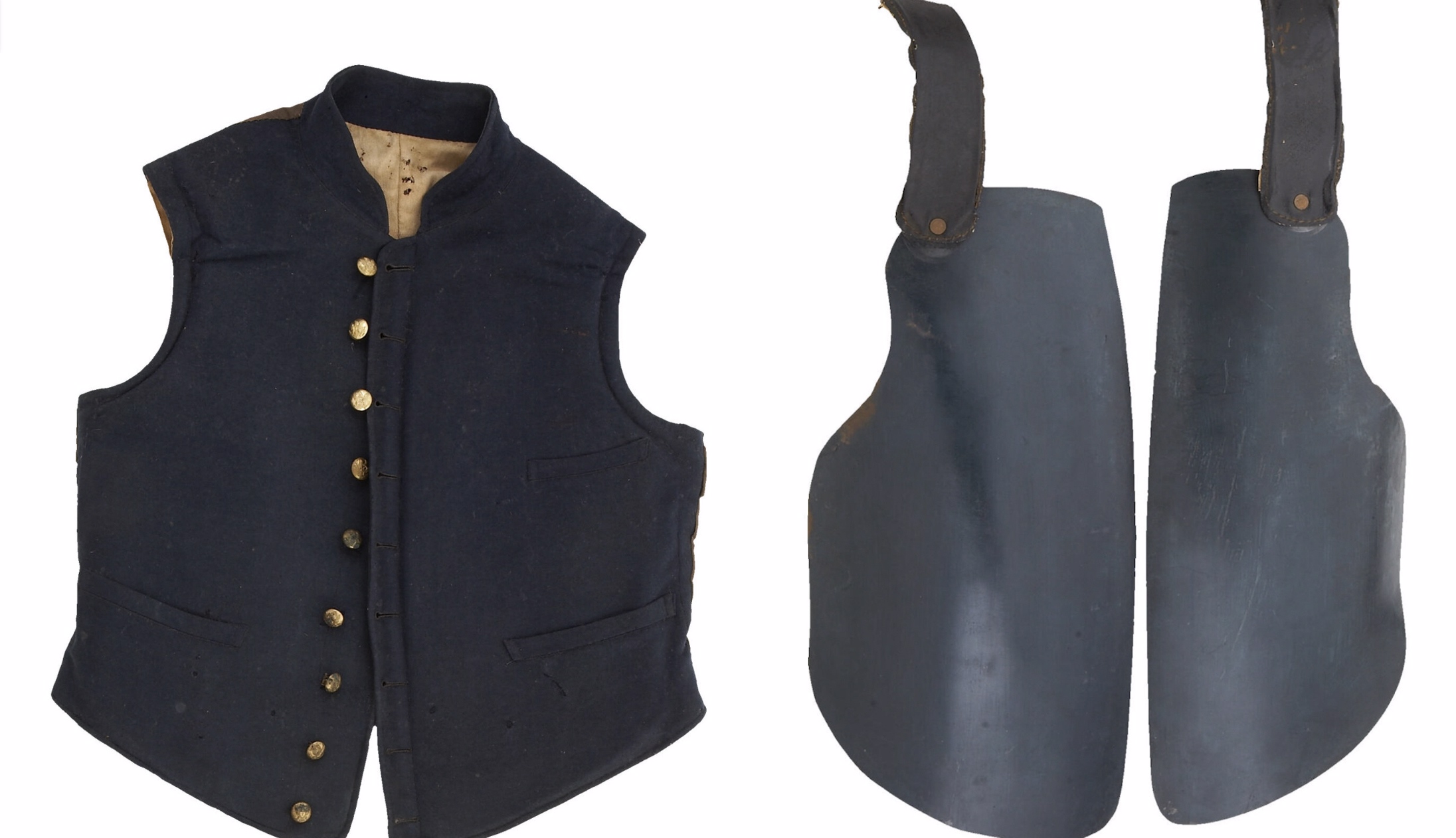
 Heritage Auctions (Ha.com)
A Union army surgeon was wearing this “bulletproof” vest when captured at the Battle of Shiloh. The thin steel plates at right fit into the vest at left.
Early in the Civil War, a number of manufacturers designed and sold personal body armor systems—what we today would consider bulletproof vests—for use by soldiers. While sound in theory, the products—which relied on thin steel plates to stop projectiles—largely failed to live up to their promises, both in comfort and, more importantly, effectiveness. By the war’s later years, such attempts at providing extra protection in battle had largely fallen out of favor with the troops.
The following articles reflect the optimism—and skepticism—that Americans at the time held for the concept of body armor. The first, taken from the December 27, 1862, issue of The Scientific American—a publication touted as “a weekly journal of practical information in art, science, mechanics, chemistry and manufactures”—highlights a view likely held by many forward-thinking Americans at the time:
It has been suggested to us, in view of the improvements which are daily carried out in iron-clad ships and batteries, that the same principle might be applied to their crews, or to infantry in the field. Some steps have already been made in this direction, and life-preserving vests have been sold, we believe, in great numbers; why, then, can we not sheath the human body so that it will be perfectly protected against rifle balls at least, and yet, at the same time, preserve its elasticity and activity unimpaired? The force of a bullet, stopped in mid career, would doubtless make the iron or steel-clad recipient wink, if it did not entirely destroy his center of gravity, but we think most of all our sharpshooters would gladly exchange the possibility of being stunned or even stricken senseless for a time, for the certainty of being killed outright without such protection. The ancient men-at-arms and Knight Templars wore suits of mail, but they weighed down both horse and rider and had to be abandoned. Let some ingenious person invent a complete personal protection, and he will assuredly reap his reward.
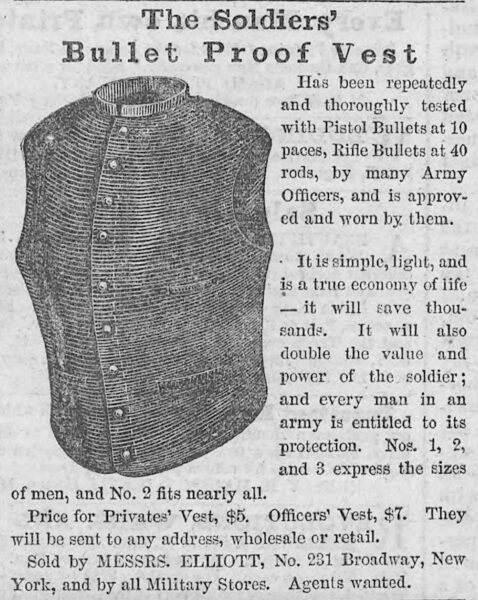 Harper's Weekly
This advertisement for a “Bullet-Proof Vest” appeared in the April 5, 1862, issue of Harper’s Weekly.
***
The next piece is from the April 5, 1862, issue of the New York publication Harper’s Weekly. Titled “Bullet-Proof Armor,” it echoes points made by the editors of The Scientific American—while also seeming to endorse a particular vest advertised in the same issue of the paper:
Why not mail men as well as ships? If a suit of iron makes wood invincible, why should not the same material make men invulnerable? If a man can buy for a reasonable price a light, bullet-proof armor, and, as it were, go about the battle-field in a casemate, why should he lose his life?
This is the question which is sought to be practically answered by the bullet-proof vest, of which Messrs. Elliott, at 292 Broadway, are the agents. It is light in weight and in price. The former is from three to five pounds, the latter is five dollars for a private and seven for an officer.
Whatever saves lives in war incalculably strengthens the force of the army. Here is a simple sheath which can be slipped within the waistcoat upon going into action. Think of it, soldiers, who wish to fight as long as the rebels do. Think of it, wives and mothers, who wish those soldiers to return.
***
Yet not everyone in the country was sold on the idea of bulletproof vests, if the following anecdote (first published in the New York Tribune, and reprinted in the April 8, 1862, issue of The Scientific American) about an exchange between Secretary of War Edwin Stanton and a “patriotic inventor” is true:
The special correspondent of the Tribune states that a patriotic inventor recently entered the office of Secretary Stanton, and proposed to sell the Government a patent armor, when the following dialogue ensued:—
SECRETARY—Has this been examined by a Board of officers?
PATRIOT—No.
SECRETARY—Then I propose a test it myself. Put it on, and I will have you shot at.
PATRIOT—Some part not protected might be hit.
SECRETARY—No danger of that, sir; get Colonel [Hiram] Berdan [of the 1st U.S. Sharpshooters] to shoot you; Colonel never misses, sir.
PATRIOT—nonplussed—I don’t consider that a fair test.
SECRETARY—I do; and I don’t think much of a man who declines a test that he is willing to subject my soldiers to. No, sir. You can’t sell patent-safety contrivances to this Department; but if you will bring an invention here which will push our armies on to the rebel forces, I will buy it. Good morning, sir.
Related topics: technology