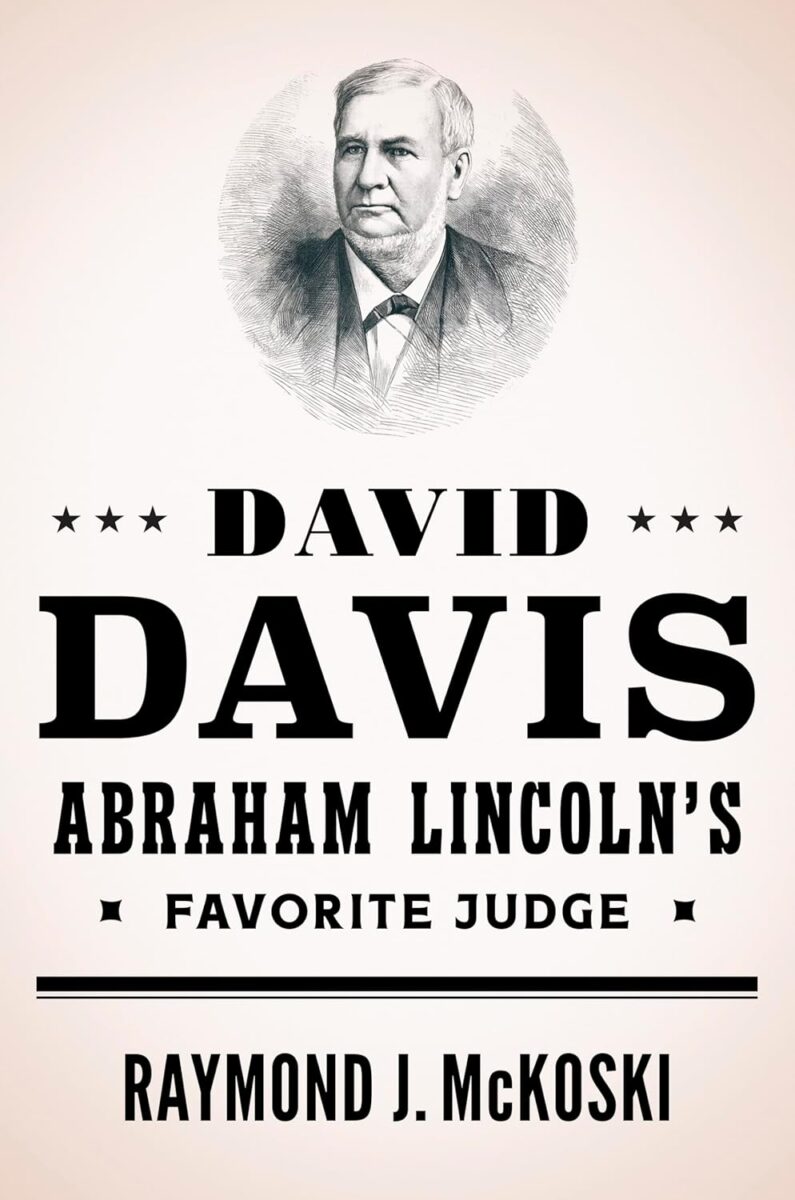
“The crucial contributions of Judge David Davis to both the executive and judicial branches of government,” argues Raymond J. McKoski, a retired Illinois Circuit Judge and adjunct professor at the University of Illinois Chicago School of Law, “have long been understudied and undervalued” (1). Davis is perhaps best known for his unwavering commitment to Abraham Lincoln and the role he played in winning Lincoln the nomination for president at the 1860 Republican National Convention in Chicago. McKoski agrees that this is a major part of Davis’s story; however, he also argues that Davis deserves more recognition for his contributions to the judicial system. McKoski does not offer a cradle-to-grave biography of Davis but focuses instead on “an unheralded country judge’s impact on the presidency and the judiciary” (3).
McKoski divides his book into four parts: “Davis, Lincoln, and the U.S. Senate”; “Davis, Lincoln, and the Presidency”; “Davis, Lincoln, and the U.S. Supreme Court”; and “Judge Davis: A Model of Judicial Impartiality.”
The story of Lincoln’s U.S. Senate campaigns are staples of the Lincoln literature and appear in most Lincoln biographies, albeit in varying levels of detail. David Davis did not manage either of Lincoln’s bids for the upper chamber, but McKoski notes that Davis expressed regret after the 1858 campaign for “failing to resign his judicial post and campaign full time for Lincoln and the Republican legislative candidates” (53).
Two years later, Davis managed Lincoln’s campaign team at the Republican National Convention in Chicago. Davis played his hand well, outfoxed wily political operatives like Thurlow Weed, and “successfully secured more delegates than the manager of any other candidate” (106). Davis also played an active role during the general election campaign. Critically, Davis did not manage Lincoln’s bid for the Republican nomination because he wanted a job. Rather, his powerful loyalty to Lincoln drove his actions. Still, once Lincoln won the election, it “opened the door a sliver for state trial court judge David Davis to attain the highest office in the legal profession: justice of the United States Supreme Court” (155). Leonard Swett, as a loyal a friend to Davis as Davis was to Lincoln, relentlessly pushed Davis’s candidacy forward. Ultimately, Lincoln appointed Davis to a seat on the nation’s highest bench.
Once on the court, Davis joined the majority on Prize Cases. He “played little public part” (178) in Ex parte Vallandigham—likely because he did not want to interfere with the U.S. war effort. Davis, along with Senator Lyman Trumbull and Congressman Isaac N. Arnold, encouraged Lincoln to rescind General Ambrose E. Burnside’s order suppressing the Chicago Times. McKoski illustrates how, here and elsewhere, Davis “employed extrajudicial means to help influence the resolution on a potentially explosive wartime court case” (183). Davis’s majority opinion in Ex parte Milligan produced anger and consternation among many Republicans, who compared his decision to Justice Taney’s in Dred Scott. McKoski presents Milligan (which ruled that the use of military tribunals to try civilians in states where civil courts are operating is unconstitutional) as evidence of Davis’s judicial impartiality. Historians have often asked what might have happened if Lincoln had lived, but they have rarely thought about Milligan. Would Davis have been able to write the same majority opinion if Lincoln, the man to whom he was so fervently loyal, had been president? This is an interesting, although unanswerable question.
Davis, McKoski concludes, “is entitled to serve as the standard bearer of the judiciary in the nineteenth, twentieth, and twenty-first centuries and beyond” (241). This is a tall claim. Some might note that Davis’s views on race do not make him emblematic of the modern judiciary and thus less fit to be a standard bearer. McKoski observes that Davis’s views on “slavery and race, as well as “other critical issues of the time deserve further investigation and analysis” (4). This is quite true. Davis’s racial attitudes, and how they may or may not have influenced his rulings, demand additional work. For example, when African American John S. Rock was admitted to practice before the U.S. Supreme Court, Davis complained in a letter to his brother-in-law, “Mr. Sumner is running his radicalism athwart every body’s prejudices. What object of swearing in the negro man, as an attorney of U.S. Supreme Court. He had no business there & never would” (222). On the other hand, Davis’s decision in Railroad Company v. Brown rejected the separate but equal doctrine. In contrast, Davis joined a 5-4 majority in the Slaughter-House Cases the same year. Davis was a complicated man. He is important to study and understand, but readers will have to come to their own conclusions about whether he should be considered the standard bearer of the judiciary.
McKoski’s interesting and informative biography reminds readers of David Davis’s importance and explores some of what the judge’s life can tell us about the tumultuous 19th century United States.
Evan C. Rothera is Assistant Professor of History and Director of Graduate Studies at Sam Houston State University.