Abraham Lincoln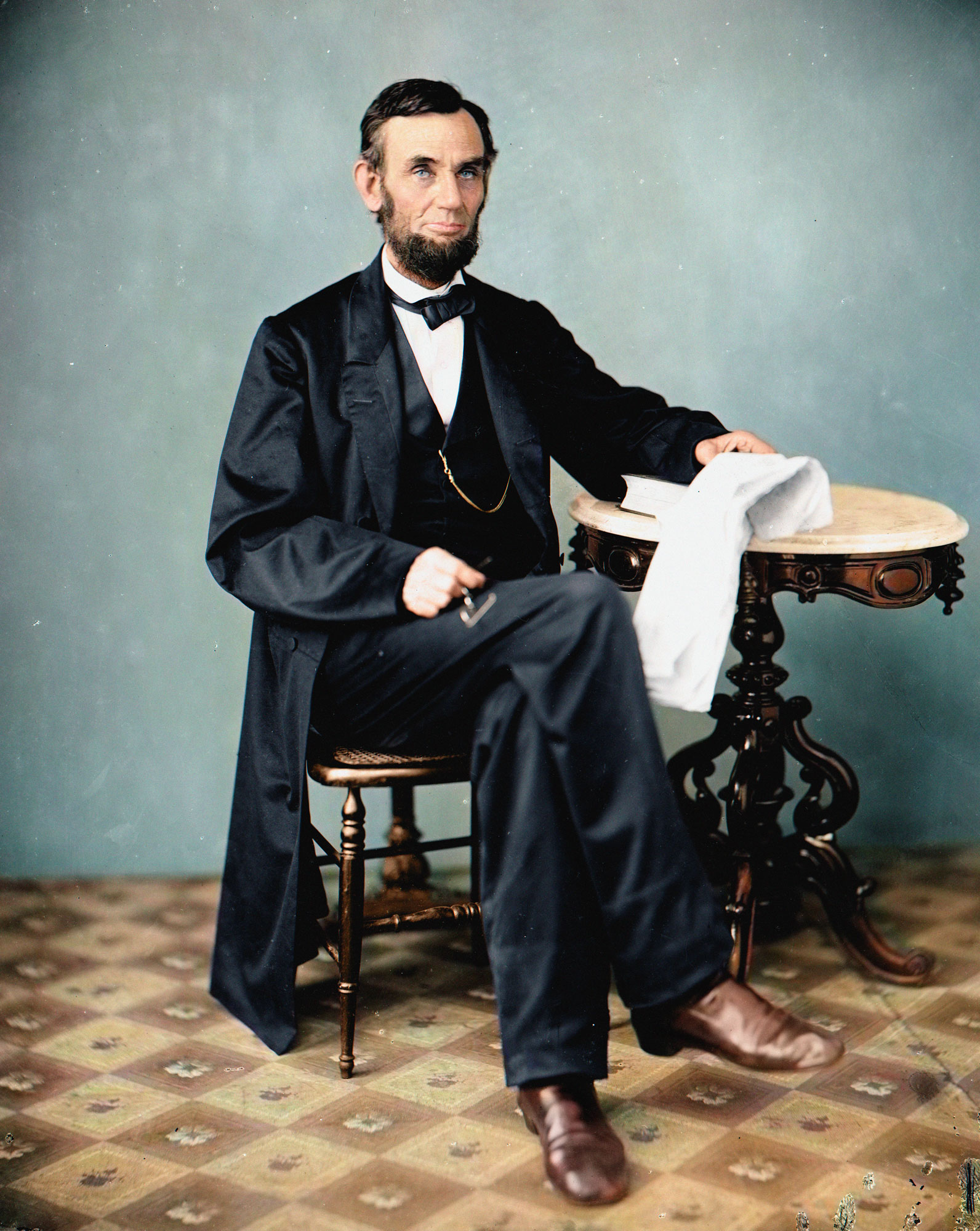 National Portrait Gallery, colorized by Mads Madsen
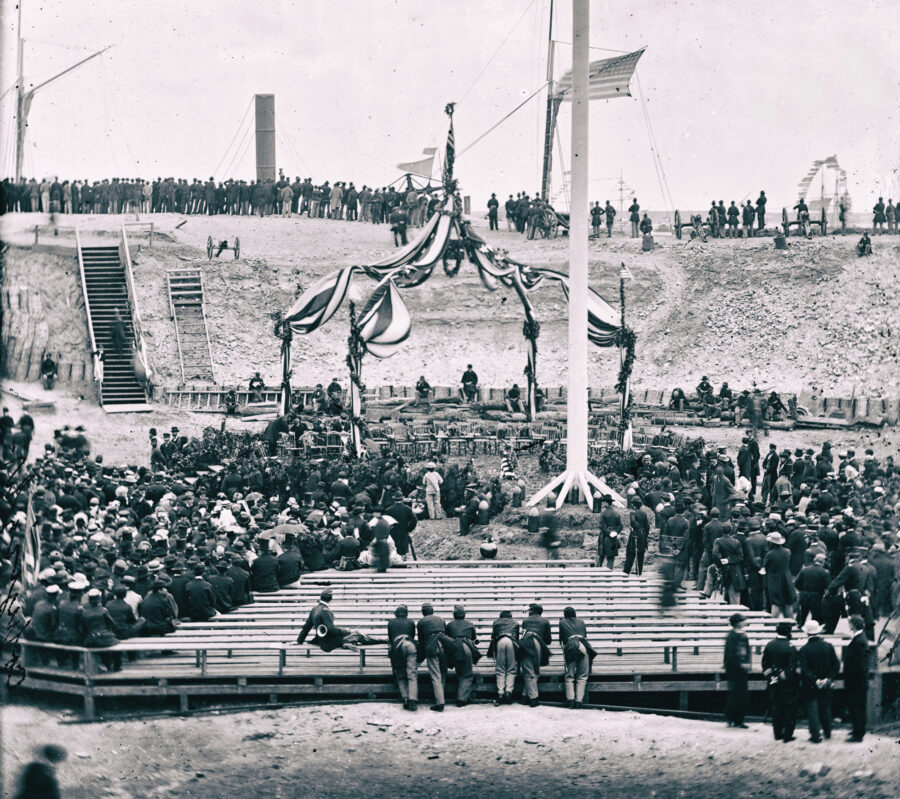
The round, 41-caliber lead bullet that John Wilkes Booth fired into the head of Abraham Lincoln on the night of April 14, 1865, was the most lethal gunshot in American history. Only five days before, the main field army of the Southern Confederacy had surrendered at Appomattox Court House, and the four dreary years of civil war between North and South were yielding to a spring of national rebirth. In Charleston, South Carolina, the Rev. Henry Ward Beecher presided at a flag-raising ceremony over the ruins of Fort Sumter. “Rebellion has perished,” exulted the most famous preacher in the Union. But, taking his cue from Lincoln’s urging a month before to have “malice toward none, charity for all,” Beecher warned against indulging “aimless vengeance” toward the defeated Confederacy. “Let us pray for the quick coming of reconciliation and happiness under this common flag.”1
Now, the man to whom everyone looked for guidance in reconstructing the nation in “reconciliation and happiness” was dead, even before the victory fireworks had burned themselves out. The result of Confederate secession was a costly but successful war, followed by a botched and even more costly reconstruction. Lincoln’s vice president, Andrew Johnson, took the presidential oath within hours of Lincoln’s death. But Johnson had none of Lincoln’s political skills, much less Lincoln’s notions of a future for the 4 million slaves whom the Civil War had freed.
 Library of Congress
Soldiers and civilians gather on April 14, 1865, to witness the raising of the U.S. flag at Fort Sumter, four years after it had been lowered in surrender to secessionist forces. This same night in Washington, D.C., President Abraham Lincoln is murdered at Ford’s Theatre.
A Tennessean who had remained loyal to the Union, Johnson saw his mission only in terms of punishing the Confederate elites whom he despised. He had no similar animosity toward the larger body of poor whites (whom he described as “poor, quiet, unoffending, harmless”), and no brief for the freed slaves. Johnson was always “very emphatic in his denunciation of what a rebel deserved and what he would get under him,” complained Grenville Dodge, one of Ulysses Grant’s corps commanders in the western theater, but “I never put my hand upon a prominent rebel, taking his stock and provisions, that Johnson did not try to pull it off.”2
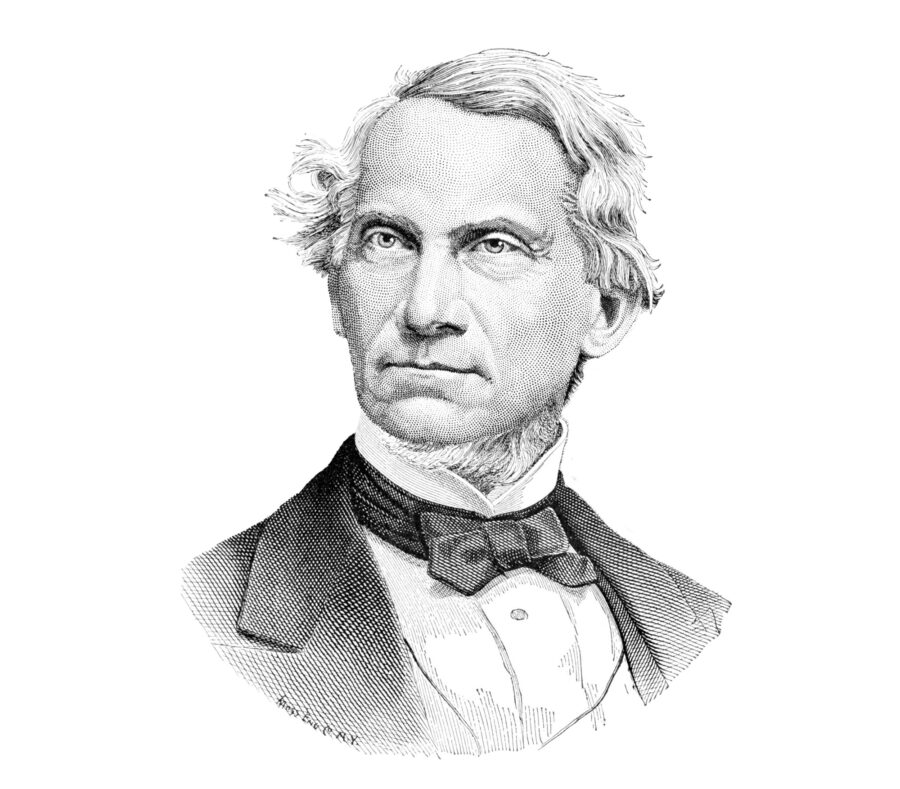
Not surprisingly, defeated southerners turned at once from despairing submission to arrogant defiance. Christopher Memminger, the former Confederate Secretary of the Treasury, said that Johnson “held up before us the hope of a ‘white man’s government,’ and this led us to set aside negro suffrage…. It was natural that we should yield to our old prejudices.” By the time Johnson left office in 1869, the pace of Reconstruction was already faltering, and Johnson had become so despised that he had barely survived an impeachment. In the years that followed, the victorious North sank into Reconstruction fatigue, while the former Confederates simply substituted Jim Crow for slavery.3
Would it have been different if Booth’s bullet had missed? Having guided the nation through a wartime valley of shadows, could Lincoln have found (as he once described it) “some practical system by which the two races could gradually live themselves out of their old relation to each other, and both come out better prepared for the new”?
 The Life and Times of C.G. Memminger (1893)
Christopher Memminger
Lincoln never laid out a single, definitive plan for Reconstruction. In fact, there was some question whether he had any business laying out such plans, since Congress was not shy about asserting its jurisdiction over any Reconstruction process. The word reconstruction had actually been on people’s lips since 1861, although at the outset, it described what would have to happen as a result of appeasing the South. Lincoln, however, never entertained any such notions of appeasement; and once past the initial waves of southern state secessions and the outbreak of civil war, he began to speak of reconstruction as a process of subduing the South and returning its states to federal authority.
He tinkered in the first place with the idea of imposing temporary military governments in the southern territory reclaimed by early Union victories in 1862—western Tennessee, lower Louisiana, the eastern coastal region of North Carolina. But these military governments had a spotty record, and Lincoln turned next to encouraging southern Unionists in occupied territory to begin forming their own governments, electing delegates to state conventions to write slavery out of their state constitutions and then electing new rounds of representatives to Congress. But Congress, jealous for its own prerogatives and suspicious of southern Unionists, refused to seat most of the representatives they elected.
In his last public speech, on April 11, 1865, Lincoln hinted broadly that he had “some new announcement” to make “to the people of the South” about Reconstruction, which would include voting rights for the freedmen. “I would myself prefer that it were now conferred on the very intelligent,” he said, “and on those who serve our cause as soldiers.” But Lincoln had nothing more specific than that to offer as yet; if anything, he was trying hard not to be too specific. “So great peculiarities pertain to each state,” he warned, “and such important and sudden changes occur in the same state; and, withal, so new and unprecedented is the whole case, that no exclusive, and inflexible plan can safely be prescribed as to details and colatterals. Such exclusive, and inflexible plan, would surely become a new entanglement.”4
This vagueness was partly a political habit of Lincoln’s—he had learned that laying down one’s cards too early was an invitation to be outbid—and partly a matter of temperament, since he was an exceedingly private man who resisted any great amount of self-disclosure. Leonard Swett, who had practiced law with Lincoln in Illinois, hoped that no one imagined they could second-guess Lincoln. “From the commencement of his life to its close,” Swett wrote in 1866, “he arrived at all his conclusions from his own reflections, and when his opinion was once formed he never had any doubt but what it was right.”
William Herndon, Lincoln’s law partner of 14 years, agreed: Lincoln was a man of “profound policies, deep prudences, etc., was retired, contemplative, abstract” and “about as shrewd a man as this world ever had,” a man “of quite infinite silences and was thoroughly and deeply secretive, uncommunicative, and closeminded as to his plans, wishes, hopes, and fears.” There can hardly be a greater example of historical presumption than predictions of what Lincoln might have done had he lived to direct Reconstruction as he had the Civil War.5
Still, there is no question that nags more often at American historical consciousness: What if Lincoln had lived? So let me yield to temptation. There are at least four paths to reconstructing the Union that seem likely to have been pursued had the president survived to finish his second term, starting with citizenship and voting rights. It scandalized Stephen Douglas in 1858 that, despite Lincoln’s protests that he had no plan to promote racial equality, “he must be in favor of conferring the right and privilege of citizenship upon the negro!” And Douglas was right: Sooner or later, Lincoln’s logic about natural equality and natural rights did favor just that.
 Harper’s Weekly
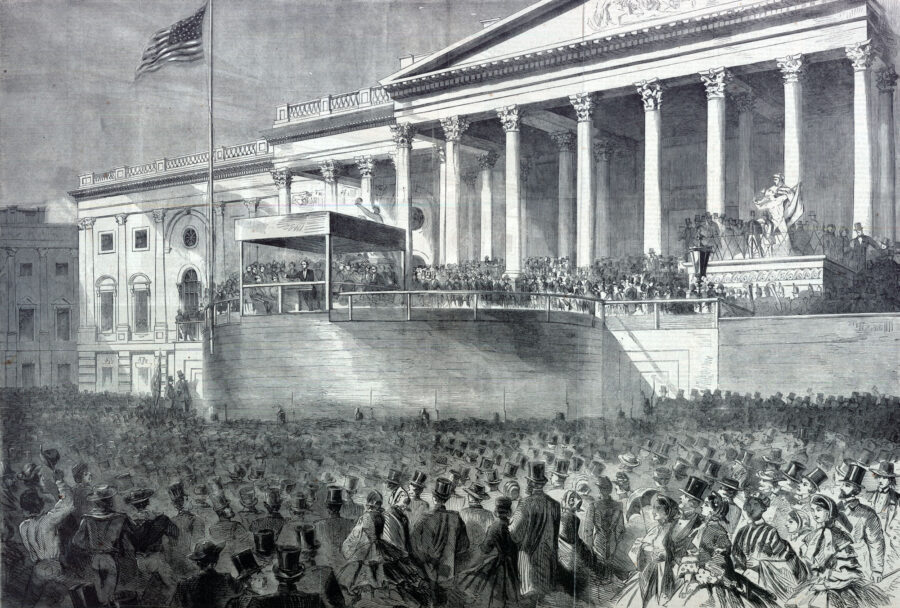
Abraham Lincoln’s logic about natural equality and natural rights—on display in his first inaugural address in 1861 (depicted above in an illustration from Harper’s Weekly)—favored citizenship and, by extension, voting rights for African Americans.
In his first inaugural address, Lincoln conceded the legitimacy of enforcing the Fugitive Slave Law of 1850, but then inverted its priorities by adding that “If the slave is to be surrendered” under the terms of the law, there should be safeguards, based on the “privileges and immunities of citizens,” which ensured “that a free man be not, in any case, surrendered as a slave.” Since the only “free man” liable to be snared by the Fugitive Slave Law was a black free man, Lincoln had attached citizenship to him—something that the Dred Scott decision’s author, sitting immediately behind Lincoln, had declared an impossibility.6
The gem within that citizenship was voting rights. If there was an emotional guiding star in Lincoln’s life, it was loyalty, and it was his admiration of loyalty in the black soldier more than anything else that persuaded Lincoln that there was no real alternative, especially for those blacks who had worn the Union blue, but to reward that service with voting rights. “Why should they do any thing for us, if we will do nothing for them?” Lincoln asked in his celebrated September 1863 public letter to the Illinois Republican politician James Conkling. By January 1864, Lincoln had come to see this as part of any peace terms with the Confederacy. If the Confederates wanted amnesty, Lincoln could not “avoid exacting in return universal suffrage, or, at least, suffrage on the basis of intelligence and military service.”7
There was also a practical political motive in promoting black voting rights. Once the war was over and the southern states reabsorbed into the Union, they would of course elect representatives and senators to send back to Washington. But if the freed slaves were excluded from the vote, then, even after the most prominent Confederates were banned from holding public office, southerners would probably vote only for white Democrats who had participated in secession politics. What was worse, before the war the southern states had been restricted from counting more than three-fifths of their slaves for determining the number of representatives from their states—the notorious three-fifths clause. With the end of slavery, these same white southerners could now claim authority to count the whole of their black populations, still without giving them any say in the voting process.
The result would be not only a return of defiant southern whites to Congress, but more of them than before. Only the voting power of the newly freed slaves in the South could offset white political dominance there. But the freedmen, with ballots in their hands, would (promised Frederick Douglass) “raise up a party in the Southern States among the poor,” and establish a long-term Republican political hegemony in the formerly Democratic South. “Give the negro the elective franchise,” said Douglass, “and you at once … wheel the Southern States into line with national interests and national objects.”8 Had Lincoln lived, both his own sense of fairness and the political needs of his administration would have made black voting rights an imperative they never were for Andrew Johnson.
But voting rights detached from economic leverage often shrivel into nothingness. Economic independence is what gives heft to political aspiration, something Lincoln understood from his own struggle to rise from poverty. One tool for the economic back-stopping of black citizenship would be education—“giving the benefit of public schools equally to black and white”—which in that last speech, Lincoln raised to a level equal in importance to voting. “Free labor insists on universal education,” and he looked forward to a day “for the profitable and agreeable combination of labor with cultivated thought.”9
Still, in Lincoln’s world, economic power was tied overwhelmingly to the ownership of land, and the newly freed slaves owned none. As one New York lawyer advised Lincoln’s Treasury Secretary Salmon Chase, “The way to secure the colored people & give them a real interest in our institutions is to confer upon them titles to small parcels of land.”10 The means for providing this lay close at hand—in the Bureau of Refugees, Freedmen and Abandoned Lands (known simply as the Freedmen’s Bureau), which was launched on March 3, 1865, with a mandate to claim land abandoned by plantation owners, or forfeited by nonpayment of taxes during the war, and divide it into 40-acre plots for former slaves to farm as their own.
Lincoln, in his career as an attorney for the Illinois Central Railroad, had no qualms about asserting the primacy of occupancy in ownership. “In equal right, better is the condition of him in possession,” he wrote in a legal opinion in 1856, and if the lands had been vacated by slaveowners, there was no one better to put in ownership than the people once enslaved to work on those lands. To encourage “persons, formerly held as slaves, to labor as freedmen in insurrectionary states” and “become self-supporting,” Lincoln ordered his generals to “suspend” any attempts to “interfere with the transportation of supplies to, or products from, any plantation worked by free labor,” and any officers who dragged their heels in observing this “will be deemed guilty of a military offence and punished accordingly.”11
By contrast, Johnson could not imagine a world in which ownership-in-fact had any appeal against ownership-in-law, even if the law had now been undermined by abandonment and treason. The plea of the freed slaves—that “Our wives, our children, our husbands has been sold over and over again to purchase the lands we now locates upon; for that reason we have a divine right to the land”—made no impression whatsoever on the president. When he issued a Reconstruction plan on May 29, 1865, Johnson offered amnesty “to all persons who have, directly or indirectly, participated in the existing rebellion” except for a small class of Confederate leaders—and “with restoration of all rights of property, except as to slaves.”12
This effectively pulled the economic rug out from under the freed slaves, allowed newly reconstituted southern state legislatures to pass “Black Codes” that sharply circumscribed blacks’ economic liberty, and threw them onto the untender mercies of their former owners as agricultural workers, sharecroppers, and menials.
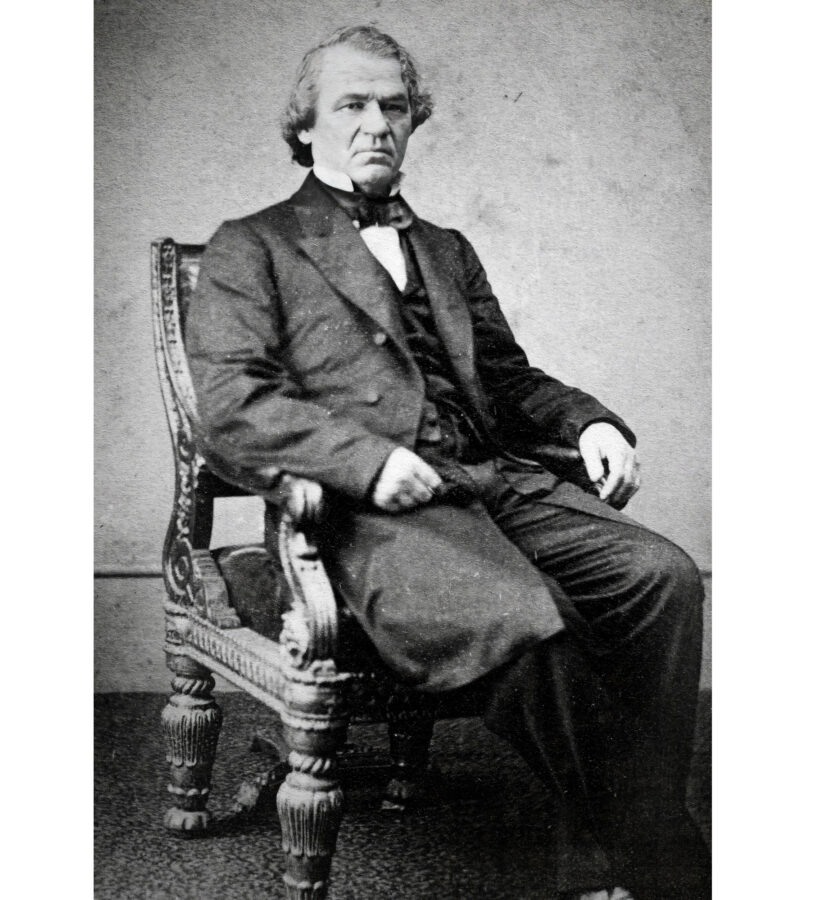 National Portrait Gallery
Unlike Lincoln, Andrew Johnson (pictured here in 1865) did not favor conferring ownership on the formerly enslaved of lands abandoned, or forfeited by nonpayment of taxes, by plantation owners who supported the rebellion. Johnson’s Reconstruction plan of May 1865 restored all rights to property (but not slaves) to the vast majority of former Confederates.
Given the Constitution’s reluctance to countenance property confiscation and bills of attainder, even Lincoln might have encountered serious legal difficulties in redistributing Confederate property after the war. But there would have been no similar blockage about reassigning title to land in the western territories owned by the federal government since the days of the Louisiana Purchase. On the very day of his assassination, Lincoln promised Speaker of the House Schuyler Colfax that he planned “to point” Union veterans “to the gold and silver that waits for them in the West.” There, “the hidden wealth of our mountain ranges” would afford “room enough for all” and make the West “the treasury of the world.”13
Turning the freedmen’s gaze westward as well would accomplish the same goal sought by the Freedmen’s Bureau, and without the seamy implication colonization carried of exile outside the United States. In 1819, the Pennsylvania Abolition Society took up a proposal that originated with the pioneering 18th-century abolitionist, Anthony Benezet, for colonizing freed blacks, not to Africa, but to the western territories “without cost, and without power of alienation” of their land “to white persons,” and in December 1861, William E. Walker, a black abolitionist and minister from Trenton, proposed designating “Florida as a territory reserved for blacks.” (If former Lincoln treasury official Lucius Chittenden’s memoir can be credited, even Lincoln toyed for a while with the idea of resettling “the whole colored race of the slave states into Texas.”)14
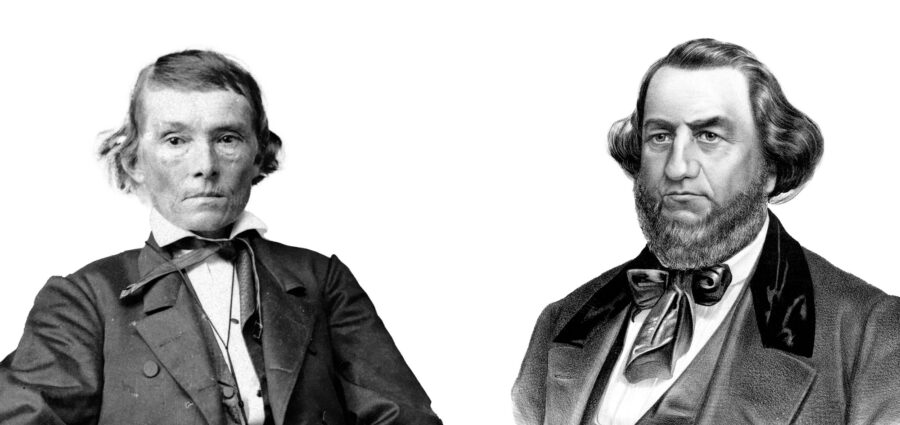 National Portrait Gallery (Stephens), Library of Congress
Alexander Stephens (left) and Herschel V. Johnson
The Homestead Act that Lincoln signed on May 20, 1862, allowed virtually anyone—including women—to lay claim to pieces of the more than 270 million acres of publicly owned land in 30 states, provided only that they were 21 years of age and that they pledged to settle the land for five years. (For Union army veterans, the residency requirement was only one year.) A second endeavor to create what amounted to a domestic form of colonization emerged out of Congress in 1866 with the Southern Homestead Act, which opened 46 million acres of public land in Florida, Alabama, Louisiana, Mississippi, and Arkansas to black veterans and white southern loyalists.
But Johnson rebuffed the call of the Freedmen’s Bureau’s director, the evangelical abolitionist general Oliver Otis Howard, to open still more public lands for black resettlement, and only 6,500 claims were actually filed. Land ownership by blacks lagged far behind that of whites in the postwar decades, and only a determined push by the federal government in privatizing land in the West for the freed slaves could have changed that. Nothing of that sort could have been expected from Johnson; it would not be too hard to imagine Lincoln, had he lived, presiding at the ceremonies at Promontory Summit, Utah, in 1869, driving the Golden Spike that united the transcontinental railroad, standing with two black westerners, mauls in their hands, on either side.
Even if these initiatives had been frustrated, Lincoln might still have opened a wider path to the future simply by cleaning the white leadership slate. Lincoln may have had no wish to hunt down the Confederacy’s leaders as the war ended. But he also had no wish to stop them leaving for exile. When he was asked whether federal authorities should seek the extradition of Jacob Thompson, a Confederate diplomat who had fled to Canada, Lincoln only said, “Well, I rather guess not. When you have an elephant on hand, and he wants to run away, better let him run.” Staff member Edward D. Neill heard Lincoln sigh that he hoped to hear nothing more about Jefferson Davis, the Confederate president. “I hope he will mount a fleet horse, reach the shores of the Gulf of Mexico, and drive so far into its waters that we shall never see him again.”
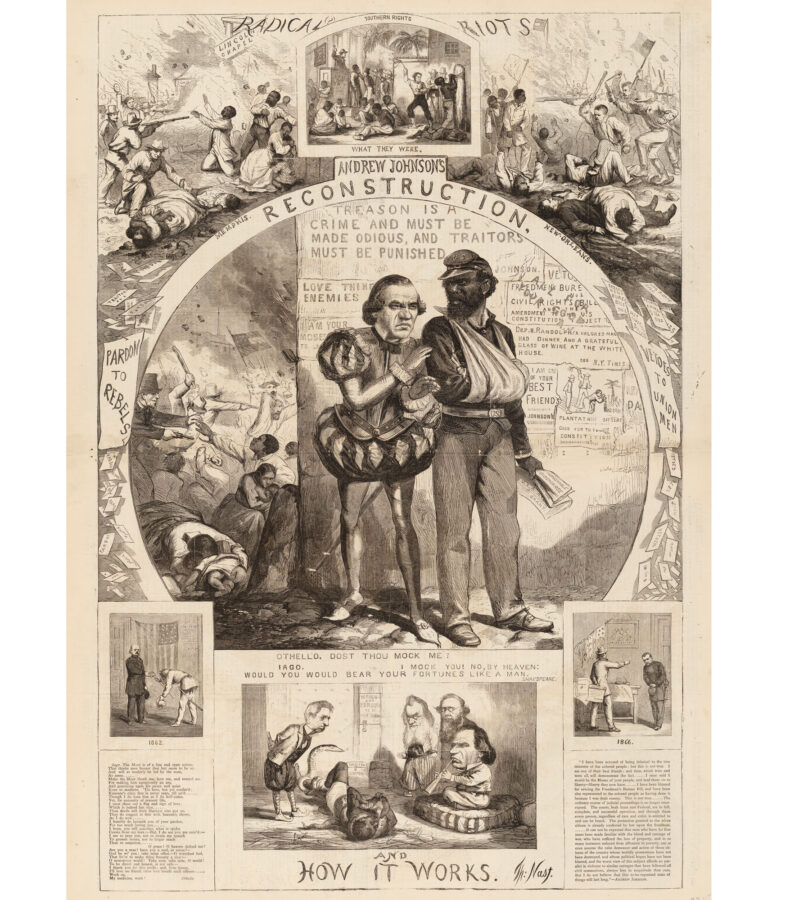 Harper’s Weekly
Andrew Johnson’s pardon policies facilitated the restoration of white power in the South—and with it a surge of violence against formerly enslaved people. Shown here: Thomas Nast’s depiction of the effects of Johnson’s pro-southern Reconstruction policies.
This would clear the way for a new leadership in the South, a leadership of Unionist whites and their natural allies, the freed slaves, and it would free him from the burden of signing death warrants. Charles Sumner remembered that when one of his Cabinet secretaries “insisted” that Davis “must not be spared, the Presdt said … ‘Judge not that ye be not judged,’ & when still further pressed on this point, he repeated these words again.”15
Johnsonʼs pardon policies, however, had a very different effect. The Georgia Legislature elected as its two new senators Alexander Stephens, the former Confederate vice president, and Herschel V. Johnson, a former Confederate Congressman; in the House of Representatives, 13 Confederate generals arrived to represent the supposedly reconstructed southern states. Not surprisingly, this attempted restoration of white power was attended by a surge of mob violence against the freed slaves, much of it organized and led by former Confederate officers and politicians. “You have doubtless heard a great deal of the Reconstructed South, of their acceptance of the results of the war,” wrote a despairing Freedmenʼs Bureau agent in South Carolina. “This may all be true, but if a man … had the list of Negroes murdered in a single county in this most loyal and Christian state, he would think it a strange way of demonstrating his kindly feelings toward them.”16
Appalled at the barefaced conceit of electing to Congress men who had only months before been trying to destroy the government, Republicans in Congress refused to seat the former rebels, and instead passed legislation that returned the southern states to military occupation. But they did so at the price of a fearful political contest with the president that allowed disgruntled southerners to realize that they could play the ends against the middle to their advantage. Trying to outmaneuver Johnson, Congress resorted to the cumbersome mechanism of amending the Constitution, not once but twice (in the 14th and 15th Amendments) to prevent a white restoration in the South. But the Supreme Court bent over backward to limit the application of the amendments, and so the restoration happened anyway.
The speed with which a renewal of white racial supremacy occurred in the former Confederacy is a reminder that, even if Lincoln had lived to finish his second term and had put an active presidential shoulder to black voting rights, to black economic integration, to black involvement in western expansion, and to the wiping-clean of the old Confederate leadership, the results might not have been hugely different from what they were. Lincoln would still have faced stiff opposition, almost as much from northern Democrats as from the white South. Although northern states routinely ratified the 13th Amendment, abolishing slavery, they just as routinely turned back state ballot initiatives on black voting rights. “It is a misfortune not to be lightly considered,” complained the North American Review in 1866, “that Connecticut and Wisconsin, by their recent votes denying the right of suffrage to their black denizens, should have shown that a large section of the Northern people is yet very imperfectly instructed as to the true nature of the principles upon which our institutions are founded.”17
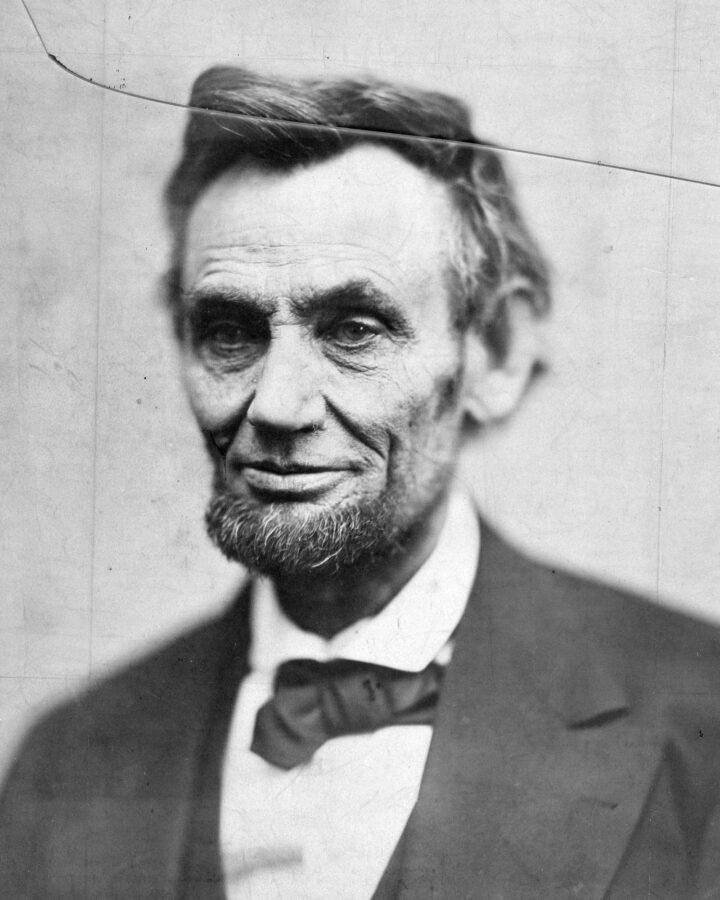 National Portrait Gallery
Abraham Lincoln in February 1865
Worse than merely “imperfectly instructed,” New York voters took the state legislature that ratified the 15th Amendment, swept the Republican majority away, and installed a Democratic majority that promptly attempted to rescind the ratification. The eventual return of southern representatives to Congress, which sooner or later would have occurred even if the most die-hard Confederates had been weeded out, would have further diluted the congressional majorities with which Lincoln had worked during the war, and if northern Democrats were able to scramble back to their feet, Lincoln would face much heavier going for Reconstruction policies than he had for wartime policies.18
Similarly, Lincoln could scarcely have guaranteed the operation of any “practical system” of racial reunion without an ongoing military presence in the South to enforce it. “Any man of Northern opinions must use much circumspection of language” while touring the South, wrote Sidney Andrews, who did in fact tour the defeated Confederacy for the Atlantic Monthly in 1865. “In many counties of South Carolina and Georgia, the life of an avowed Northern radical would hardly be worth a straw but for the presence of the military.”19 Yet, Americans were chronically unwilling in times of peace to foot large military budgets, and in 1865 the soldiers themselves were mostly civilians- in-uniform who wanted nothing more than to go home at war’s end.
Above all, Lincoln would have occupied the Executive Mansion only until 1869, which is not a long time to implement the vast programs his version of Reconstruction would have required. He might, like Franklin Delano Roosevelt in 1940, have been persuaded to seek an unprecedented third term; but the yardstick for measuring that possibility is even reedier than the ones I have been using thus far. Moreover, his successor would surely have been (as Johnson’s was) Grant, and Grant had problems of his own. In the end, not even Abraham Lincoln might have been able to wrench success out of Reconstruction. It is difficult to see how he could have avoided an extended military occupation, or how he could have secured the black vote with anything less than the constitutional amendments that were in fact adopted, or how he could have dealt with the reemergence of a cross-sectional Democratic opposition, and no guarantee of success.
And yet, it is also hard to imagine how we could have done worse. “Had Mr. Lincoln lived,” said Frederick Douglass in December 1865, “the negro of the South would have more than a hope of enfranchisement and no rebels would hold the reins of government in any one of the rebellious states.” This was because Lincoln was “a humane man, an honorable man, and at heart an anti-slavery man” who “looked to the principles of liberty and justice, for the peace, security, happiness and prosperity of his country.” Twenty- three years later, Douglass had not changed his mind: Lincoln was a “man so broad in his sympathy … so free from narrow prejudice … that all classes and conditions of men could claim him as a … friend, a brother, and a benefactor.”20
Only days before his death, a jubilant Lincoln told New Jersey politician James Scovel that “if God gives me four years more to rule this country, I believe it will become what it ought to be … no longer one vast plantation for breeding human beings for the purpose of lust and bondage, but it will become a new valley of Jehosaphat, where all nations of the earth will assemble together under one flag worshipping the common God, and they will celebrate the resurrection of human freedom.”21 Perhaps. One hundred and fifty-eight years later, we are still struggling to live up to that expectation.
Allen C. Guelzo is the Thomas W. Smith distinguished research scholar in the James Madison program at Princeton University, and the author of the forthcoming Our Ancient Faith: Lincoln, Democracy, and the American Experiment (Knopf).
Notes
1. Martha Hodes, Mourning Lincoln (New Haven, 2015), 28; Terry Alford, Fortune’s Fool: The Life of John Wilkes Booth (New York, 2015), 258; Beecher, Oration at the Raising of “The Old Flag” at Sumter (Manchester, 1865), 12, 17.
2. Stephen V. Ash, Middle Tennessee Society Transformed, 1860-1870: War and Peace in the Upper South (Baton Rouge, 1988), 107; Hans L. Trefousse, Andrew Johnson: A Biography (New York, 1989), 280; Dodge, “Personal Recollections of Some of Our Great Commanders in the Civil War” (February 6, 1901), in Personal Recollections of the War of the Rebellion: Addresses Delivered before the Commandery of the State of New York, Military Order of the Loyal Legion of the United States, ed. A.N. Blakeman (New York, 1907), 215.
3. Memminger, in Speeches, Correspondence and Political Papers of Carl Schurz, ed. F. Bancroft (New York, 1913), 1:283, 2:256.
4. Lincoln, “To Michael Hahn” (March 13, 1864) and “Last Public Address” (April 11, 1865), in Collected Works of Abraham Lincoln, ed. R.P. Basler (New Brunswick, NJ, 1953), 7:243, 8:400-401.
5. Leonard Swett to Herndon (January 17, 1866) and interview with David Davis (September 20, 1866), in Herndon’s Informants: Letters, Interviews, and Statements about Abraham Lincoln, eds. R.O. Davis and D.L. Wilson (Urbana, 1997), 166, 348; Herndon to unknown correspondent (November 24, 1882), in The Hidden Lincoln: From the Letters and Papers of William H. Herndon, ed. E. Hertz (New York, 1940), 88.
6. Lincoln, “Remarks at Springfield, Illinois” (November 20, 1860) and “First Inaugural Address” (March 4, 1861), in CW, 4:142-143, 264; Douglas, in The Lincoln-Douglas Debates, ed. D.L. Wilson and R.O. Davis (Urbana, 2008), 162; James Oakes, Freedom National: The Destruction of Slavery in the United States, 1861-1865 (New York, 2013), 356-357.
7. Lincoln, “To James S. Wadsworth” (January 1864), in CW, 7:101.
8. “Interview with Delegation of Blacks” (February 7, 1866), in The Papers of Andrew Johnson: Volume 10, February-July 1866, ed. P.H. Bergeron (Knoxville, 1992), 48; Douglass, “An Appeal to Congress for Impartial Suffrage,” Atlantic Monthly 19 (January 1867): 116.
9. Lincoln, “Address before the Wisconsin State Agricultural Society, Milwaukee, Wisconsin” (September 30, 1859), in CW, 3:480.
10. William Curtis Noyes, in Roger Lowenstein, Ways and Means: Lincoln and His Cabinet and the Financing of the Civil War (New York, 2022), 212.
11. Lincoln, “Opinion on Land Titles in Beloit, Wisconsin” (March 24, 1856) and “Order Concerning Lessees and Owners of Plantations Worked by Freedmen” (September 30, 1864), in CW, 6:337, 8:30.
12. “Bayley Wyat’s Speech,” in Friends Intelligencer 23 (January 26, 1867), 747; “By the President of the United States: A Proclamation” (May 20, 1865), in The War of the Rebellion: A Compilation of the Official Records of the Union and Confederate Armies (Washington, 1899), Series 2, 8:579.
13. Edward Winslow Martin, The Life and Public Services of Schuyler Colfax (New York, 1868),188.
14. Paul Escott, Lincoln’s Dilemma: Blair, Sumner, and the Republican Struggle over Racism and Equality in the Civil War Era (Charlottesville, 2014), 235; William J. Jackson, New Jerseyans in the Civil War: For Union and Liberty (New Brunswick, NJ, 2000), 111; Beverly C. Tomek, Colonization and Its Discontents: Emancipation, Emigration, and Antislavery in Antebellum Pennsylvania (New York, 2011), 40–41; Chittenden, Recollections of President Lincoln and His Administration (New York, 1891), 337.
15. Charles A. Dana, David Davis, and Gideon Welles, in Recollected Words of Abraham Lincoln, eds. Don and Virginia Fehrenbacher (Stanford, CA, 1996), 131, 132, 486; Neill, Reminiscences of the Last Year of President Lincoln’s Life (St. Paul, MN, 1885), 14; Speed, Reminiscences of Abraham Lincoln and Notes of a Visit to California: Two Lectures (Louisville, 1884), 33; Sumner to the Duchess of Argyll (April 24, 1865), in The Selected Letters of Charles Sumner, ed. B.W. Palmer (Boston, 1990), 2:295.
16. Robert K. Scott, in Piedmont Farmer: The Journals of David Golightly Harris, 1855-1870, ed. P.N. Racine (Knoxville, 1990), 556.
17. “The President’s Message,” North American Review 102 (January 1866): 253.
18. LaWanda and John H. Cox, “Negro Suffrage and Republican Politics: The Problem of Motivation in Reconstruction Historiography,” in Reconstruction: An Anthology of Revisionist Writings, ed. K.M. Stampp and L.F. Litwack (Baton Rouge, 1969), 159-165.
19. Sidney Andrews, “Three Months Among the Reconstructionists,” Atlantic Monthly 17 (February 1866): 238.
20. Joseph R. Fornieri, “Lincoln on Black Citizenship,” in Constitutionalism in the Approach and Aftermath of the Civil War, eds. P.D. Moreno and J.G. O’Neill (New York, 2013), 80; Douglass, “Draft of a Speech on Lincoln” (December 1865), in Knowing Him By Heart: African Americans on Abraham Lincoln, eds. F.L. Hord and M.D. Norman (Urbana, 2023), 175 and “In Honor of Lincoln,” Washington National Republican (February 13, 1888).
21. Scovel, “Talked to Ministers About Lincoln’s Life,” Philadelphia Inquirer (February 13, 1900).
Related topics: Abraham Lincoln