Not long ago, I was caught off guard by someone asking what single book I would recommend for a reader who wanted a good introduction to the Civil War. Five decades had passed since I needed such an introduction, so I was not acquainted with more contemporary examples, but I tried to remember the better paperback Civil War histories and memoirs I collected in high school. Somewhat tentatively, I offered my questioner Bruce Catton’s This Hallowed Ground.
Historians reflexively revert to nonfiction at such moments, but the question suggested an absence of historical aspiration beyond a desire to know what our country was like during its most turbulent era. It had been a similar hunger that drove me to devour all those paperbacks when I was a boy. I might have given a different answer had I hesitated long enough to reflect that those books failed to satisfy me, conveying as they did the chronology and the cast of our national drama without giving it much depth.
Paradoxically, neither history nor memoir—nor even original diaries and letters—have ever made the war quite as real for me as fiction has. Catton eloquently shrouded his actual Union and Confederate soldiers in glory, but they sprang from nowhere, fully armed and uniformed, and they lived only until their armies disbanded. The imaginary characters created by Stephen Crane, Mackinlay Kantor, and Robert Penn Warren emerged more convincingly complete, with pasts and personalities independent of their military incarnations.
 Raintree County
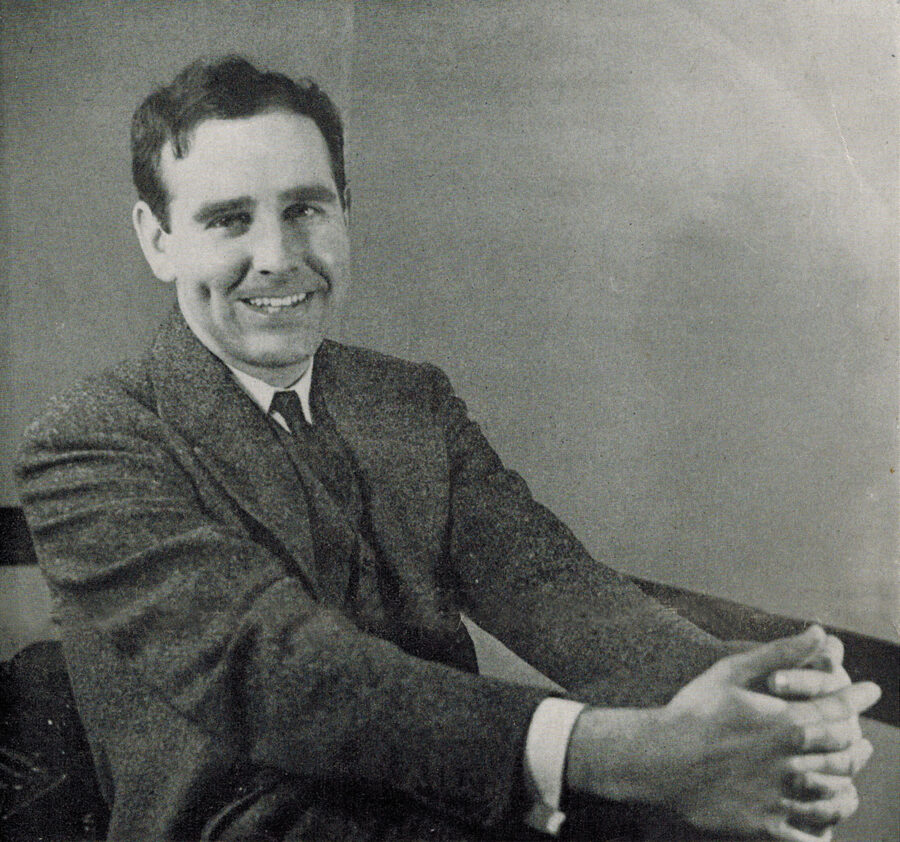
Ross Lockridge Jr.
Kantor, Warren, and other novelists also offered sound, engaging portraits of the political and social tensions, but if pressed for a single comprehensive treatment of the era in fiction I could choose nothing better than Raintree County. With this entrancing epic, Ross Lockridge Jr. fashioned an entire society from the clay of an apocryphal quadrangle in Indiana. He located the county too far west of Ohio to be as far east of Indianapolis as it was supposed to be, inventing a place accessible only to readers who could penetrate cartographical interstices. His home-grown protagonist, John Wickliff Shawnessy, a middle-aged schoolteacher born in 1839, gradually reveals the county and its population through a single day’s reveries of growing to manhood there.
The war pervades the novel without dominating the narrative, much as it would have weighted the atmosphere of any Midwestern community over the second half of the 19th century. One of Shawnessy’s children is given a chapter in which she remembers that “everything was either Before the War, During the War, or After the War.” The mileposts in Shawnessy’s life parallel—and are shaped by—the landmark events on the road to war and reunion.
Johnny (as Shawnessy is identified before and during the war) is a reader, a dreamer, a poet, and an idealist. His memories begin with Election Day, 1844, when his father’s hero, Henry Clay, lost the presidency to James K. Polk, who prodded the United States into its first unwitting steps toward dissolution. Uncle Tom’s Cabin persuades Johnny and his father of the evils of slavery, and the Kansas-Nebraska Act infects Raintree County with a political distemper as contagious as any virus.
But all is not politics. Love and lust alternate and mingle in the mind of adolescent Johnny, while his neighbors gasp and gossip over adulterous scandals. The county includes every ideological class, from nationalists and Southern sympathizers to altruists and adventurers, as well as economic and political opportunists whose avarice and ambition will propel them far from home.
Johnny is gripped by a spiritual attachment to place that may be best appreciated by someone who came of age in one spot, and especially a rural one—as so many once did, and so few now do. He lives in what he calls “the Republic,” which encompasses Indiana, including Raintree County. Thus, Raintree County is the Republic, and the Republic is Raintree County. That reciprocal identification with homeland underlays a national allegiance less deeply ingrained in peripatetic modern generations, but understanding it lends clarity to the enormous sacrifices made in the name of the Union.
It is the Shawmucky River, meandering through the heart of the county, that harbors Raintree’s mythic quality. Along the Shawmucky’s serpentine banks Johnny daydreams of the prehistoric inhabitants of nearby Indian mounds, and of the legendary tree from which the county took its name. There he reads Shakespeare and feels the yearning that betrays his fear of being forgotten—the afterthought to every youth’s early meditations on mortality. One summer day he navigates the river in a leaky boat as far as Paradise Lake, seeking the raintree and the philosophical revelations he expects it to divulge. Instead, he nearly finds a watery grave.
The three most important affairs of Johnny’s life begin with encounters on that river. He attends a fledgling local academy with one of three women he will eventually embrace along the Shawmucky—the one he never married, but should have; he dreams of her in the opening scene, and grieves for her in the penultimate passage. Their sole instructor is Jerusalem Webster Stiles, a native of the county who has returned with an Eastern education, whom the local yeomen refer to as “Perfessor.” If their identical initials fail to mark the erudite and cynical Stiles as the alter ego of the ever-hopeful hero, a graphic hint closes the 1,160-page opus.
Not until the reader becomes intimately acquainted with Raintree County is the war superimposed on life there. The intrusion comes as it would have to someone living at the time—compellingly, but not completely. The business of life always intervenes, even during a carnival of death. Not all battles are fought by armies, nor are all wars waged between nations, as Lockridge demonstrated with a plot closely constructed around tumultuous events in his own grandfather’s life. For the battle scenes he had to be more creative, throwing Shawnessy into several active campaigns, because his grandfather’s entire war consisted of a peaceful summer as a hospital steward in a 100-day regiment. In the novel, it is the grasping, two-faced politician who seeks that short and safe enlistment.
 Raintree County
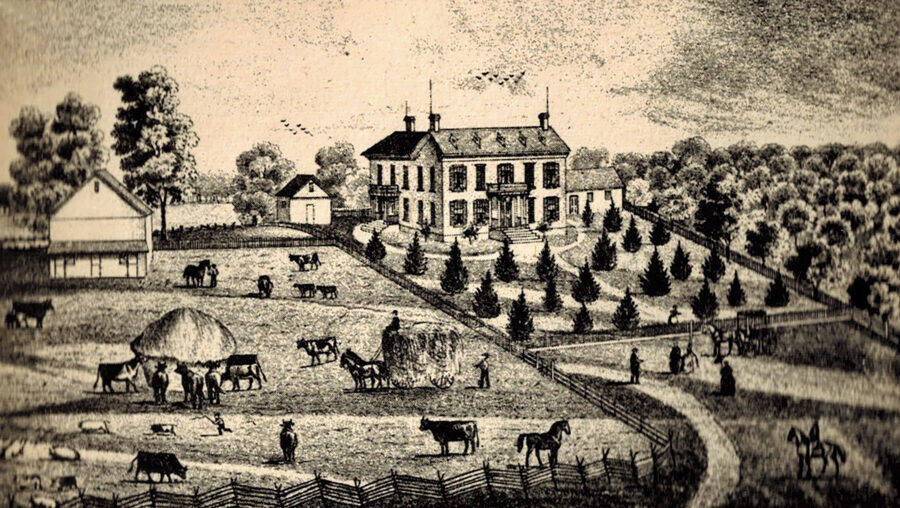
Life in Raintree County as depicted in an illustration from Ross Lockridge Jr.’s novel.
In the county of his fancy, Lockridge probably came closer than any other novelist to portraying the war as it was experienced and remembered by most Americans. In that endeavor he also exceeded many a historian for whom the demands of documentation impose limitations on the minutiae that lend a story verisimilitude, if not veracity. The success of Raintree County stands as firmly on the author’s research as on his sumptuous style. Lockridge devoured newspapers, ephemera, and apparently the Oxford English Dictionary to color his narrative with the fashion, architecture, social interactions, and vocabulary of the period. But for the premature appearance of derbies and bustles, and a faint ring of anachronistic military parlance, the details and dialogue might have been recorded by a contemporary.
The novel is framed around Independence Day, 1892, in the town on the old National Road where Shawnessy lives with his second wife and their three children. A prominent U.S. senator who attended the local academy with Johnny is scheduled as the guest speaker. Professor Stiles returns to report on the senator’s remarks for a daily newspaper in New York, where he has lived since departing Raintree County hastily in 1859, after an indiscretion with a preacher’s wife. Like Socrates examining the Athenians against the backdrop of another fratricidal struggle, the professor poses the questions that launch most of the flashbacks comprising the heart of the novel. In the course of the day, Shawnessy’s daydreaming exposes his own past in tantalizing fragments that emerge out of sequence.
For much of the novel, Shawnessy evinces a vague but perceptible sadness that remains unexplained until near the end. Only when the veil is lifted from the last and most pressing mystery is the cause disclosed. His personal tragedy ranks with the public calamity of the Republic Shawnessy reveres, but like his Republic he soldiers on, making the best of what is left. He discovers that some of what is left is very good indeed.
Shawnessy and Stiles do not ruminate on the same war and peace portrayed by Margaret Mitchell’s romantic Southern caricatures in Gone With the Wind. Lockridge’s pair look back on a more complex conflict that stirred them with fluctuating twinges of reconciliation, redemption, and betrayal. Shawnessy feels the reconciliation early, before he comes home from the war, and he finds the redemption later. The more radical Stiles emphasizes the betrayal of freedmen in particular and working men in general, in addition to his longstanding indignation over the social bondage of women.
For all the contentment and hope that Shawnessy exudes, and all Stiles’ smug misanthropy, their reminiscences in the final furlong of their lives evoke a gnawing melancholy. In one afternoon and evening they summoned all the ghosts of a lifetime, of whom they are the surviving earthly embodiments by virtue of their powers of recollection. The two are not likely to ever meet again. Soon enough the recollections will cease for one, and then for the other, whereupon all they knew and felt will vanish into the dark of the forgotten past, perhaps never even to be visualized by some young dreamer reclining on a riverbank.
That nostalgia for a lost boyhood and a lost age recurs throughout the flashbacks, and often in the frame-day conversations. Bedding down one night on the March to the Sea, Corporal Johnny Shawnessy wonders how long it will be before the last surviving veteran “would tent for the last time in the old camp ground of a longforgotten war?” In 1892, at mention of the battles carved on the Indianapolis Civil War monument then under construction, Shawnessy laments that those place names would be “meaningless” to future generations. “People will already have forgotten,” he predicts, “before dirt falls on the face of the last incredibly old comrade of the Grand Army.”
The landscape he looked on provokes and betokens much of his longing—as it still does today, for those who can picture what the American countryside looked like in the 19th century. The mere mention of the Civil War conjures visions of stone walls and rail fences, dirt roads, and lush, open fields, and that imagery may exert stronger subliminal attraction than today’s inhabitants of a ravaged and densely cluttered geography realize. The passion for battlefield preservation represents both a compulsion to commemorate epic heroism and a collective desire to preserve bucolic vistas where the reflective can retreat and contemplate a vanished America.
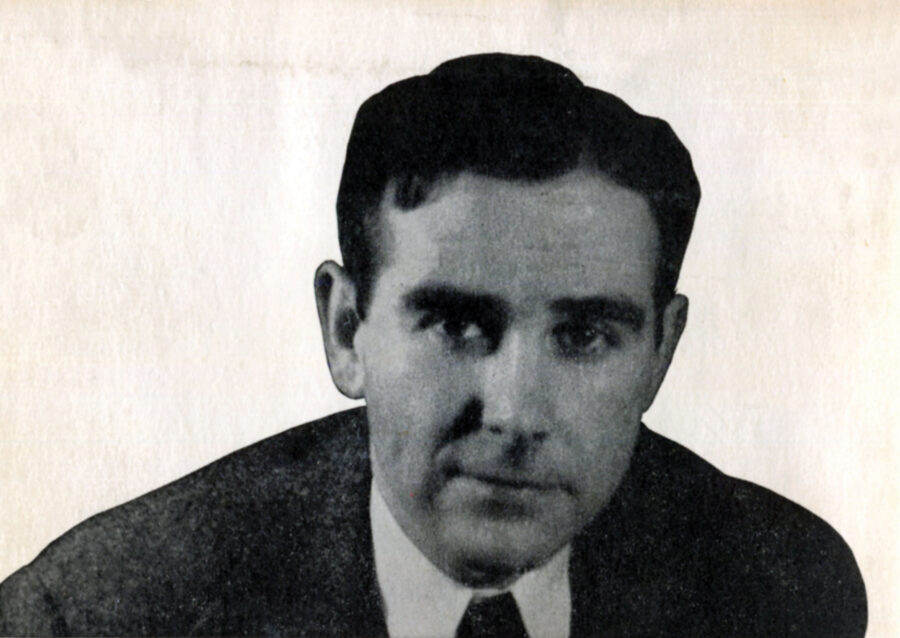 Raintree County
Ross Lockridge Jr.
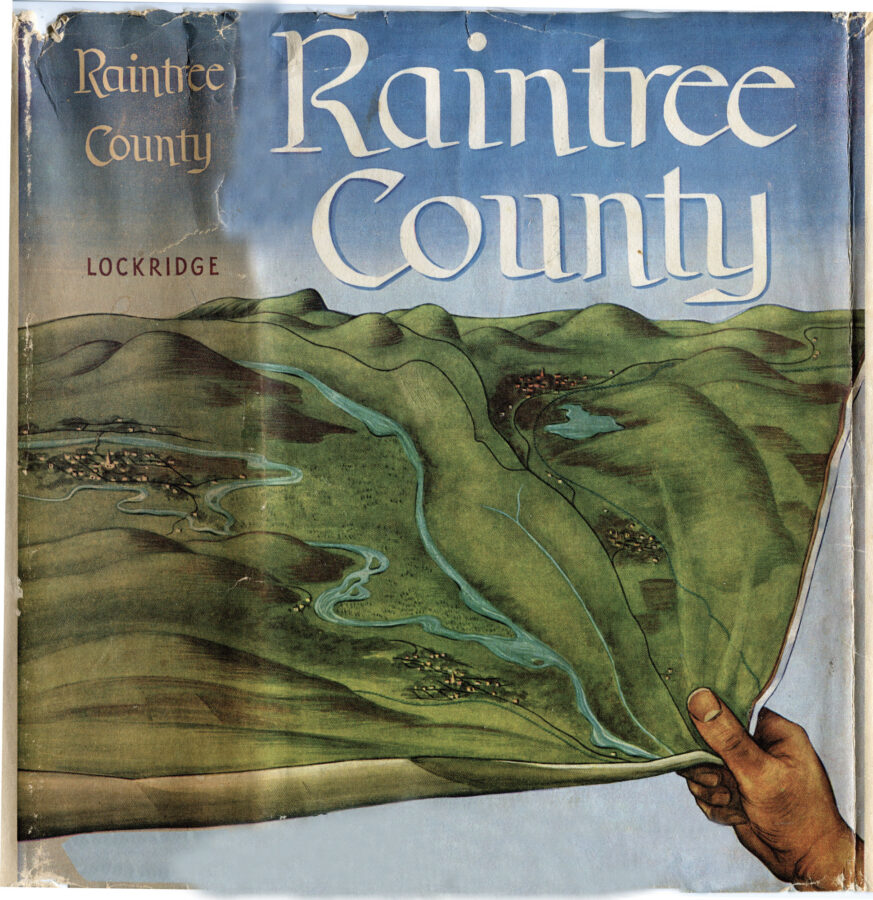
“Let each remember the face of the earth as it was in his childhood,” Shawnessy muses during the Fourth of July program, remembering that land as “mystical, brooding, maternal.” The topography of his native county lures him as viscerally as the body of the mysterious woman of his dream, over whose form a map of the county settles like a silk shroud, verdant and voluptuous. So deliberately did Lockridge blend love of the home county with the carnal instinct that he made a sketch of that map-draped body, inspiring one of the more subtly sensuous dust jackets ever folded around the covers of a book.
As dusk descends on Shawnessy and Stiles, the impending threat to their “mystical America” posed by the “sooty monster” of industrialism adds to the wistfulness of their reunion. The professor-turned-reporter remarks that “the Declaration of Independence and the Constitution never foresaw the Modern City”—which, he adds, “destroys all the ancient values, prides, loyalties, convictions.” He advises his former pupil to “shed a tear” for his home county, “because the City’s going to eat it up.”
Lockridge only lived to be 33, but by then he had already absorbed and distilled the best of Western literature. He imitated James Joyce in the mechanism of a single frame-day, but his narrative was immeasurably more engrossing. He immersed his readers in the florid prose of Thomas Wolfe, but maintained better control over it. He engaged in the protracted storytelling of William Faulkner, but proved more generous with periods and paragraph breaks. His metaphorical forays among gloomy woods and beating drums revealed his debts to Dante and Walt Whitman. All those masters, and more, amble anonymously through this crowded, deftly crafted chronicle, imperceptibly adding their lilt and inflection to Lockridge’s own mellifluous voice. The result is a masterpiece.
Inexplicably, Lockridge died by his own hand only weeks after Raintree County became the country’s bestselling book. If he feared that he might never exceed the accomplishment of his first novel, he may have been right. In its historic scope, its literary allure, and its faithful depiction of our most tragic era, Raintree County has never been equaled, let alone surpassed, in three-quarters of a century.
William Marvel is the author of many books about the Civil War era, including Radical Sacrifice: The Rise and Ruin of Fitz John Porter (UNC Press, 2021).