 Library of Congress
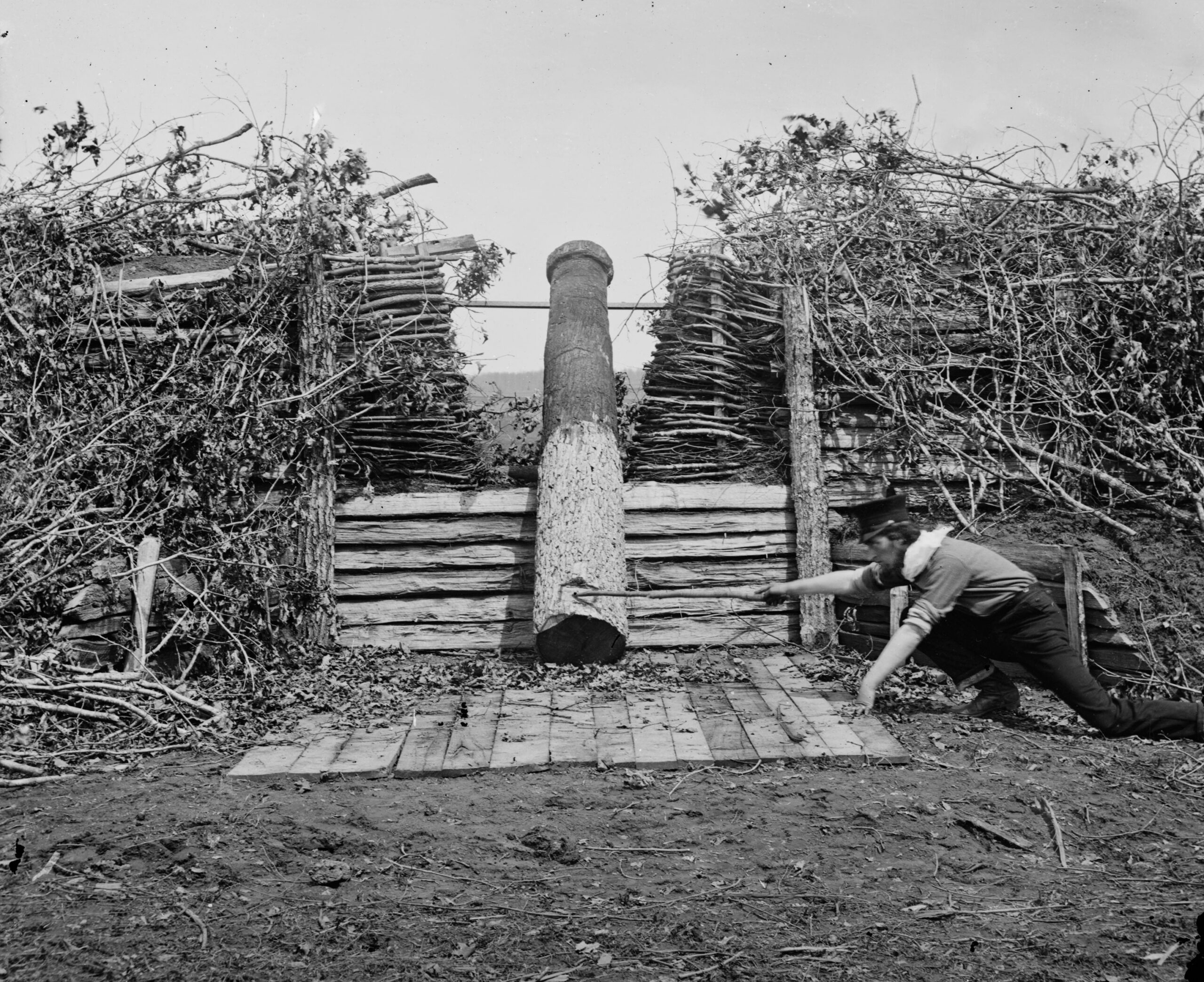
A man pretends to fire a faux cannon devised from a wooden log found in abandoned Confederate defensive works at Centreville, Virginia, in March 1862. Such so-called “Quaker guns” were employed by Confederates there and at Yorktown to fool Union general George B. McClellan into believing he faced a better-equipped and more-fortified enemy, thereby slowing his advance toward Richmond.
quak•er•guns | noun | An imitation of a gun made of wood or other material, and placed in the port-hole of a vessel, or the embrasure of a fort, in order to deceive the enemy; so called from its inoffensive character.1
The Confederate position at Yorktown in the spring of 1862 appeared impenetrable to commander George B. McClellan and his Army of the Potomac. The enemy line—which was stretched across the Virginia Peninsula between a fortified outpost at Point Gloucester, across the York River to Yorktown, and down the James River to Mulberry Island—bristled with artillery and swarmed with at least 100,000 men in gray. McClellan made repeated appeals to Washington for additional manpower, but President Abraham Lincoln refused, opting to keep the 30,000 men of Irvin McDowell’s I Corps near the capital to protect it against Confederate threats, including the presence of Thomas J. “Stonewall” Jackson’s Rebels in the Shenandoah Valley. “Our neighbors are in a very strong position,” McClellan concluded in early April. “I cannot turn Yorktown without a battle, in which I must use heavy artillery & go through the preliminary operations of a siege.”2 In truth, the overly cautious McClellan faced not a massive army at Yorktown, but a small force of around 8,000 to 10,000 soldiers commanded by a master of theatrical disguises.
John Bankhead Magruder, nicknamed “Prince John,” was an amateur actor well known for his flamboyant mannerisms and lavish lifestyle. Born in 1807 in Port Royal, Virginia, he secured an appointment to the United States Military Academy at West Point in 1826. Seemingly immune to the rules and rigors of military life, the cadet gleefully participated in the infamous “Eggnog Riots” and routinely slipped away to Benny Havens’ Tavern. After graduating, Magruder was stationed in North Carolina, Maryland, Florida, and later Texas, where his idiosyncratic habits and charm made him a favorite among his fellow soldiers. As one historian noted, “his eccentricities … endeared him to most fellow officers, especially those who enjoyed his elaborate military reviews.”3
In Texas under General Zachary Taylor in 1845–1846, Magruder developed a theater and put on several plays, including a much-loved rendition of Shakespeare’s Othello. He turned up to a ball in Washington, D.C., dressed as the king of Prussia, his authentic outfit complete with velvet cuffs and silver collar buttons. In yet another “performance,” Magruder hosted a reception for British officers when they were stationed together along the Canadian border. Having rented the finest china, glassware, and furniture available, Magruder was asked by an astonished guest, “American officers must be paid enormously. What is your monthly pay?” “Damned if I know,” Magruder replied. Turning to a servant, he said, “Jim, what is my monthly pay?” The servant prudently elected not to answer.4 The native Virginian resigned from the U.S. Army just three days after his state seceded from the Union. A year after joining the Confederate cause, Magruder—by then a major general—found himself opposite McClellan near Yorktown, his troops standing in the way of a Union advance toward Richmond.
Outnumbered four-to-one by McClellan’s approaching army, Magruder acted quickly and decisively by establishing a defensive Confederate line with infantry outposts and artillery redoubts across the peninsula. ‘‘Genl. Magruder was well fitted for the task confided to him,’’ observed a staff officer. ‘‘He had the faculty of an engineer in discovering strong and weak localities intended to be defended, and allowed no detail to escape him in the way of preparation.’’5 Intending to deceive the enemy with an elaborate charade, Magruder ordered his men to install cannon-size black painted logs along their artillery position and march back and forth as officers frequently shouted orders and bugles and drums blared. “This morning we were called out by the ‘Long roll’ and have been traveling most of the day, seeming with no other view than to show ourselves to the enemy at as many different points of the line as possible,” reported an exhausted soldier from Alabama.6
Robert Miller of the 14th Louisiana Infantry explained the strategy, “the way Magruder fooled them was to divide each body of his troops in two parts and keep them travelling all the time for twenty-four hours, till reinforcements came.”7 The ruse worked. A Union soldier from Maine “saw across the open space a long line of rebel earthworks with a stream in front, the rebel flag was flying and we could see the secesh officers riding along their lines inside the works.”8 In the face of Magruder’s elaborate deception, McClellan delayed his advance, allowing time for the arrival of much-needed Confederate reinforcements, including Joseph E. Johnston’s force of over 40,000 men.
 Library of Congress
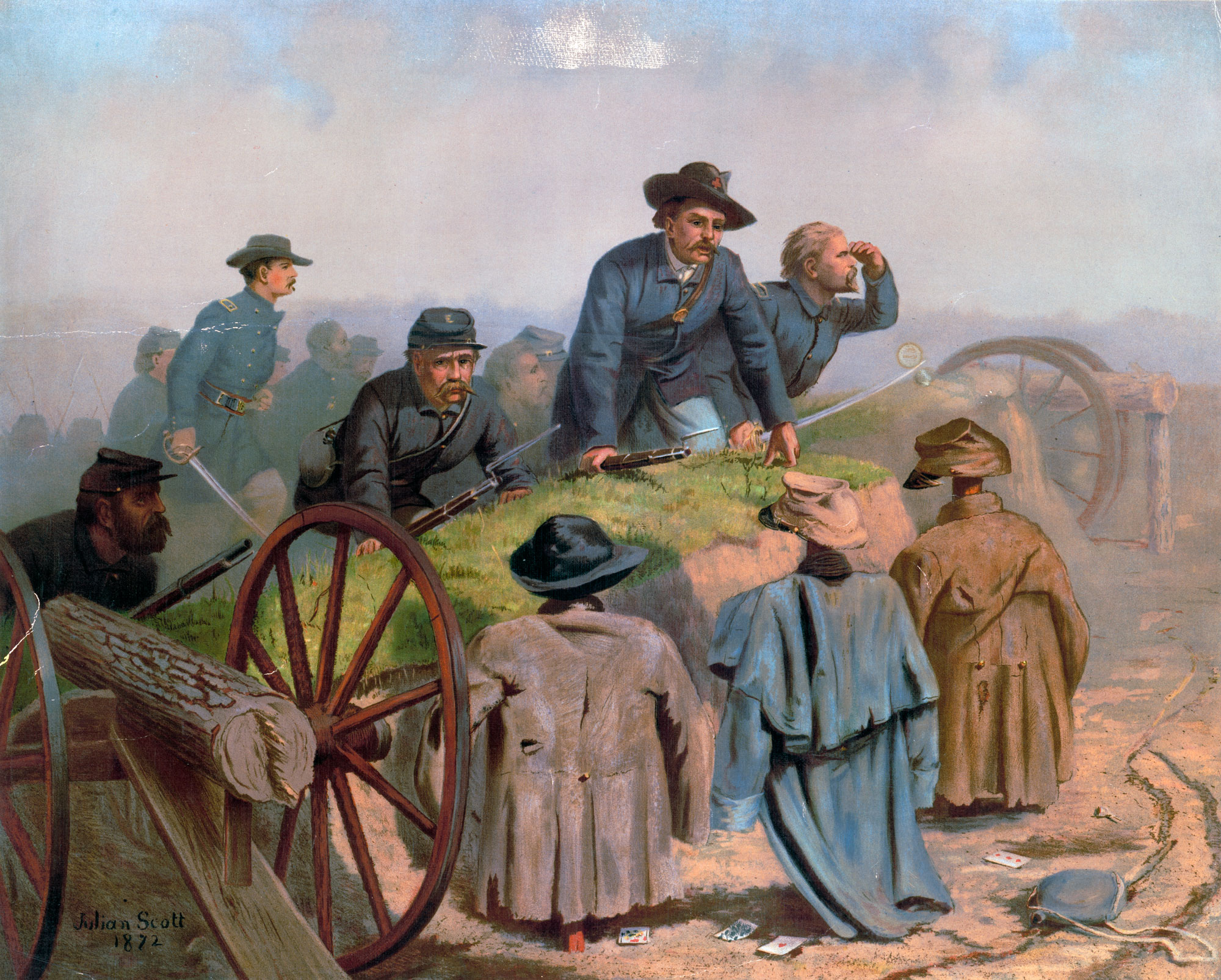
This Julian Scott painting depicts Union soldiers discovering dummy defenders and Quaker guns in an abandoned Confederate earthwork.
McClellan continued to amass heavy artillery and smaller batteries, as the two armies settled into what would be a monthlong siege. On April 29, Johnston, who had assumed overall command of the Confederates on the peninsula, concluded “the fight for Yorktown … will be one of artillery, in which we cannot win.” Four days later, the Confederate army slipped away under cover of darkness.9 Advancing Union soldiers were startled to discover harmless logs among the 77 pieces of captured enemy artillery. “In the inside intrenchments were wooden guns projecting from the embrasures. Fort Magruder, which we built strong works to reduce, was found to be a weak place. Its inside works were sand bags, filled up with logs of wood painted black on the end,” reported a correspondent from a Philadelphia newspaper.10 McClellan had—yet again—been bamboozled by Quaker guns.
Two months earlier, Johnston’s men had pulled off the same ruse against McClellan at Centreville, Virginia. “The fancied impregnability of the position turned out to be a sham…. [S]ome of the forts have maple logs painted to resemble guns…. Some of our soldiers cried when they found that ‘quakers’ were mounted on the Rebel breastworks,” reported the New-York Tribune on the Centreville sham.11 Recalling the Union advance on the Virginia Peninsula, New York soldier Charles O. Shepard wrote, “I remember our cautious advance, in constant expectation of the terrible slaughter which must come when these guns opened up on us; but ne’ery a slaughter. The ‘Rebs’ retreated as we advanced, changing to another and more favourable base, leaving us the mortification of having been held in check with wooden guns.” He went on, “the ‘Rebs’ had taken away all the real guns from their forts and put painted wooden ones in their stead, and thus McClellan was completely befooled…. With shame and confusion of face we marched back to Alexandria.”12
Although many Americans first learned of Quaker guns during the Civil War, the phrase had made it into print several decades before. In his 1808 account of the American Revolution, Nathaniel Fanning, an American naval officer, described a British privateer with “ten wooden (or Quaker), guns manned with twenty-five officers, men and boys.”13 Then, in 1810, William Duane, a self-described “late Lieutenant colonel in the Army of the United States, and author of the American Military Library,” included the phrase in his new A Military Dictionary. Defining a French term, he wrote, “Passe-volans likewise means those wooden pieces of ordnance which are made to resemble real artillery, and fill up the vacant places in a ship. They were first adopted by the French, inconsequence of regulation, which was made by M. de Pontchartrain, when he became minister of the marine department. He gave orders, that no vessel, except such as carried 16 guns, should sail to and from America. In order to comply, at least in outward appearances, with this regulation, the merchants had recourse to passe-volans, or wooden substitutes, that are called by us quaker guns. More advantages than one are indeed derived from this invention, which has been adopted in every civilized country.”14 Such acts of military deception were hardly new in 1810. Yet linking this concept of military trickery to the pacifist Quakers, or the Religious Society of Friends, was a uniquely American concept.
Today, if any Americans encounter Quaker guns, it would be with their appearance in modern text or daily conversation. As the United States confronts another ideological and political battle between diametrically opposed forces, a growing number of citizens are reassessing the strength of the nation’s founding principles. Are our civil and political rights firm against attack or are they Quaker guns only looking invulnerable to assault? Assessing the sanctity of the First Amendment’s free speech protections in a September 2025 case, a district court judge in Massachusetts declared, “Small wonder then that our bastions of independent unbiased free speech—those entities we once thought unassailable—have proven all too often to have only Quaker guns…. [L]aw firms cower, institutional leaders in higher education meekly appease … [and] media outlets from huge conglomerates to small niche magazines mind the bottom line rather than the ethics of journalism.”15
Tracy L. Barnett is a visiting assistant professor of history at Old Dominion University in Norfolk, Virginia. She has a doctorate in American history from the University of Georgia. Firearms—their meaning to men and their availability in 19th-century America—are the center of her scholarship.
Notes
1. John Russell Bartlett, Dictionary of Americanisms: A Glossary of Words and Phrases Usually Regarded as Peculiar to the United States, Fourth Edition (Boston, 1877), 508.
2. Stephen W. Sears, To the Gates of Richmond: The Peninsula Campaign (New York, 1992), 38.
3. Peter S. Carmichael, “The Great Paragon of Virtue and Sobriety: John Bankhead Magruder and the Seven Days,” in Gary Gallagher, ed., The Richmond Campaign of 1862: The Peninsula and the Seven Days (Chapel Hill, 2000), 99.
4. Carmichael, “The Great Paragon of Virtue and Sobriety,” 98-99; Sears, To the Gates of Richmond, 24-25.
5. Joseph L. Brent, Memoirs of the War Between the States (New Orleans, 1940), 159.
6. John Gilchrist Barrett, ed., Yankee Rebel: The Civil War Journal of Edmund DeWitt Patterson (Chapel Hill, 1966), 17.
7. Sears, To the Gates of Richmond, 37.
8. Ibid., 37.
9. Ibid., 59.
10. Inquire (Philadelphia, Pennsylvania) reprinted in Fall River Daily Evening News (Fall River, Massachusetts), May 6, 1862.
11. New-York Tribune, March 13, 1862.
12. Emphasis in the original. Entre Nous [Charles O. Shepard], Christmas Stories for My Sister’s Children: Personal Reminiscences of a Not Uneventful Life (n.p., 1878), 28.
13. Nathaniel Fanning, Memoirs of the Life of Captain N. Fanning, an American Navy Officer (n.p., 1808), 143.
14. Capitalization has been standardized. William Duane, A Military Dictionary, Or, Explanation of the Several Systems of Discipline of Different Kinds of Troop, Infantry, Artillery, And Cavalry; The Principles of Fortification, and All The Modern Improvements in the Science of Tactics (Philadelphia, 1810), 513, 559.
15. American Association of University Professors v. Rubio, 1:25-cv-10685, (D. Mass. 2025): 152.