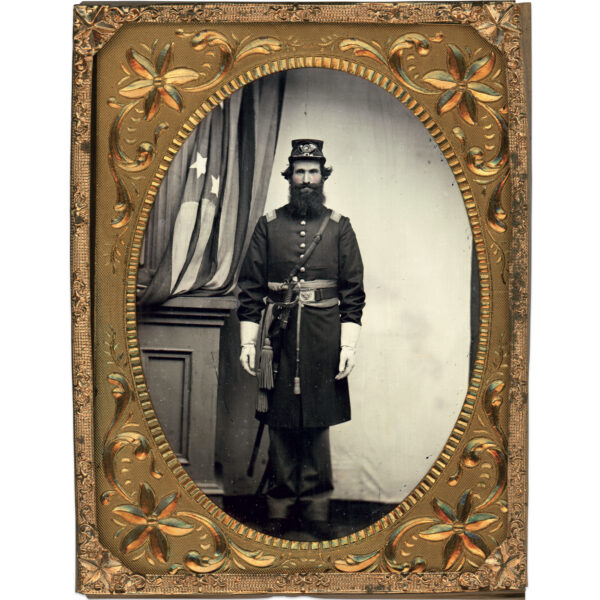
Manton Marble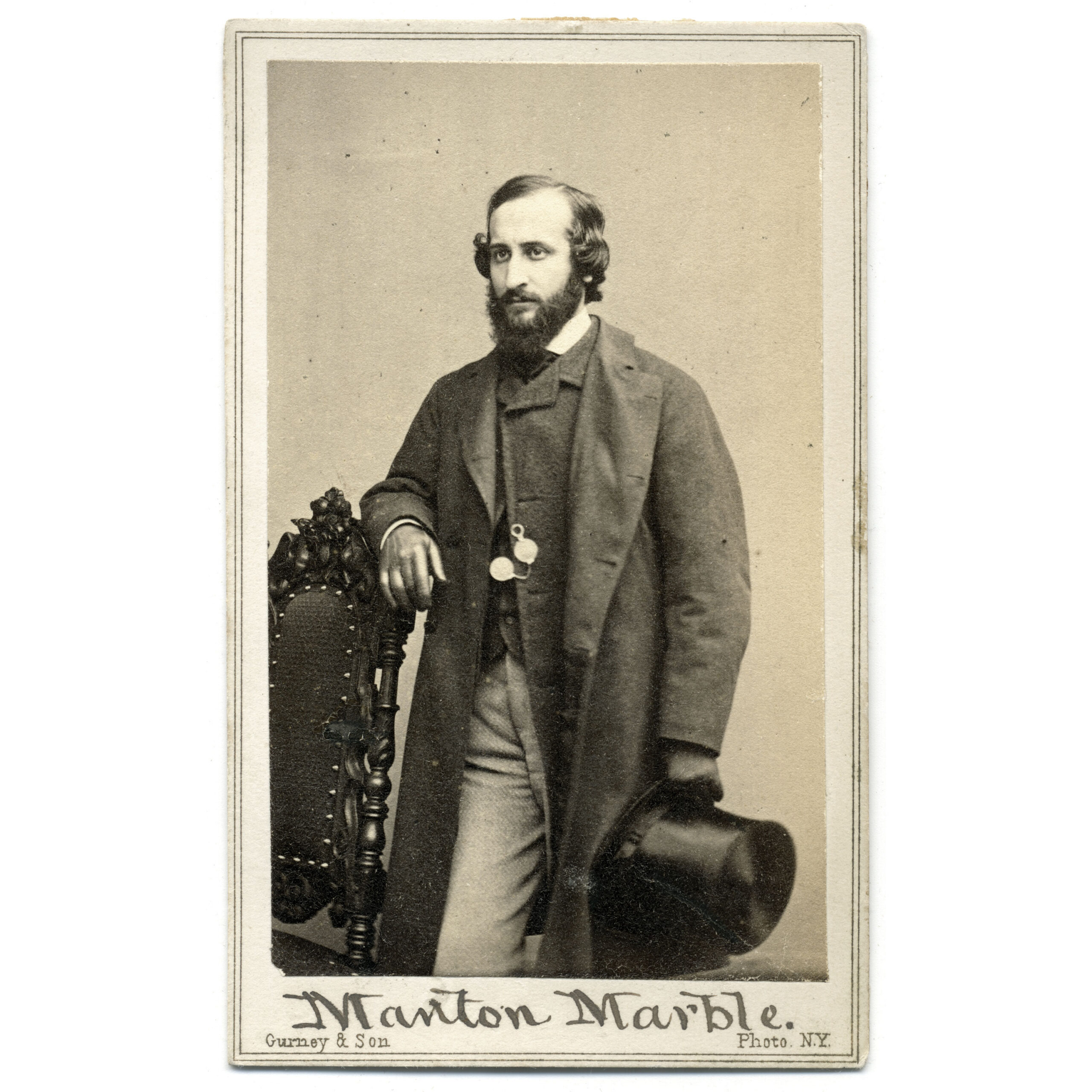 Ronald S. Coddington Collection
Late one night in May 1864, several New York City newspapers received envelopes reportedly from The Associated Press. Inside was a proclamation dated May 17 from the executive mansion in Washington signed by President Abraham Lincoln. In it, Lincoln begged God to forgive him for his weaknesses, declared May 26, 1864, a national day of fasting, humiliation, and prayer, and called for a whopping 400,000 more volunteers from war-weary states to serve in the Union army by June 15—less than a month away.
The night editor of The New York Times was suspicious. The envelope was not of the kind used by the AP, the handwriting was in a different hand than usual, and the timing of the delivery—3:30 a.m.—was unusual. He concluded the proclamation was forged and did not publish it. The night editor of another newspaper, the Daily News, had also become suspicious and after consulting with the Times did not publish it. But two newspapers, the Journal of Commerce and the World, printed the edict in full. The news caused the stock market to tank the next day and provoked outrage in the city.
The White House issued a denial on May 18. Soon after, the duped news organizations’ offices were occupied by the military and publication was ceased. After the World’s presses began to roll again a few days later, editor and owner Manton Marble, pictured here, published “A Letter to Abraham Lincoln,” which blamed the president and Republicans for planting the fraudulent document. Marble, a British-born journalist who had made the World a mouthpiece of anti-war Democrats, was skewered by majority pro-Union Republican newspapers. “Mr. Manton Marble is a very transparent sham. He has not the cleverness of an ordinary actor, and is quite unable to sustain the character which he has undertaken,” noted the Buffalo Morning Express, adding, “His nobodiness is immense and his non-individuality extraordinary.”
The perpetrator of the hoax happened to be another newspaper editor, the Brooklyn Eagle’s Joseph Howard Jr. He had a long history with numerous publications in the city. In fact, it was he who had written the story of Lincoln dressed in a scotch cap and long cloak to evade recognition as he passed through Baltimore to attend his 1861 inauguration.
Howard’s motivation was money. He had invested in gold and knew that a story threatening a longer war would prompt jittery investors to raise the price of the precious metal. It did, and he cashed in. Carted off to imprisonment at Fort Lafayette, Howard gained his release after 14 weeks when Lincoln pardoned him.
The story quickly faded, and Marble worked in newspapers until 1876, when he retired. He remained active in Democratic politics, advised party leaders, and wrote several books. He died in 1917 at 82.
Ronald S. Coddington is publisher of Military Images, a magazine dedicated to showcasing and preserving photos of Civil War soldiers and sailors.