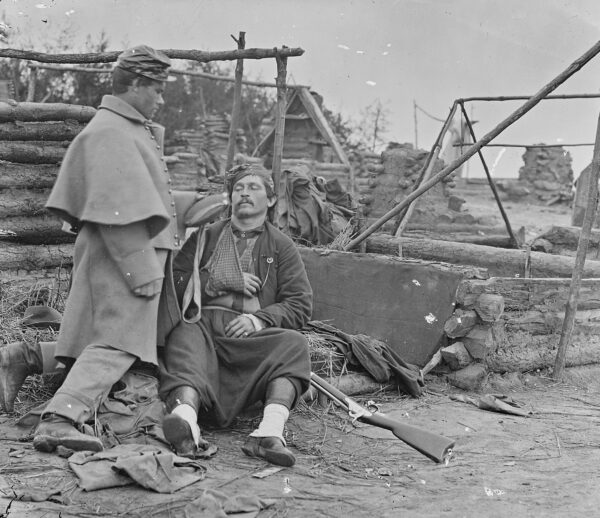
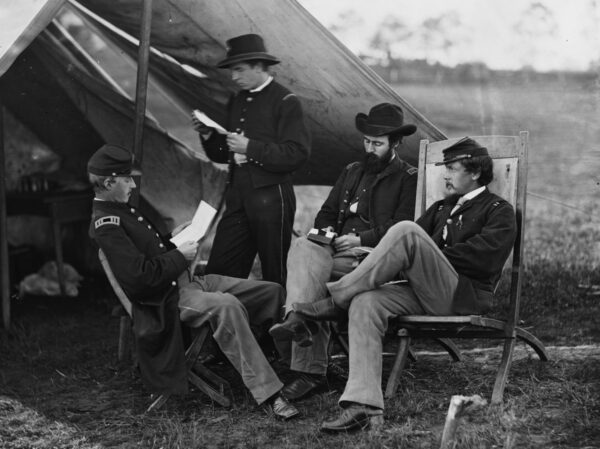
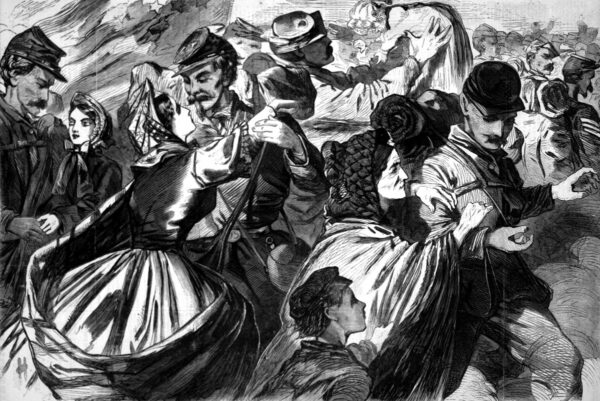
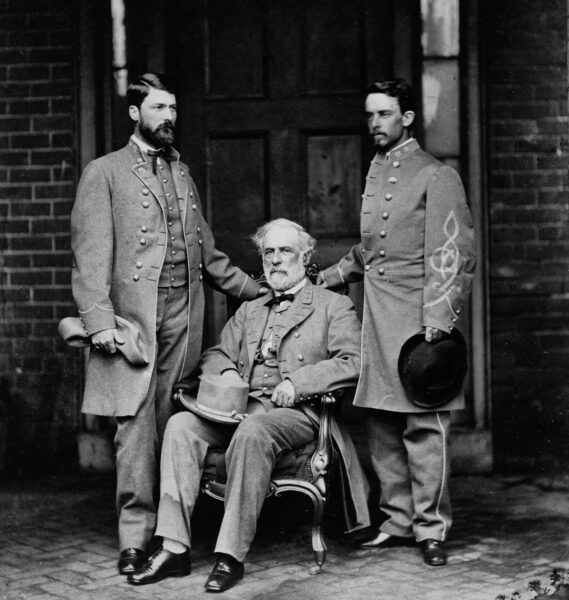
A solemn duty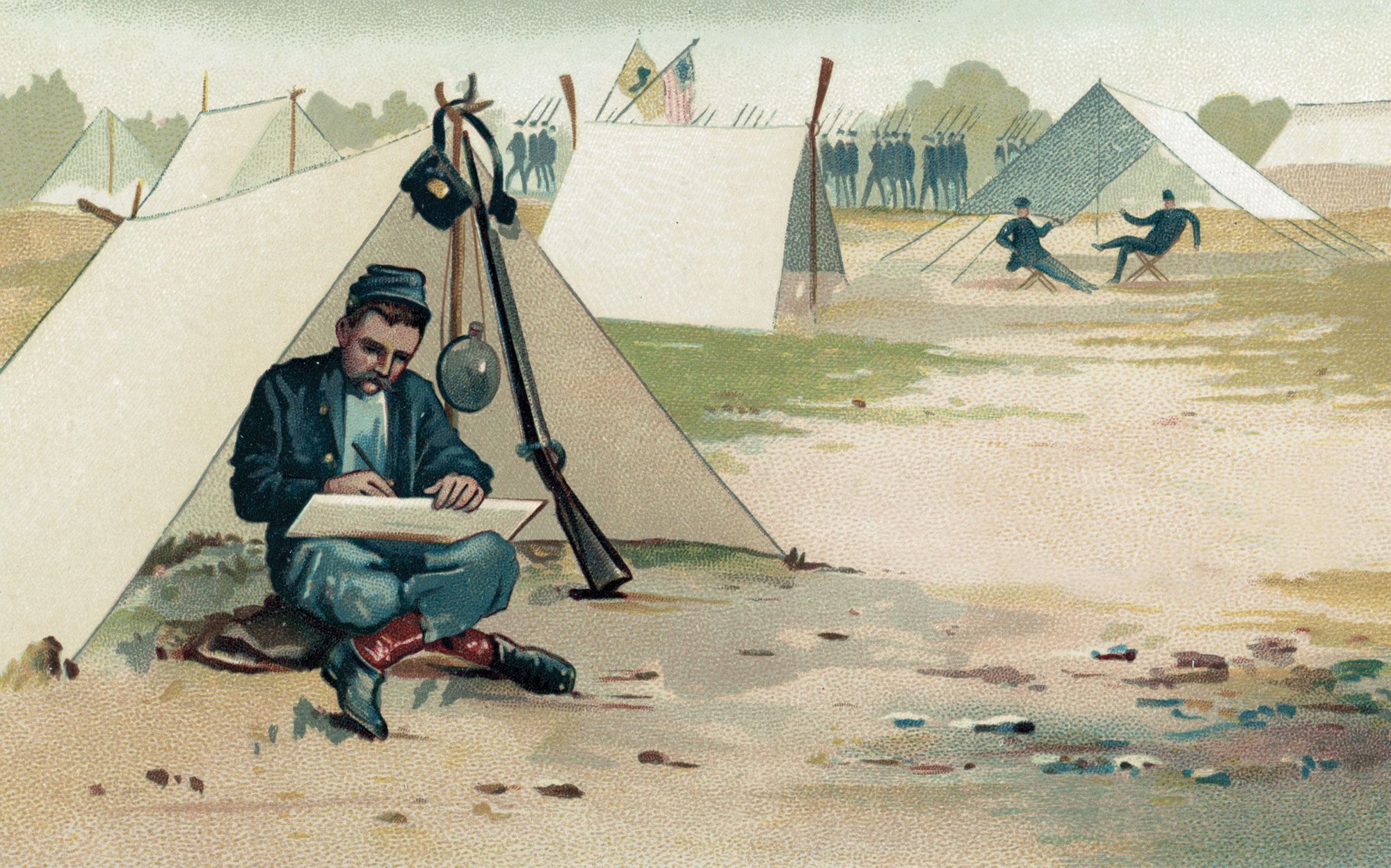 Library of Congress
The Civil War’s awful human cost was paid on battlefields and in hospitals, and extended to the home front, where families and friends were anguished to learn of the loss of a beloved soldier. The terrible news sometimes came on a list of casualties published in the local newspaper. But it often began with a letter from the front reporting the death and offering condolences.
Receiving those tidings, loved ones were shattered by sorrow, families were prostrated with grief, and communities gathered up their sympathies for the bereaved.
Writing a letter of notification and condolence to a deceased soldier’s relatives was a solemn duty. For 19th-century Americans, death was often an intimate family affair. The deathbed was a sacred spot, a place where the family circle closed around its loved one to offer comfort and reassurance and to witness a peaceful passing. To be present at such a deathbed was considered a great privilege; to be unable to attend was greatly regretted. To die alone and unattended, away from the family circle, was a terrible prospect.1
Soldier’s letter envelope Library of Congress
The war disrupted those conventions irreparably. Deprived of anything familiar—parents, siblings, wives, home—dying soldiers looked to surrogates—their comrades of company and regiment—to stand by them on the deathwatch, to bury them and mark their graves, to send the fateful letter. No formal system existed for transmitting the news of a soldier’s death to his family, so the melancholy duty of writing the letter fell to his comrades. Often the regimental chaplain or the company commander or another officer took on the task. Under certain circumstances, enlisted men, hospital personnel, or visitors to the front wrote to the soldier’s home. Historian Drew Gilpin Faust has noted that letters of notification and condolence often followed certain formulas. They offered sympathy to the bereaved, discussed relevant money matters such as pay due the deceased, and provided the type of information about the passing away that a family member would have sought at a peacetime deathbed. Such letters, Faust writes, “sought to make absent loved ones virtual witnesses to the dying moments they had been denied.”2
More than a dozen notification and condolence letters survive concerning members of the 154th New York Volunteer Infantry, a regiment that was raised in Cattaraugus and Chautauqua counties and served in the Army of the Potomac’s XI Corps and the XX Corps of the Army of the Cumberland and the Army of Georgia. The letters are but a small fraction of the number that were written; 232 members of the regiment died in the war. Nevertheless, they form a random sample of the genre and demonstrate how the soldier and civilian writers of these letters responded to this saddest demand of their service and comradeship. The earliest examples concerned soldiers who died of disease before the regiment had experienced battle.
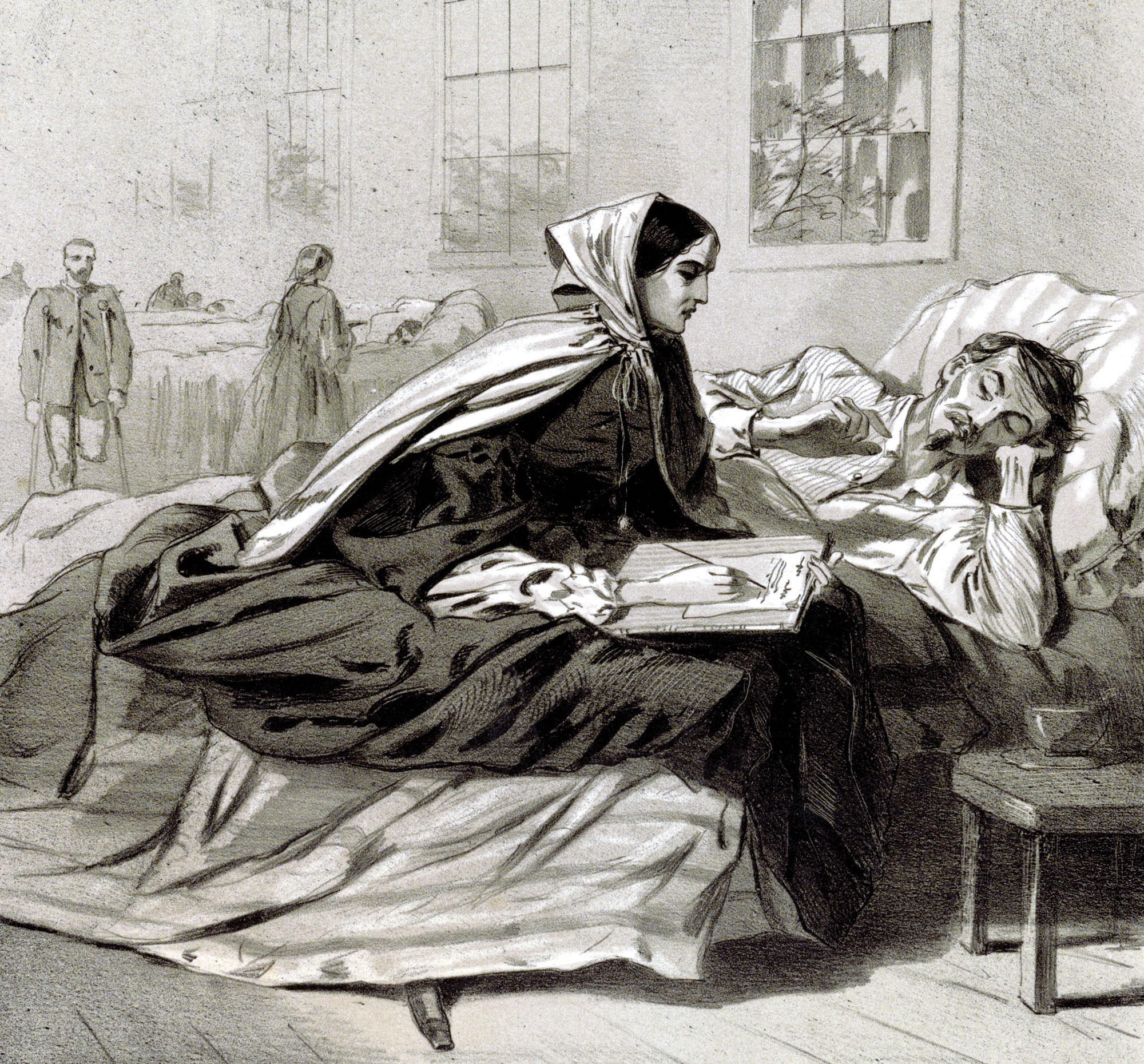 Library of Congress
In this wartime illustration by Winslow Homer, a nurse writes a letter for an ailing Union soldier. Families of hospitalized soldiers relied on staff and caretakers to write them of their loved ones’ last moments.
On rare occasions, a relative managed to reach the bedside of a dying soldier. Such was the case with Private Edward Shults, 22, of Company K, whose brother arrived at the Odd Fellows Hall General Hospital in Washington, D.C., on the morning of February 15, 1863, about an hour before Edward died. Four days later a hospital attendant, Andrew Kemmisen, wrote to Shults’ father in Ellicottville, New York: “I thought you might be gratified to hear more of the circumstances of his sickness and death than your son could give you.” Private Shults had arrived at the hospital six days before he died with a high fever and a rapid pulse; he was generally delirious “and seemed to suffer much, though he did not probably realize it.” Kemmisen and the young soldier shared the Christian faith and discussed religion. “It was painfully interesting to hear him pray and sing and shout,” Kemmisen wrote, “when his mind was all in confusion.” Hospital personnel “did all we could to sooth his pathway to the grave; but we trust he had a friend that was better to him than father or mother, brother or sister.” Attendants made sure Shults remained in bed and gave him water when he thirsted. Wracked with pain, he suffered much on his last night, repeatedly crying, “Jesus, lover of my soul, Let me to thy bosom fly.” His prayer had been answered, Kemmisen believed. Soon after his brother arrived, Shults failed rapidly, and the end came at 11 a.m. as Washington’s church bells tolled to summon the faithful. “Thus passed away a Christian soldier, leaving dear ones to mourn his loss,” Kemmisen wrote; “but you do not mourn as those who have no hope; you have the cheering assurance that he was prepared to die, and that your loss is his eternal gain.” Several witnesses to Shults’ death remarked, “I wish I was as sure of going to Heaven as that young man.” Kemmisen “assisted to lay him out, and I have seldom seen so pleasant a corpse.” He closed by recommending to the bereaved parents the consolation of religion and exhorting all of Shults’ relatives “to secure that preparation for death which will enable them to meet him in Heaven.”3
Shults’ family thought so much of the letter that they shared it with a local newspaper, whose editor commented that it would be read with much interest by Shults’ young friends. Meanwhile Shults’ body—presumably accompanied by his brother—arrived in Ellicottville on March 7, 1863, and was buried the next day in the village’s Jefferson Street Cemetery. “A large concourse of our citizens accompanied the remains to their last resting place,” reported the Cattaraugus Freeman, adding, “Edward was universally loved and respected by all who knew him.”4
 Courtesy of Frances Ortwein (Bull); Courtesy of Holly Ray (Fay)
After Private Eason W. Bull, 25, of Company D, 154th New York Infantry (left), died of disease on February 19, 1863, a comrade, Private Nathaniel S. Brown, wrote Bull’s brother: “It is with a trembling hand and an aching heart that I address you with a silent pen,” he began. “I have lost a bunk mate and a friend.” Right: Joseph B. Fay
Private Eason W. Bull of Company D was 25 when he died of disease around noon on February 19, 1863, at the regimental hospital near Stafford Court House, Virginia. The next day Bull’s tent mate, Private Nathaniel S. Brown, wrote to Eason’s brother, Wyman Bull. “It is with a trembling hand and an aching heart that I address you with a silent pen,” he opened. “I have lost a bunk mate and a friend.” Brown then described Bull’s rapid decline. In just a few days he had been struck successively by a bowel complaint, typhoid fever, delirium, and death. The night before he died, he called out for his nephew Willie, Wyman Bull’s baby son. “He had as good care as could be had,” Brown assured Bull’s brother. “I was with him when he breathed his last.” Brown detailed the location of Bull’s burial spot on a farm about a mile from Stafford Court House, on a little hill at the edge of a pine grove, with a small pine at the head of the grave. “He has had a good burial [compared] to what the most of the poor soldiers have,” Brown wrote. According to family legend, Bull was buried in a hollowed log; his body was later reinterred in Fredericksburg National Cemetery.5
Private William Henry Sprague of Company E died on March 2, 1863, two days before his twentieth birthday, at the division hospital at Stafford Court House. Sprague had kept his parents in Ripley, Chautauqua County, informed of his well-being in a series of letters that began soon after he left home and ended abruptly on February 20. Two days later, he fell ill. His company comrades “did not take any harm about him at first,” according to Private Truman A. St. John, but on February 23, Sprague’s condition worsened. “He was the sickest boy I ever saw,” St. John wrote. “He was crazy as a loon.” Sprague was admitted to the regimental hospital and three of his comrades cared for him through the night. On February 25, St. John wrote to Sprague’s parents that their son had been diagnosed with inflammation of the bowels, but that a doctor predicted recovery. By March 1, St. John wrote that “Henry is a great deal worse,” and had been transferred to the division hospital, where he had been diagnosed with inflammation of the brain and was lying insensible, unaware of his surroundings and unable to recognize his comrades. St. John and Private James F. Bacon “watched the poor fellow in his sleep,” having been summoned to his bedside. “I have not heard Henry say anything about you, nor any of his friends since he has been sick,” St. John wrote, closing his letter with “hoping that poor Henry will be better by morning.”
But the next morning, Corporal William Kendall turned over the letter begun by St. John the previous day and wrote the Spragues that their son had died senseless, leaving many friends who missed him greatly. The company was sending his remains to Brooks Station to be shipped home, accompanied by a comrade, but it was not certain that could be accomplished without a proper pass. Kendall closed with a reflection: “Oh, this unholy war! It’s a disgrace on all of God’s good people.”
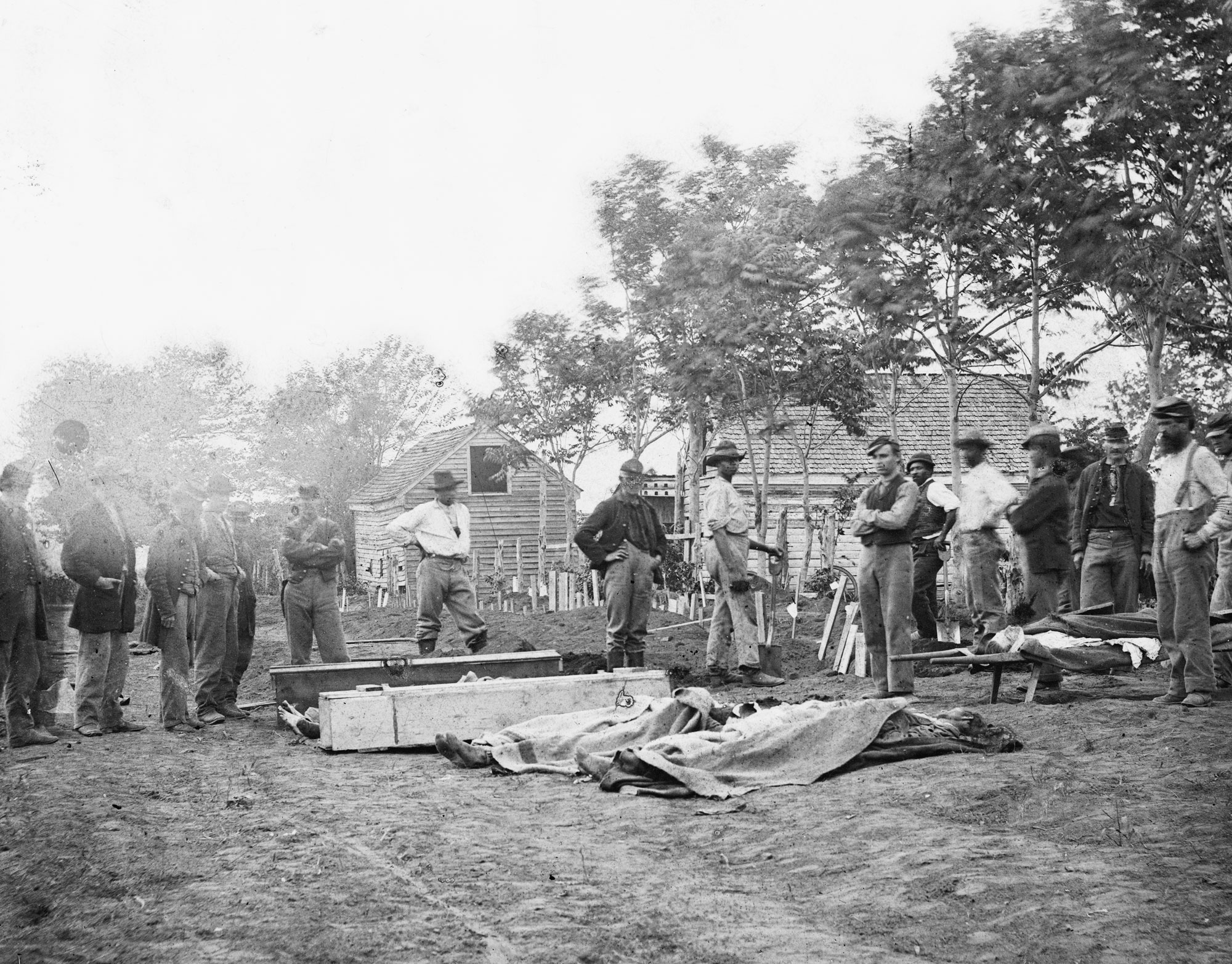 Library of Congress
Soldiers whose bodies could not be sent home for lack of money or transportation were often buried in graves dug by their comrades, who in turn informed the families by letter of any pertinent details. Shown here: Union soldiers prepare to bury men killed during the Wilderness Campaign in 1864.
Later that day, Joseph B. Fay, Company E’s captain, sent official notice of Sprague’s death to his parents and enclosed formal resolutions of regret from the company. He described the suddenness of Sprague’s illness and delirium before his death. “I made every effort to have him embalmed and sent to your care,” Fay wrote, “but could not.” If the Spragues found it proper, they could find the “Sacred Spot” plainly marked near the railroad at Brooks Station. Fay concluded with “I believe all has been done that could be under the circumstances in which we are placed.”
Two weeks later, St. John described to the Spragues the unsuccessful effort to have Henry’s remains sent home. The family had made the request, and the company had raised money to grant it, but the lack of a proper pass—as Kendall feared—had thwarted the plan. Sprague had been buried in uniform in a “good rough board coffin,” his headboard clearly marked with name, company, and regiment. It would cost a great deal to transport his body home at that late stage, St. John wrote, and he advised the family “to let him rest where he now lies.” He was buried “in peace,” St. John stressed in a tender passage expressing his personal sympathy to the family.6
The resolutions of regret adopted by Sprague’s company have not been located, but no doubt they closely resembled surviving examples. Copies were sometimes sent to hometown newspapers in addition to the deceased’s family. Such was the case with the preamble and resolutions passed by Company E on the death of Private Eleazer Swetland at the brigade hospital in Lookout Valley, Tennessee, on March 21, 1864. They extolled Swetland as one of the company’s “most faithful members, a true-hearted gentleman, a sincere patriot, and one who was beloved by us all,” and extended warm sympathy to his friends and relatives, “especially to his youthful widow.” Copies of the resolutions were sent to four Chautauqua County newspapers for publication.7
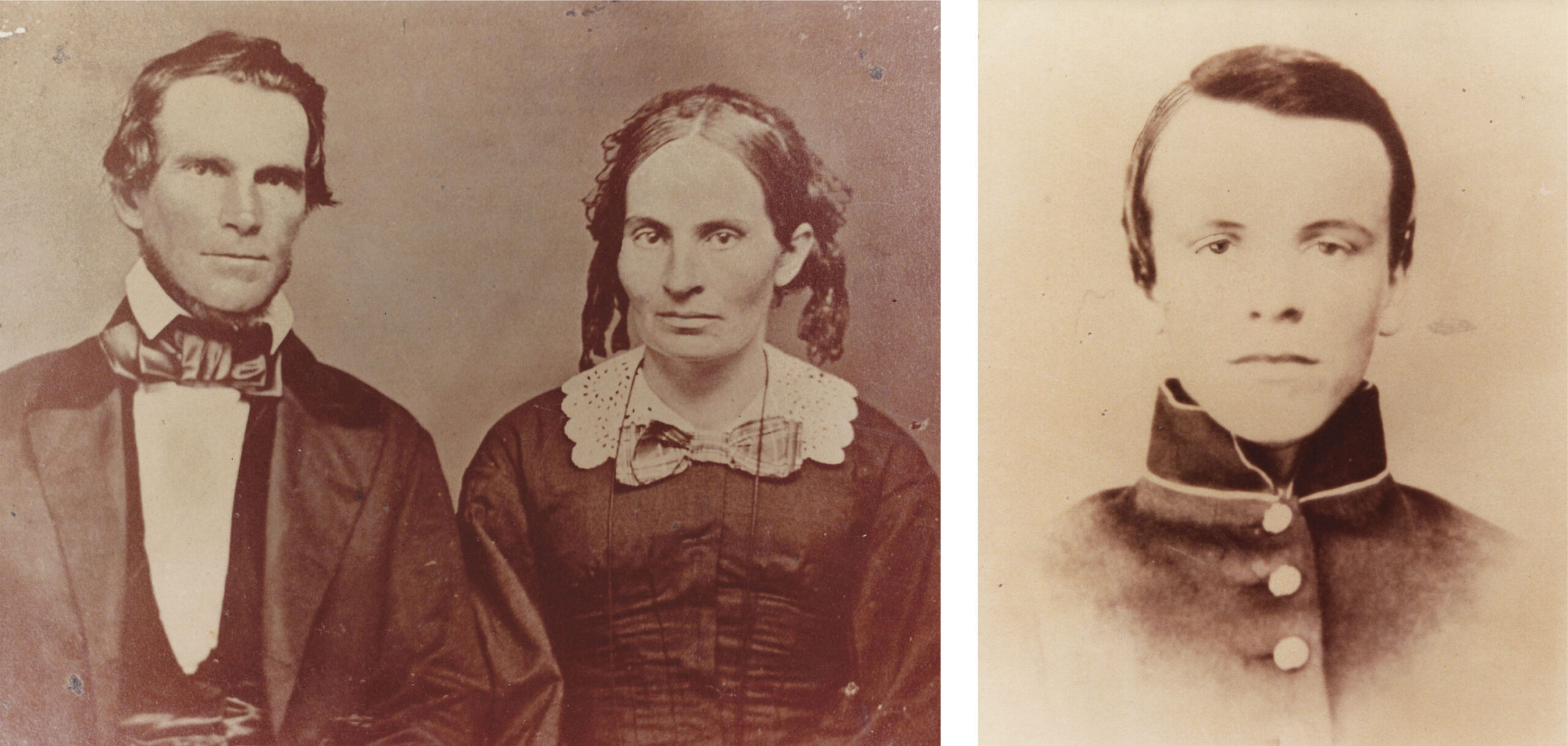 Courtesy of Gerald Merrill
Barzilla and Ruba Merrill (left) and Alva Merrill (right)
In resisting the Confederate flank attack on the XI Corps at the Battle of Chancellorsville on the evening of May 2, 1863, the 154th New York suffered 240 casualties out of 590 men present for duty, a 40 percent loss rate and the fourth-highest Union regimental casualty count in the fighting. Twenty-nine men were killed and nine mortally wounded, among them Private George P. Southeron of Company A. Southeron was wounded in the hip and remained for days on the battlefield, which was held by the Confederates, until he was transported by ambulance to the division hospital near Brooks Station. On May 18, 1863, Chaplain Henry D. Lowing wrote to Southeron’s wife. “He suffered very much on the field and in riding in the ambulance, but we hope the worst is now over,” Lowing reported. “He has good care and everything done for his comfort that can be under the circumstances. He says that in all his suffering Jesus has been a friend that sticketh closer than a brother and has comforted him in all his trials. Never he said did his promise appear so precious and you [must] be assured by me that He will stand by him to the end.” That came six days later. Presumably Lowing notified Mrs. Southeron of her husband’s death in another missive.8
No notification and condolence letter concerning the Chancellorsville casualties could have been more poignant than the one an assistant surgeon, Corydon C. Rugg, wrote in response to an inquiry from Mrs. Ruba Merrill of Dayton, Cattaraugus County, New York. It was his “painful” duty to inform her that her husband, Barzilla, 45, and their son, Alva, 18, both privates in Company K, had been killed. Rugg related what little he knew about their deaths: Her husband was slightly wounded in the shoulder before being shot in the head and neither of their remains could be recovered. Corpses of the Union dead on the Confederate-controlled battlefield had been “thrown together in piles and covered up.” Rugg wrote bluntly, “It would be more difficult to find your son than your husband and you might as well look for a gold dollar in the sea as to try to find either of them.” Retrieval of any of the regiment’s dead was “an utter impossibility.” “As I can write nothing which can bring you consolation (and as there is but one that can give consolation in such cases),” Rugg closed with “you will of course look to that source for the same.”9
Two months after Chancellorsville, the 154th New York was decimated on July 1, 1863, in the first day of fighting at Gettysburg. The regiment took 265 officers and men into the battle and suffered 207 casualties, a loss ratio of 78 percent. Among them were five killed, six mortally wounded, and 173 taken prisoner (roughly a third of whom died as prisoners of war).10
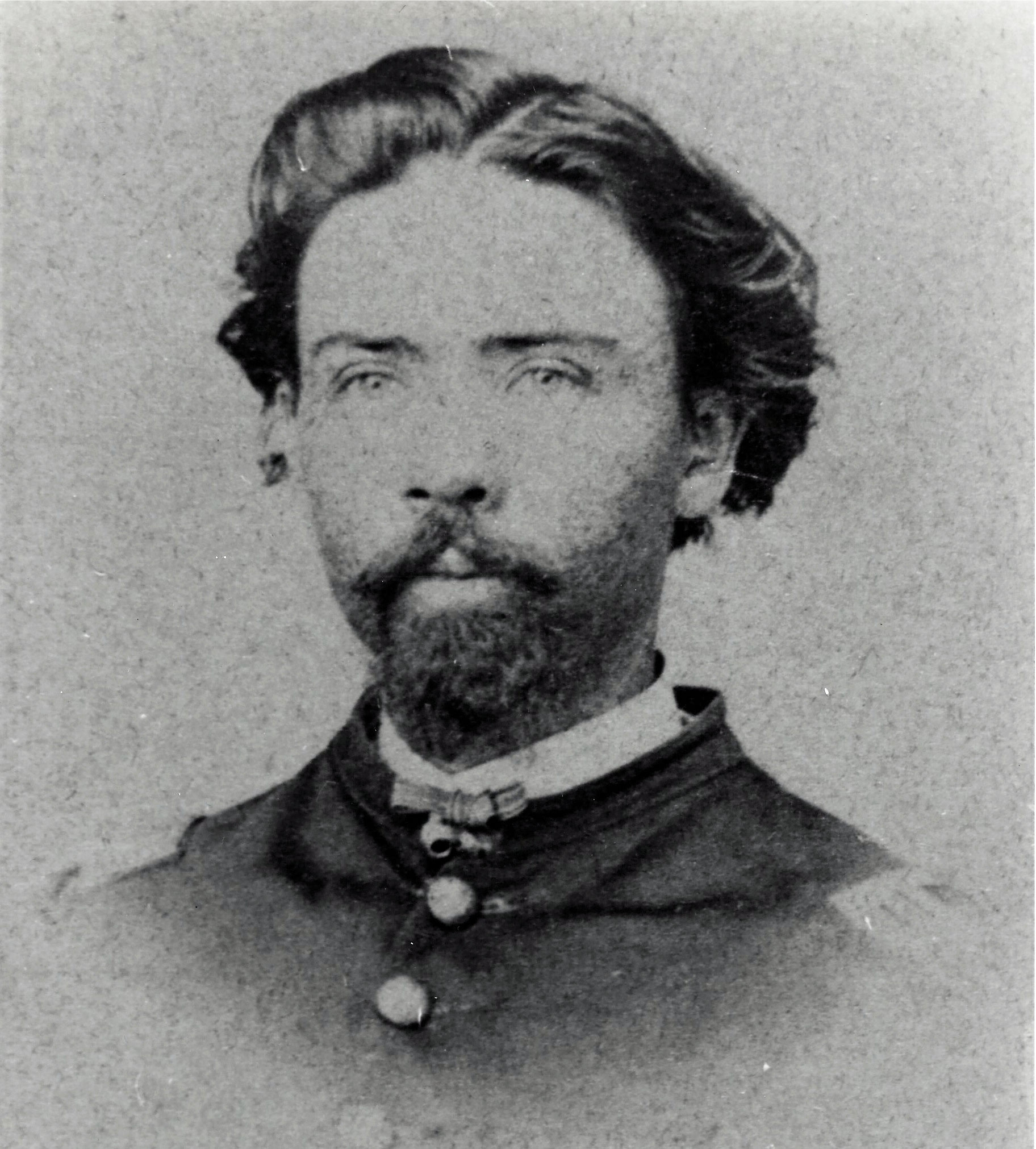 Courtesy of William C. Welch
James M. Gallagher
One of the mortally wounded was Thaddeus L. Reynolds, 18, a musician of Company I from Olean. News of his death (he was the only member of the regiment wounded on July 3) was sent to his father by James W. Phelps, of Great Valley, Cattaraugus County, who visited the 154th’s wounded after the battle and described the visit on his return home. He had reached Gettysburg on July 8 and found Reynolds in a tent with seven regimental comrades at the XI Corps hospital on the George Spangler farm. Reynolds “knew himself to be dangerously wounded,” Phelps reported, “but did not suffer much, considering the extent of his wounds.” Shell fragments had shattered Reynolds’ left hip and damaged his left hand, which had been partially amputated. Assistant surgeon Dwight W. Day of the 154th New York expressed surprise that Reynolds had lived more than a few days. Reynolds was quiet or sleeping during Phelps’ first two days in Gettysburg, but on July 11 lockjaw set in. By the next morning his condition had worsened and he was in much pain. A doctor ordered that he be chloroformed, and Reynolds died under its influence that afternoon.
Phelps gave money to an agent of the United States Christian Commission to purchase a coffin for Reynolds. “None but the cheapest can be obtained,” Phelps noted, “and very few of them.” The grave was plainly marked and the remains could be recovered if the family so desired. “You would have no difficulty in identifying the body from certain peculiarities,” wrote Phelps, who sent Reynolds’ personal effects to the family. He closed by relating some of Reynolds’ last thoughts. “He said he prayed that God would spare his life, but if not His will that he might be resigned to leave this world.” The day before he died, he spoke of his father’s poor health, saying he “feared his death would kill his Father.” Phelps closed by assuring the family that Dr. Day and regimental comrades had done all they could for the sufferer’s comfort.11
 Library of Congress
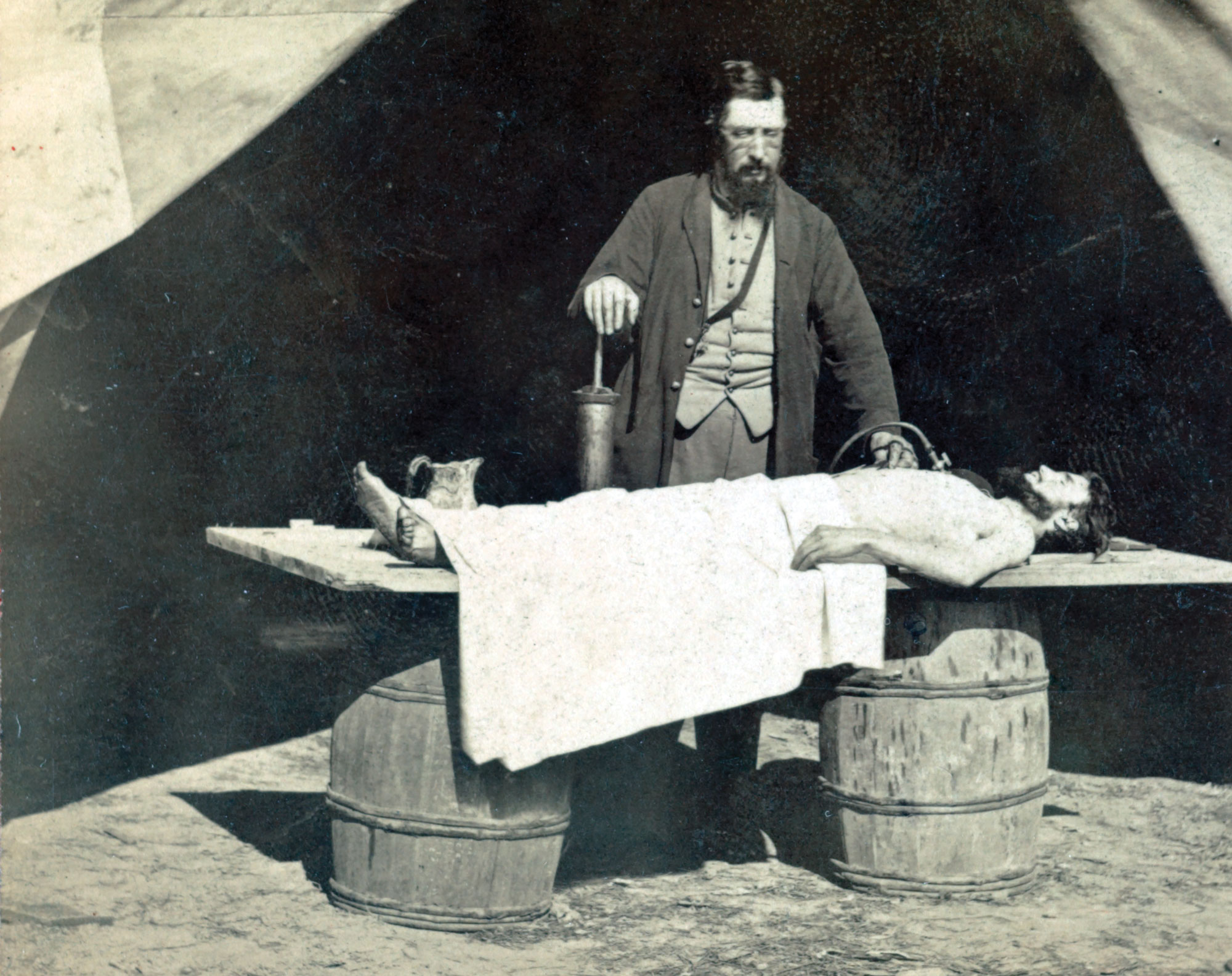
When it was possible to send a soldier’s remains home, comrades might have the body embalmed if it were possible. Shown here: Dr. Richard Burr, an embalming surgeon in the Union’s Army of the James, demonstrates the procedure on a body.
The personal items that Phelps sent to Reynolds’ family went unrecorded. The accounting of documented soldiers’ effects still conveys sadness more than a century later. When, during the Atlanta Campaign, Corporal Hugh Erwin of Company F died of fever on June 4, 1864, at the Second Division, XX Corps hospital at Acworth, Georgia, his company comrade Private William D. Harper recorded his possessions: two wallets, a silk handkerchief, a ring, a “housewife” containing scissors, needle, and thread, and three dollars in greenbacks and nine cents in coins. Sergeant Charles H. Brown of Company F died of congestive intermittent fever at the division hospital at Springfield, Georgia, on December 7, 1864, during the March to the Sea. When the 154th reached Savannah, Private Edson D. Ames of Brown’s company sent the sergeant’s effects home in a cigar box.12
Wilber Moore, 18, enlisted at Jamestown and served as a private in Company H. In mid-September 1863, while the depleted 154th New York was transporting new troops to the front from Alexandria, Virginia, Moore took sick. On September 22, his company comrade Corporal James M. Gallagher wrote to Wilbur’s mother, Emeline Moore, forwarding Moore’s allotment check for $60 and notifying her of his condition. He had been sick for two weeks but seemed to be improving. He was a “noble young man” of a “pure and innocent character” seldom found in the ranks. Gallagher hoped he would recover and return to the company in good health. Those hopes were dashed two days later, when Moore died at the division hospital of typhoid fever.
Gallagher wrote again to Emeline Moore the next day, describing three visits to the hospital on the night her son died. In the last he found Moore weak and pale, yet perfectly sensible and aware of his fate. He asked Gallagher “to send him home, to his mother. This I promised to do.” He asked Gallagher to hold his hand, and about a half-hour later he slipped away “very easily; without a struggle.”
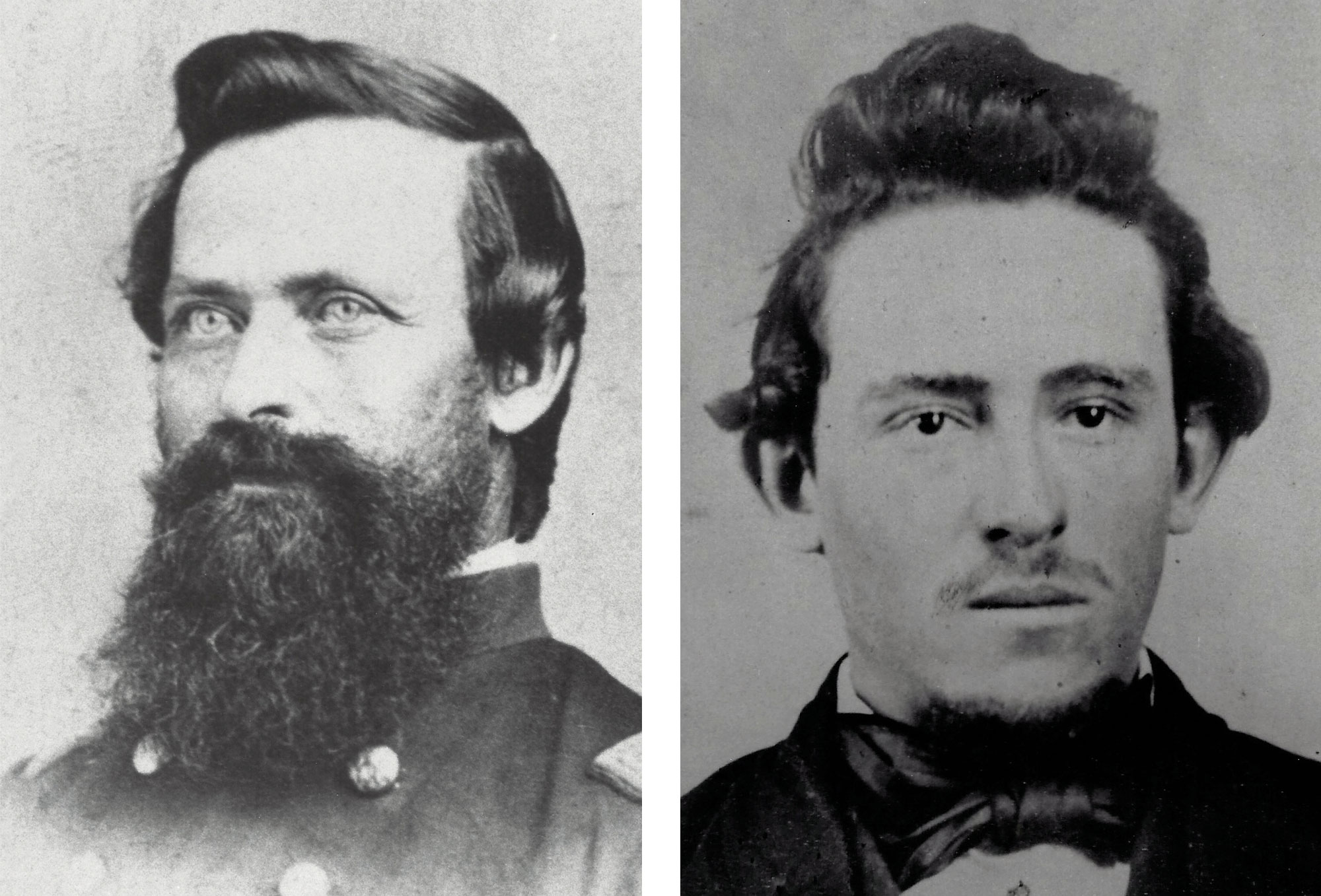 New York State Adjutant General’s Office (Warner); Courtesy of Richard D. Champlin (Champlin)
Lewis D. Rarner (left) and Martin Van Buren Champlin
Gallagher had Moore’s body embalmed and sent home by express to Steamburg, New York. “If you wish to take the corpse from the coffin that it is in,” he informed Mrs. Moore, “you can do so with safety.” Gallagher enclosed receipts for the embalming, shipping, and a telegram, totaling $53.50. Then he got down to business. Moore’s wages covered $16 of the expenses, leaving a total of $37.50 that Gallagher had borrowed to send his body home. If Company H were large, he would not ask Mrs. Moore to pay the bill, but the men were few and their wages small; her recompense would be welcome. He would try to send her son’s pocketbook and handkerchiefs; the rest of his clothing he would credit to Moore’s account on the company books.
Gallagher closed his letter with a well-phrased tribute to the departed’s “character and private conduct,” testifying that Moore was “a noble boy with a true, manly soul,” kind, generous, affectionate, strictly moral and upright, surrounded by warm friends and good associates, and highly beloved and respected by all. “And his memory shall ever remain as a brilliant jewel at the bottom of every heart in his company,” Gallagher closed. “You may well feel proud of your son, & know that his memory is cherished here in the army where his noble & brave deeds have become familiar to all who knew him.” Whether Mrs. Moore reimbursed Gallagher is unknown.13
Sometimes an officer could not find the words to notify a loved one of their loss. Such was the case when Private Isaiah S. Washburn of Company C died on December 11, 1863, at the XI Corps hospital at Chattanooga, Tennessee. He was 39 and had enlisted the year before; he left a wife and children in Hinsdale, Cattaraugus County. When Washburn’s townsman, First Lieutenant and Quartermaster Timothy A. Allen, could not complete a letter to his satisfaction, he turned to Sergeant William Charles of Company F, the regimental armorer, for help. Charles finished the letter with the assertion that God would be a protector to the widow and a father to the fatherless, and that Washburn had “died for a noble cause, battling for his country, freedom, and the dearest rights of man.”14
The fates of many injured members of the 154th who had been left behind on the fields at Chancellorsville and Gettysburg were unknown. Consequently, some letters were written months after the battles, when a soldier’s death was finally ascertained. Martin Van Buren Champlin, 21, enlisted at Portville, Cattaraugus County, and served as a private in Company C. Almost a year after Chancellorsville, Major Lewis D. Warner sent a businesslike reply to an inquiry by Peter Keyes, whose relationship to Champlin is unknown. He described how the regiment “beat a precipitate retreat” from the battlefield, leaving its casualties behind, and that there was “no reasonable doubt” that Champlin had been killed; a company comrade had seen him “fall on his face as if very severely wounded, if not killed outright.” Warner closed with a statement of Champlin’s due pay and bounty, and stated that his account could be settled at the proper department in Washington.15
Nineteen members of the 154th were killed or mortally wounded during the Atlanta Campaign. Among them was Private Lewis L. Jones of Company F, who was 20 when he enlisted in his hometown of Freedom, Cattaraugus County, in 1862. He was shot in the wrist and hip at the Battle of Dug Gap on Rocky Face Ridge on May 8, 1864, and was sent to General Hospital No. 1 at Nashville, Tennessee, where he died on June 3, 1864. Sergeant John M. Irvin of Company F, who had also been wounded at Dug Gap, sent a letter the same day to Jones’ father. Irvin reported that gangrene had set into Jones’ wound, causing his death. Irvin enclosed receipts for the elder Jones to sign if he wanted his son’s remains to be sent home; in the meantime, Jones would be buried in the hospital cemetery and his grave marked. Irvin enclosed a lock of Jones’ hair, “for I know that friends often desire such.” He closed by stating that Jones had five months’ pay due, and offering to provide any other information he could.16
James D. Quilliam was 26 when he enlisted in 1862 at Westfield, Chautauqua County. A private in Company E, he was wounded in the face by a spent ball at Gettysburg, and stayed on as a nurse at Gettysburg hospitals until September 1863. During the Atlanta Campaign Quilliam was severely wounded in his ankles and thigh in fighting near Pine Knob. He died on July 8, 1864, in Ward 7 of General Hospital No. 1 at Nashville. Later that month, Quilliam’s wife, Rhoda, received a terse note from J. Poncher, the hospital’s chaplain: “This book belonged to Mr James Quilliam, of Co. E 154th N.Y. He died July the 5th [sic.]”17
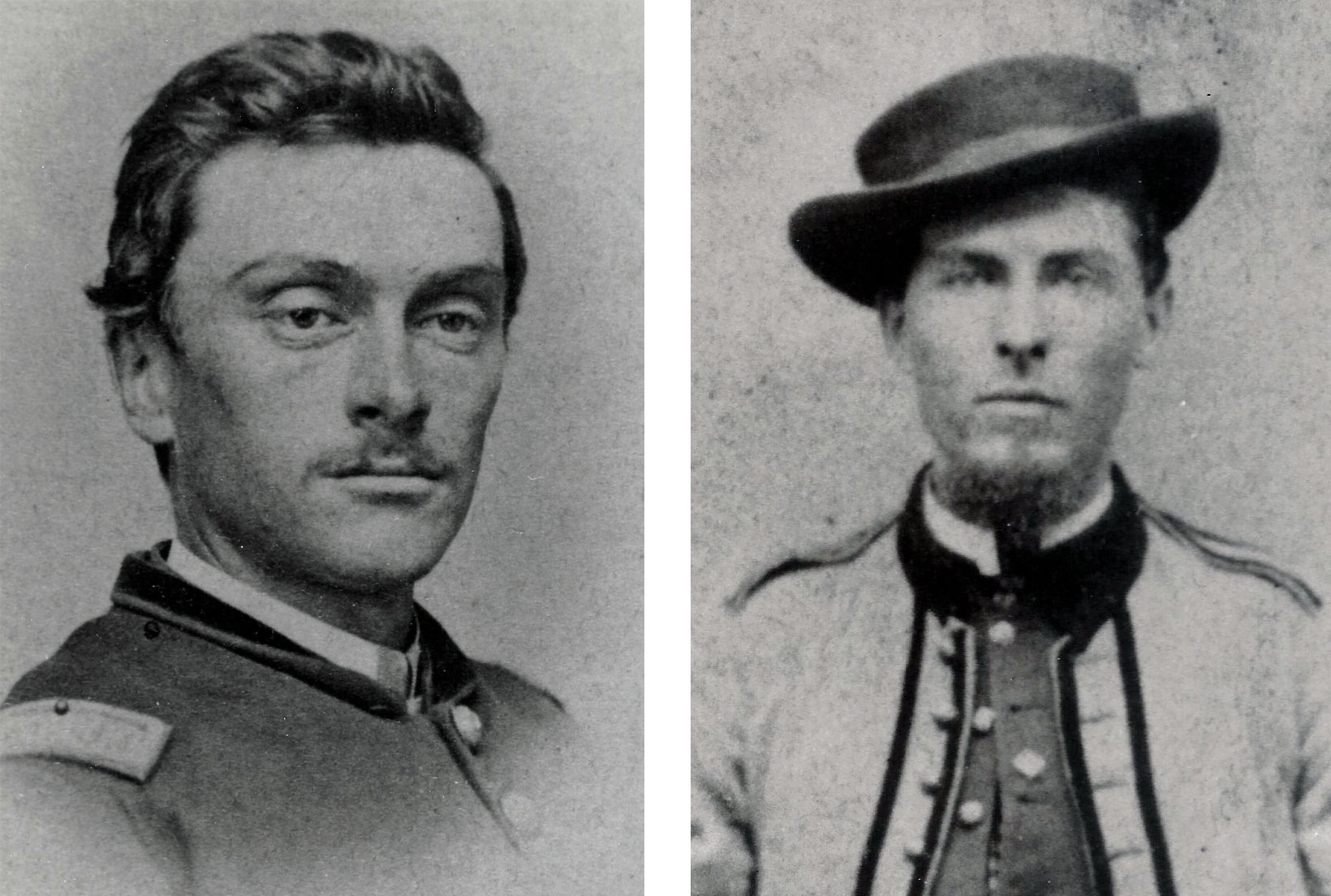 Courtesy of William C. Welch (Benson); Courtesy of Isabel Cross (Irvin).
Alfred W. Benson (left) and John M. Irvin
During the March to the Sea, near Springfield, Georgia, on December 7, 1864—the same day that Sergeant Charles Brown died of disease at the division hospital—a shocking accident took the life of Private Jesse D. Campbell of Company D, from the Cattaraugus County town of Lyndon, who had enlisted at 22. When the regiment reached the vicinity of Savannah and was once more able to send mail, Campbell’s company commander, Captain Alfred W. Benson, described the circumstances of Campbell’s death in a letter to his father. Campbell and two comrades had gone ahead of the regiment to forage some potatoes from a roadside field. As they sat waiting for the regiment to arrive, Campbell reached for his musket, which was leaning against a fence. As he drew it to him, the hammer snagged on the ground or some weeds and the weapon fired a round into Campbell’s chest, killing him instantly. His comrades buried him on the spot. “Thus perished one of the noblest and bravest of soldiers, and a virtuous and ever faithful Christian,” Benson wrote. “The moral purity of his character and his ever kind and genial disposition had endeared him to all his comrades in arms, and we mourn the departed as a brother, and will ever cherish his memory as one of the bravest and truest of the many who have fallen in this bitter contest.” Benson closed with a prayer that the “Good Angels” would sustain the bereaved family.18
Marshall A. Perkins, 22, from the Cattaraugus County town of East Otto, was a sergeant in Company B when he was wounded in the shoulder at the Battle of Peachtree Creek on July 20, 1864. While recovering from his wound at the general hospital at Jeffersonville, Indiana, he contracted diphtheria. On January 4, 1865, Perkins notified his parents that he was gaining slowly and enjoying a diet of turkey, chicken soup, baked pudding, mashed potatoes, bread and butter, and milk. “My arm gains slow,” he wrote. “I can hold some things in my hand.” He died 10 days later. An officer of the Veteran Reserve Corps, Second Lieutenant S.H. Morrison, sent the news to Perkins’ father in a brusque letter: “It becomes my painful duty to inform you that Sergt. Marshall A. Perkins Co. B 154 N.Y. Vols. died in this hospital today of inflammation of the lungs. Enclosed you will find two receipts of his effects which you are requested to sign and return to this office with proper directions for their transmittal to you by express. For all further information you will address Chaplain C.W. Fitch at this Hospital.” Whether the elder Perkins contacted Chaplain Fitch is unknown.19
Almon L. Gile, 23, was first sergeant of Company C when he was captured at Gettysburg. The war was winding down when former major Lewis D. Warner, now lieutenant colonel commanding the 154th, responded to a letter of inquiry from Gile’s brother. Warner’s response indicates the uncertainty surrounding the fate of many Gettysburg prisoners. Gile reportedly had died in August 1864 at the prisoner of war camp at Andersonville, Georgia, of “scrofula and general debility” brought on by exposure and insufficient and substandard food. After Warner discussed
the money Gile had coming, he praised his “moral character, his social qualities, his zealous performance of his duties, and whole bearing as a soldier & a man.” Had Gile lived, Warner wrote, he would have risen to a captaincy. Then Warner’s letter turned into a diatribe against “Rebel malevolence, and disregard of every claim of humanity” in the treatment of Union prisoners. “Had they drawn their prisoners up in line and at [a] signal deliberately shot them,” Warner declared, “the act would have been praiseworthy and commendable compared with the deliberate murder by inches which our brave boys have undergone.” Gile died of chronic diarrhea at Andersonville on September 10, 1864, and is buried in Grave # 8317 of the Andersonville National Cemetery.20
Writing to loved ones of the deceased, comrades of the 154th New York attempted to narrow the distance between a deathbed at the front and a family at home. They described in great detail the soldier’s last hours, sparing no particulars of pain and suffering. They were careful to detail the nature of mortal wounds. They provided a clear picture of how a soldier died. Comrades related how they cared for the dying. They relayed messages and statements from dying soldiers to their loved ones and even reported the absence of messages. When the end came, comrades attempted to have soldiers’ remains embalmed and sent home; failing that, they did their best to ensure a good burial and a well-marked grave.
Comrades offered loved ones praise of the good character of the deceased. Formalizing their respects, comrades composed and presented resolutions to the families of departed soldiers, and made their eulogies public on the pages of hometown newspapers. Comrades tendered the solace of religious consolation to the bereaved, entrusting mourning loved ones to a merciful deity.
Comrades sent the soldiers’ personal effects home to their loved ones. They also took care of the business dictated by military regulations, handling matters regarding wages, ration allotments, sutler’s accounts, clothing allowances, receipts for effects, bounties, and final statements of the departed.
Strangers were not always as caring as comrades in informing loved ones of their loss. Notifying Marshall Perkins’ father of his son’s death, Lieutenant S.H. Morrison wrote with the impersonal detachment of a commissary officer discussing rations. Chaplain J. Poncher likewise sent an unfeeling note to the widow of James Quilliam. But strangers sometimes displayed the same compassion that the soldier’s comrades did. From the Odd Fellows Hospital, Andrew Kemmisen wrote an exemplary letter of sympathy to Edward Shults’ father. The letter that James Phelps sent to the father of Thaddeus Reynolds contained many of the hallmarks of compassionate letters composed by a man’s fellow soldiers.
“We mourn the departed as a brother,” Alfred Benson wrote of Jesse Campbell. Whether written by a brotherly comrade or a sympathetic stranger, the best letters of notification and condolence brought loved ones’ imaginations to the side of their dying soldier, and helped them witness his departure from the mortal coil.
Mark H. Dunkelman of Providence, Rhode Island, has written and lectured extensively on the history of the 154th New York Infantry. He led the drive to erect a monument to the 154th at Chancellorsville and designed the mural at Coster Avenue in Gettysburg that depicts the regiment in action on the battle’s first day. His work was spotlighted in our Winter 2014 issue.
Notes
1. Lewis O. Saum, “Death in the Popular Mind of Pre-Civil War America,” in David E. Stannard, ed., Death in America (Philadelphia, 1975), 30–48; Drew Gilpin Faust, This Republic of Suffering: Death and the American Civil War (New York, 2008), 6–11; Mark S. Schantz, Awaiting the Heavenly Country: The Civil War and America’s Culture of Death (Ithaca, NY, 2008), 6–19.
2. Faust, This Republic of Suffering, 14–18, 29–30, 106–109.
3. “Death of Edward Shults,” Cattaraugus Union, March 6, 1863, quoting letter of Andrew Kemmisen to Dear Sir, February 19, 1863.
4. Ibid.; “The remains of Edward Shults,” Cattaraugus Freeman, March 12, 1863.
5. Nathaniel S. Brown to Wyman Bull, February 20, 1863, courtesy of Frances Ortwein. Spelling, case, and punctuation have been corrected in quoting from soldiers’ letters.
6. Presidents, Soldiers, Statesmen (New York, 1898), vol. 2, 1325; Truman A. St. John to William S. Sprague, March 1, 1863; William Kendall to William S. Sprague, March 2, 1863; Joseph B. Fay to William S. Sprague, March 2, 1863; St. John to William S. Sprague, March 16, 1863, all in the Sprague pension file, National Archives (hereafter NA), Washington, D.C.
7. “Resolutions passed by Co. E, 154th N.Y.V.,” Fredonia Censor, April 6, 1864. Swetland is buried in Grave #649, Section B, Chattanooga National Cemetery.
8. Henry D. Lowing to Mrs. Southeron, May 18, 1863, author’s collection.
9. Corydon C. Rugg to Ruba C. Merrill, May 30, 1863, courtesy of Louise Koenig.
10. Mark H. Dunkelman, “We Were Compelled to Cut Our Way Through Them, and in Doing so Our Losses Were Heavy: Gettysburg Casualties of the 154th New York Volunteers,” Gettysburg Magazine, Issue No. 18, 56.
11. James W. Phelps to Mr. Reynolds, July 24, 1863, Reynolds pension file, NA. Reynolds is buried in Grave #118, New York State Section A, Soldiers’ National Cemetery, Gettysburg.
12. Memorandum in back of William D. Harper diary, courtesy of Raymond Harper; Edson D. Ames to his family, March 30, 1865, courtesy of Carolyn Ames Simons.
13. James M. Gallagher to Emeline Moore, September 25, 1863, Moore pension file, NA.
14. William Charles to Ann Charles, December 30, 1863, courtesy of Jack Finch. Washburn is buried in Grave #637, Section B, Chattanooga National Cemetery.
15. Lewis D. Warner to Peter Keyes, April 24, 1864, courtesy of Louise Crooks.
16. John M. Irvin to Mr. Jones, June 3, 1864, Jones pension file, NA. Jones is buried in Grave #9179, Section I, Nashville National Cemetery.
17. Dunkelman, “We Were Compelled to Cut Our Way Through Them,” 47; J. Poncher to Rhoda Quilliam, July 28, 1864, courtesy of Edithe Nasca.
18. Alfred W. Benson to Dexter Campbell, December 20, 1864, Campbell pension file, NA.
19. S.H. Morrison to L. Perkins, January 14, 1865, Perkins pension file, NA.
20. Lewis D. Warner to George L. Gile, April 3, 1865, Gile pension file, NA.