 Natural History Museum
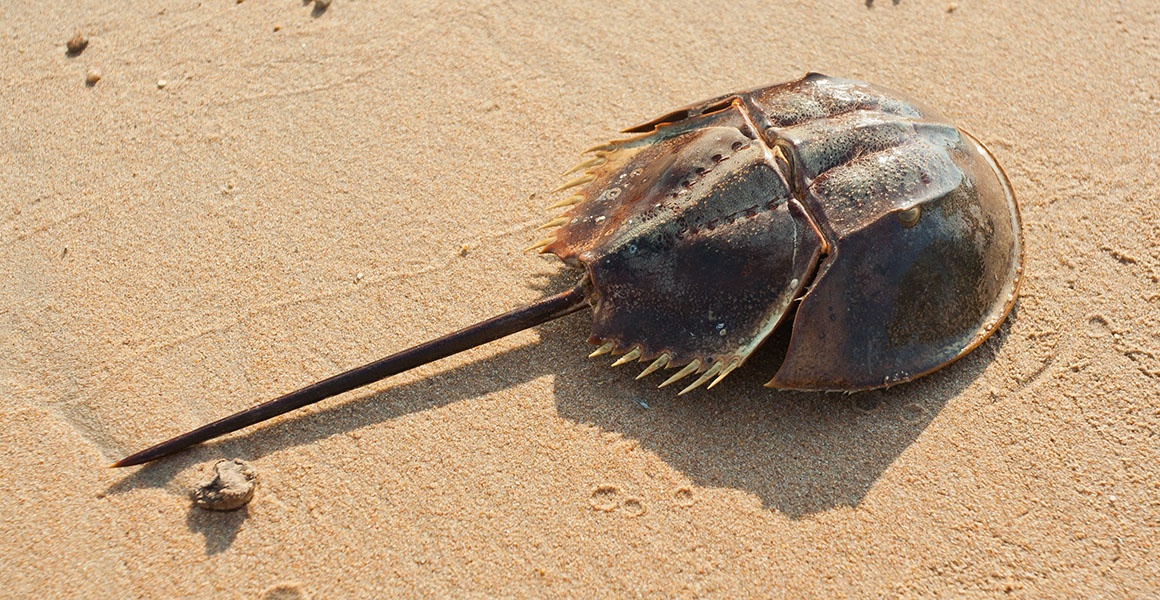
A horseshoe crab
In early 1864, the editors of The Scientific American published the thoughts of a reader from Frankford, Pennsylvania. Identified only by his initials (C.D.K.), the writer had a fantastical idea for a new warship inspired by a crustacean known today as a horseshoe crab. It goes without saying that his idea failed to find any serious backers. C.D.K.’s letter follows in full.
Messrs. Editors:—Perfection is only to be found amongst the numerous specimens of the handiwork of the Great Creator, which he has placed so lavishly around us for our use and instruction, and we should make the proper application of the lessons which are continually placed before us. If we seek color, form, or perfect adaption to the use intended, we can find them all among the many models which nature has given us for guides. It was many years before the principle of the arch was discovered and applied, and yet every human being carried a perfect illustration of it in the arrangement of the bones of his body. And for lighthouses and towers, where we can be found for stays or supports a better system than that shown in the roots of the sturdy oak. The design of the roof of the London Crystal Palace was taken from a leaf. A new and fashionable design for a calico pattern was found to have existed as a fossil many thousands years old. [Bernard] Palissey [sic], the famous potter, discovered in a fossil shell a perfect system of defensive fortification. And now when the public mind and the minds of inventors are run wild over the changed system of warfare inaugurated with heavy guns and shot-proof vessels let us see what nature will do for us. She furnishes a model of an engine of war, which, if made of suitable size, could destroy any vessel now afloat, in spite of iron plates, big guns, and almost anything else. I allude to the species of crab (L. cyclops) the king crab or horse foot found off the coast of New Jersey. This creature is provided with almost everything requisite for a first-class ram ship, and to this I would invite the attention of scientific men and naval constructors. I will not enter into a scientific description of the animal in detail, but will simply state its most prominent features for the purpose specified.
In shape it is like a turtle, covered with a thick shell or armor, and armed with a sharp stylet or prow. The back of it is brought down wedge-shape, which will enable it to have considerable speed through the water. Its propelling power is placed underneath, so that its feet or paddles are hid and are not liable to be injured. It has apparatus to lower and raise itself in the water, around the bow, and it is armed with a row or smaller spikes, which would be sure to strike anything met in its path through the water. A vessel constructed to contain in itself the above-mentioned principles, with the addition of a telescopic smoke-stack and pilot-house, and perhaps a revolving prow, would be really formidable. Manned with a pilot, engineer and fireman, it could attack any vessel with impunity; being submerged when in action, and showing nothing but the smoke-stack, it could approach a vessel without being seen, and then, with its great and weight, it could strike a blow with the force of a dozen “Swamp Angels,” thus utterly demolishing its opponent. If attacked and surrounded by boats, it could raise to the surface, spin around and scatter its assailants like chips. In fact, under almost any circumstances, I can see in a monster king crab admirable means for protection and defense.
Source
The Scientific American, January 30, 1864
Related topics: naval warfare, technology


so beautifully written!