 Library of Congress
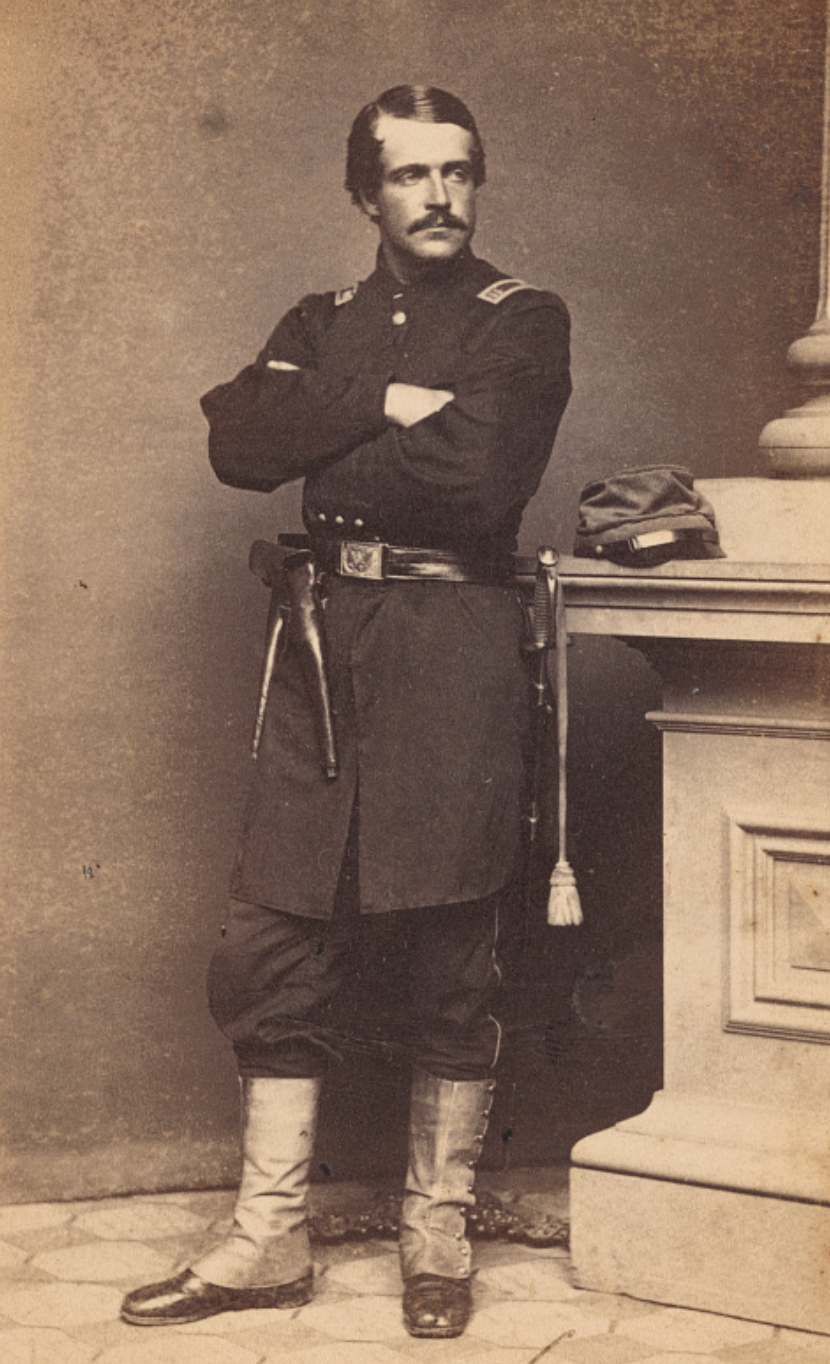
Captain William E. Strong
The cover story of the September 28, 1861, issue of Harper’s Weekly highlighted the recent death-defying exploits of Captain William E. Strong, 2nd Wisconsin Infantry. Correspondent S. Whiteley, writing from Washington, D.C., informed the newspaper’s editor of the unconfirmed tale in a letter dated September 10, 1861. He wrote:
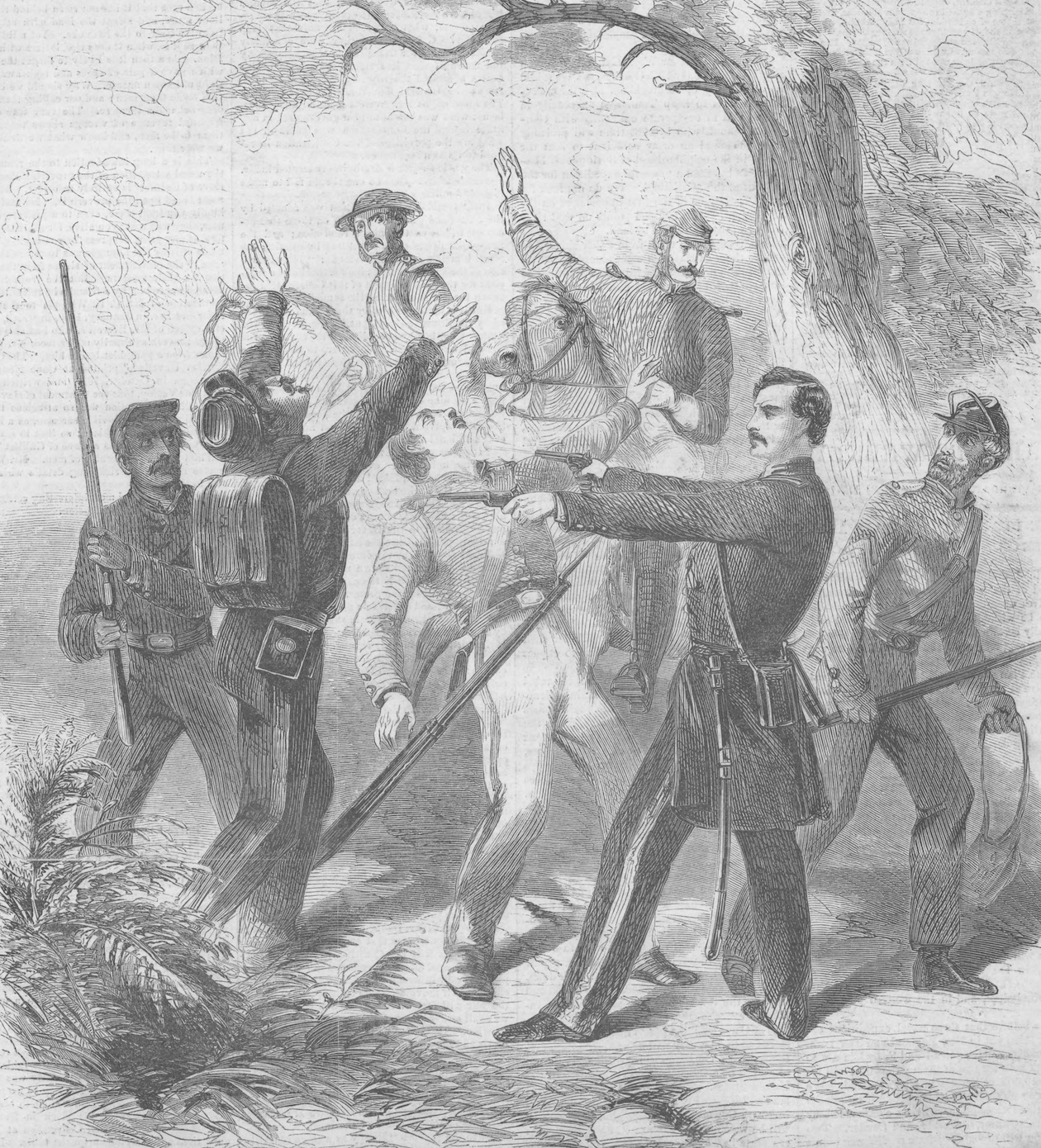
While on duty extending our line of pickets, three miles northwest of Chain Bridge, on Friday last, Captain Strong was taken prisoner. As he neared the river he left three men while, according to the orders of Major [Charles] Larrabee, he reconnoitred, preparatory to assigning them positions. Having proceeded about a quarter of a mile without discovering the slightest trace of the enemy, he returned by a slightly different route to avoid the rough road he had passed over, when he suddenly was surrounded by six rebel pickets—two cavalry and four infantry. The Captain surrendered; and while they marched him about twenty rods, amused themselves by applying the choicest epithets, and promising themselves the pleasure of a hanging bee. The Captain wondered why they did not disarm him, but still did not see any way of escape until one of them, noticing his splendid pair of revolvers, said they would relieve him of them. “Certainly, gentlemen,” said the Captain, drawing them from his belt behind him, and cocking them silently; “here they are!” As he said the words he fired each, and two men fell dead at his feet, while he wheeled and secured cover in some thick bushes, eluding the immediate pursuit of all except two bullets, one of which pierced his canteen, the other, a small round pistol ball, passing through his left check and coming out of his mouth, without injuring a single tooth, but slightly cutting his tongue!
 Harper's Weekly
This illustration of Captain William E. Strong’s “gallant exploit” ran on the cover of Harper’s Weekly on September 28, 1861.
Emerging from the cover of the thicket, he was headed off by one of the mounted men, who presented his carbine close to the Captain’s breast. Here the young man’s presence of mind (or natural shrinking) saved him; for as the horseman fired he suddenly wheeled, the charge penetrating his coat, vest, and shirt (discoloring the buttons), and slightly grazing his body. The rider’s horse bounding forward at this moment, Captain Strong returned the compliment, putting a bullet in the rebel’s shoulder, and had the satisfaction of seeing him fall from his horse, one foot remaining in the stirrup, his head striking the ground and stumps every time the affrighted horse jumped. In a moment more he was met by some of the picket, who heard the firing, completely exhausted from the uneven contest and the loss of blood from his wound.
I have learned the following particulars of Captain Strong. He was born at Granville, New York, and was but twenty years of age on the 10th day of last August. For many years he has resided at Racine, Wisconsin, where his father died about four weeks since. Two years since he was spending a few days at Andover with his uncle before entering the Cambridge Law School. Here, while walking a rope at the gymnasium, he fell, breaking all his ribs on the left side, and his right arm near the wrist. From this time he has never fully recovered. Without entering at Cambridge he returned to Racine as soon as able, prosecuting his law studies in the office of Messrs. Strong & Fuller, and on the memorable 16th of April was admitted to the bar of Racine County. On the 17th, hearing of the fall of Sumter, he opened an enlisting office, and on the same day his company—the “Belle City Rifles”—was full. At Bull Run, he fought bravely, and narrowly escaped from being killed, one ball carrying off his cap, another cutting his sword-belt; and though remaining at the head of his men until the retreat, from exposure, mortification, and pain from his old internal injuries, he had to be carried from the field more dead than alive.
Captain Strong is reckoned one of the best shots in the West—as the records of the “Chicago Audubon Club” will show, and as many of his regiment who saw him shoot while in camp at Madison will attest—for they say he carefully laid his double-barreled gun on the ground about ten paces in front of him, three two pigeons up in the air, turned a “hand-spring,” seized his piece, and brought down both birds!
I can not close this narrative without paying a tribute due to the virtue of temperance. Like our lamented Ellsworth, Captain Strong never drinks intoxicating liquors.
Truly yours,
S. Whiteley
Soon after returning to his regiment, Strong received promotion to major and a transfer to the 12th Wisconsin Infantry. A promotion to lieutenant colonel followed in February 1863. Just before war’s end, in March 1865, Strong was breveted brigadier general for his conduct during William T. Sherman’s Carolinas Campaign. After the war, Strong resided in Chicago, where he rose to president of a lumber company. In 1891, Strong, 50, died during a business trip to Italy. He was survived by his wife, whom he wed in 1867, and their two children.

Thanks for the very interesting information! have you guys ever done any other articles or research on any other Officers or Soldiers of the Second Wisconsin?