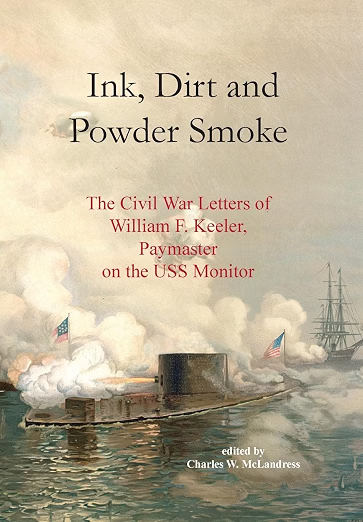
Of the thousands of volunteers who donned the blue uniforms of the United States Navy during the Civil War, perhaps none was as avid a writer as Paymaster William F. Keeler. His copious and detailed letters, first published in the 1960s, have now been republished—this time in their entirety—for new generations to experience.
As a volunteer staff officer, Keeler provides great insight into how the U.S. Navy worked in the Civil War, especially for those not fully acquainted with maritime terminology. He volunteered to serve aboard USS Monitor and was present aboard the ironclad in its initial trials and sailing down the coast; during the famed Battle of Hampton Roads, at the Battle of Drewry’s Bluff, and when it foundered in a storm in December 1862. From there, Keeler joined the blockade aboard the war steamer Florida—serving along both the Atlantic seaboard and in the Gulf of Mexico, as well as taking part in the capture or destruction of several rebel blockade-runners.
Keeler’s letters were kept in the family until the early twentieth century; during World War II, they were purchased by the United States Naval Academy Museum. In the 1960s, academy professor Roberty M. Daly published a two-volume collection of the letters, which have become widely cited in secondary works about the federal navy. Daly’s books, however, are only some of Keeler’s letters, which were significantly trimmed for space.
What makes Keeler’s letters stand out is their detail and humanistic qualities. As a civilian volunteering for naval service, Keeler’s letters contain different details about naval life that career officers typically leave out of their own correspondence. He is not afraid to call out problems or to expose inefficiencies in the service as he adjusted to naval life; nor is he afraid to provide honest looks at his fellow officers. Keeler’s descriptions go beyond battles and combat operations. You will not find a more detailed account of living conditions on a wartime ironclad anywhere.
Ink, Dirt and Powder Smoke is not simply a republishing of those abridged letters. Instead, Charles McLandress provides an unabridged transcription of all of Keeler’s wartime letters (some 170 of them). In addition, McLandress includes biographical information about Keeler and his wife, Anna; a family tree; footnotes elaborating on information in letters which appear on virtually every page; chapter introductions that help set the stage and provide background information; and appendices that provide glimpses into Keeler’s time as a newspaper correspondent, his obituary, and numerous brief biographies of people mentioned in letters. The book also includes a collection of images: of Keeler, the ships he served aboard, and other persons mentioned, as well as several of Keeler’s hand-drawn maps and diagrams of the USS Monitor.
Charles McLandress is the best person to revisit Keeler and his wartime letters. As Paymaster Keeler’s great-great-grandson, he has not simply added more correspondence to the publication, but he provides family context that has never been brought to light. His family connections add great credence to the volume, and his website for the book includes even more background information for any interested readers, including correspondence between the family and Professor Daly when he was editing the letters in the 1960s.
In Ink, Dirt and Powder Smoke, Charles McLandress had compiled, transcribed, and republished in their entirety some of the most important letters from a Civil War era naval officer. They merge technology, politics, and social aspects of the naval war in ways other officers’ writings do not; his descriptions of the ironclad Monitor are the most detailed and personable in existence. This unabridged collection should be widely read by anyone studying the Civil War at sea, ironclads, the blockade, or the trials endured by volunteer officers.
Neil P. Chatelain is an associate professor of history at Lone Star College North Harris and the president and editor-in-chief of Emerging Civil War.