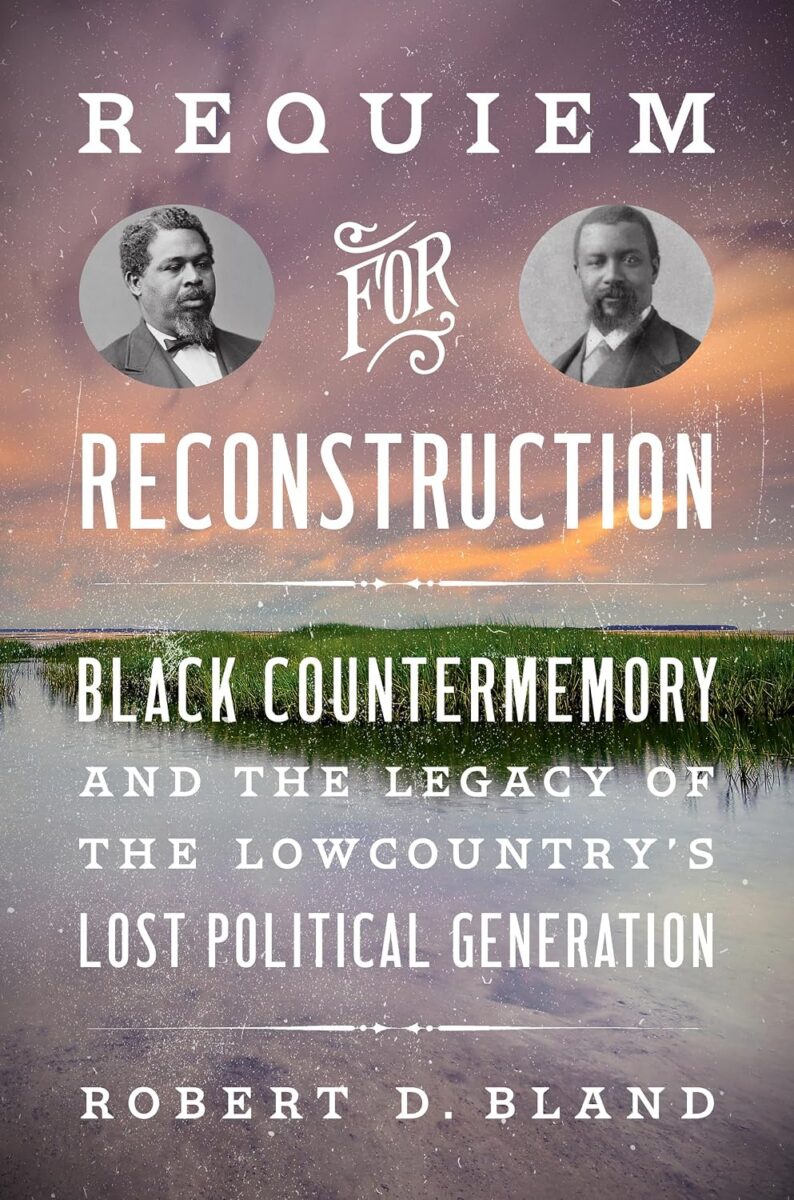
Historians have plowed the historiographic field of Reconstruction in South Carolina for many decades. The fertile soil of the Lowcountry, in particular, has been foundational for many of the most important Reconstruction histories. Into this heady mix comes Robert D. Bland’s book, Requiem for Reconstruction. Like many accounts of the South Carolina Lowcountry, it focuses on Black political leaders, but what makes this book distinctive is Bland’s attention to the memory of Reconstruction. This innovative and refreshing cultural history examines the struggle over the meaning of Reconstruction from the post-Civil War years to the 1920s. Bland argues that the Lowcountry’s political history became foundational for a countermemory that became “the modern intellectual foundation of African American history” (6).
Our understanding of Reconstruction owes much to Lowcountry Black Americans, Bland asserts, who preserved “a rival memory of Reconstruction” (3). They faced long odds in this endeavor. They had the vote taken from them through violence and disfranchisement. They witnessed how Lost Cause propagandists redefined the meaning of the Civil War. Their sense of loss engendered a “psychic and spiritual toll” (5) that was not unlike the post-WWI lost generation. To preserve and restore a countermemory, they had to create a new archive. This included remembering Black Reconstruction leaders locally through cultural traditions, but it also included creating new institutions, such as the Association for the Study of Negro Life and History and its main publication, the Journal of Negro History. A new generation of Black activists and writers “returned to Reconstruction history” (159) for inspiration in their twentieth century struggles against Jim Crow.
The central figure in this story is Robert Smalls, a Civil War hero and thrice-elected congressman. Among the Lowcountry Black leaders during Reconstruction, he stood out. He was born in the region, had been enslaved, and rose through the political ranks in Beaufort. Many other Black politicians, however, were northern transplants and had national aspirations. Indeed, many perceived the Lowcountry as a bellwether for Black success and a place where the destiny of the race could be realized. Bland focuses on the tension between advocates of racial destiny and grassroots leaders, like Smalls, as they weathered the storm of the white supremacist backlash to Reconstruction. Smalls often served as a foil for critics in the national Black press. He was less refined, attuned to machine politics, and willing to explore partnerships with independent parties, such as the populists.
But Smalls emerges in Bland’s retelling as an important figure in the forging of a Reconstruction countermemory. As the space for formal Black politics shrank further in the 1890s, activists and intellectuals created an archive of the Reconstruction generation’s accomplishments. Those sources and memories, for instance, were integral to W. E. B. Du Bois’s seminal Black Reconstruction.
Requiem for Reconstruction is highly recommended for scholars of the Civil War era. Bland offers a fresh perspective on an old history and ably integrates electoral politics with cultural history.
Justin Behrend is professor of history at SUNY Geneseo and the author of Reconstructing Democracy: Black Grassroots Politics in the Deep South after the Civil War.