 Library of Congress
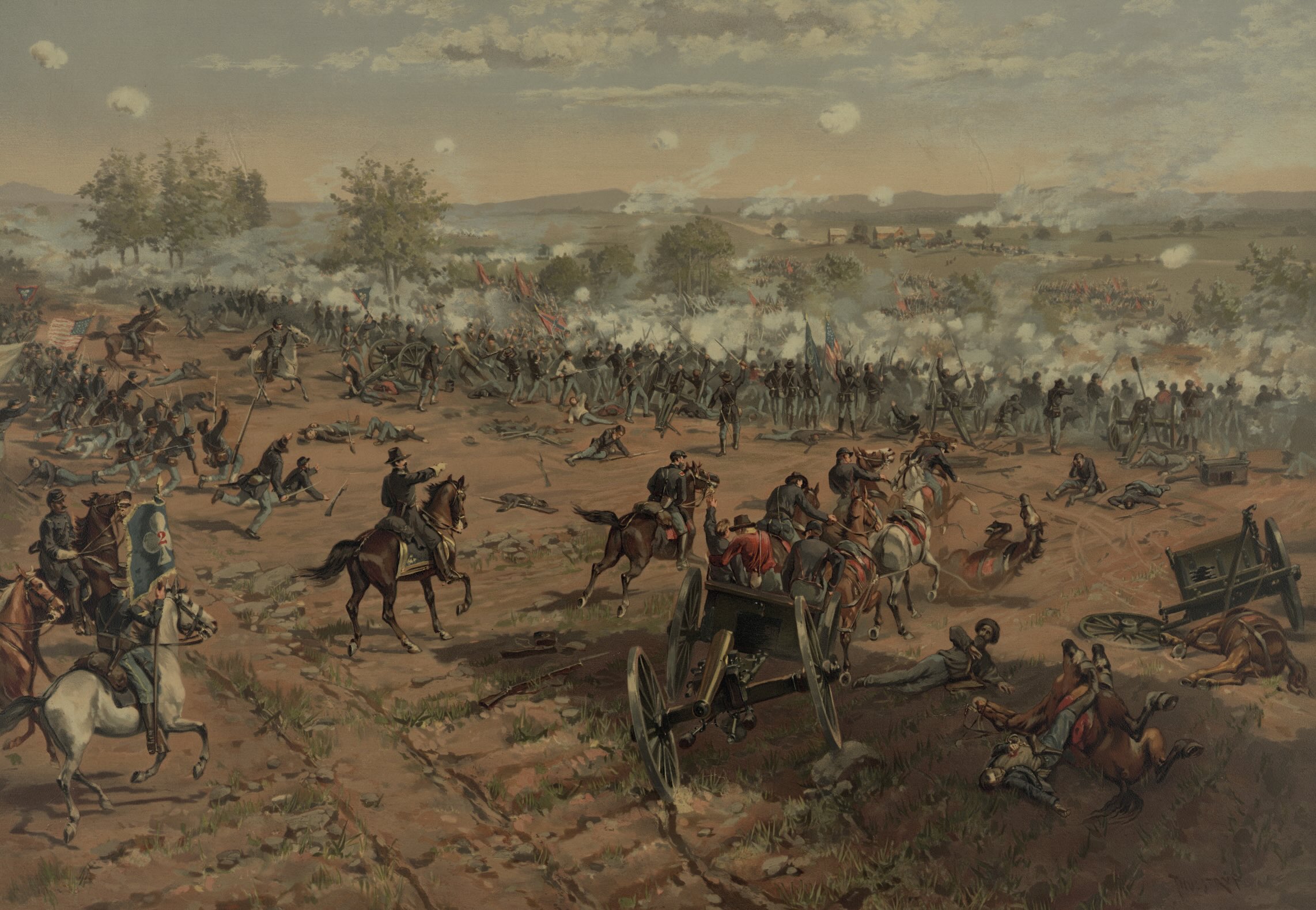
This painting by Thure de Thulstrup depicts the fighting during Pickett’s Charge at the Battle of Gettysburg. A post-engagement heat wave made for miserable conditions for the wounded left behind to recover.
The Battle of Gettysburg, July 1–3, 1863, and its aftermath represent calamities that defy description. Numerous historians have diligently chronicled the care of the sick and wounded in the days, weeks, and months after the battle.1 That said, one aspect of that period remained uncertain for over 160 years: the weather. As it happens, the weather during a key portion of the aftermath proved much worse than historians ever realized, particularly a stretch of extremely hot weather in Gettysburg that August. With most of the care for the wounded taking place outdoors, the weather is certainly a circumstance germane to that subject. However, even those cared for indoors would have experienced the weather in the century before air conditioning. The lack of adequate airflow inside would-be “hospitals” had to exacerbate an already terrible situation.
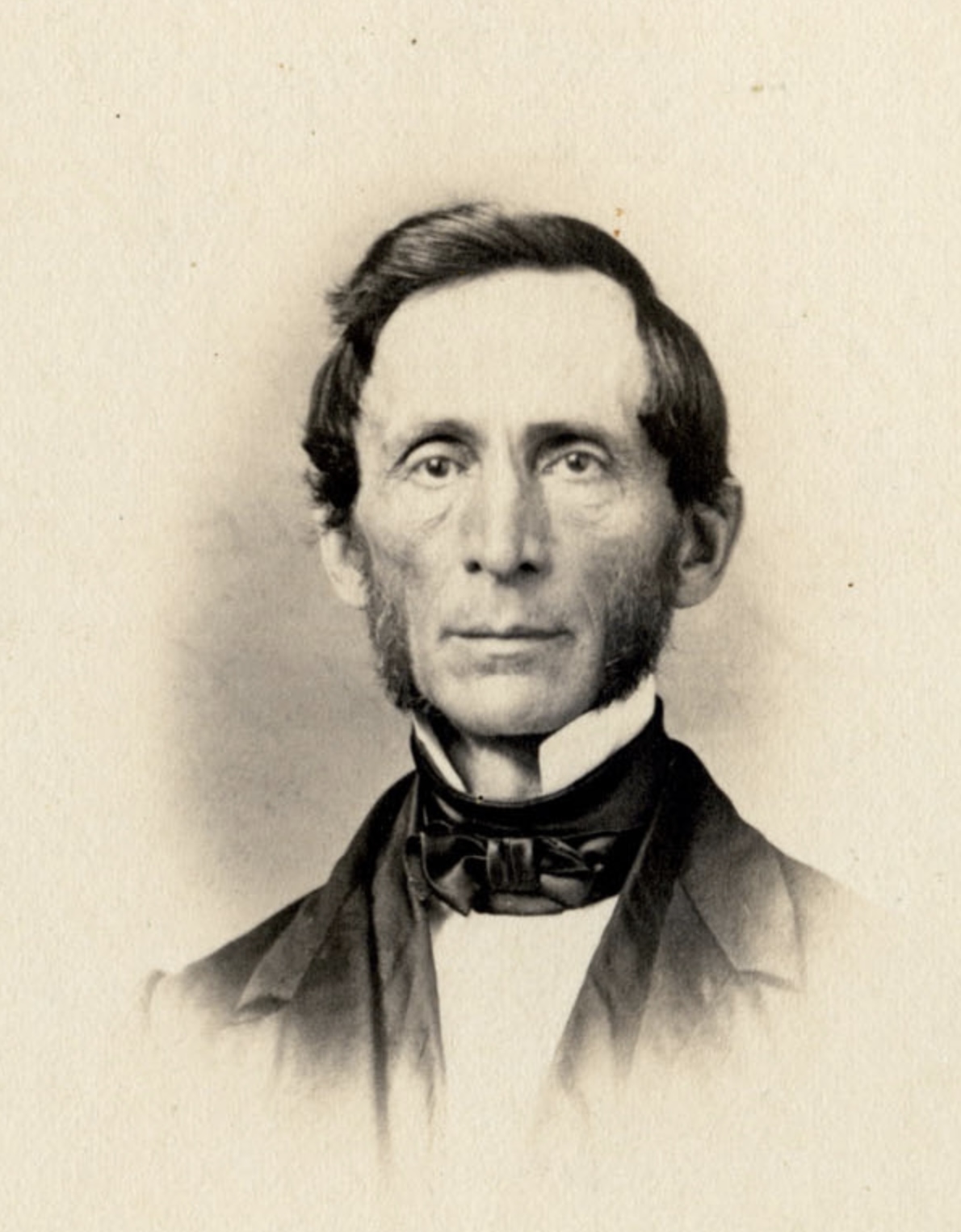
Data pertaining to the weather at Gettysburg during the battle’s aftermath long remained incomplete. Though the observations recorded by weather observer Dr. “Professor” Michael Jacobs for July 1863 are extant in the National Archives collection, his records for August–December 1863 are missing from this collection.2 (Jacobs was a founding instructor at what was known then as Pennsylvania College, and later Gettysburg College. He first was an instructor in mathematics, chemistry and natural philosophy or physical science. By 1841 he was also teaching meteorology.) However, thrice daily weather observations for August 1863 from two weather observers in nearby Harrisburg, the Pennsylvania capital, provide a reliable picture of Gettysburg weather in August.3 Observations taken at the U.S. Naval Observatory in Washington, D.C., offer key insights to the weather conditions that prevailed over the mid-Atlantic region for the entire period of the aftermath, to include a historic heatwave that hit the region in August. In addition, the recent discovery of a previously unused duplicate set of Jacobs’ records for September–December 1863 allows for a complete examination of the weather in Gettysburg for that period of the aftermath.4
In considering these observations, we can now reveal how the weather in Gettysburg during the time after the battle, most importantly that August, represents a crucial factor in understanding its effect on those left to suffer through the aftermath.
BACKGROUND
The fight for survival in Gettysburg began in earnest on July 1 with the commencement of the battle, the largest to ever take place in the Western Hemisphere. Three days of brutal fighting resulted in a calamity that boggles the mind. Approximately 51,000 casualties occurred at Gettysburg with upward of 7,000 killed, an estimated 33,000 wounded, and nearly 11,000 either captured or missing in action.5 As the battle ended, the plight of the wounded came to the fore. When the armies departed Gettysburg, approximately 21,000 wounded soldiers were left behind in the town of only 2,400 citizens.6
As a result, the entire borough and surrounding area became what author and historian Gregory Coco aptly labeled “a vast sea of misery.”7 Coco’s book by that title identifies over 150 Gettysburg area locations that morphed into makeshift hospitals during and after the battle.8 Here, the maimed, wounded, and sick sought refuge at scores of local farms, private residences, churches, schools, the Lutheran Theological Seminary, and Pennsylvania College. Some of these makeshift hospitals fell under the authority of the Union army while others had first been established by Confederate forces during the battle. Regardless, by July 4, it seemed the wounded were everywhere.
Almost immediately, efforts began to evacuate the wounded to established hospitals in the region. And within a few weeks, many of those deemed well enough to endure transport in railroad cars had been moved to medical facilities in nearby towns and cities such as Harrisburg, Philadelphia, Baltimore, and Washington, D.C.9 But as historians examined the various aspects of the care of the wounded, the question persisted: What was the weather like during the aftermath? And how might it have affected that dire situation?
POST-BATTLE WEATHER: JULY
 Gettysburg College Library
Dr. Michael Jacobs
As the town reeled from the ramifications of the battle for the remainder of that fateful July, excepting the heavy rains that set in immediately after the engagement, the weather may have been a saving grace. In the five days after the battle (July 4-8), Professor Jacobs never measured a temperature higher than 76 degrees. During the four-week post-battle period July 4-31, the temperature at 2 p.m. was 80 degrees or lower on 14 of the 28 days, with another nine days between 81 and 84 degrees. The highest 2 p.m. temperature in that period was 86 degrees (Jacobs did not record the daily maximum temperature, but his 2 p.m. observation was likely to have been within a few degrees of the daily high). In addition, Jacobs recorded 9 p.m. or 7 a.m. temperatures below 70 degrees on 15 days, suggesting at least some weather-related respites at night.10
Still, reasonable estimates of the daily high temperature paired with humidity observations from nearby Harrisburg suggest the heat index in Gettysburg probably reached or exceeded 90 degrees for at least part of the afternoon on eight to 10 days in the period July 4-31, with most of those hotter days in the latter third of the month. (For context, at a heat index of 90 degrees, heat stroke, heat cramps, and heat exhaustion are possible with prolonged exposure and/or physical activity.)11 It is also worth noting that the ground temperatures during the day would have been even higher, punishing soldiers unfortunate enough to be left on the sunlit ground.12
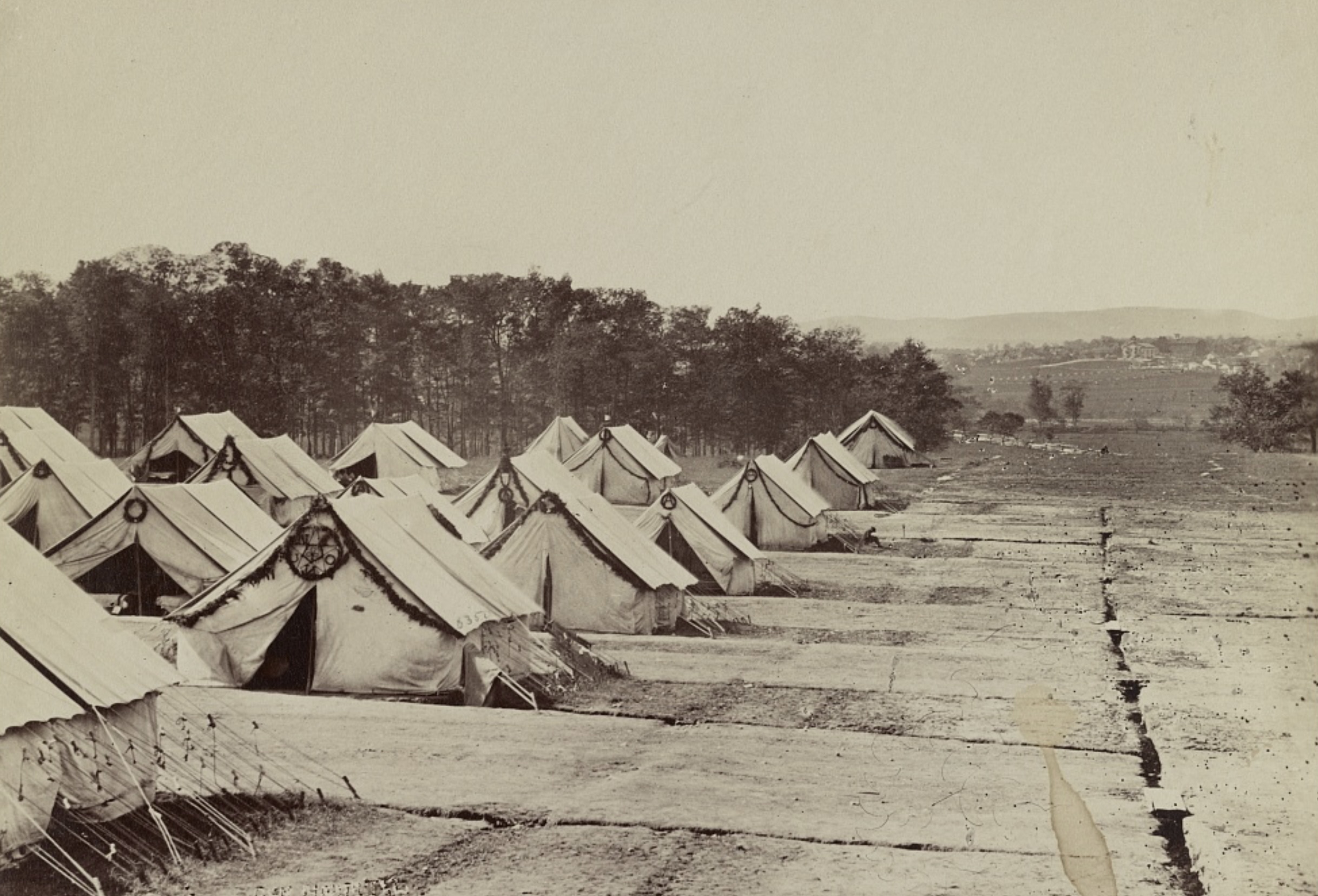
Meanwhile, efforts continued to move as many wounded as possible to larger city hospitals with as many as 800 casualties per day transported by train. Remarkably, by July 24 some 16,125 wounded had been evacuated.13 But despite these efforts, over 4,200 seriously wounded remained in Gettysburg.14 Fortunately this date also marked the establishment of a large tent hospital dubbed Camp Letterman (in deference to the medical director of the Army of the Potomac) on the George Wolf farm. Located adjacent to York Pike, this military hospital was less than two miles from the town square and stood adjacent to the Gettysburg Railroad.
 Library of Congress
A portion of Camp Letterman as it appeared in August 1863.
With this, the process of moving the remaining wounded from sundry locations in and around Gettysburg to Camp Letterman began. Many of these men were so severely injured they could not yet be transported by rail to larger city hospitals.15 The establishment of Camp Letterman allowed for centralized treatment of the wounded while also optimizing details such as access to water and necessary medical supplies. In any event, the building heat and humidity near the end of July portended an August when weather conditions would greatly add to the misery of the camp’s patients and their caretakers.
POST-BATTLE WEATHER: AUGUST
As noted above, with Professor Jacobs’ August 1863 records missing, previously unused weather records for that month from two weather observers in Harrisburg (35 miles northeast of Gettysburg) allowed for estimating meteorological conditions in the war-torn borough. In addition, the extremely detailed observations (every three hours, including the daily high and low temperatures) gathered at the Naval Observatory in Washington, 65 miles to the south, provided a greatly expanded data set that allows for a robust estimate of Gettysburg’s weather in this timeframe.16 And as fate would have it, this estimate points to a period of extreme heat that proved truly rare for the region.
As it happened, in August 1863 a historic heatwave—even by modern standards—engulfed the mid-Atlantic region. Consider that during the first 25 days of that August in Washington, temperatures reached 90 degrees or more on 22 days.17 In comparison, an examination of weather records for the period August 1-25 from Dulles Airport in each year since records began in 1962 shows a maximum of 19 days when the temperature reached 90 degrees or higher in that period.18 Even in downtown Washington, where official weather records go back to 1872 and urbanization has likely boosted temperatures, no more than 19 days in the period August 1-25 in any year show a maximum temperature of 90 degrees or higher.19
Thus, placed in a historical context, the run of 22 days (out of the first 25) of 90-degree plus temperatures in Washington during August 1863 marked a truly remarkable occurrence. Of course, Washington is not Gettysburg. But this does demonstrate the order of magnitude of the heatwave and its potential impact on the wounded, whether they be in hospitals in Washington, Baltimore, Philadelphia, or Harrisburg (and other regional hospitals) and to a significant degree, those located in Gettysburg.
Regarding Gettysburg, observations from both Harrisburg observers (the best proxies for Gettysburg) indicate the 10-day period from August 2-11 was particularly hot, with seven days of 90-degrees or higher heat at 2 p.m.20 Coupled with the humidity, the heat index likely exceeded 105 degrees at least part of the afternoon on most of these days. Supporting these observations, the maximum temperature at the Naval Observatory exceeded 90 degrees each day in the period August 2-11, while the maximum estimated heat index probably exceeded 110 on at least three days.21
In Baltimore, one of the cities to which many wounded were evacuated, a local press report from August 12, 1863, helps tell this story: “Yesterday was decidedly the warmest and most oppressive day of the summer…. The morning opened scorchingly hot … at 5 o’clock (a.m.) the mercury indicated eighty-eight degrees. At noon it had gone up to ninety degrees; at four o’clock in the afternoon to ninety-five degrees, and at half-past five o’clock it stood at ninety-two and a half degrees.22 Exposed to the sun at four o’clock, the mercury went up to one hundred and forty degrees.” The writer summed up the situation by indicating, “Such a temperature has a fearful effect upon health and life. Already more deaths have occuraed [sic] from the effects of heat than for several years past.”23
Though the heat abated slightly during the period August 12-19, it returned with a vengeance between August 20-24, with afternoon temperatures in Harrisburg of 90 degrees or higher each day, and a maximum estimated daily heat index at least in the mid-to-upper 90s. The maximum thermometer at the Naval Observatory in Washington registered 90 degrees or higher each of those five days with three days above 95 degrees; heat indices there may have topped 105 degrees on several of those days.24 Thus, as the wounded at Camp Letterman continued to struggle for any bit of recovery, the Weather Gods did anything but offer them succor.
The heatwave broke on August 25, mercifully providing relief to those who survived both their wounds and the brutally hot days. The same could be said for those wounded languishing in hospitals in nearby towns and the larger regional cities. While a number of patients at Letterman had died from their wounds during the month, others had recovered enough for relocation to major city hospitals. By the end of August some 1,600 wounded remained at Camp Letterman.25
We will probably never know how much the extreme heat in the region contributed to the loss of life among the thousands wounded in the Battle of Gettysburg. Almost certainly it would have fostered infections in festering wounds and complicated post-surgical healing. Undoubtedly it would have caused great discomfort. That said, finally knowing the facts about the weather during July, and especially August 1863, helps historians better understand how much more the wounded and their caretakers suffered during this dreadful period of the battle’s aftermath.
Jeffrey J. Harding, an independent historian and Licensed Battlefield Guide Emeritus at Gettysburg National Military Park, is interested in resolving historical mysteries. He once led the quest to locate a “missing” pen used by FADM Nimitz to sign the Japanese Instruments of Surrender on September 2, 1945. His books include Gettysburg’s Lost Love Story – The Ill-Fated Romance of General John Reynolds and Kate Hewitt and, with Jon Nese, The Weather Gods Curse the Gettysburg Campaign (History Press/Arcadia Publishing), which is the 2026 recipient of the Bachelder-Coddington Distinguished Book Award.
Jon Nese is a teaching professor and associate head for undergraduate programs in the Department of Meteorology and Atmospheric Science at Penn State. There he oversees the Weather and Climate Communications Group, which is responsible for Weather World, the department’s long-running weekday weather magazine show. Before joining Penn State, where he had earned his doctorate in meteorology, he was chief meteorologist at the Franklin Institute Science Museum in Philadelphia and an on-air storm analyst at The Weather Channel. He has co-authored three books: The Philadelphia Area Weather Book, A World of Weather: Fundamentals of Meteorology, and most recently, The Weather Gods Curse the Gettysburg Campaign.
Notes
1. The term “wounded,” hereafter, encompasses the hospitalized sick soldiers as well. This paper covers the portion of the aftermath pertaining to the care of the wounded and sick that stretched from July 4 to November 20, 1863.
2. These records are also missing from the National Oceanic and Atmospheric Administration (NOAA) weather records collection named FORTS.
3. Professor Jacobs and the Harrisburg observers recorded meteorological data on behalf of the Smithsonian Meteorological Project.
4. During 2018 Harding learned that the American Philosophical Society in Philadelphia holds a duplicate set of Jacobs’ September to December 1863 observations. These primary source documents were created by Jacobs and his son, Henry Eyster Jacobs.
5. https://www.battlefields.org/learn/civil-war/battles/gettysburg; https://www.nps.gov/gett/learn/historyculture/gettysburg-overview.htm
6. United States War Department, War of the Rebellion: A Compilation of the Official Records of the Union and Confederate Armies, 128 vols. (Washington, D.C., 1880-1901), Series I, Vol. 27, Part 1, 198 (hereafter cited as OR).
7. Gregory A. Coco, A Vast Sea of Misery (Gettysburg, PA, 1988), p. vi.
8. At least 60 of these were “military” hospitals dedicated to the care of various corps, divisions, etc.
9. https://www.nps.gov/gett/learn/historyculture/gettysburg-overview.htm
10. NOAA FORTS, Michael Jacobs’ meteorological observations for Gettysburg, July 1863.
11. It should be noted that official temperature readings are taken in the shade and heat indices are also shade-based measurements. Moreover, per NOAA, sunlight can add an additional 10-15 degrees to the “feels like” temperature.
12. In the way of a typical example of the type of variance in temperature (normally measured at roughly five feet off the ground) and ground temperature, in Washington, D.C., on August 11, 1863, the temperature at 3 p.m. measured 95 degrees and the ground temperature at that time measured 141.5 degrees. The exact numbers are not available for Gettysburg, but the degree of variance between temperature and ground temperature would probably have been similar.
13. OR, Series I, Vol. 27: Pt.1, 25; Matthew Atkinson, “‘War is a hellish way of settling a dispute’ Dr. Jonathan Letterman and the Tortuous Path of Medical Care from Manassas to Camp Letterman,” npshistory.com/series/symposia/gettysburg_seminars/13/essay5.pdf; Michael Mahr, “The Story of Camp Letterman,” civilwarmed.org/camp-letterman/.
14. Gregory A. Coco, A Vast Sea of Misery: A History and Guide to the Union and Confederate Field Hospitals at Gettysburg, July 1-November 20, 1863 (El Dorado Hills, CA, 1988), 167.
15. Ibid., Vast Sea of Misery, 167. Coco lists the number of wounded still in Gettysburg, as of July 25, at 4,217.
16. The Naval Observatory data set was not part of the Smithsonian Meteorological Project. Naval Observatory chroniclers recorded a wider variety of data than the Smithsonian observers. During the summer of 1863, Jacobs and the two Harrisburg, PA, observers only recorded temperatures three times a day; the Naval Observatory chroniclers recorded them eight times a day. The Naval Observatory chroniclers also employed self-registering thermometers that allowed measurement of both daily high and low temperatures. In addition, they measured ground temperature using a thermometer placed in the sun a few inches above ground level.
17. NOAA FORTS, U.S. Naval Observatory meteorological observations for Washington City, August 1863.
18. xmacis.rcc-acis.org/.
19. Ibid.
20. NOAA FORTS, William Hickok and John Heisely meteorological observations for Harrisburg, PA, August 1863.
21. NOAA FORTS, U.S. Naval Observatory, August 1863.
22. Baltimore Sun, August 12, 1863. Recall that official temperatures are measured in the shade. The “sun” temperature referenced here indicates that the thermometer was placed in direct sunshine and probably at the surface, where temperatures are magnified by proximity to the ground.
23. Ibid.
24. Ibid., NOAA FORTS, Hickok and Heisely, Harrisburg, PA, August, 1863.
25. Coco, A Vast Sea of Misery, 168.