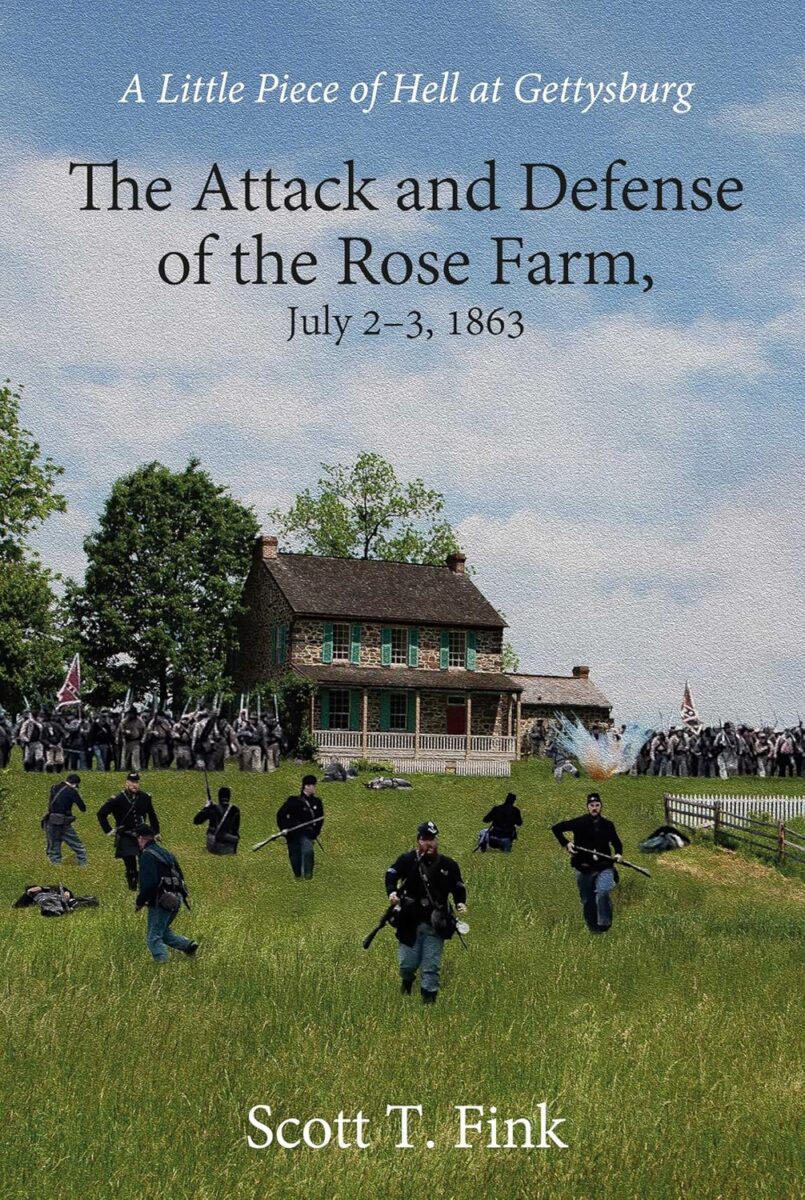
Compared to other places on the Gettysburg battlefield, the Wheatfield has long been neglected in popular memory. This is partly due to the confusing nature of the fighting. Scott T. Fink’s book A Little Piece of Hell at Gettysburg seeks to highlight the significance the Rose Farm, the vortex of the Wheatfield fighting, and brings the forgotten stories of the brutality, bravery, and compassion on this sector of the battlefield to life. Fink claims that the Rose Farm and its surroundings are the “keys” to understanding the Wheatfield. Overall, the author does an excellent job of portraying the soldiers’ experiences and the legacy of war. However, the greater significance of the Rose Farm in the battle remains obscured.
With a personal background in the U.S. Army and National Guard, Fink wants to highlight the soldiers’ experiences, and he achieves this goal through a masterful use of primary sources. The human experiences truly come to life through Fink’s interweaving of official reports, regimental histories, and soldiers’ diaries and memoirs. Fink records the occasional lighthearted moments, such as a rabbit digging its claws into the neck of private in the 118th Pennsylvania. This made the private fear that he got shot through the neck and elicited plenty of laughter from his comrades.
Fink documents the brutality of the battle, such as the merciless effects of triple canister shot and wounded soldiers drinking from blood-red streams. But he also discusses the compassion soldiers had for each other, such as when Confederate Lieutenant Oliver risked his life to tend to wounded Union lieutenant Purman. Oliver did not expect Purman to survive, but he ended up becoming his acquaintance after the war.
Fink does a good job at evaluating contradictory or disputed sources. For example, it has been disputed whether the Roses or the Ogdens lived on the Rose Farm immediately before and after the battle. Fink convincingly argues for the Rose family’s occupancy since the John Rose’s post-battle damage claim matches up closely with the actual damages recorded in military sources (Odgen’s claim does not). Fink also takes dates into account when weighing evidence. If a piece of oral history cannot be traced to an early written source, Fink cautiously notes its context and compares it with other sources, as he does in his chapter on the history of the Rose Farm before the war.
In addition to making the battle come to life, Fink also succeeds in showing the legacy of the war. The fighting around the Rose Farm took a toll on the civilian population. Exposed or hastily-buried corpses littered the field, and the Rose Farm fell into financial ruins. Mary Josephine, the 27-year-old daughter of John Rose, suffered chronic hysteria from living in a practical graveyard. The post-war reconciliation movements then saw the return of Confederate bodies from the Rose Farm to South Carolina, but not without opposition.
The chapter on post-battle photography on the Rose Farm is Fink’s most brilliant chapter in the book; he argues that Union photographers became active agents in creating a shared memory of war for a national audience. Nineteenth-century photographers operated like artists instead of neutral reporters, and they frequently manipulated their shots through choices of angle, props, and the re-arranging of bodies.
Fink’s book is not without flaws. The significance of the Rose Farm in the context of the Battle of Gettysburg or the Wheatfield actions remains unclear. While Fink claims that the Rose Farm holds the “key” to clarifying the mysteries of the Wheatfield, this clarity does not come through in the narrative. Fink’s study of the Rose Farm does solve some mysteries, such as Confederate Brigadier General Paul Semmes’ wounding, but the author rarely discusses what greater mysteries about the overall battle could be solved by a deeper understanding of the Rose Farm. The closest Fink’s book ever gets to showing the Rose Farm as a “key” to greater mysteries is about Gardener’s post-battle photos. For a book titled The Attack and Defense of the Rose Farm, the “attack” and “defense” are still shrouded in the fog of battle.
Harry Zhang is a graduate student studying the U.S. Civil War in the Department of History at Texas A&M University.
Thank you for reviewing my book. As I stated in the introduction, “If the Wheatfield was the GATEWAY to Little Round Top, then places like Stony Hill, the Ravine, Rose Woods, and Rose hill were its keys.” If the Union defense did not hold those key points as long as they did, a Confederate attack of Little Round Top earlier might have succeeded. Especially with Wofford’s fresh brigade following on. As it was, when Wofford’s brigade ultimately took the Wheatfield during their attack, the VI Corps had already arrived on Little Round Top and thwarted their efforts. While the Wheatfield was not the “key” to the battle, it played a pivotal role as a gateway to that key terrain feature. Therefore, the Rose Farm was significant to the outcome of the battle.