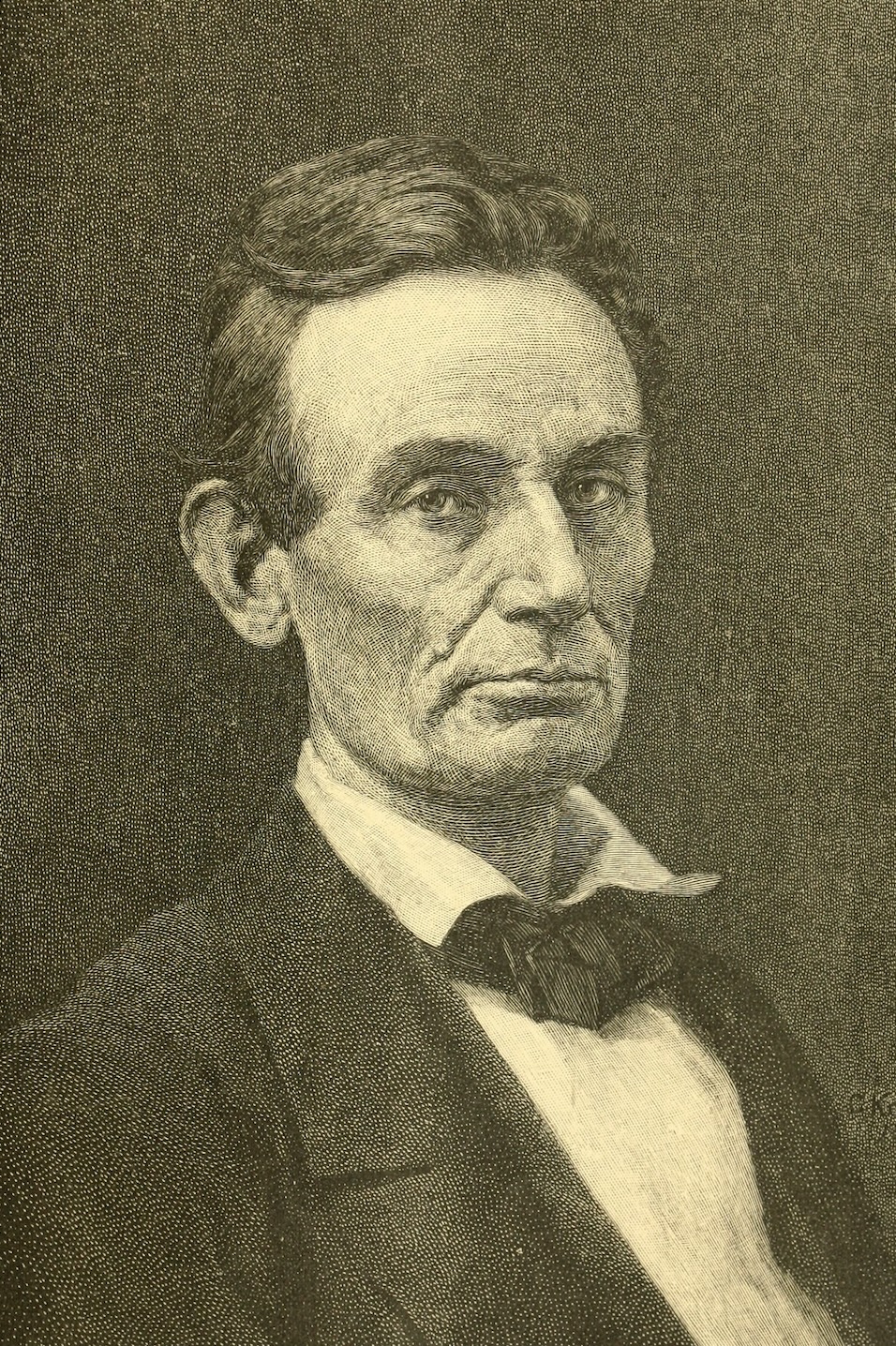
 Library of Congress
Abraham Lincoln
Abraham Lincoln has risen in American culture to become something akin to a national sage. Thomas Jefferson shares a similar status but, while both presidents sit on the National Mall surrounded by their most resonant words, any quick online search will show Lincoln cited far more frequently. For many admirers, he is the model of American wisdom.
But unlike Jefferson, the college educated son of a wealthy Virginia plantation owner, Lincoln received less than one year of formal education. A product of the Kentucky frontier and rural Indiana, he did not live near a local school. Instead, traveling teachers occasionally set up shop nearby and provided the local children with a few weeks of rudimentary education. Lincoln had little regard for these “so-called” schools, relating in an 1859 campaign biography that “no qualification was ever required for a teacher, beyond ‘readin, writin, and cipherin,’ to the rule of three.” To accentuate the point, he remarked that if “a straggler supposed to understand latin, happened to so-journ in the neighborhood, he was looked upon as a wizard.” In an earlier campaign biography, Lincoln had been even more succinct, listing his education as merely “defective.”
This glaring lack of formal schooling tempts one to conclude that Lincoln’s status as America’s best writer-president proves that “genius” is some innate quality that preordains certain people for greatness regardless of their environment or resources. Lincoln would have disagreed and put education atop all other pursuits. His “defective” education instilled in him a yearning for useful knowledge. This reportedly pitted young Abraham against his father, Thomas, as the son rejected the father’s life as a farmer and carpenter. Lincoln borrowed whatever books he could—reading them between chores and into the evenings—to learn things. He studied readers, worked through math problems, and absorbed histories of famous people, especially George Washington. Lincoln created his own education system.
This drive to tackle subjects and learn whatever he needed to succeed was what propelled Lincoln into the middle class. When his future law partner William H. Herndon stated Lincoln’s “ambition was a little engine that knew no rest,” he was at least partly referencing his partner’s constant search for knowledge and advancement. In his 20s, Lincoln set out on his own and settled in New Salem, Illinois. Reading was essential to his experience and success there, as he sought out books to become a surveyor, borrowed prominent legal tomes to become a lawyer, and as postmaster stayed up on politics by perusing newspapers before he delivered them. Lincoln passed the bar without attending college or law school—an easier task than it is today, but nevertheless remarkable among his peers. Even his attraction to Mary Todd can be viewed in this light, as she was a highly educated woman with a fondness for talking politics. When in 1832 Lincoln embarked on a political career, one of the pillars of his campaign was his belief that education is “the most important subject which we as a people can be engaged in.”
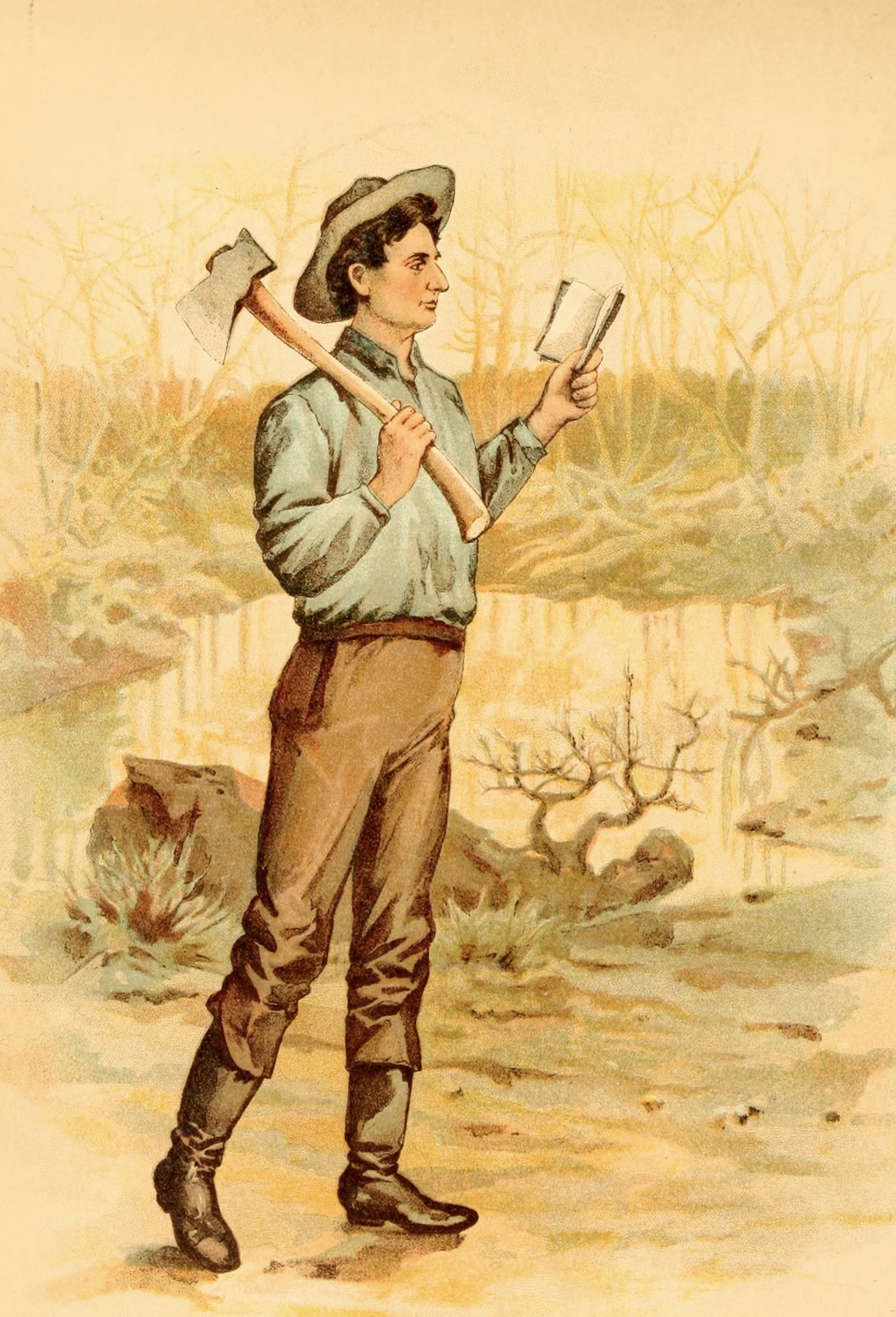 True Stories of Great Americans (1897)
A postwar illustration depicts a young Lincoln engrossed in a book.
By midcentury, it was clear that the two greatest contributors to Lincoln’s success were books and hard work. His 1860 letter to an aspiring lawyer is often quoted for its final passage: “work, work, work is the main thing.” Yet earlier in the letter, Lincoln is very specific about reading. “The mode” to becoming a lawyer “is very simple, though laborious, and tedious. It is only to get the books, and read, and study them carefully.” He then recommends William Blackstone, Joseph Chitty, Simon Greenleaf, and Joseph Story. Less quoted are similar letters, in which Lincoln recommends the same books. “If you wish to be a lawyer,” he told an aspirant hoping to clerk in Lincoln’s Springfield law office, “attach no consequence to the place you are in, or the person you are with; but get books, sit down anywhere, and go to reading for yourself.” Lincoln instructed another fledgling student to read “books for himself without an instructor. That is precisely the way I came to the law.”
None of this should be confused with an opposition to formal education. After all, Lincoln sent his son Robert to Harvard for college and then law school. It surely wasn’t lost on Lincoln that in only three generations, his family went from illiterate Thomas to self-educated Lincoln to best-educated Robert. Tad Lincoln—the only other surviving child at the time of his father’s assassination—had trouble with his early schooling, but his parents had an educational plan that Mary successfully enacted in the years between their White House residency and Tad’s death at 18 in 1871.
Lincoln’s educational journey never ceased and we can see it in action at several key moments of his life. At some point, Lincoln tackled Euclidian geometry and in the late 1840s became increasingly interested in science—even securing his own patent for “Buoying Vessels Over Shoals.” Assuming the presidency on the brink of an insurrection, Lincoln checked out books on strategy from the Library of Congress and later personally tested military inventions on the National Mall.
Lincoln’s commitment to self-improvement is evident, too, in his views on race. Debates have raged for decades over what Lincoln believed about race and slavery, but taken in broad strokes, one can see an evolution from opposition to slavery to envisioning some form of free biracial America. Lincoln’s support for colonization and blunt statements about white racial superiority gave way to embracing emancipation, black military service, voting rights for black men, and state-sponsored schools for black children—all probably inspired by his increasing interaction with African Americans themselves and the wider black community’s obvious desire for freedom. How ironic that a “defective” education ultimately primed Lincoln to reject some of the biases of his age and to try to foster “a new birth of freedom.”
This aspect of Lincoln may be the one I most admire. It would have been easy for him to turn his back on intellectual growth after being faced with incompetent teachers and few resources for learning. Instead, those obstacles imbued Lincoln with the humility to always know what he didn’t know and the determination to find answers wherever he could. What’s more, he knew the knowledge he gained didn’t only improve his own life, but it empowered him to better empathize with those around him and try to make their lives better too. Whatever his flaws, Lincoln’s respect for education undergirded many of his actions—something well worth our imitating.
Christian McWhirter is a public historian and author of Battle Hymns: The Power and Popularity of Music in the Civil War. He serves as the Historical Initiatives Consultant for the Lincoln Presidential Foundation and editor of the Journal of the Abraham Lincoln Association. He previously served as Lincoln Historian at the Abraham Lincoln Presidential Library and Museum.
Related topics: Abraham Lincoln
If we could bring ourselves to read a few more books (of the proper kind), we might advance a bit toward the mountaintop occupied by Lincoln.