Copy of Herman Melville’s Battle Pieces and Aspects of the War.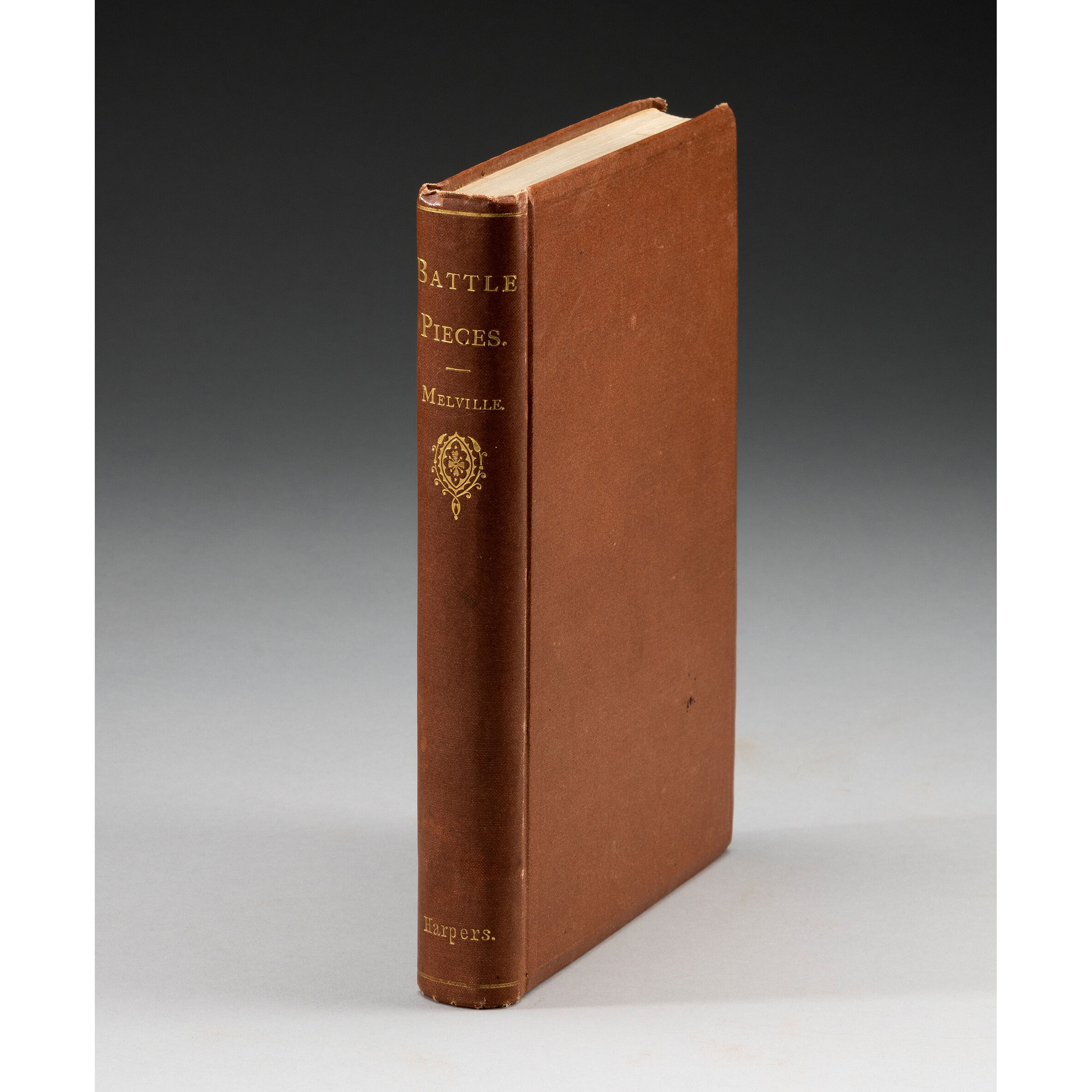 Heritage Auctions (HA.com)
Ode to a Hero
The Artifact
An inscribed copy of Herman Melville’s Battle-Pieces and Aspects of the War
Condition
The book has some very slight signs of wear (including rubbing, soiling, and blisters), stray ink spots on the upper cover, and faint ring stains on the finish on both covers. Otherwise, it is an extremely bright and fresh copy.
Details
At the time of the firing on Fort Sumter, William Francis Bartlett, 20, was in his junior year at Harvard. He immediately gave up his studies and enlisted as a private in the 4th Battalion Massachusetts Infantry in his native state. When that unit’s 90-day enlistment term expired, he signed up with the 20th Massachusetts Infantry—the so-called “Harvard regiment”—as a captain. The following spring, Bartlett was shot in the left knee during the siege of Yorktown, a wound that would result in the amputation of his leg. He returned home, finished his degree, then reenlisted as a colonel in the newly forming 49th Massachusetts Infantry. In May 1863, Bartlett was shot twice while leading the 49th in battle at Port Hudson, Louisiana, wounds that led him to resign his commission that September. While he was recuperating, he joined yet another regiment, the 57th Massachusetts, which comprised mostly veterans whose terms of enlistment in other units had expired. At the Battle of the Wilderness in May 1864, Bartlett was again wounded, in the head; promoted to brigadier general the following month, he was captured during the Battle of the Crater in July (he was stranded after his prosthetic leg was shot away) and spent several months in Richmond’s Libby Prison.
Bartlett’s postwar return with the 57th to Pittsfield, Massachusetts, inspired one of the town’s natives, author Herman Melville, to write a poem about the heroic young officer, “The College Colonel,” which appeared in his first book of poetry, Battle-Pieces and Aspects of the War (1866). The following year, Melville gave a copy of the book (shown here) to Bartlett, which he inscribed: “Brevt Major Genl. Wm. F. Bartlett / with the respects of the Author / Arrowhead 1867.” After the war, Bartlett worked in manufacturing and eventually settled in Pittsfield, where he died of tuberculosis in 1876 at 36.
Quotable
“The College Colonel” describes the return home of a young officer—inspired by Bartlett—and his men: “He rides at their head; / A crutch by his saddle just slants in view, / One slung arm is in splints, you see, / Yet he guides his strong steed—how coldly too…. // A still rigidity and pale— / An Indian aloofness lones his brow; / He has lived a thousand years / Compressed in battle’s pains and prayers, / Marches and watches slow. / There are welcoming shouts, and flags; / Old men off hat to the Boy, / Wreaths from gay balconies fall at his feet, / But to him—there comes alloy.”
Price
$50,000 (realized at Dallas, Texas, in June 2024). “Inscribed copies of Battle-Pieces are rare,” a Heritage Auctions representative noted then. “According to online records, only one other copy has appeared at auction since 1991.”